At ProductCon New York, I made an announcement I've been building toward for years.
I've officially launched Product Partners, an AI consulting firm built specifically to help product teams drive successful AI transformations. Not training alone. Not strategy decks. End-to-end transformation – from assessment through working AI operating model – built directly alongside your team.
But before I get into what Product Partners is and why I built it, I want to share what I've been seeing across the product organizations we've worked with. Because the real reason Product Partners exists isn't the opportunity. It's the gap.
The 80% Problem: Most Product Teams Are Stuck at Level One
Over the past 12 years, Product School has worked with more than 1,400 product teams at large enterprises – JP Morgan, Nike, Visa, Walmart, and hundreds more. That access has given us a clear view of where teams are in their AI journeys.
What I'm seeing: over 80% of product teams are stuck at Level One.
They have CEO commitment to AI. They've rolled out tools. People are getting individual productivity gains – faster drafts, better meeting summaries, quicker research. But those gains aren't translating to meaningful business outcomes. Revenue isn't moving. Shipping velocity hasn't changed in a meaningful way. Customer metrics look the same.
This is what I call the messy middle – and it's where most companies are living right now.
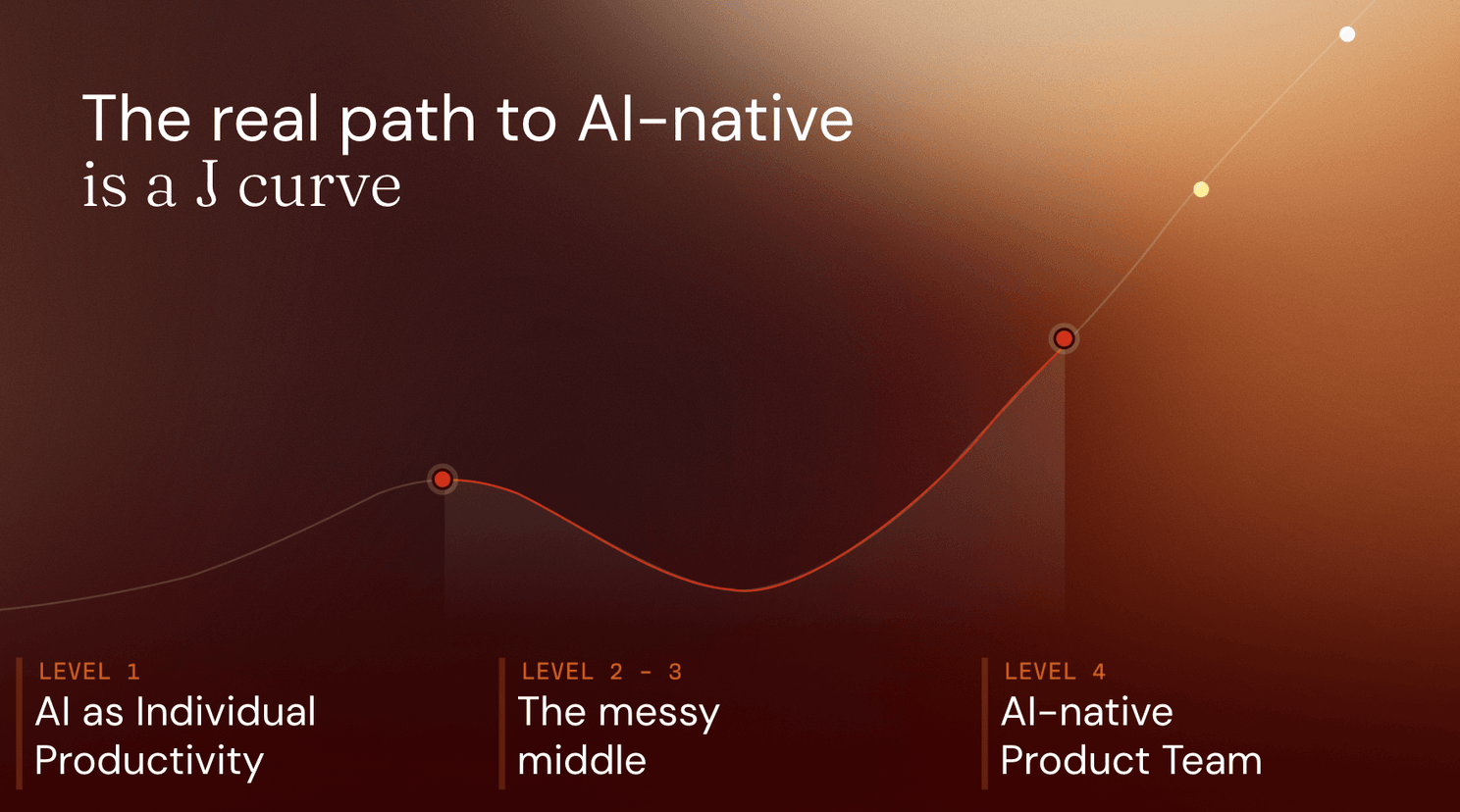
The path to becoming AI-native is often drawn as a perfect exponential curve. You start using AI, productivity climbs, and suddenly you're in the top-right quadrant. That's not what actually happens.
The real path looks like a J-curve. Individual productivity gives you a quick bump – you get that magical feeling when AI does something you didn't think was possible. But then it drops. Sharply. When you try to scale that individual magic into a shared team environment, when you try to replace legacy systems and create real cross-functional workflows, things get complicated. That's the false summit. And the longer you sit there, the bigger your opportunity cost compounds.
The top 1% of AI-native product teams navigated that J-curve. They didn't get lucky. They built something specific. They built an AI operating model.
What "AI-Native" Actually Means
Before I explain the operating model, I want to define AI-native clearly – because the term gets used carelessly.
An AI-native team is one that defaults to AI as the primary way to get work done.
That doesn't mean AI replaces human judgment. It doesn't mean you hand everything to an agent and walk away. It means AI is the starting point. Humans step in for judgment, creativity, accountability, and the places where AI hits its limits. The result is dramatically higher leverage – humans focused on the highest-order work, while AI handles the high-volume, lower-judgment work underneath.
The executives behind the most successful AI-native product teams – the CEO of Figma, the CPO at Slack, VPs of Product at Shopify, Robinhood, Rippling, Vercel – none of them were born AI-native. They all had to transform, and they had to do it fast, at scale.
That transformation required more than a strategy deck. It required a new operating model.
The AI Operating Model: What It Is and Why It's the Real Differentiator
At this point, virtually every company has an AI strategy. Strategy is the input. The problem is the gap between strategy and execution.
The AI operating model is the engine that closes that gap.
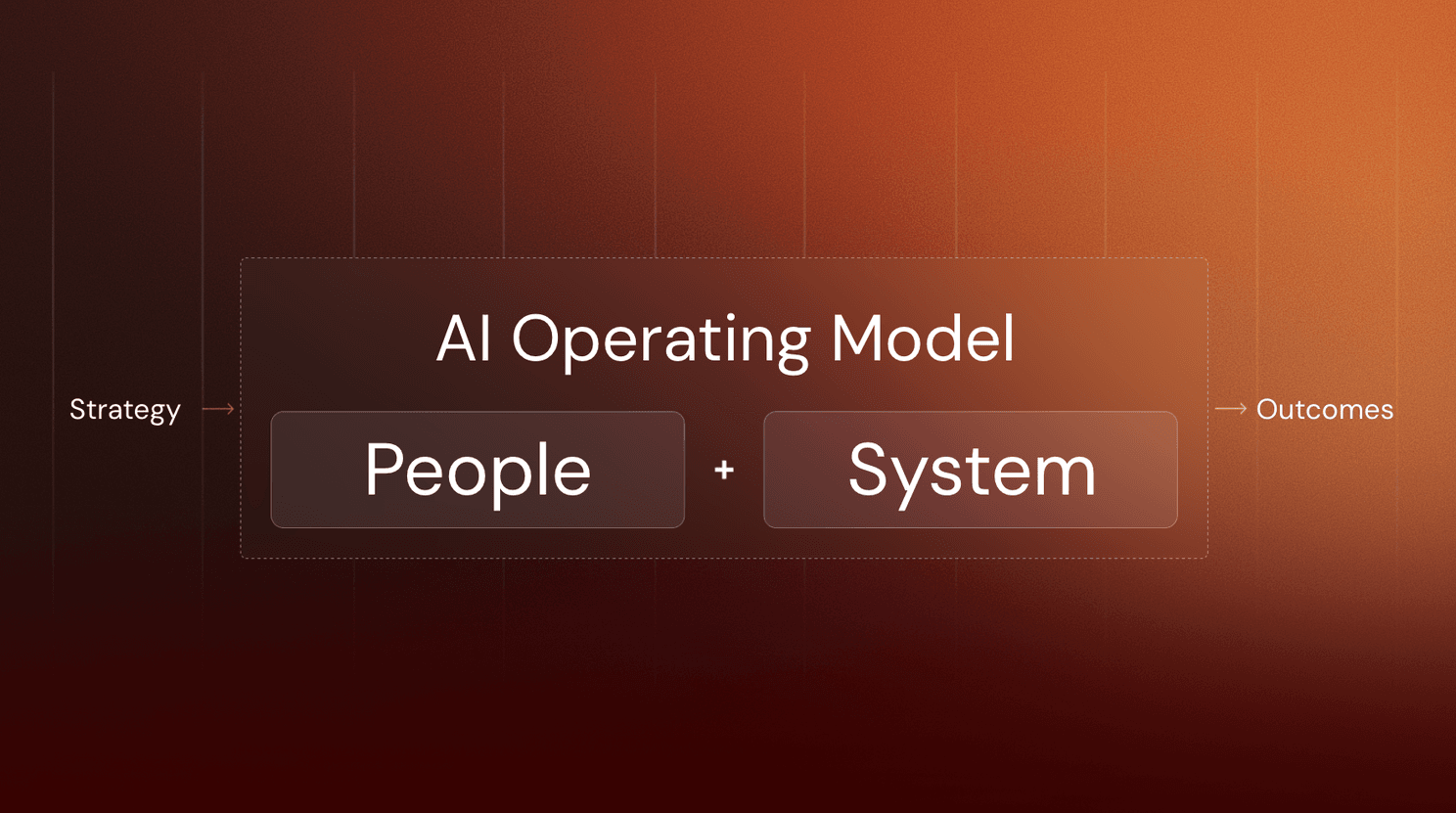
It has two core components: System and People.
The System is a shared workspace pre-loaded with the right agents, tool integrations, up-to-date company data, relevant context, guardrails, and automated workflows. The point is that anyone on the team can start building immediately – without having to configure their own isolated setup, without having to understand the plumbing.
The People component is org design, training, and change management. How is the team structured? What skills does the team need to harness the system? How are incentives aligned from top to bottom to drive adoption that actually sticks?
You need both. The System is the engine. The People are the driver. One without the other produces nothing.
Let me walk through the specific initiatives I've seen winning product teams execute to build their AI operating models.
People Initiatives: Four Moves the Top 1% Are Making
1. Product Managers as Builders
The convergence of PM, designer, and engineer roles is real. It's already in job descriptions at Meta. The term emerging across the industry is "builder" – someone who can contribute meaningfully across the full product development cycle, not just own one lane.
This doesn't mean PMs are replacing engineers or designers. It means the baseline expectation is shifting. The value goes to whoever can operate across the stack. If you're waiting to see if this trend holds, you're already behind.
2. From Two-Pizza Pods to Two-Slice Pods
Jeff Bezos famously said that if you can't feed your team with two pizzas, the team is too big. That ceiling has dropped again. AI-native product teams are smaller – much smaller – because agents fill what used to require headcount.
The PM-to-engineer ratio is approaching 1:1. Teams are leaner, faster, and more capable than they were at twice the size. The agents don't eat pizza. They eat tokens.
3. People Managers as Player-Coaches
As management layers flatten, the expectation for people managers changes fundamentally. The baseline is no longer managing; it's building while managing.
I use a simple formula: Producer × Expert × Leader × Manager. The multiplication matters. If any variable is zero, the result is zero. A manager who doesn't build (Producer = 0) produces nothing that multiplies. A manager with no domain or AI expertise (Expert = 0) can't lead a team they don't understand.
Every people manager needs all four:
Producer: Can get things done end-to-end as an individual contributor
Expert: Deep enough AI knowledge to lead by example and stay ahead of the team
Leader: Applies the right judgment, influences others
Manager: Gets leverage through people and agents
4. AI Training – And Keeping It Current
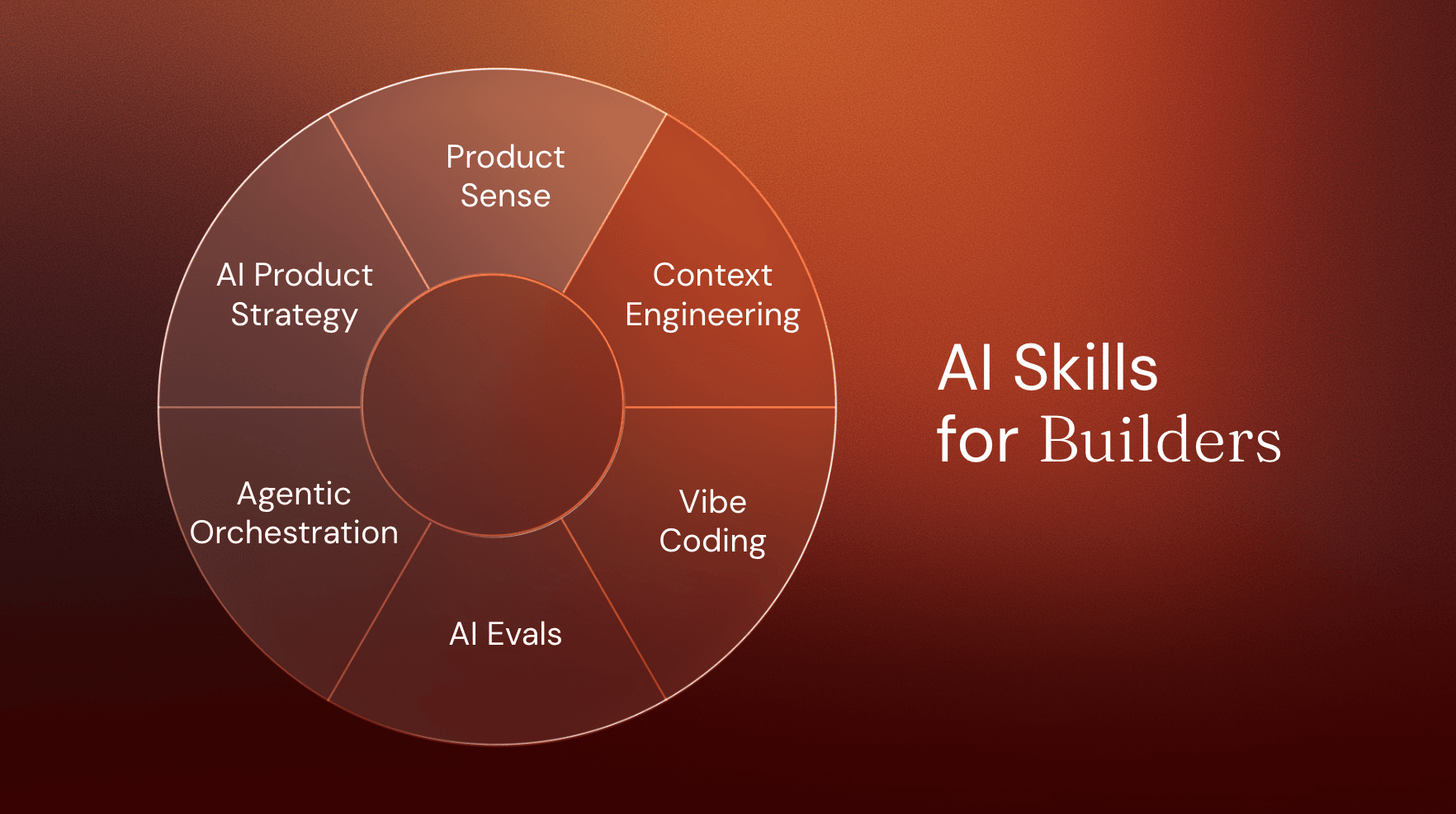
The skills AI-native teams need aren't optional extras. They're table stakes for staying relevant. What we're building at Product School reflects what we're seeing at the leading edge: AI product strategy, vibe coding, agentic orchestration, AI evals, product sense, and context engineering.
The challenge most training programs face is that the content ages faster than it can be updated. We've built a feedback loop that allows us to update content quarterly rather than annually. The pace of change in AI is too fast for annual curriculum reviews.
System Initiatives: Building the Engine
1. The Cross-Functional AI Transformation Team
The debate in most companies – "Do we need a Chief AI Officer?" – misses the point. The approach that works is a small, cross-functional AI transformation team with a very clear mandate.
This team doesn't try to transform the entire company at once. They go pod by pod, team by team. They build the platforms, connectors, and plumbing: across LLMs, data, knowledge bases, and automated workflows. They manage enablement and change management.
Critically, they don't work alone. They partner with functional champions – early believers who aren't part of the central team but build on top of what the core team creates. Those champions provide the feedback that drives the central team's roadmap. This two-layer model – core team plus champions – is how transformation actually spreads through a large organization.
2. SaaS Consolidation
The teams doing this well are consolidating up to 66% of their SaaS stack. That's not an aspiration – it's a result I've seen repeatedly.
The framework breaks into three buckets:
One-third: Tools that aren't being used enough, or point solutions now covered by a broader platform. Stop paying for them. No replacement needed.
One-third: Tools that need to be replaced – but replaced with AI-native alternatives that cover broader scope and integrate cleanly via MCPs and well-defined APIs.
One-third: Tools that can be replaced by in-house solutions. If the switching cost is low and the capability is simple enough, vibe code your own solution and eliminate the license.
The goal isn't just cost reduction. It's integration. You want the smallest possible number of tools, highly integrated through MCPs and APIs, so data flows freely – even when that data is unstructured. Every tool you eliminate is one less seam for agents to get stuck at.
3. Agents with Team-Level Visibility
One of the highest-leverage system moves is giving agents visibility at the team level – not the individual level.
The model: a shared workspace, fully preconfigured with the right agents, tool integrations, company data, skills, guardrails, and automated workflows. Anyone can jump in without individual setup. They interact with agents the same way they'd interact with a human colleague in Slack.
This workspace includes the necessary security controls – access policies, cost limits, human-in-the-loop oversight. Some organizations require agents to operate only in open channels to drive collaboration and shared learning.
What this eliminates is the fragmentation problem. Individual AI setups are inconsistent, unsecured, and don't compound. Team-level visibility means the whole organization learns from every interaction, and the capability grows faster than any individual could build on their own.
4. Shipping Democratization
Traditional product development has separate frameworks for planning (PDLC) and shipping (SDLC), loosely connected by slow manual handoffs. Product managers own planning. Engineers own shipping. Everyone waits for everyone else.
AI-native teams have collapsed this into a single high-velocity loop.
Product managers and designers can now express requirements in natural language or interactive wireframes. AI agents ingest those inputs and draft pull requests. PMs and designers are now participants in the shipping phase – not observers waiting for a handoff.
The guardrail that makes this work: code review remains strictly under human engineering oversight. The primary bottleneck is no longer how fast code can be written. It's how reliably code can be evaluated for security, performance, and architectural integrity before deployment. Shift that bottleneck, and you've dramatically compressed the cycle.
The Outcomes: What This Looks Like in Practice
When teams actually execute these initiatives – not dabble, but execute – the outcomes are significant:
5x faster development cycles. As agents become team members and handoffs tighten, the compounding effect on output is substantial.
40% higher feature adoption and customer retention in areas where AI-informed shipping replaces assumption-driven roadmaps.
Up to 50% lower costs as teams become leaner and higher-impact.
I want to be direct about the last point. Some of that cost reduction comes from smaller teams. This is real. Smaller, higher-leverage teams are the structural outcome of an AI-native operating model done right. That's a shift worth being honest about.
On metrics: AI adoption rates and token usage are weak proxies. They can be gamed and they don't map to business value. The right metrics are the same ones they've always been: shipping velocity, customer satisfaction, and revenue growth.
Introducing Product Partners
Now let me tell you what we're building to help product teams get here.
Product Partners is an AI consulting firm.
Born from Product School – the company I started 12 years ago in Silicon Valley, which has become the global leader in AI training for builders – Product Partners is the natural extension to serve entire product teams at large enterprises. While Product School continues to serve individual product leaders through its AI training programs, Product Partners brings both training and implementation together in a single engagement.
Same DNA. Different scope
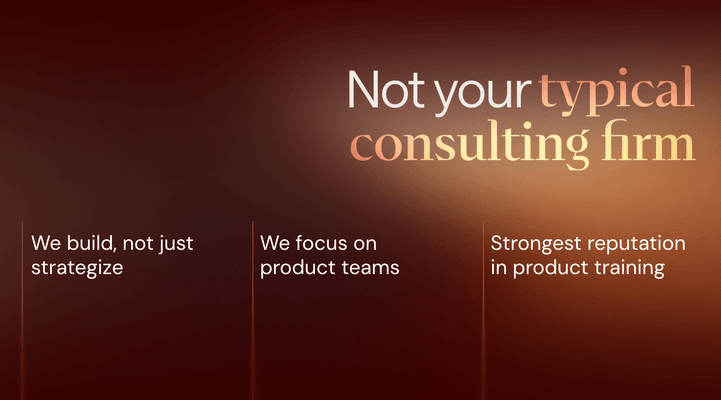
Here's why I believe traditional consulting firms are broken for AI transformation – and what we're doing differently:
Most consulting firms define the strategy, hand over a beautiful implementation plan, and leave before implementation begins. The deck looks great. Nothing changes.
We operate differently across three dimensions:
We build, not just strategize. Our AI Product Leaders and Forward Deployed Engineers embed directly alongside your team. They write code. They deploy agents. They redesign workflows. The deliverable isn't an implementation plan on a shelf. It's a working AI operating model and a team trained to harness it – so you keep building long after we're gone.
We focus exclusively on product teams. Product management, engineering, and design. That specificity is a choice. It lets us go deep on the nuances that actually drive successful AI transformation for product teams, rather than taking a generalist approach across the entire organization. Most consulting firms can't tell you the difference between how AI transformation affects a PM versus a forward-deployed engineer. We can – because we've been living inside product teams for 12 years.
We bring the strongest reputation in product. Over 1,400 product teams upskilled. A community of 2 million product professionals. A 12-year track record that includes the most respected product leaders in the industry – CPOs, VPs, and founders who've contributed to ProductCon, The Product Podcast, and our courses. That's not a network we assembled for this launch. That's the community we've been building since the beginning.
The Bottom Line
The gap between companies that are winning with AI and those still stuck in Level One is not a strategy gap. Virtually everyone has a strategy. The gap is operational. It's the absence of the system and the people infrastructure to turn that strategy into compounding business outcomes.
The top 1% built an AI operating model. They didn't wait for the technology to mature or for certainty to arrive. They built through the messy middle.
The question for every product leader is: how long are you going to sit at the false summit?
Updated: May 28, 2026