Global AI spending is soaring past $200 billion this year (1). Most of it isn’t moving the needle.
For product leadership, that’s a wake-up call. Every new tech or AI capability now comes with the same question: Should we build it ourselves or buy it off-the-shelf?
Building gives you control and differentiation. Buying gets you speed and stability. As AI reshapes timelines, costs, and capabilities, the old trade-offs no longer apply.
In this article, you’ll learn how to approach the build versus buy decision in the age of AI. We’ll explore how to evaluate your options, what’s changed with AI entering the picture, and how leading teams are making smarter, faster decisions.
Level up on your AI knowledge
Based on insights from top Product Leaders from companies like Google, Grammarly, and Shopify, this guide ensures seamless AI adoption for sustainable growth.
Download Guide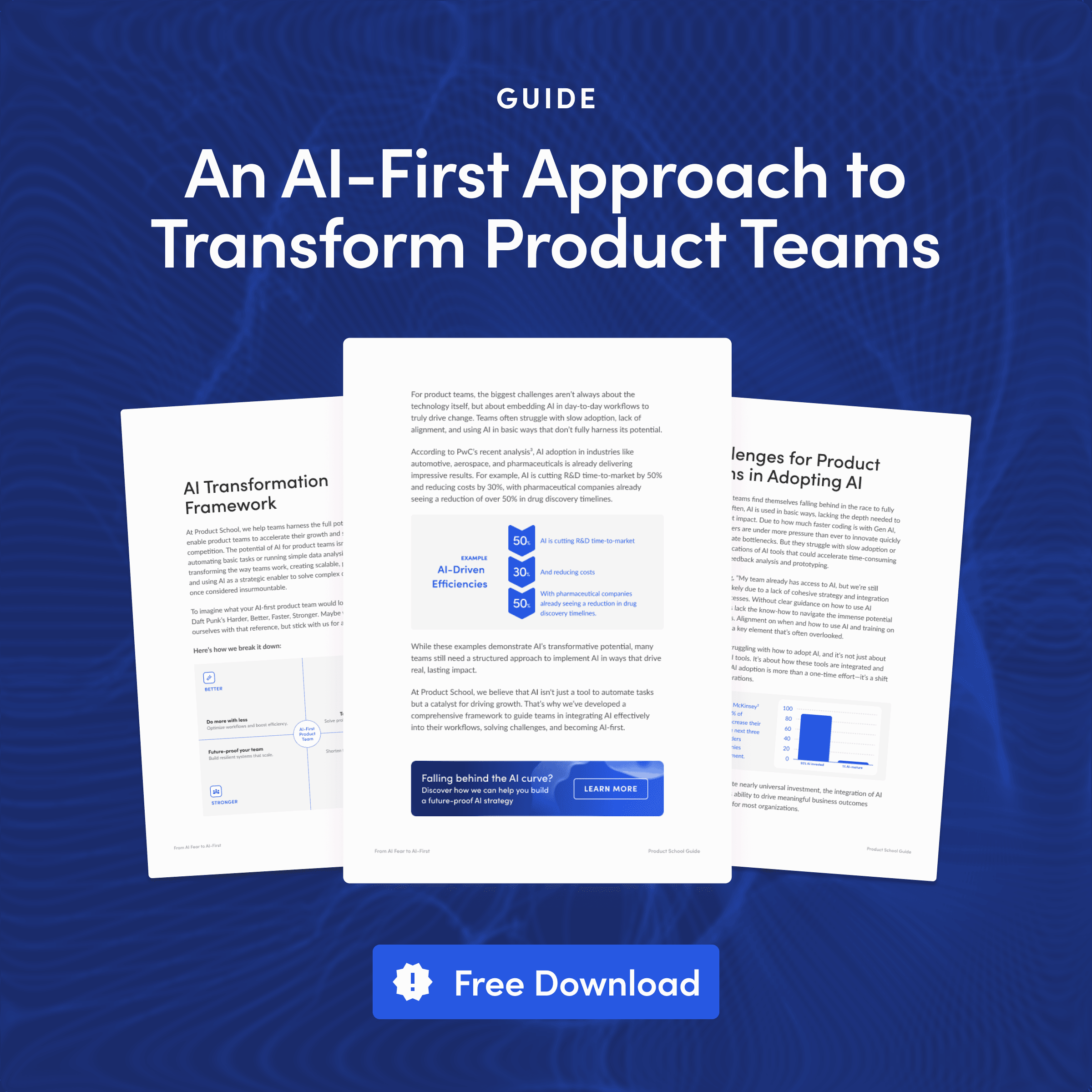
Build Versus Buy Decision Framework
There’s no shortage of frameworks for deciding whether to build or buy. Still, product teams get it wrong for the same reason. They treat it like a cost question, not a strategy question.
The truth is, every build versus buy decision is a mirror of your product goals and the company’s priorities: how you value time, ownership, product innovation, and control. It also reflects the reality of your current setup: your team’s capabilities, your data and governance constraints, your tech stack, and how much operational capacity you actually have right now.
That’s why the real answer is rarely a clean “build” or “buy.” Most teams will probably end up saying yes and no to both. They’ll buy what’s commoditized or urgent or build what’s differentiating or deeply contextual based on the simple realities they’re operating in at that moment.
Below are the five factors that alter the team’s decision to build or buy.
Cost in build vs buy analysis
Cost is about long-term ownership. Building software means a higher upfront investment but gives you an asset you can evolve over time.
Buying, on the other hand, reduces immediate cost and risk but ties you to ongoing vendor fees and pricing changes. Smart teams look beyond the first invoice to the total cost of flexibility.
Time-to-market in the build vs buy decision
Speed has always been the hidden currency of product success. Buying software gets you running faster, sometimes in weeks instead of months.
But what you gain in speed, you might lose in alignment. Building takes longer, but it lets you design workflows that truly fit your product team and customers.
Capabilities and customization in the build vs buy software decision
Off-the-shelf tools solve standard problems, but if your product relies on specialized algorithms, integrations, or product experience, customization is key. Building in-house gives you creative control; buying forces you to play within someone else’s sandbox.
Expertise and maintenance in the build versus buy strategy
Teams with strong technical and product capabilities can afford to build more because they can sustain, evolve, and govern what they create over time.
Teams without that depth often benefit from buying mature solutions and focusing their limited capacity on higher-leverage problems. The most effective organizations balance both: they buy where ownership adds little strategic value and build where learning, control, and differentiation compound.
If not, buying gives you ready access to expertise, updates, and support. The smartest product-led organizations balance both: buy for non-core functions and build where learning compounds into future advantage.
Strategic control in the build vs buy decision framework
The ultimate question: Does this software define your competitive edge?
If it does, in most instances, you should build it. Ownership means freedom to experiment, adapt, and differentiate.
If it doesn’t, buying frees your team to focus on what truly drives value, your North Star. The strongest product leaders know control is expensive, but sometimes, it’s worth every line of code.
How AI Is Changing Build vs Buy Strategy
AI hasn’t just added a new column to your build vs buy decision matrix. It has changed what “build” and “buy” even mean.
Below are five dimensions where AI quietly rewrites the rules of any build vs buy strategy.
Speed in build vs buy software analysis
In an AI context, speed is no longer about “how fast can we ship a feature” but “how fast can we learn whether this capability is real value or a demo.”
With pre-trained models and APIs, teams can build a working AI prototype in days. That changes the balance of power between build and buy. You can often validate a build path almost as fast as you can sign a vendor contract.
The real bottleneck becomes AI evaluation, not product development.
When speed is the constraint, most teams should. Use quick, internal prototypes to test whether an idea works before committing to a full build or a long-term vendor.
The teams that win on speed do not just buy to go faster. They prototype, learn, and only then decide whether a long-term build or buy commitment makes sense.
Cost in build versus buy strategy
AI reshapes the cost side of the build vs buy decision framework. Traditional budgeting models struggle with AI because cost is tied to usage, experimentation, and continuous improvement.
Building your own AI capability brings heavy fixed costs: specialized talent, data pipelines, evaluation tooling, and infrastructure.
But over time, this can become a compounding asset if AI is central to your product strategy. Buying an AI-powered product or API is cheaper to start with and easier to justify in a business case, but you are now renting someone else’s learning curve.
Smart teams do not just compare line items. They ask:
Is this AI capability strategic enough that internal expertise will pay off in a year or two?
If the answer is yes, short-term “savings” from buying might be hiding a long-term dependency that gets expensive as usage scales.
Capability and quality in the build vs buy decision matrix
In classic software, capability was mostly about feature coverage. In AI, capability is about performance, reliability, and how well a model understands your specific domain.
Buying access to a high-performing foundation model can give you world-class capability on day one. It also means you inherit its blind spots and training data. Building on top of your own data, with your own RAG system in place, with your own evaluation harness, lets you tune quality to your reality.
The trade-off is obvious: more control and differentiation versus more effort and risk. A practical way to think about capability in build vs buy software analysis:
If an off-the-shelf AI solution already meets your success criteria, your default should be to buy. But if your product’s advantage depends on doing significantly better than what generic models can offer, that’s when investing in building or fine-tuning your own AI starts to make sense.
In other words, do not build AI to prove you can. Build when quality at the edge is your moat.
Data and governance in the build vs buy software decision
Data has always mattered, but in AI, it sits at the center of the buy vs build decision framework. Your data volume, quality, sensitivity, and governance posture all push you in one direction or the other.
If your product value comes from proprietary, regulated, or highly sensitive data, pushing everything through a third-party AI vendor may not be tenable long term. Building (or at least hosting and orchestrating) more of your AI stack in-house can give you the control you need over access, lineage, and compliance.
For this dimension, the key questions are simple but non-negotiable: Can we safely and legally send this data to a vendor, and at what level of granularity?
If the honest answer is “we are not sure,” that is usually a sign that your build vs buy strategy should start with strengthening data governance and clarity before signing multi-year AI contracts.
Integration and evolution in the build vs buy decision framework
Integration used to mean wiring a tool into your stack. In the AI era, integration means wiring continuous learning into your workflows. This is where many build vs buy decisions quietly succeed or quietly fail.
Buying an AI solution often looks attractive because it promises quick integration. But every external AI system you adopt comes with a subtle tax: changes to its behavior, models, or pricing happen on someone else’s schedule.
Building more of the AI capability in-house takes longer, but it lets you decide when to retrain, how to adapt to new data sources, and how to expose AI decisions to your users. A simple way to evaluate integration in a build vs buy decision matrix:
If the AI capability will sit at the core of your critical user journey or workflow, favor building or at least owning the orchestration layer
If the AI capability is an internal accelerator with limited user exposure, a well-chosen vendor integration is usually enough
In short, AI has turned integration into a strategic choice about who controls the evolution of your product’s intelligence: you or your vendors.
Build vs Buy Decision Matrix for AI-Driven Teams
How can product teams systematically decide between building or buying with the entrance of AI? While the underlying decision hasn’t changed, AI alters the trade-offs by lowering experimentation costs, accelerating development, and expanding who can realistically build software.
This matrix applies to all build vs buy decisions today — from core product capabilities to internal systems and AI-powered tools — and reflects how those shifts change what matters most.
Below are some pivotal criteria in a buy vs build decision framework, and how to approach them today:
Strategic Alignment: Is the capability core to your product’s competitive advantage? If yes, leaning toward building makes sense (to innovate in-house and differentiate). If not, buying a reliable solution is usually sufficient and lets you focus your energy on what truly sets you apart.
Time-to-Value: How urgent is the need? For an immediate pain point or market opportunity, buying (or reusing an existing AI service) will deliver value fastest. If you have the luxury of time or the problem is very specific, investing the time to build a tailored solution could pay off with a better fit, even if it takes longer to launch.
Cost & Resources: Consider both budget and team resources. Building demands up-front investment (developers, data infrastructure) plus ongoing maintenance, but it avoids paying vendor margins. Buying shifts costs to recurring license or usage fees, which are predictable but can grow with scale. Also factor in your team’s skills – If you lack the technical and product capability or bandwidth to own the system long term, the cost (and risk) of building is much higher.
Data & IP: Who has the data, and how sensitive or unique is it? If success with the AI solution will rely on your proprietary data (or if data can’t leave your environment due to privacy regulations), building in-house ensures you stay compliant. If, on the other hand, a vendor has a vast dataset or pre-trained model that you could never match, buying into that capability can be the pragmatic choice.
Integration & Flexibility: How well will the solution integrate with your systems and workflows, and how much flexibility do you need? A custom-built solution can be designed to slot perfectly into your product stack and processes. An off-the-shelf product might require you to adjust some workflows to fit its way of working, and it may offer limited customization. Consider the risk of vendor dependency too: if you buy, you’re partly tied to that vendor’s ecosystem and roadmap.
Every organization will weigh these factors differently.
The optimal decision aligns with your AI product strategy and your AI maturity. For example, an AI-native startup (one that’s “born AI,” with AI expertise at its core) might favor building proprietary models in-house to push product innovation.
In contrast, a traditional company in an AI-first transformation might initially buy AI tools to accelerate learning and quick wins, then gradually build more in-house as its capabilities grow.
Critical Questions for Your Build vs Buy Decision Framework
The best product leaders don’t rush into a build or buy decision; they interrogate. They know that the real clarity comes from the questions they ask before the first line of code or contract is signed.
Our product leadership team asks questions like these before every major investment. These are the questions that reveal whether a capability is truly core, whether the team has the capacity to own it, and whether the solution will still make sense a year from now.
Use these questions as your decision filter.
What are we really trying to change in the product or business by making this build vs buy decision?
This forces leadership to anchor the decision in outcomes, not technology.If we were starting this company today, with no legacy stack, would we build this or buy it?
This helps expose decisions driven by sunk cost rather than strategy.If this works far better than expected, what new problems will success create for us?
This surfaces scaling, cost, and vendor lock-in risks before they bite you.If this completely fails, what is the most likely failure mode: tech, adoption, data, or ownership?
This clarifies where you need resilience and who must be accountable.Whose job will fundamentally change if we build this ourselves versus buy it from a vendor?
This highlights impact on teams’ day-to-day work and skills, not just architecture.What would we learn by building that we absolutely cannot learn by buying?
This asks whether the learning curve itself is a strategic asset worth paying for.If a top-tier competitor announced they were buying this capability tomorrow, would we still want to build it?
This tests whether “build” is driven by ego or by a real need to differentiate.What is the smallest experiment we can run in two to four weeks that would make this build vs buy decision 10x clearer?
This shifts the conversation from opinion to evidence via AI prototypes or quick integrations.Are we designing this choice for our current org chart, or for the company we want to be in two years?
This keeps you from hard-wiring today’s constraints into tomorrow’s architecture.In the context of AI, where do we need deep control over models, data, and evals—and where are we happy to be “just a smart customer”?
This draws a boundary between AI capabilities you must own and those you can confidently outsource.If this vendor doubled prices or changed their roadmap next year, how hard would it be for us to switch or bring it in-house?
This forces a sober look at optionality and long-term leverage.How will this build vs buy choice change what our best people actually do with their time every week?
This ensures you don’t “win” technically while accidentally degrading how your top talent creates value.Which customers or segments care the most about this capability being exceptional, not just present?
This helps decide whether “good enough” from a vendor is fine, or whether excellence here is part of your moat.Does this decision move us closer to being AI-first in how we work, or does it keep AI as a sidecar tool?
This ties the decision directly to your AI maturity journey, not just to a single feature.
Build vs Buy Strategy with AI Tools: Prototyping, Evals, and Agentic AI
Throughout this article, “build vs buy” has referred to any capability decision made in a world where AI lowers experimentation costs and accelerates development, not just decisions about AI tools themselves.
Now, this part will narrow down the focus to AI tools in particular. AI’s rise has introduced new concepts and tools that influence the build vs buy strategy. Three in particular are shaping modern decisions: Agentic AI, AI Prototyping, and AI Evals.
Agentic AI
Agentic AI refers to autonomous AI systems (AI “agents”) that can understand goals, make decisions, and take actions with minimal human guidance.
It’s an emerging area. For example, AI agents that handle customer inquiries or automate multi-step workflows. Many vendors now tout “AI agents,” but not all are truly autonomous (some are just advanced chatbots or scripts).
In practice, the build vs buy decision for agentic AI hinges less on raw capability and more on ownership and risk. While many teams can now prototype agents quickly, far fewer are equipped to define reliable boundaries, monitor behavior, and integrate agents safely into real operational workflows.
For most organizations, buying or partnering makes sense early. Over time, teams often discover that owning the orchestration layer (not necessarily the agent itself) is what provides control, adaptability, and long-term leverage.
If a third-party agent platform can do the job well, buying might get you results faster. Just be mindful of vendor lock-in and whether the agent can be adapted to your unique needs down the line.
Advanced AI Agents Certification
Design and implement adaptive, multi-agent AI systems with memory, collaboration, and risk safeguards. Deploy production-ready AI agents at scale.
Enroll now
AI Prototyping
AI prototyping is the practice of rapidly creating a working model of an AI-powered feature using existing models or low-code tools. Teams can now go from idea to a functioning prototype in hours, not weeks.
This dramatically lowers the effort to experiment by building small proof-of-concepts internally. In turn, those experiments inform the build vs buy decision.
A quick prototype can validate whether an in-house approach is feasible and effective, or whether an external solution performs better. In practice, product teams should use rapid prototyping as a learning tool before committing: it’s a low-cost way to gather evidence on what approach will likely yield the best outcome.
Vibe Coding Certification
Go from idea to prototype in minutes. Build, debug, and scale AI prototypes with the latest tools to integrate APIs securely and hand off to engineering fast.
Enroll now
AI Evals
“AI evals” (AI evaluations) are structured tests of an AI system’s performance, accuracy, and reliability. They give teams a data-driven way to assess both in-house and vendor solutions against the outcomes that actually matter.
Kunal Mishra, a Group Product Manager at Amazon, expressed an important opinion on a Product School Webinar:
Evaluation isn’t just some engineering vanity or a nice-to-have. It is the steering wheel of a product’s quality, the bedrock of user trust, and the critical input for building versus buy strategy. It’s your primary defense against escalating any legal, brand, and compliance risk.
In other words, robust evaluation practices let you choose (and later adjust) the build or buy path based on evidence rather than hype. By defining clear success criteria (for example, does our AI feature actually reduce support call volume by 20%?) and measuring real outcomes, you avoid the “sugar high” of unproven AI demos.
AI evals ensure that whichever solution you choose is delivering value. They alert you if a change of course is needed (say, switching vendors or improving your model) to meet your goals.

AI Evals Certification
Learn to build trusted AI products. Design eval suites, integrate CI/CD gates, monitor drift and bias, and lead responsible AI adoption.
Enroll now
Rethinking the build vs buy strategy in the age of AI
In the end, build versus buy is a strategy question. Every build vs buy software decision quietly encodes what you believe about your product, your team, and the kind of company you are trying to become.
AI just makes those beliefs harder to hide. You are no longer choosing between “custom feature” and “off-the-shelf tool.” You are choosing which capabilities you will own, which learning curves you will climb, and where you are comfortable being “just a smart customer” of other people’s models and platforms.
The teams that will win are not the ones who always build or always buy. They are the ones who prototype fast, run real AI evals, ask hard questions up front, and treat every build vs buy decision framework as a way to sharpen their focus.
Transform Your Team With AI Training That Delivers ROI
Product School's AI training empowers product teams to adopt AI at scale and deliver ROI.
Learn more
(1): https://www.goldmansachs.com/insights/articles/ai-investment-forecast-to-approach-200-billion-globally-by-2025
Updated: January 5, 2026