AI product sense is product judgment applied to AI features. It’s the ability to reason about probabilistic outputs, model failure modes, and user trust alongside the standard product trade-offs of scope, value, and effort.
That matters now because AI is not an edge-case product work. Stanford AI Index Report says organizational AI adoption reached 88%, and reported that 71% of organizations regularly use generative AI in at least one business function.
If you want a stronger foundation for product judgment, start with our product sense interview. This article picks up where that one leaves off: what changes when the product has a model inside, what strong AI product judgment looks like, how the new interview formats work, and how to build the skill.
TL;DR: AI Product Sense
AI product sense is product judgment applied to AI features. It means reasoning about user value, scope, and trade-offs while also accounting for probabilistic outputs, model failure modes, evals, and user trust.
AI does not replace classic product sense. It extends it. PMs still need structured thinking, user empathy, and prioritization, but now they also need to understand when a model is good enough to ship and how to measure that responsibly.
The biggest shift is moving from deterministic features to probabilistic systems. AI features may work most of the time, but product teams still need to decide what error rate is acceptable, where fallback is needed, and how failure should be handled.
Strong AI product judgment starts with the failure mode. Good AI PMs ask what happens when the model is wrong, how often it happens, which users are affected, and whether the product can fail safely.
AI features are managed through evals, not just specs. PMs need to define what “good” looks like through criteria such as accuracy, faithfulness, relevance, latency, cost, safety, and user trust.
Strong AI product sense means making trade-offs intentionally. A PM may choose speed over completeness for autocomplete, but choose accuracy and traceability over speed for a legal, financial, or policy assistant.
Trust becomes a core product requirement. AI products need clear scope, visible sources when relevant, easy editing, undo options, confidence signals, and escalation paths so users know when to rely on the system.
Senior PM interviews are starting to test this skill directly. Meta’s reported “Product Sense with AI” round reflects a broader shift: senior PMs are expected to reason about AI features, eval criteria, failure modes, and technical trade-offs, not just propose good product ideas.
PMs can build AI product sense by shipping small AI features, getting fluent in evals, practicing AI-specific product sense prompts, and studying real AI product failures.
The future PM bar is clear: AI product sense is becoming table stakes for senior product roles, especially as more products put models inside core workflows.
What Is AI Product Sense?
AI product sense extends classic product sense into the parts of product work that become harder the moment a model enters the stack:
variable outputs,
evaluation criteria,
latency-versus-quality trade-offs,
retrieval failures,
risk thresholds, and
the trust implications of all of it.
Classic product sense asks what to build, for whom, and why. AI product sense adds two tougher questions: when is a probabilistic answer good enough, and how will we know?
The key point is that this is not a separate craft. The AI PMs who already know how to think clearly about user value, product prioritization, and trade-offs usually adapt fastest. What changes is the operating environment.
Generative AI is variable, and traditional software testing is insufficient for AI systems. Teams end up defining rubrics for instruction, text quality, grounding, safety, and custom product-specific checks instead of relying on one perfect spec.
In other words, AI product sense is product sense extended, not replaced. The PM who already has strong user empathy and structured thinking is starting from the right place. The missing layer is learning how model behavior changes the bar for quality, risk, and trust.
AI Product Strategy for Leaders
By the end, you will possess a board-ready AI Strategic Roadmap and Governance Framework, positioning you not just as a product builder but as the executive leader driving your company’s transformation.
ENROLL NOW
What Changes When AI Is in the Product
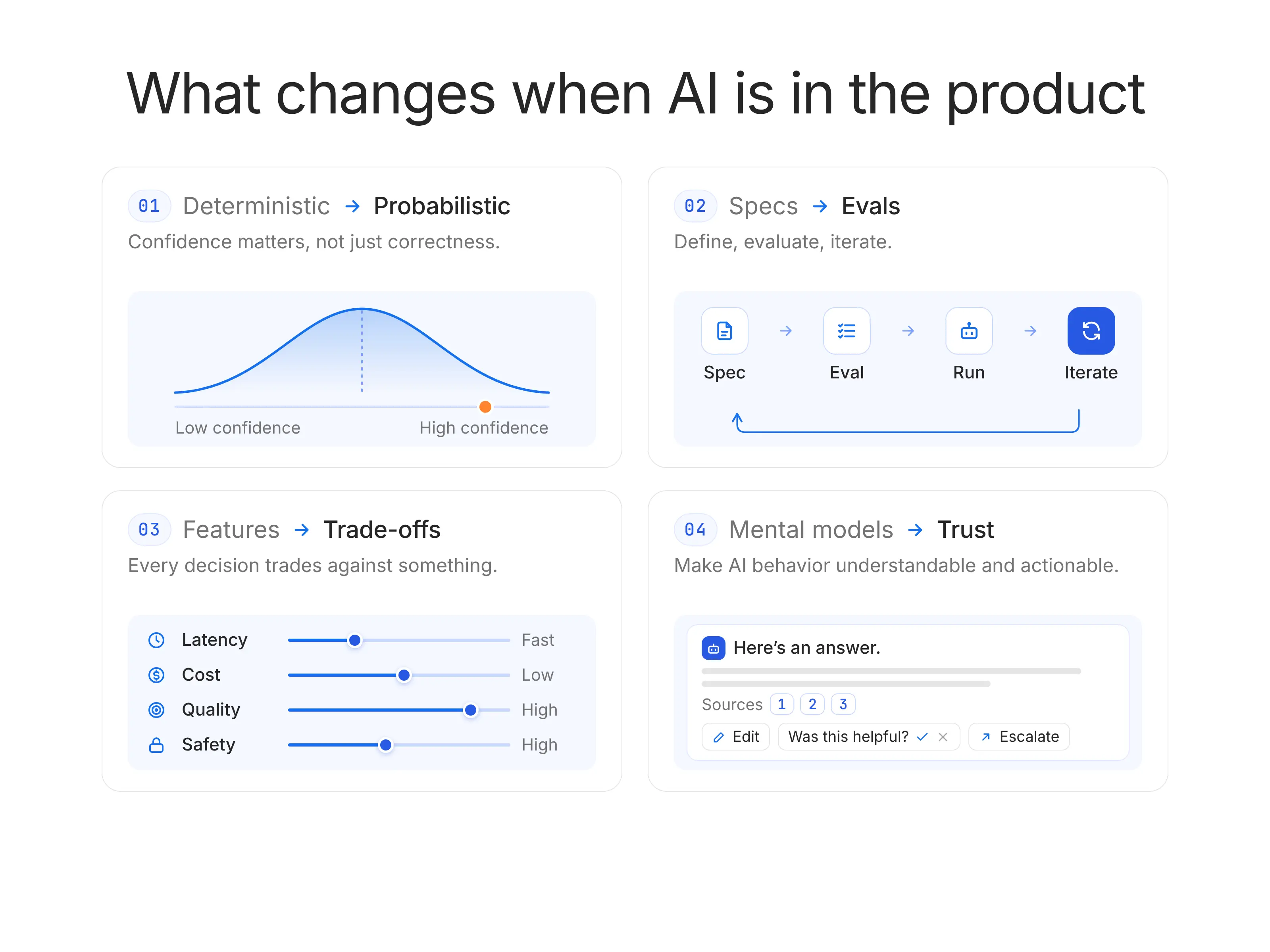
The biggest shift is not that product fundamentals disappear. It is that the same fundamentals now have to operate inside a probabilistic system.
From deterministic to probabilistic. Traditional features usually fail in obvious yes-or-no ways. AI features fail on a distribution. If a support-ticket classifier is 92% accurate, that still leaves roughly one wrong decision in every twelve. The PM’s job is not to celebrate the top-line number. It is to decide whether that error rate is acceptable, which cases need fallback or review, and what the user experiences when the system is unsure.
From specs to evals. In classic software, a strong spec can get you most of the way to a working feature. In AI products, the real control surface becomes the evaluation plan. The PM still defines intent, but now also has to define what a good answer looks like, what failure looks like, what dataset reflects reality, and what threshold is safe enough to ship. That is why AI-native teams end up talking about AI eval sets, rubrics, graders, and review loops.
From building features to designing trade-offs. AI features force product decisions that are technical and user-facing at the same time: latency versus quality, cost versus depth, recall versus precision, flexibility versus consistency. Strong AI product sense means picking the trade-off deliberately and defending it.
From user mental models to user trust. Users can learn a deterministic feature by repetition. With AI, they are also learning when not to rely on it. That changes the job from pure interaction design to trust design: clearer scope, visible sources when relevant, easy editing, graceful fallback, and escalation paths for higher-risk moments.
What Good AI Product Judgment Looks Like in Practice
The difference between strong and weak AI product sense usually shows up before the product roadmap discussion gets polished. You can hear it in the first questions a PM asks. The stronger PM is usually the one who is already forcing clarity around AI evaluation, failure boundaries, and trust, not just feature ambition.
AI Evals Certification
Learn to build trusted AI products. Design eval suites, integrate CI/CD gates, monitor drift and bias, and lead responsible AI adoption.
Enroll now
Strong AI PMs ask about the failure mode before the success case.
They treat accuracy as a distribution, not a trophy number.
They push back on vague framing like “the model just needs to be smarter,” because smarter often means slower, costlier, or harder to control.
They know when to hard-code, when to retrieve, and when to rely on a model.
They measure the product at the workflow level, not just the model-output level.
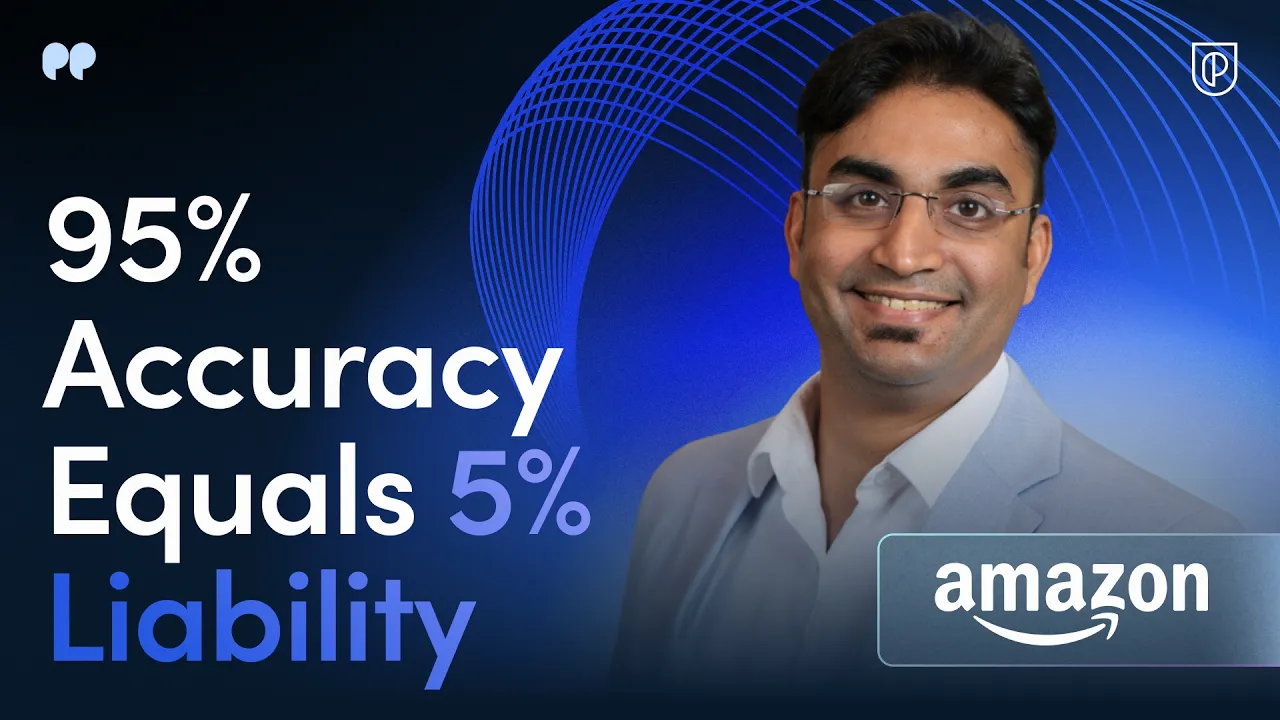
Abhinav Kasliwal, AI Product and Technology Leader at Amazon, makes the same point in Product School’s webinar.His warning is simple: “Accuracy measures model performance, not product success.” He explains that accuracy alone “doesn’t tell you if your users use your AI or trust your AI. It doesn’t tell you if they will find it useful. It doesn’t tell you if they will come back.”
That is the heart of AI product sense. A 95% accurate AI feature can still fail if users do not trust it, if it is too slow, if it gives technically correct but unhelpful answers, or if it costs more to run than the value it creates.
Strong AI product judgment means defining the real quality bar early, exposing the trade-offs clearly, and measuring whether the AI feature creates trust, usefulness, adoption, and business impact — not just whether the model performs well in isolation.
AI Product Sense in Senior PM Interviews
As of 2026, the clearest public example is at Meta. Public descriptions of the reported Product Sense with AI format are coming primarily from interview-prep resources (like Prepfully in 2025) and candidate accounts. Those descriptions consistently say it is showing up mainly in senior PM loops, especially IC6+ and some management tracks.
Across those accounts, the shape of the round is familiar, but the bar is higher. Candidates are still solving a product sense problem. But now, they are expected to reason through where AI helps, how quality should be evaluated, what can fail, and how to use AI without outsourcing judgment.
That is what separates a senior answer from a mid-level one.
A mid-level candidate may identify the user problem and propose a plausible feature. A senior candidate is the one who names the trade-offs, defines the eval criteria, explains when the model should defer to rules or humans, and stays coherent when probed on latency, trust, cost, and risk.
For the structured-thinking base layer, start with Product School’s product sense interview guide and CIRCLES Framework guide. Then pair them with our guide to common AI Product Manager interview questions and the Senior Product Manager career guide. The right prep order is simple: master the classic structure first, then add the AI layer instead of replacing the fundamentals.
The published signal is broader than one named round. Anthropic’s Candidate AI guidance now gives candidates explicit guidance on where AI collaboration is encouraged during parts of the hiring process.
PM roles increasingly ask for hands-on experience with LLM workflows and AI-powered features. Even when the interview is not literally called “AI product sense,” AI fluency is clearly entering the hiring bar.
How to Develop AI Product Sense
The fastest way to build AI product sense is to practice making product decisions under AI constraints.
That skill is becoming career leverage as well as product leverage. LinkedIn’s January 2026 labor market report lists product management as one of the U.S. job functions with the highest share of AI-skilled members, alongside engineering and research. Lightcast also found that job postings mentioning AI skills offer 28% higher salaries than comparable postings without AI skills.
A practical way to build the muscle looks like this.
1. Ship one small AI feature
A small internal copilot, classifier, assistant, search improvement, or summarization flow is enough to teach the real lessons.
The value is in making the decisions yourself.
What counts as a good output?
What happens when the model is wrong?
How much latency will users tolerate?
When should the system ask for confirmation instead of acting alone?
These are the questions that turn AI knowledge into product judgment.
A small feature also forces you to see how quickly AI work becomes cross-functional. You will need engineering input on feasibility, design input on trust and transparency, data input on measurement, and business input on whether the feature is worth the cost.
2. Get fluent in evals
AI product sense gets much stronger when you understand evals well enough to use them in product conversations. Start with our AI evals guide, then go deeper with the AI Evals Certification.
You do not need to become an evaluation specialist overnight. But you do need to understand the basics: precision, recall, grounding, faithfulness, hallucination rate, task success, and human review.
These concepts help you move from vague debates to clearer questions like “is it more faithful to the source, more useful to the user, and still fast enough to ship?”
This is especially important because AI product quality is rarely captured by one number. A feature can be accurate but slow. Useful but risky. Cheap but unreliable. Evals help PMs see those trade-offs before users feel them.
3. Practice the interview format deliberately
Take a classic product sense prompt and rewrite it as an AI feature. Then answer four extra questions every time: why AI at all, what can fail, how will you measure quality, and what trade-off are you choosing?
For example, “design a better support experience” becomes “design an AI support assistant.”
That means you still need the classic product sense base: the user, the problem, the goal, the constraints, and the success metrics. But now you also need to reason about hallucinations, escalation paths, source attribution, latency, cost, and what the system should do when it is uncertain.
Doing this with a peer or coach is much more useful than memorizing clever AI talking points. The combination of our product sense interview guide, CIRCLES Framework guide, and AI PM interview questions is a stronger prep stack than generic AI interview advice.
4. Build a failure library
The fastest way to develop judgment about AI failure modes is to study real failures. Read incident writeups, postmortems, public critiques, and risk frameworks.
Over time, you will start to recognize the same patterns. You’ll notice:
confident hallucinations,
weak retrieval,
misleading summaries,
unsafe recommendations,
hidden bias,
poor fallback design,
and products that look impressive in demos but break in real workflows.
NIST’s Generative AI Profile is useful here because it names recurring risk areas such as confabulation, information integrity, privacy, bias, harmful content, and value-chain risk. It is a good reminder that AI failures come from predictable product, data, model, and governance gaps.
Do not just collect examples as scary stories. Turn them into product questions.
What would the PM have needed to measure earlier?
What guardrail was missing?
What user expectation was violated?
What fallback should have existed?
That habit is what turns abstract AI risk awareness into practical AI product sense.
AI Product Sense Is Becoming A Senior PM Skill
AI product sense is product sense extended, not replaced. The PMs who already have strong judgment have the foundation. The work now is learning the AI-specific extensions around evals, failure modes, trade-offs, and trust.
As more products put models in the middle of core workflows, this stops being a niche specialty and becomes table stakes for senior PM roles. To build that skill systematically, start with the AI Product Management Certification and deepen it with the AI Evals Certification.
AI Evals Certification
Learn to build trusted AI products. Design eval suites, integrate CI/CD gates, monitor drift and bias, and lead responsible AI adoption.
Enroll nowUpdated: November 6, 2026