Product strategy skills are the specific capabilities that let you turn a goal into a plan somebody can execute: defining the goal precisely, deciding how success gets measured, working inside real constraints, sequencing the work, and planning for what goes wrong.
Something has also shifted in the last two years that makes this worth revisiting properly. McKinsey's August 2026 research found that product managers in the fastest-moving organizations reported a 24% reduction in time spent on execution work against an 18% reduction in time spent on strategic work.
Execution compressed faster than strategy did. Strategy now takes up a larger share of the job.
This guide covers the five skills, what AI changed about each one, how the expectations shift by level, and where to actually learn them. If what you need is the definition of product strategy along with a framework and template, our product strategy guide covers that ground.
Key Takeaways
Product strategy skills are five discrete capabilities: goal definition, success measurement, constraint identification, sequencing, and risk mitigation.
Strategy is a plan for how you get there. The work is being more specific about the goal than the vision is, and deciding in advance how you will know whether it is working.
AI compressed execution work faster than it compressed strategic work, so strategy is a bigger share of the product management job than it was two years ago.
AI helps with some of these five skills and barely touches others. Drafting and scanning got much faster. Deciding did not.
The skills do not change as you climb. An Associate PM and a VP are doing the same five things at different scope, with different consequences for getting them wrong.
Strategy skills and strategy frameworks are different things. Plenty of PMs can complete a framework and still produce a plan nobody can execute.
The fastest way to improve is to write a real strategy for a real product and have someone senior find its weakest component.
What Are Product Strategy Skills?
Product strategy skills are the capabilities behind producing a strategy that holds up. It includes naming a goal precisely enough to act on, deciding how it will be measured, understanding what constrains you, ordering the work, and anticipating what could break it.
They are distinct from strategy frameworks, and conflating the two is the most common mistake I see. A framework is a template for the output. A skill is what lets you fill that template with something true.
You can complete a CIRCLES exercise or a four-Ps cascade cleanly and still hand your team a document that falls apart the first time someone asks what you are giving up to do it.
Frameworks are genuinely useful, and our product strategy frameworks guide covers the ones worth knowing.
But no framework supplies judgment about which goal is worth committing to. That part is the skill.
The Five Core Product Strategy Skills
Shahid Hussain, Group Product Manager at Google, gave the cleanest working definition of strategy in our talk that I have heard from a practitioner:
"I like to define strategy as a plan for how we get there. What we need to do first is be very specific about the goal, to a level that is more detailed than the vision, and how you're measuring success against that goal, so that you know as you're going through it whether you are being successful or not."
He goes on to describe identifying resource constraints, deciding which activities come first, adding intermediate milestones, and building external issues and their mitigations into the plan. Between them, those components make a workable taxonomy of the skill.
Here is how I would break it down.
1. Defining the goal more precisely than the vision does
The skill is specificity under pressure to stay vague. Vague goals survive meetings because nobody can disagree with them, which is exactly why they are worthless as strategy.
"Become the default tool for design teams" is a vision. "Move from 12% to 25% of new design teams choosing us within four quarters" is a goal. The second one can be wrong, which is what makes it useful.
2. Deciding how success gets measured before you start
This is not the dashboard you build after launch. It is the measurement decision made while the strategy is still arguable, when choosing a metric still constrains what you are allowed to do.
The test is whether your measure would tell you to stop. If every plausible outcome reads as success, you have chosen a metric that protects the plan instead of testing it. Our Product Analytics and Experimentation certification goes deep into this specific gap.
3. Identifying the constraints that actually bind
Every plan has a budget, headcount, platform, and regulatory limits. The skill is knowing which ones genuinely bind and which are assumed.
The constraints are usually the real ones:
The team that will not prioritise your dependency
The executive who has already decided
The architecture decision from three years ago that rules out half your options
A strategy that names those is more useful than one that lists the budget.
4. Sequencing the work, with milestones along the way
Which activity comes first, and what proof arrives and when. Sequencing is where strategies most often fail silently, because a plan with the right components in the wrong order stalls in month two.
Milestones do two jobs:
They give you evidence early enough to change course
They give the team the experience of finishing something.
A twelve-month plan with no checkpoint before month twelve is a bet, not a strategy.
5. Planning for what goes wrong, with mitigations built in
The skill most PMs skip entirely, and the one that separates a strategy from a wish.
Name the external issues that could break the plan, then write the mitigation into the plan itself rather than leaving it as a risk register nobody opens. A strategy that states its own failure conditions is more credible in an executive review, not less, because the alternative is being surprised in public by a risk you had privately considered.
How AI Changed Product Strategy Skills
Start with the finding, because it is more specific than the usual claim that AI changes everything.
McKinsey's survey found that reduction in execution time outpaced reduction in strategic time by 24% to 18% among product managers in the fastest-moving organizations. Execution went down faster.
If the parts of your job that were mechanical shrink faster than the parts that require judgment, judgment becomes a larger share of what you do and a larger share of how you are evaluated. A product manager who was carried by execution throughput has less to stand on.
The more useful question is which of the five skills AI actually helps with, because the answer varies a lot.
Skill | How much AI helps | What actually changed |
Defining the goal | Little | A model will draft ten goal statements in a minute. Choosing the one your company will commit to is untouched. |
Deciding measurement | Moderate | Modelling and simulating outcomes got much cheaper. Deciding what counts as success did not. |
Identifying constraints | High relevance, different answers | Engineering capacity is no longer the binding constraint on many teams. Alignment and decision speed often are. |
Sequencing and milestones | Moderate | Activities compress, so sequences shorten, and milestones need to land more often to stay meaningful. |
Planning for what goes wrong | Moderate to high | Scanning for risks and drafting mitigations is genuinely faster. Judging which risks matter is not. |
Notice the pattern. AI is strongest on the generative parts of strategy work and weakest on the decisions. Interestingly, four of the five skills above are decision skills.
It also matches what teams are reporting from the collaboration side. A Forrester Consulting study commissioned by Miro in Q3 2025, surveying 518 decision-makers across engineering and product design, IT, and lines of business, found that 75% said most AI tools focus on individual work rather than team productivity. Creation scaled but deciding together did not.
Which Product Strategy Skill Is Your Weakest?
Most product managers are solid at three of these five and quietly weak at one or two. Working out which one is your gap matters because the fix is different for each.
Score yourself 0 to 3 on each. Score what you actually did on your last strategy, not what you believe you would do on a good day.
Skill | What weak looks like in practice |
Goal definition | Your goal could not be wrong. Every plausible outcome reads as success. |
Measurement | You chose the metric after the plan was agreed, not while it was still arguable. |
Constraints | Your constraints list is budget and headcount. The real blocker was a person or a decision already made. |
Sequencing | No checkpoint arrives before month six. |
Risk mitigation | Risks sit in a separate register that nobody has opened since kickoff. |
Give yourself 0 if you recognise yourself in the description above, 1 if you did it but only after someone asked, 2 if you did it unprompted, and 3 if you did it unprompted and it changed the plan.
What your total means:
0 to 5. What you are calling a strategy is closer to a roadmap with ambition attached. Start with goal definition, because the other four are hard to do well against a vague goal.
6 to 10. You can produce a strategy that reads well and stalls in execution. The gap is usually sequencing or constraints, so check which of those two scored lower.
11 to 13. Competent, with one visible hole. Fix the lowest score before adding anything new.
14 to 15. Your limit is no longer the document. It is getting other people to act on it, which is a different skill set covered in our guide to getting buy-in from stakeholders.
One pattern worth naming: risk mitigation is the most commonly skipped of the five and the cheapest to fix. If it scored the lowest, you can close most of that gap this afternoon by going back to your current strategy and writing down three things that could break it, with what you would do about each.
How the Bar Rises From Associate PM to VP of Product
The five skills do not change as you move up. The scope changes, and so does the cost of getting it wrong.
Four transitions describe the shift from individual contributor to product leader:
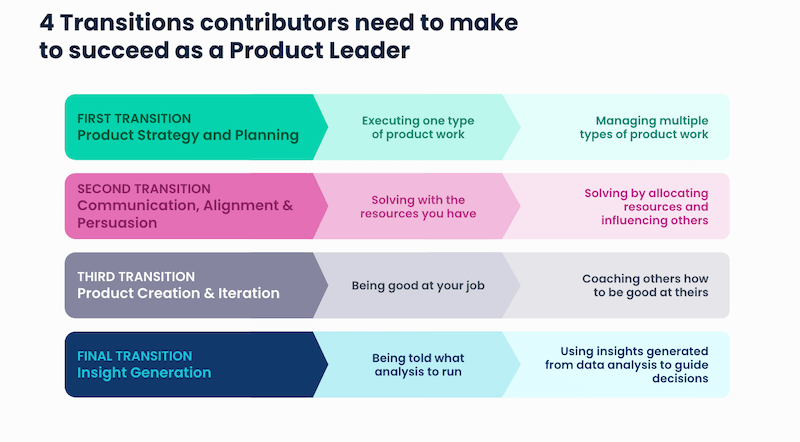
From executing one type of work to managing several
From solving with the resources you have to solving by allocating them and influencing others
From doing the work well to coaching others to do it
From being told what analysis to run to driving decisions from the analysis you initiated
Level | Scope of the strategy work | What separates good from adequate |
Understands the goals set above them and how their work ladders up | Can explain why the roadmap looks the way it does | |
Contributes to strategy and influences the roadmap | Brings a defensible recommendation rather than a list of options | |
Makes product-wide trade-offs and owns a near-term roadmap | Names what is being sacrificed, and why | |
Consolidates themes into an investment thesis across a team | Ties team-level work to company strategy without hand-waving | |
Changes strategy and process proactively at the pillar level | Adjusts the plan before the data forces it | |
Defines focus and sets outcome expectations for the organization | Says no at a scale where saying no is expensive |
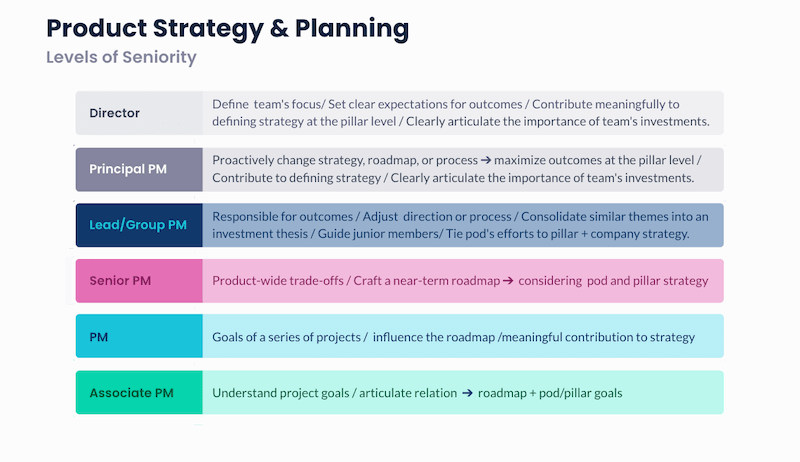
For the full ladder, including titles, scope, and what each level owns beyond strategy, our product manager career path guide covers it properly.
Resources and Courses to Improve Your Product Strategy Skills
There are four tiers worth knowing, and my honest advice is to work through them in order. Free will take most product managers further than they expect… Paying before you have written a real strategy tends to buy vocabulary a lot faster than judgment.
Free resources
Product School's Product Strategy Template. The most directly useful item on this list. The fastest way to improve is to write a real strategy, and the template forces you through every component rather than letting you stop at the ones you find easy.
The Product Podcast. Product leaders describing strategy decisions they actually made, including the ones that did not work.
Our product strategy blog cluster, including the frameworks guide and the product vision guide.
Free live events and the Slack community. The value here is having a real strategy critiqued by people who have written one, which is hard to get any other way.
Turning AI Doubt into AI Strategy
Ryan Daly Gallardo, SVP of Product, Consumer at Dow Jones, reveals how to test without eroding trust, embed cross-functional safeguards, and use evidence-based design to deliver AI features that improve engagement.
Download Playbook
Books
Three books, chosen because they are about strategy rather than about process.
Good Strategy Bad Strategy, Richard Rumelt (2011). The clearest explanation of why most documents called strategy are not strategy. Not product-specific, which is exactly why it travels well.
Playing to Win, A.G. Lafley and Roger Martin (2013). Strategy as a cascade of linked choices. Useful when your problem is that your strategy is really a list.
INSPIRED and EMPOWERED, Marty Cagan and the SVPG partners. The product-specific counterpart to the two above.
One paid course
A single certification runs $2,999. For this topic specifically:
AI Product Strategy for Leaders is the closest fit if your gap is the strategy layer itself.
Product Leadership fits if you are setting strategy across several teams.
Product Management Foundations fits if the underlying craft is the gap rather than strategy specifically.
The product strategy skill is distributed across those three. I would rather tell you that than route you into a course that does not match what you came for.
Product Leadership Certification
Elevate your product strategy and decision-making by integrating AI-driven insights.
Enroll now
Ongoing membership
Pro Membership is $3,999 a year and covers two certifications plus weekly live AI workshops. Unlimited is $4,999 a year and covers ten, plus a ProductCon ticket and the AI tool suite. Upcoming start dates are published in advance. This tier makes sense when your gap is breadth across a year rather than one specific skill.
Tier | What it costs | Best for | Where it falls short |
Free resources | Nothing but time | Anyone who has not yet written a full strategy document | No structure and no deadline, so most people do not finish |
Books | $20 to $40 each | Building durable judgment that outlasts tool cycles | Slow, and reading one changes nothing on its own |
One certification | $2,999 | A specific, named gap you can already describe | Wasted if you do not apply it within weeks |
Membership | $3,999 to $4,999 a year | Breadth across several areas over a year | Overkill if you only need one thing |
I am not going to tell you a certificate makes you a better strategist. What structured training buys is reps under review, which is the part you cannot get from reading. What you do with that is between you and your next planning cycle.
The Fastest Way to Get Better at This
Write a real strategy for a product you actually work on, using the five components above. Then give it to someone more senior than you and ask them which one is weakest.
Most product managers have never had a strategy document properly critiqued. They have had roadmaps questioned and metrics challenged, but not the underlying logic examined line by line. That is the main reason the skill plateaus around Senior PM, and it is fixable in an afternoon by someone willing to be blunt with you.
Start with the free template. If you want the structured version afterwards, AI Product Strategy for Leaders is where that work continues.
Updated: September 29, 2026