Product managers in 2026 face a clear choice: embrace AI or fall behind. Companies are increasingly demanding AI fluency. PMs with AI skills are often in higher demand and command higher salaries.
In short, learning AI pays off, but only if you stay focused on problems, not on shiny tech. Here’s why learning AI matters, what to learn, and how we would tackle a 12-month plan if we were in your shoes.
Will you be an AI PM or a legacy PM?
Bridge the skill gap and become a certified AI Product Manager before the market moves without you.
LEARN MORE
Why AI Skills Matter for Product Managers in 2026
As AI tools for product managers continue to reshape the product landscape, here are four grounded reasons it’s becoming a critical skill for every type of product manager.
Boosts productivity and decision-making. AI can analyze vast data to surface user insights. AI helps PMs analyze vast amounts of data quickly, providing actionable insights for better decision-making. This means quicker, more data-driven AI roadmaps and product prioritization.
Automates routine tasks. Repetitive work (reporting, basic A/B tests, user survey analysis) can be handled by AI, freeing you to focus on product strategy and product innovation. Tricia Maia, the head of product at TED, points out in the recent Product Con appearance that AI tools can draft product roadmaps or PRDs, but cautions: if you let AI do all the heavy lifting, your critical-thinking muscles will atrophy. Skilled PMs use AI to speed things up, not to avoid tough decisions.
Enables personalization and innovation. AI-powered personalization keeps users engaged. AI can segment users and tailor experiences in real time, which leads to better user retention. It also sparks new product ideas (recommendation engines, voice assistants, etc.) that were impossible before.
Future-proofs your career. Companies expect PMs to speak AI. One industry article stresses that PMs with AI know-how will be in “higher demand” as product-led organizations realize AI’s potential to “skyrocket productivity”. In practice, AI-savvy PMs are often the ones getting promoted or courted by hot startups and organizations.
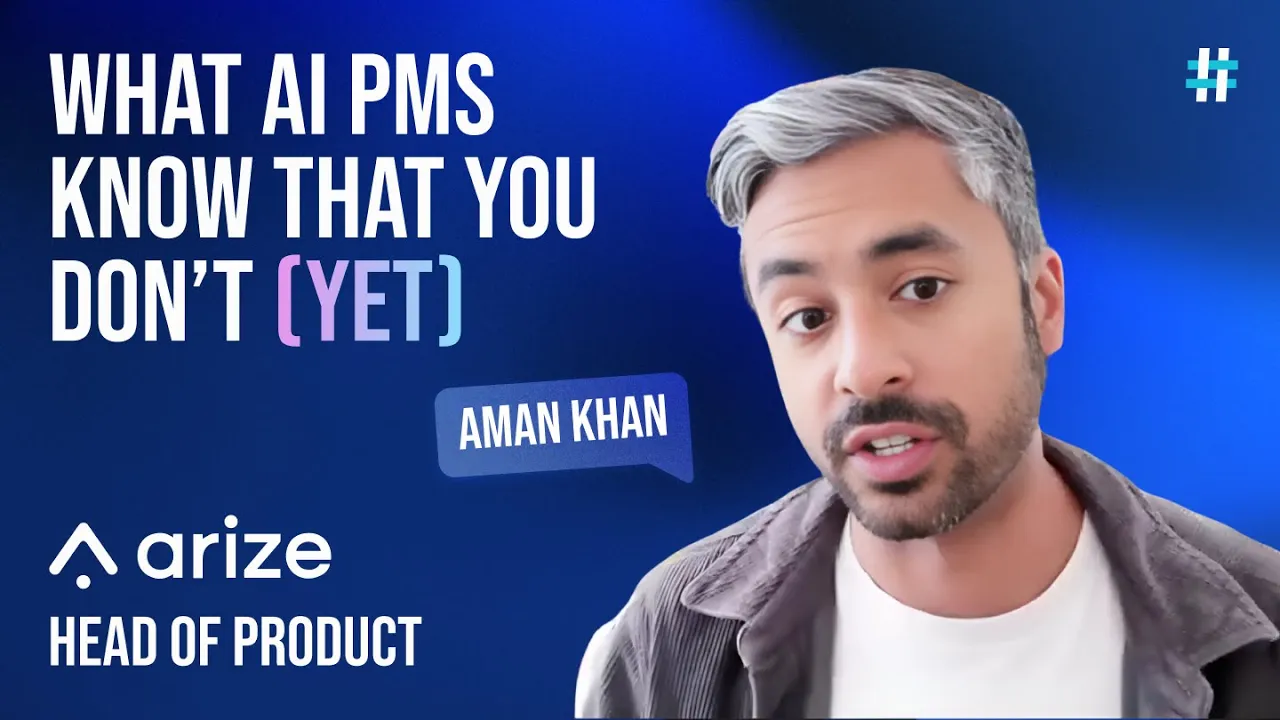
Aman Khan, Head of Product at Arise, makes this shift very clear in his ProductCon talk about using Cursor as a PM:
The PM role is changing...functions that used to be discreet are now overlapping more and more across product, engineering, design, sales, and marketing.
His demo shows what that looks like in practice. With tools like Cursor, PMs don’t just write PRDs and wait for updates. They can explore the codebase, ask “what does this file do? explain it like I’m a PM”, spin up prototypes, and even add basic tests or AI evaluations alongside their engineering partners. AI becomes a way to participate in the end-to-end product workflow, not just to “vibe code” on the side.
AI shouldn’t replace product judgment. It should give AI PMs more context, more leverage, and a tighter feedback loop with engineering.
AI learning roadmap: a 12-month path for product managers
This 12-month plan takes you from AI novice to confident user of AI in your product role. Each phase builds on the last, blending study with practical steps and constant attention to user needs.
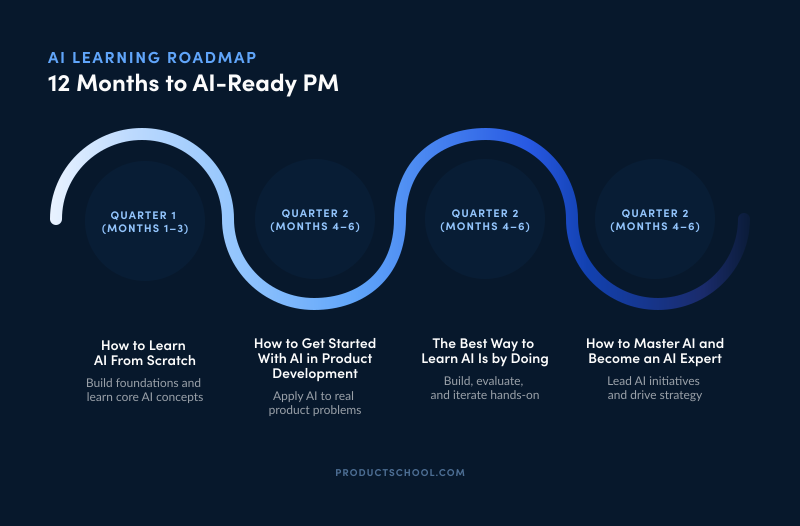
Month 1–3: How to learn AI from scratch
Build foundational knowledge. Start with broad concepts: what is machine learning, generative AI, NLP, computer vision, etc. Take an introductory course (for example, AI for Product Managers Certification) to understand key ideas. Don’t skip understanding data: learn basic statistics, data analysis for PMs, and how training data works. (Product managers don’t need to write models, but you should grasp how they learn from data.)
Practice with no-code tools. Experiment with drag-and-drop AI tools for PMs, simple demos, and AI prototyping tools. For instance, use Google’s Teachable Machine on a small dataset to see how training works. Play with a ChatGPT for product managers or RAG for product managers. These low-code experiments make the ideas concrete.
Learn the language of AI. Get familiar with common terms (like “model”, “training”, “overfitting”, “LLM”, etc.). This pays off when you talk to engineers or stakeholders. Resources like blogs on AI product strategy, AI PMs, AI innovation strategy, YouTube talks, or a glossary cheat-sheet can help. Tricia Maia goes even further by advising: start by listening to users and problems before picking any tool. Similarly, learn the user context before diving into tech.)
Use quality learning resources. Follow high-level AI newsletters or podcasts to stay updated. We recommend you explore our AI certifications as a way to “bridge the knowledge gap” for non-technical PMs. Plan a weekly study schedule (1–2 hours on AI basics) to build momentum.
AI Product Management Certification
Adopt an AI-first mindset: design AI-native UX, build agents, define modern PRDs, and ship trustworthy AI-powered products.
Enroll now
Month 4–6: How to get started with AI in product development
Apply AI to real problems. Identify a small, specific AI use case in your current product or workflow. For example, use one of these 21 AI tools to summarize user survey text, or add an AI-based recommendation on a landing page. Even an AI prototype can teach you how data flows and where models struggle.
Study AI product examples. Look at companies using AI in your industry. What user need does it solve? Read case studies or blog posts (e.g. how Spotify uses ML, or how a fitness app uses computer vision). Understanding these examples clarifies how to integrate AI.
Collaborate with experts. Talk to your data scientists or engineers. Ask them to explain a current AI product goals and challenges. This builds both your comfort and your credibility. A “customer-centric” approach here is key: remember Maia’s point that every AI feature should start with user needs.
Learn about AI ethics and data. Read basic guides on AI bias and privacy (for example, OpenAI’s usage policies or IBM’s AI Fairness 360 docs). As you implement features, think: “Is our data fair and clean?” AI PMs should be aware of risks and regulations early on.
Iterate with user feedback. After you launch any AI experiment, get user input. Does it actually make a task easier or more fun? Tricia Maia saw many AI prototypes “land flat” because they lacked a clear problem to solve. Avoid that by constantly asking users, “how does this help you?” and iteratively testing.
Prototype with AI tools. Use tools like Cursor, Replit, or other AI-native IDEs to “vibe code” small features: a simple agent, a summarizer, a smarter search. Start by prompting an LLM to draft a PRD that includes model, data, prompt, and evaluation recommendations, then work with engineering to turn that into a high-fidelity prototype.
This is exactly the skill stack you’ll need for more advanced work with agents and production-grade AI systems. This is how you bridge the PM ↔ delivery bottleneck instead of waiting on it.
Vibe Coding Certification
Go from idea to prototype in minutes. Build, debug, and scale AI prototypes with the latest tools to integrate APIs securely and hand off to engineering fast.
Enroll now
Months 7–9: The best way to learn AI is by doing
Build a mid-level project. Now that you know the basics, tackle a bigger personal project or hackathon. For instance, try fine-tuning a RAG system on domain-specific data or put together an AI agent with n8n or Zapier. This hands-on work is the best way to learn AI.
Practice AI evals as a core skill. Go beyond “does it look good?” and practice systematic evaluation. For one of your projects, define an eval stack that includes latency, hallucination rate, bias/fairness, and task success, then create a small “golden set” of test cases and run it every time you change the model or prompts. Start classifying failure modes (e.g., missing context, unsafe output, wrong tone) and log them.
Deepen specialized knowledge. If your product uses images, take an online course in computer vision; if it uses language, study NLP. (Many free courses are available.) This isn’t mandatory for all PMs, but diving deeper where your product needs it can turn you into the go-to expert on that aspect.
Use AI as a creative partner. Tricia Maia suggests on the Product Con to prompt AI to challenge your thinking. For example, have an LLM act as a skeptical CEO and critique your outcome-based roadmap, or ask it to generate analogies to explain a concept. This “simulated feedback” helps you refine narratives and anticipate objections.
Gather community feedback. Present your AI ideas to peers or on forums (Product School’s Slack Community, Reddit’s r/ProductManagement, AI meetup groups, etc.). Getting external input exposes gaps in your understanding and helps you communicate more clearly (another nod to Maia’s storytelling focus).
AI Evals Certification
Learn to build trusted AI products. Design eval suites, integrate CI/CD gates, monitor drift and bias, and lead responsible AI adoption.
Enroll now
Month 10–12: How to master AI and become an AI expert
Lead an AI initiative. By now, aim to launch a full AI-driven feature or product. Scope it end-to-end: define product OKRs, work with data engineers, and rollout to users. Applying your skills in a real product context cements learning.
Strategize AI in the roadmap. Try to build an AI product strategy. Write a product requirements doc for an AI feature: outline the user problem, data needs, key metrics, and safeguards. Treat this like any major feature (because it is!), not just a gimmick.
Teach and share. Host an internal lunch-and-learn on what you’ve learned about AI in the past year. Explaining concepts to others will deepen your mastery and position you as an AI expert on your team. (Plus, as Tricia Maia notes, storytelling is most effective when you’re authentic: teaching reinforces your own understanding.)
Refine your storytelling. By the end of year, make it a habit to ask: “What’s the story behind this AI feature?”. Whenever you pitch or document something, lead with the critical user’s journey, use concrete examples, and clarify the transformation. Proofread product messaging to ensure it doesn’t “read like ChatGPT wrote it,” and always include why it matters.
Stay curious and ethical. The AI field evolves daily. Follow AI ethics developments and new research. Consider advanced training (a workshop, a conference). And remember: as Maia warns on the Product Con, AI shouldn’t replace your gut and judgment. Keep exercising your “critical thinking, emotional intelligence, and persuasive delivery” so these muscles stay strong even as AI handles routine work.
Own AI evals and agent readiness. Treat evaluation as a first-class product surface, not an afterthought. For any multi-modal or agentic system your team is deploying, design an eval strategy: define success metrics (latency, hallucination rate, safety, task success), set up golden test sets and failure mode taxonomies.
Advanced AI Agents Certification
Design and implement adaptive, multi-agent AI systems with memory, collaboration, and risk safeguards. Deploy production-ready AI agents at scale.
Enroll now
Best Practices to Learn AI as a PM
As AI reshapes product work, the PMs who continually reskill and upskill will be the ones who stay relevant, valuable, and hard to replace (not by AI itself, but by other PMs who know how to use it better).
Below are advanced best practices that go beyond the basics and help both individuals and teams build lasting AI capability, not just short-term feature wins.
For individuals: Advanced habits that compound
Build a “problem thesis,” not a tool wishlist
Write one page that names the top three user problems AI could plausibly improve in your product, plus three anti-goals you will not chase (e.g., “no chatbots unless deflection improves CSAT by X”). Review monthly.
Common mistake: jumping into model choices before articulating the user/job to be done.Learn AI evaluation before implementation
Study how you’ll measure success (offline and online) before you pick a model: task success, satisfaction, error severity, latency, cost per successful outcome. Draft a tiny “AI eval card” for every AI idea.
Common mistake: optimizing for accuracy alone and ignoring experience metrics like trust, clarity, and time-to-value.Shadow your data like a PM, not a data scientist
Make a lightweight “data map”: sources, owners, freshness, gaps, PII risks, and known biases. Sample 100 real rows regularly to spot edge cases you’ll never see in dashboards.
Common mistake: assuming the data you have represents the users you care about.Practice failure-first design
For every AI feature, script the five ways it can go wrong (hallucination, stale context, toxic output, slow response, silent failure) and specify graceful fallbacks users will actually see.
Common mistake: shipping “no-answer” dead ends or silent model retries that look like bugs.Treat prompts and guardrails as product, not prose
Version prompts, test them with fixtures, and keep a short “system card” that states purpose, constraints, and banned behaviors. Review deltas when results regress.
Common mistake: copying prompts from blogs and never revisiting them after launch.Build an evidence journal
Keep a running log of small experiments: prompt variants, retrieval settings, costs, wins, and failures (with screenshots). Review weekly to extract reusable patterns.
Common mistake: repeating the same experiments or AI prototypes because you didn’t capture what worked.Schedule a weekly “pair hour” with an engineer or data scientist
Rotate partners and topics (retrieval, caching, tracing, evals). You’ll absorb mental models you won’t get from courses.
Common mistake: treating AI as a solo study project detached from the team’s constraints.Red-team yourself
Once a month, try to break your own AI agent like a skeptical user or a strict regulator. Log the top three failure prompts and the mitigations you’ll ship next.
Common mistake: assuming happy-path demos reflect production reality.Learn the cost/latency calculus
Track token costs, caching hits, and P95 latency. Get comfortable trading small quality gains for big speed or cost wins when they don’t harm outcomes.
Common mistake: chasing marginal quality improvements that users can’t feel but finance will.Storyboard the change, not the feature
Write a short “story card” for each AI idea: who the user is, what changes for them, what proof they’ll see, and how you’ll explain it in-product.
Common mistake: launch copy that reads like it was written by a bot and never answers “why now?”
For teams: An operating system that makes AI stick
Create an AI upskilling plan before scaling AI work
Define who needs which level of AI fluency (PMs, design, eng, ops), set a 6–12 month learning path (foundations → prototyping → evals → agents), and point people to trusted courses and resources.Set an AI charter that forces strategy before tools
Write the principles: start with user outcomes, minimum AI eval bar, privacy stance, and what you won’t build. Revisit quarterly.
Common mistake: “We added AI” with no connection to your product strategy.Stand up a lightweight model governance loop
Have a shared eval suite (golden tasks + red-team cases), pre-prod regression gates, and post-launch drift alerts. Make a single owner accountable.
Common mistake: shipping one-off AI widgets without a way to catch regressions.Manage prompts, context, and retrieval like code
Store prompts in version control, add fixtures, and document retrieval schemas. Treat context windows as product surface area.
Common mistake: tribal prompt knowledge hidden in personal docs.Create data contracts and quality SLAs with upstream teams
Define schema guarantees, freshness windows, and alerts for breaking changes that will silently degrade model quality.
Common mistake: blaming the model for what is really a data pipeline problem.Build a ground-truth and annotation program early
Even a tiny, well-labeled set can anchor evals and online checks. Write clear labeling guidelines; audit labeler consistency monthly.
Common mistake: relying only on aggregate metrics with no human-checked references.Bake in safety, privacy, and explainability from day one
Run a lightweight DPIA, document user-facing disclosures, design reversible actions, and ship visible fallbacks.
Common mistake: retrofitting safety when the feature is already in the wild.Use canaries, kill-switches, and observability by default
Roll out to 1–5% with tracing and quality dashboards. Give on-call a one-click rollback.
Common mistake: all-user releases with no plan for model weirdness at scale.Establish a vendor and model selection rubric
Score options on accuracy, latency, cost, privacy posture, eval transparency, and portability. Keep a second-source plan.
Common mistake: deep lock-in to a single model with no escape path.Make “no demo without data” a rule
Require demos against anonymized real data and red-team prompts. Celebrate honest misses; fix them before storytelling externally.
Common mistake: polished prototypes that crumble on contact with production inputs.Ritualize storytelling to align execs and engineers
Adopt an audience-before-content memo for AI launches: the user’s current struggle, the story arc of change, the proof (evals + telemetry), and the safeguards.
Common mistake: decks that list features and benchmarks but never explain the user transformation.Run monthly “model readouts” instead of status updates
Share what improved, what regressed, the top user-visible failures, and the trade-offs you’re making next.
Common mistake: project updates that hide quality signals inside vanity metrics.Invest in capability mapping, not generic training
Map who is T-shaped where (retrieval, evals, safety, cost). Pair people to cross-pollinate; rotate owners for shared systems.
Common mistake: broad AI workshops with no follow-through into the product.
AI Training for Product Teams
Master the new Product Playbook and turn AI experiments into scalable, revenue-driving initiatives with product-focused team training from Product School.
Learn more
Best AI Learning Resources from Product School
Here is a condensed overview of our top AI learning resources, designed to help you integrate artificial intelligence into your product strategy, regardless of where you are in your journey.
1. The Playbooks
A CEO's Field Guide to Going AI-First: Our strategic blueprint for leaders, providing a practical framework to drive scalable AI adoption and integrate it into team workflows.
Lead AI Integration Across Products and Teams: Featuring the Financial Times CPO, this roadmap unites experimentation with execution to drive GenAI adoption across your organization.
Human-Centered AI Design: Partnering with TED, we reveal how to pair AI’s scale with human oversight to build products that resonate with users.
Turning AI Doubt into AI Strategy: A five-step framework from the SVP of Product at Dow Jones for responsibly testing and scaling AI features to transform user doubt into engagement.
AI-Driven Growth Loops: A guide to replacing traditional funnels with scalable AI-powered loops, helping you build defensible moats in the AI era.
2. The Guide
AI Guide: Integrate AI to Drive Innovation and Efficiency: Our essential collection of insights from top Product Leaders, compiling AI-first strategies to help teams unlock growth and win in the new era.
3. The AI Templates
AI PRD Template: The ultimate planning tool to define business objectives, map user journeys, detail model requirements, and outline risk mitigation.
AI User Flow Template: A guide to crafting intuitive interactions by mapping actions, data inputs/outputs, and designing to avoid bias.
AI Prompt Template: A structural tool ensuring high-quality LLM results by teaching you to clearly specify role, audience, and goal.
4. The Micro-Certification
Artificial Intelligence Micro-Certification (AIC): Our free, self-paced course. It’s the perfect starting point to understand foundational AI concepts and the tech stack without financial commitment.
5. The Podcast
The Product Podcast: Interviews with C-Suite leaders (Google, Spotify, Cisco) focused on building delightful, secure AI products in regulated markets.
6. The Certifications
AI Product Management Certification: Our foundational course for PMs to establish AI knowledge. It bridges the gap between product and engineering to help you build your first AI-native features.
AI Prototyping Certification: Learn to use AI tools to build high-fidelity prototypes in hours, allowing you to test hypotheses significantly faster.
AI Evals Certification: A technical course for designing evaluation pipelines for non-deterministic products, ensuring your LLMs are safe and reliable for deployment.
Advanced AI Agents Certification: For the cutting edge of automation, this course teaches you to orchestrate multi-agent systems that solve complex user problems.
How to Get Started With AI: The Next Move Is Yours
AI is no longer a futuristic skill. It is the new baseline for product excellence. The PMs who will lead the next decade are the ones who treat AI as a core craft they actively practice, shape, and question. You now have the roadmap, the mindset, and the principles. The only thing left is motion.
You don’t need to know everything to begin. You only need to start.
The compound effect of consistent curiosity will outperform perfection or hesitation every time. As Tricia Maia reminded us, AI will not replace great product managers. The danger is being replaced by another human who knows how to wield AI more effectively.
So take the first step this week. Learn intentionally, build responsibly, and tell the story behind every AI decision you make. If you commit to that process, you’ll shape how it’s used, lead teams with clarity, and build products that matter.
Level up on your AI knowledge
Based on insights from top Product Leaders from companies like Google, Grammarly, and Shopify, this guide ensures seamless AI adoption for sustainable growth.
Download Guide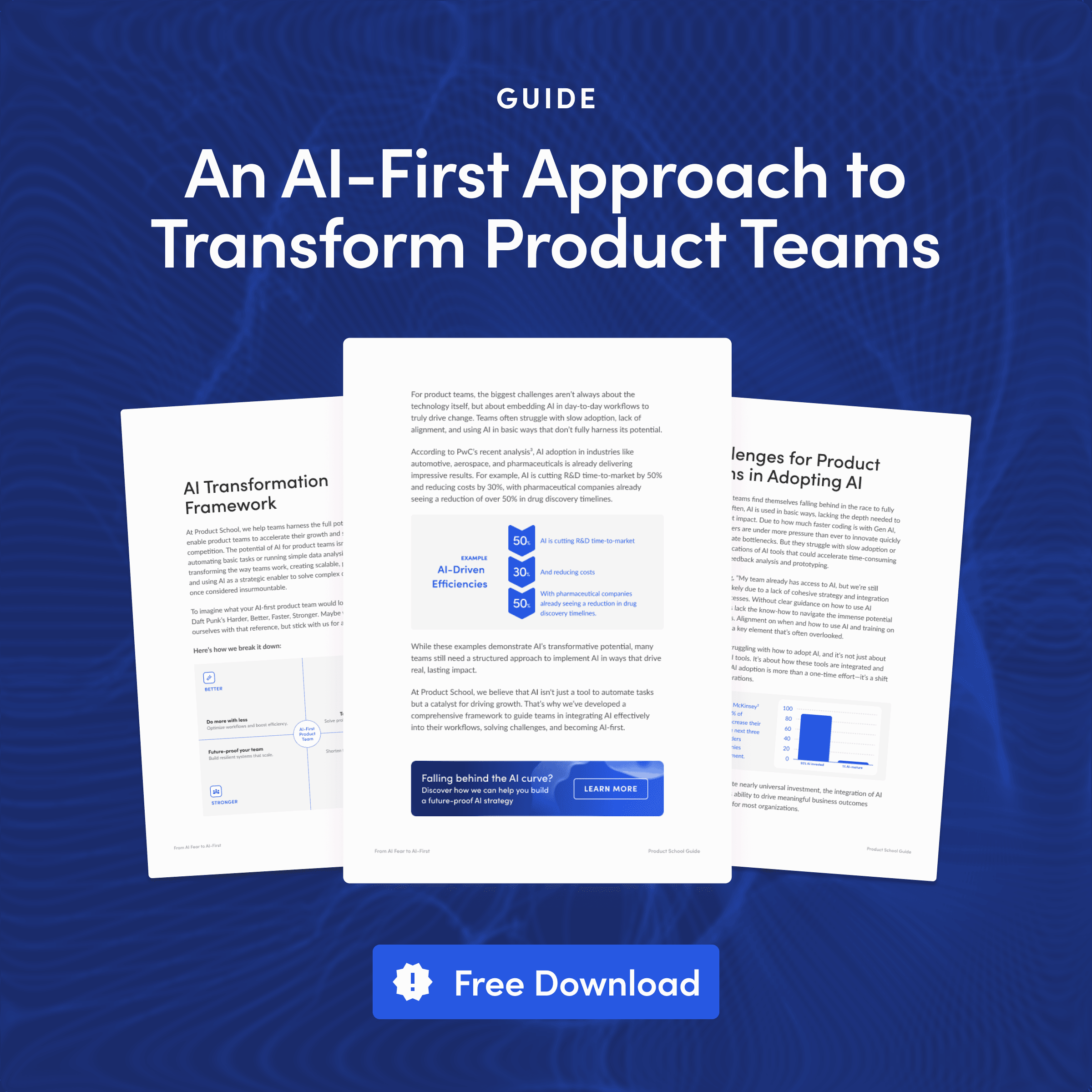
Updated: October 1, 2026