This article provides product managers with a practical framework for implementing Human-in-the-Loop (HITL) AI to ensure product quality and improve system reliability.
Workflow Design: Blend automation with human judgment through confidence thresholds and iterative feedback loops.
Risk Mitigation: Prevent pitfalls like automation bias and ethical errors by involving humans in high-stakes decisions.
PM Strategy: Prioritize establishing clear decision ownership and prototyping the human workflow alongside the AI model.
Artificial intelligence can work astonishing feats at lightning speed, but even the most advanced models have blind spots. That’s why human-in-the-loop (HITL) AI has become a cornerstone for product teams building AI-driven products.
This article will explore what human-in-the-loop AI really means for AI product managers, why it matters for maintaining high-quality and accountable AI systems, and how to design practical workflows that mix automation with human oversight. We’ll also look at common pitfalls of leaving AI to operate with no human guidance. The goal is a practical, accessible guide to HITL.
Level up on your AI knowledge
Based on insights from top Product Leaders from companies like Google, Grammarly, and Shopify, this guide ensures seamless AI adoption for sustainable growth.
Download Guide
What Is Human-in-the-Loop (HITL)?
Human-in-the-loop is an approach where humans actively participate in the AI orchestration pattern or decision-making multi-agent process. Instead of the AI running completely on autopilot, a person remains “in the loop” to review, input, or override decisions.
This human involvement can happen at various stages of an AI system, including:
Training and prototyping: Humans label data or shape the model’s development (for example, curating training data or refining prompts during AI prototyping).
Validation and testing: Humans evaluate AI outputs in test runs, catching errors or bias before full AI agent deployment (often called AI evaluations, essentially, humans grading the AI’s performance).
Real-time inference oversight: Humans review certain AI outputs in production, such as approving important decisions, handling exceptions, or being on standby to intervene if something looks wrong.
Rather than fully delegating decisions to an “AI agent,” the HITL approach embeds human judgment at key points to guide, review, and correct the AI. This is essential for cases where the AI may lack context, encounter ambiguous inputs, or where errors carry high consequences.
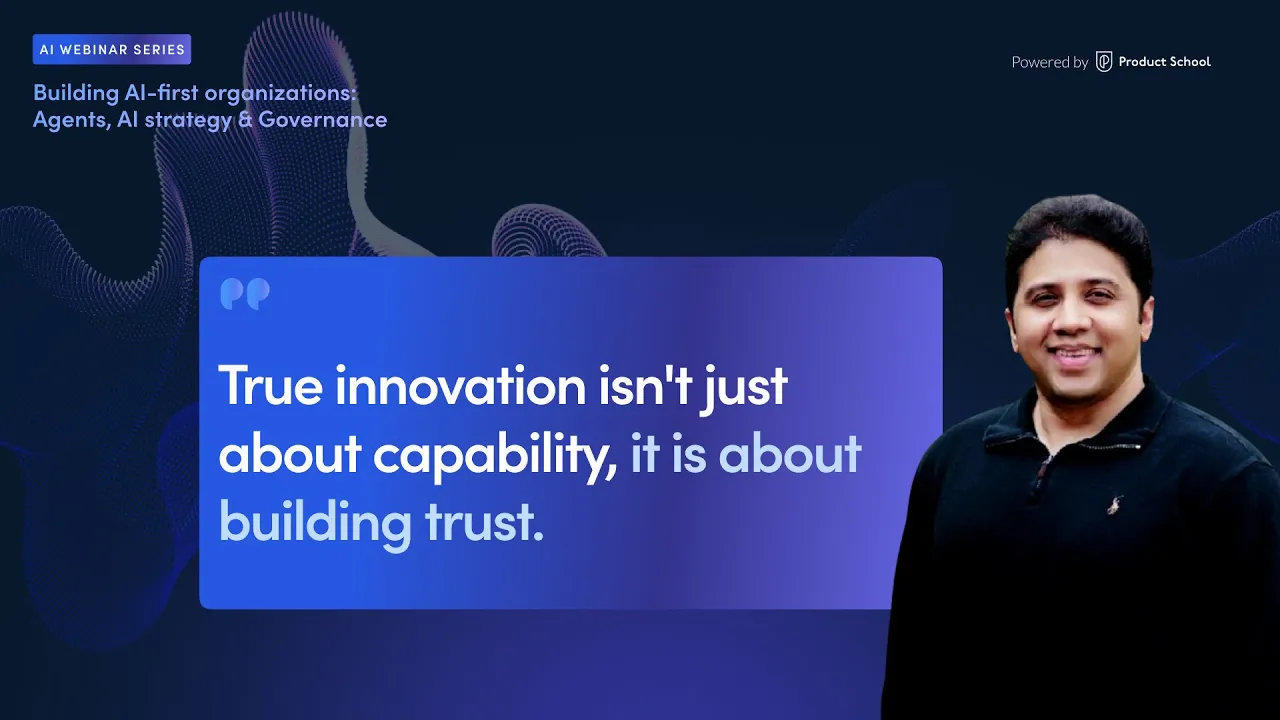
Murtaza Chowdhury, AI Product Leader at Amazon, described this shift well in Episode 2 of Product School’s AI series:
The output wasn't perfect, but it was 80% complete before a single developer even wrote a line. That's the shift. Humans moving from doing the heavy lifting to guiding and validating what AI produces.
In a human-in-the-loop approach, “the human” (usually an AI product manager) ultimately retains control.
Why Human-in-the-Loop Matters for Product Teams
AI can accelerate workflows dramatically, but it still makes mistakes. Even advanced models struggle with ambiguity, domain context, and edge cases that fall outside their training data or RAG systems.
Human oversight closes these gaps and ensures the product remains reliable, fair, and accountable.
1. Improving accuracy and reliability with human-in-the-loop review
Automated systems can deliver almost-right answers that still need refinement. Humans catch these subtleties, correct errors, and return feedback into the loop so models improve over time.
In higher-stakes workflows, adding manual review or dual review on top of AI evaluation for sensitive decisions prevents failures from slipping into production.
2. Bias mitigation and ethical reasoning
Models inherit patterns from historical datasets, including problematic ones. Without oversight, those patterns can become discriminatory outcomes that hurt users and damage trust. This is an AI ethics issue.
People bring context, cultural understanding, and ethical judgment that AI simply cannot assume on its own.
3. Accountability, compliance, and auditability in HITL systems
When a human reviews or approves a decision, accountability doesn’t rest solely on the algorithm. This is non-negotiable in regulated industries where decisions must be explainable and traceable. HITL workflows produce documented audit trails that satisfy governance, internal reviews, and external compliance requirements.
4. Transparency and trust through visible oversight
Users trust AI products more when they are not treated as closed boxes. Human checkpoints create visibility into how decisions are made and ensure a person can intervene before outputs reach customers.
For many products, the perception that “someone is still watching the system” plays a meaningful role in building long-term trust with an AI business model.
5. Safety, risk management, and preventing irreversible errors
In domains where errors can lead to harm (healthcare, financial loss, critical infrastructure) humans serve as the safety layer that intervenes when the AI generates an unsafe recommendation. This makes HITL an operational risk-management tool, not just a product design choice.
The AI handles scale, the human handles irreversibility. Once again, Murtaza Chowdhury, summarized this mindset clearly:
We establish governance boards, human review loops, and escalation paths so someone always owns the decision even when AI assists in making it. Embedding responsibility from day one doesn't slow product innovation. It makes it sustainable. It builds trust.
Two Human-in-the-Loop Approach Design Essentials
Implementing HITL in a product workflow means thoughtfully combining automation with oversight.
The goal is to let the AI tools handle what it’s best at (volume, speed, pattern recognition) while inserting human judgment where it’s most needed. Here are practical ways to design effective human-in-the-loop workflows:
1. Combining AI automation with human oversight
Start by mapping out your AI-driven process and identifying points of uncertainty or risk. These are the stages where a human should be placed in the loop.
For example, if you have an AI model making content moderation decisions, you might allow the AI to automatically remove obvious spam, but have human moderators review borderline cases before any final removal. Or in a recommendation system, the AI could generate suggestions which a human editor then approves for quality and brand fit.
A common strategy is to use confidence thresholds. If the AI is very confident (and it’s a low-risk task), it can act autonomously. But if its confidence is low or the situation is unusual, route the output for human review.
Many teams design pipelines where only the tricky cases or low-confidence predictions go to humans, which keeps things efficient. This way, humans focus on where they add the most value which includes handling exceptions, refining edge cases, and providing feedback for improvement.
It’s also crucial to give humans easy tools to perform their oversight role. For instance, a dashboard can highlight AI-generated outputs that need approval, with clear options to accept, edit, or reject them. Logging and notification systems should be in place so that if an AI action is overridden, it’s recorded (for learning and accountability) and the team is alerted if something consistently needs intervention.
By explicitly defining which decisions the AI can make solo and which require human sign-off, you create a workflow that blends autonomy with oversight.
2. Building feedback loops for continuous improvement
Designing a HITL workflow isn’t a one-and-done task. It requires setting up feedback loops so the system keeps getting better. Every time a human in the loop corrects the AI or provides additional input, that information should be used to refine the model or its outputs going forward.
For instance, if your moderation AI keeps flagging a certain slang word as hate speech but your human moderators repeatedly mark it as harmless in context, that feedback can be used to update the AI’s rules or training data.
Over time, the AI will make fewer mistakes, and the humans can gradually scale back their involvement to only the truly hard cases. In effect, you are training the AI with human-in-the-loop reinforcement. Techniques like reinforcement learning from human feedback (RLHF) are formal ways to do this in AI development, but even outside of ML training, a simple loop of “AI suggests → human corrects → AI updates” works wonders.
Product teams should facilitate this by capturing the human’s input every time they intervene. Teams should make it easy for the human to flag “why” they adjusted something (was the AI’s output factually wrong, off-brand, too risky?) Those annotations are extremely valuable.
Data product managers or product analysts can review them to tweak the model or add new decision rules. This continuous improvement cycle is where the true power of HITL emerges: humans and AI improving each other’s performance iteratively.
Also, plan for periodic AI evaluations with humans in the loop. For example, every new version of your model could be tested by humans on a sample of tasks to see how it’s performing (before you fully trust it live).
This proactive approach catches issues early. It’s analogous to a pilot taking a new airplane through test flights. You wouldn’t let a fully automated system fly passengers without a human test phase.
Best Practices for Building a Human-in-the-Loop Approach
Human-in-the-loop only works when it is designed, staffed, and measured like a real product system. These best practices help you avoid “HITL theater,” where humans exist on paper but do not actually improve outcomes.
1. Design HITL from day one
Retrofitting human oversight later is painful because your data, UI, logging, and ownership are already set. When you design HITL upfront, you can define what gets reviewed, what gets auto-approved, and what gets escalated before users feel the impact.
Treat “human review” like a core feature with clear requirements. Write it into user stories and acceptance criteria the same way you would for user onboarding or billing.
A simple way to start:
Define which decisions are reversible vs irreversible.
Decide what the AI is allowed to do without approval.
Specify what evidence the reviewer must see to approve an output.
Build the logging you will need for audits and iteration.
This is the shift Murtaza Chowdhury, AI Product Leader at Amazon, described perfectly:
Humans moving from doing the heavy lifting to guiding and validating what AI produces.
2. Establish clear governance and ownership in the human-in-the-loop workflow
If no one owns the decision, the AI owns it by default. That is how risk silently enters production. Governance is not a committee meeting. It is clarity on who can approve, who can override, and what happens when the system is uncertain.
Assign a decision owner per workflow. In many products, this is a rotating on-call reviewer pool with a clear escalation path to a domain lead.
What “clear ownership” looks like in practice:
A named role that approves or rejects outputs for each high-risk workflow (usually an AI PM).
A documented escalation path for ambiguous cases.
A definition of what “approved” means and what evidence is required.
A post-incident process that updates policies, not just model prompts.
Use governance boards when decisions cross teams, regulations, or customer impact thresholds. Keep the board focused on rules and guardrails, not individual approvals.
3. Train and support the humans in the loop
Humans in the loop are not a generic QA function. They need to understand the model’s strengths, its failure modes, and what good decisions look like in your product context. If reviewers are guessing, you will get inconsistent outcomes and slow feedback loop cycles.
Give reviewers short rubrics with examples. Avoid abstract principles like “be fair” and replace them with concrete “approve if” and “reject if” guidance.
To make review high quality and sustainable:
Provide a reviewer playbook with real examples and edge cases.
Standardize reason codes so feedback becomes usable training data.
Calibrate reviewers with quick weekly alignment sessions on tricky cases.
Watch for reviewer fatigue and reduce cognitive load in the UI.
This is also where your AI evaluations become real. Review decisions should feed evaluation sets so you can measure whether changes improve accuracy, safety, and consistency.
4. Use HITL selectively so it scales
Putting a human on every output defeats the point of automation. The goal is selective oversight where humans spend time on decisions that are uncertain, high-impact, or sensitive. Everything else should flow with minimal friction.
A practical pattern is risk-based routing. The AI handles low-risk, high-confidence cases, while the system routes low-confidence or high-stakes cases to humans.
Ways to scale without losing quality:
Set confidence thresholds and tune them with real review data.
Route by impact, such as account bans, claims denial, or compliance actions.
Use sampling audits for auto-approved cases to detect silent failures.
Add a “manual only” switch for incidents and model regressions.
This is also how to use AI agents responsibly. Let agents draft, summarize evidence, and propose actions. Keep execution behind human approval for anything with meaningful downside.
5. Continuously monitor and improve the loop
HITL is not static. Your model will drift, your policy will evolve, and user behavior will surprise you. Monitoring tells you whether the loop is actually improving outcomes or just adding latency.
Track evaluation metrics that reflect both model quality and review health. A system that looks accurate but causes reviewer overload will still fail in production.
High-signal metrics for product teams:
Override rate by category and by model version.
Time-to-review and queue backlog.
Agreement between reviewers on the same type of case.
Escalation frequency and reasons.
Downstream incidents tied to missed reviews.
Use these AI evaluation metrics to decide where to increase automation and where to tighten oversight. Then run AI evaluations before and after changes so you can prove impact.
6. Document and communicate the HITL design
If you cannot explain your oversight model, you cannot defend it. Documentation is what turns “we have humans in the loop” into a system you can audit, improve, and trust. It also helps stakeholders understand where accountability lives.
Document the workflow in plain terms. Include what triggers review, who approves, what evidence is shown, and how decisions are logged.
What to document so it stays useful:
Decision policies and routing rules.
Reviewer guidelines and reason codes.
Escalation paths and incident procedures.
Data sources, model limitations, and known failure modes.
Model and policy change logs tied to evaluation results.
This connects directly to what Murtaza Chowdhury shared when he said:
Model intent, data sources, and limitations so that teams and customers can see the process inside rather than treat AI as a closed box and accountability ties it all together.
7. Validate HITL workflows during AI prototyping before you scale
Most teams prototype the model but forget to prototype the human workflow. The result is a system that performs well in demos and fails in production because the review experience is slow, confusing, or inconsistent. Prototype the loop early, not just the output.
In AI prototyping, simulate real traffic and real edge cases. Test how reviewers handle ambiguous outputs, what evidence they need, and how often they disagree.
A practical prototyping checklist:
Run a small pilot with real reviewers and real tasks.
Build a lightweight evaluation set from pilot cases.
Stress-test with adversarial prompts and edge inputs.
Measure review time and decision consistency.
Decide what becomes automated only after evaluation results hold.
This is where AI evaluations pay off as a product discipline. You are evaluating the system of AI plus humans that your customers will actually experience.
Common Pitfalls When Removing Humans from the Loop
What can go wrong if you decide to “let the AI handle it” and remove humans from the process? Quite a lot. Over-automating without oversight can lead to serious issues:
Embedded bias at scale
AI quietly amplifies biased patterns in data when no one is checking outputs. Without a human in the loop, unfair decisions can spread across thousands of users before anyone notices.Automation bias and blind trust
Product teams start assuming “the system is always right” and stop challenging results. Problems only surface when a major failure forces everyone to ask who was actually responsible.Quality drift and silent degradation
Models that are never reviewed slowly drift away from real-world needs. Users just experience answers that feel off, and trust erodes without a single obvious incident.No context, no common sense
AI makes decisions based only on patterns, not lived reality. Without a human to inject context, you get technically plausible but practically absurd outcomes.Regulatory and legal exposure
Some decisions legally require human review or an appeal path. Fully automated multi-agent systems can violate regulations and expose the company to fines, lawsuits, and reputational damage.Opaque decisions and weak audit trails
If no one reviews or explains AI outputs, you end up with decisions you cannot justify later. That makes post-mortems, audits, and user complaints hard to resolve.Overconfidence in immature systems
Teams move from an AI prototype to production without adding human checkpoints. The result is shipping an “experimental” model as if it were robust, with no guardrails when it fails in the wild.
When and Where to Keep the Human in the Loop
Knowing you need human oversight is one thing; knowing where to put it is another. Not every single micro-decision needs a person watching. Otherwise, AI would bring no efficiency.
The art of HITL in product management is determining when and where human oversight is most critical. Here are some guidelines:
High-risk or safety-critical decisions
Use HITL when mistakes could cause real harm. Humans act as the final decision layer for scenarios like medical triage, financial risk, or autonomous control.Regulated domains and compliance checkpoints
Certain decisions legally require human review or appeal paths. HITL helps teams satisfy auditability, fairness, and documentation standards.Ethical and value-sensitive judgments
Models may produce outputs that are technically correct but socially or ethically off. Humans inject nuance, cultural context, and brand alignment.Edge cases and novel situations
Models struggle with inputs they haven’t seen before. Route low-confidence or out-of-distribution cases to human review before committing to an action.Early-stage deployment and prototyping
New models should be tested with human review before full autonomy. Reduce human intervention only after the system demonstrates consistent performance in the wild.User-facing decisions that require explanation
If customers or stakeholders may ask “why?”, keep a human in the decision loop. This ensures transparency, recourse, and accountability instead of opaque denials.
A Scalable Human-in-the-Loop Approach
Human-in-the-loop (HITL) AI is a strategic architecture, not a temporary safety blanket. This guide explored how product teams leverage HITL to maintain quality, safety, and accountability. By designing workflows with confidence thresholds and feedback loops, teams can iteratively refine models while preventing pitfalls like automation bias and quality drift.
Success requires treating human review as a core feature:
establishing clear governance
prototyping workflows early
focusing oversight on high-risk decisions
Ultimately, embedding human judgment allows AI to earn autonomy over time, enabling you to ship faster and scale without gambling user trust.
A CEO's Field Guide to AI Transformation
Research shows most AI transformations fail, but yours doesn’t have to. Learn from Product School’s own journey and apply the takeaways via a powerful framework for scaling AI across teams to boost efficiency, drive adoption, and maximize ROI.
Download Playbook
Updated: February 23, 2026