AI product management careers are being built under a job title that currently describes at least four different jobs. Each has a different scope, a different skill bar, and a pay gap between them that runs past $150,000 a year.
The demand signal is real. LinkedIn's 2026 Labor Market Report found that only about 3% of US members list AI skills at all, with adoption concentrated in a few functions: Engineering at 10%, Product Management at 10%, Research at 8%.
For the foundational definition, start with our AI product manager guide. This piece picks up elsewhere: the titles you will actually see, what each pays, how the ladder works, how people really get in, and whether the label survives the next two years.
Key Takeaways
AI product management is not a one-track. 2026 recruiting data shows the title covering four distinct roles: customer-facing copilot PM, internal AI platform PM, embedded ML feature PM, and AI operations PM.
Pay follows scope, not the title. Roles owning real model and evaluation work command a large premium; bolt-on AI feature work pays close to a standard product management salary.
Published salary averages disagree by roughly $65,000, because each source samples a different mix of those four jobs under one search term.
The ladder runs from associate PM to AI PM, senior, staff or principal, then director or VP of Product, typically across eight to twelve years.
Evaluation fluency, meaning the ability to read a model evaluation and decide whether it is good enough to ship, is the most consistently named gate between managing an AI feature and owning an AI product.
There is no dominant entry route. Classic product management is still the most common door, followed by data science, engineering, and founder backgrounds.
Certificates alone do not move hiring managers. Shipped AI work does.
The title itself may not last. Earlier product specialisms dissolved back into general product management once the underlying skill became standard.
What Job Titles Actually Fall Under AI Product Management?
At least four, and they are not interchangeable.
The clearest breakdown I have seen comes from 2026 AI product manager hiring guide by senior recruiter Mike Carter. He runs product and AI hires across more than 30 US metros. His argument is that the phrase compresses four working roles into one req. The most stalled searches happen because the job description borrows bullets from three of them at once.
That framing is worth borrowing for your own career, not just for hiring.
Archetype | What they actually own | Base comp, mid-level | Base comp, senior |
Copilot or assistant PM (customer-facing) | The chat surface or in-product copilot: latency targets, the eval set, guardrails, prompt iteration, and the response when the model gets something wrong in public | $175K–$245K | $260K–$360K |
AI platform PM (internal) | The model gateway, feature store, eval harness, and inference budget, with internal engineering and data science as the customer | $185K–$250K | $270K–$380K |
ML feature PM (embedded) | Model-powered features inside a mostly classical product: recommendations, ranking, summarization, smart defaults | $155K–$215K | $230K–$310K |
AI ops and internal tools PM | Rolling AI into go-to-market, support, operations, or finance, for internal users only | $140K–$200K | $215K–$285K |
The copilot seat is the one most companies think they want, and the one that punishes an unprepared organization hardest. A customer-facing AI-native surface needs an eval set, a guardrail layer, and an incident path before it needs a PM. The embedded ML feature seat is the unglamorous one, and by Carter's account the one that ships the most measurable revenue at roughly thirty percent less cost.
Beyond those four, the vocabulary keeps sprawling: AI/ML Product Manager, AI Builder, Applied AI Product Manager, Data Product Manager, AI Product Owner, and variants like Computer Vision PM or NLP PM.
There is also a naming pattern worth recognizing. Many companies append the surface to the base title.
At the time of writing, Netflix has listed an "AI Product Manager, Catalog and Content Understanding," Anthropic a "Research Product Manager, Model Behaviors," and Scale a "Staff Product Manager, Agentic Platform" in the $238K–$297K range.
The archetype is in the suffix, not the prefix. Read the suffix.
AI product manager vs. data product manager vs. AI product owner
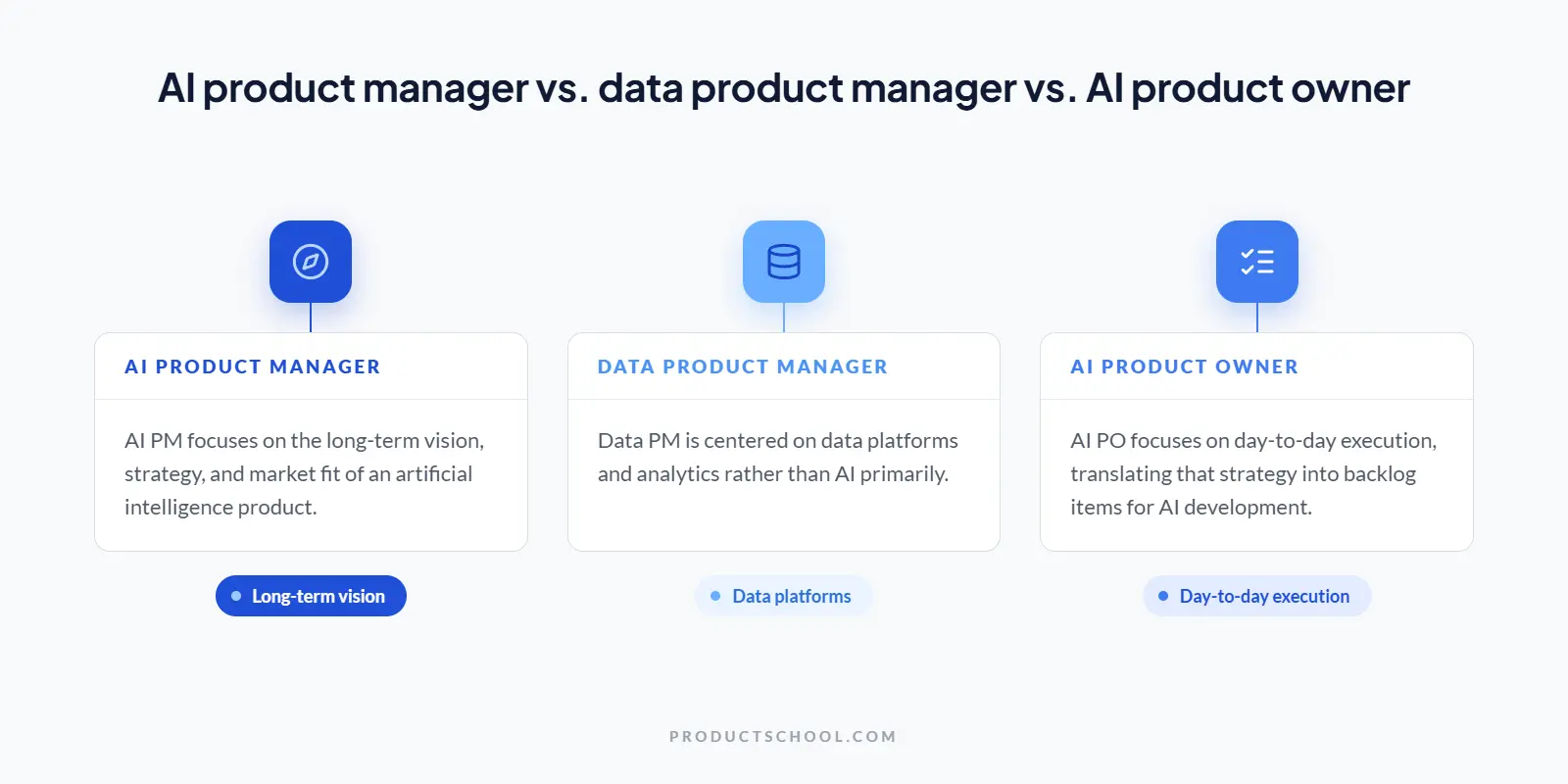
(1) AI Product Manager and ML Product Manager are largely interchangeable. Where companies distinguish them, ML PM signals deeper model lifecycle ownership, including training data and retraining. AI PM can cover any AI-powered product, including one built entirely on a third-party model.
(2) Data Product Manager is adjacent but different, centered on data platforms and analytics rather than AI features. It overlaps mainly when the product's value comes from the data layer itself.
(3) AI Product Owner is the one to watch. It has grown quickly in enterprise postings and sits closer to the delivery team and deployment pipeline. It appears far more often at large enterprises rolling out internal AI product workflows than at AI-native startups.
That distinction is my read of posting patterns rather than a figure from a named study, so check it against the job in front of you.
Will the "AI Product Manager" Title Actually Stick?
Nobody knows and anyone who says otherwise is selling something. But the argument matters before you rebuild your LinkedIn headline around it.
The skeptical case has a history behind it. Product management has run this cycle with Mobile PM, Web3 PM, Crypto PM, Growth PM, Data PM, and Gamification PM. Each had a specialist moment, then folded back into "product management" once the tooling became baseline.
AI PM seems to follow the same arc within about two years. The better question is whether the role you are offered is a durable AI product seat or a temporary title that’s about to dissolve. That is a fair challenge, and it lines up with something I have said before: the title matters less than the skillset behind it.
So here is where I land. The label is provisional. The skill premium underneath it is not. Optimize for the capability, stay relaxed about the noun, and read every posting for scope. For the longer version of where the profession is heading, see our piece on whether AI will replace product managers.
How Much Do AI Product Management Careers Actually Pay?
Between roughly $132,000 and $305,000, depending on which source you read.
Published averages disagree by about $65,000 for the same title. Those are the four archetypes showing up in the compensation data because each platform samples a different mix of them.
Source | What it measures | Typical or average | Reported range |
Glassdoor (2026) | Self-reported base, "AI Product Manager" | ~$198K | $164K–$243K (25th–75th percentile) |
Glassdoor (2026) | Senior Product Manager, AI | ~$227K | $182K–$290K |
KORE1 salary guide (2026) | Recruiter-benchmarked base, all levels | $150K–$230K | $250K–$550K total comp, senior |
ZipRecruiter (Aug 2026) | Aggregated postings and self-report | ~$159K | $141K–$197K (25th–75th percentile) |
Salary.com (2026) | Compensation survey model | ~$132K | $114K–$154K |
6figr (2026) | Self-reported total comp, all levels | $305K median | $244K–$390K |
US figures. For the broader pay picture across levels and cities, see our guide to product management salaries in today's economy.
The split that explains the numbers
Applied AI product work, meaning bolt-on features on top of a third-party model, runs roughly $120,000 to $160,000 base and $140,000 to $210,000 total. Core AI product work, meaning roles owning real model behavior and AI evaluation, reaches $320,000 to $520,000 total at senior level, against roughly $280,000 for a senior PM on a non-AI product.
Applied work corresponds to the embedded and internal tools seats. Core work corresponds to the copilot and platform seats.
The premium is conditional
First off, a premium is the extra amount a role pays compared to an equivalent role without that specialization — expressed as a percentage.
Quoted premiums for AI product roles run anywhere from 10% to 40% over a comparable senior PM, depending on who is measuring. The spread is wide because most of those figures are averages across the four archetypes above, and the premium is not evenly distributed among them.
The condition is what matters. Recruiter compensation benchmarks from 2026 put the realistic premium in the 10% to 25% band, but only for roles that own real model behavior and evaluation. Where the work is a language model bolted onto an existing feature, the gap against a standard senior PM salary closes to almost nothing.
Adding "AI" to your title does not add the premium. Owning the model decision adds the premium.
That is the reasoning behind how we built the AI track. The AI Product Management Certification covers the requirements work the higher band is actually paying for, AI Evals cover the essential evaluation; Vibe Coding gets you to a shipped product you can point at, and Agentic Workflows and Loops go deeper on the agent systems that increasingly define the copilot and platform seats.
Geography moves the number less than it used to
San Francisco and San Jose lead at roughly $360,000 median total compensation, New York around $342,000, Seattle around $336,000, per KORE1's 2026 read. Texas metros sit 15% to 20% below the top.
The wrinkle is remote. Roles at AI-native companies tend to price near the Bay Area band rather than the local market.
The AI Product Management Career Ladder
The career ladder runs from associate PM to AI PM, then senior, staff, or principal, and on to director or VP, typically across eight to twelve years.
Stage | Typical years in PM | What you own | What gets you to the next rung |
Associate PM | 0–2 | One feature or surface, with a senior PM watching | Ship something users keep, and learn the eval loop secondhand |
AI Product Manager | 3–5 | An ML-backed product area, the eval set, the vendor calls | Kill a feature that demoed well and failed in production, and explain why |
Senior AI PM | 6–9 | A full product line and the bar for "good enough to ship" | Set strategy others execute, and mentor PMs who outgrow you |
Staff or Principal AI PM | 10+ | Cross-product AI strategy and org-wide quality definition | Move outcomes without owning the teams, and pick the right bets early |
Director or VP of Product | 12+ | Product orgs, headcount, and a number the CEO repeats to the board | Hire and keep people better than you |
The rung where careers split is the third to fifth year. That is where you stop managing a roadmap around an AI feature and start owning the judgment call on the model itself.
The ‘Usual’ Career Ladder Is Not the Only Way Up
That table describes progression once you are inside product management. So, what if you’re not in the product management?
Realistically, there is no conventional front door to AI product management. Nowadays, a few enter at the bottom and ride the rungs up, because there is no meaningful volume of entry-level AI PM hiring. The seat assumes you already learned the product, or something adjacent, somewhere else.
The people in these roles arrived sideways: a PM who happened to ship a recommendation feature, a data scientist tired of handing models to someone else, an engineer who kept getting pulled into scoping conversations.
That matters right now because companies are hiring for AI capability immediately rather than growing it internally over eight years. When the constraint is urgent, an associate PM is often not the most competitive candidate for the work, and the alternatives are not junior.
Software engineers are the strongest alternative path
They arrive with the technical skillset the role is scoped around. They can read a pull request, sit in a model design review, and argue a latency budget without bluffing.
What they build on the way in is prioritization frameworks, stakeholder judgment, and the discipline of saying no to former teammates. The missing muscle is product judgment rather than technical depth.
Our guide to what a product manager actually does is a reasonable orientation point, and the Product Management Foundations Certification covers the base layer directly.
Product Management Foundations Certification
Use the most popular certification to learn the core skills, mindset, and tools to become a great Product Manager in the age of AI, and ship products people actually use.
Enroll now
Data scientists and ML engineers come in from the other side
They know the model cold and the customer less so. The humbling part is usually watching a real user ignore a feature they were proud of. What converts them fastest is moving from evaluating models in isolation to evaluating them as products. This is the same judgment the AI Evals Certification is built around.
Designers and founders are the two routes people underestimate
Designers already own the trust, fallback, and interaction problems that AI features live or die on. Founders and operators who have shipped under real pressure often skip the bottom two rungs entirely because they have already made the call to kill something that was not working.
Both benefit most from closing the technical gap fast, which is what Vibe Coding and Claude Code for Product Managers are designed to do.
The through-line is that all four routes converge on the same competence rather than the same résumé. Engineers add product judgment. Data scientists add customer judgment. Designers add technical fluency. PMs add the model layer. That convergence is a broader shift than any one title, and we unpacked it in our piece on what an AI builder is.
So read the ladder as a leveling guide, not a route map. It tells you what each rung owns and what earns the next one. It does not tell you where to get on.
Claude Code for Product Managers
Claude Code is already changing how the best PMs work — at Stripe, Linear, and the fastest-moving teams in tech. Use the AI tool reshaping product work to prototype, analyze, and ship, before a ticket is written.
ENROLL NOW
Evaluation fluency is the actual gate
Can you read an offline test set and an online metric and say, with real reasons, whether the model is ready?
That question separates a PM who manages an AI feature from one who owns an AI product. You do not need to build the eval harness. You need to read it and hold an opinion that survives a research scientist pushing back.
The organizational version of the same judgment call is visible in McKinsey's State of AI 2025 report, published November 2025. It found 88% of organizations now report regular AI use in at least one business function, up from 78% a year earlier, but only about one-third have begun scaling AI across the enterprise, and only around 6% qualify as high performers attributing more than 5% of EBIT to AI. Almost everyone has a pilot. Almost nobody has a product.
The people who close that gap can tell a demo from something that holds up in production. To build that muscle, start with our guide to AI evals for product managers and go deeper with the AI Evals Certification.
Where the path stalls
The applied-only ceiling: you get good at bolting a language model onto an existing product, never learn to own the model or the evaluation, and hit the lower of the two pay grades above. A fine choice made deliberately, an expensive one made by accident.
Title inflation: a seed-stage company hands you "Head of AI Product" because you were employee number three and owned the chatbot. The title stops meaning anything at the next company, because there was no ladder underneath it.
The eval wall: you ride the roadmap and stakeholder skills to senior, then hit the first room where someone asks you to defend a model decision on the merits. If you spent years routing around that conversation, the wall does not move.
How Do You Break Into an AI Product Management Career?
There is no front door. There are about five side doors, and the one you walk through shapes what you will be strong at and what you will learn in public.
From classic product management: the most common route by a wide margin. What is missing is the model layer, and the people who close that gap fastest stop treating the data scientist as a vendor and start sitting in evaluation reviews.
From data science or ML engineering: you know the model cold and the customer less so. The curve is prioritization, stakeholder work, and watching a real user ignore something you were proud of.
From software engineering or design: strong systems instincts, weaker on prioritization and organizational politics. Real, but slower.
From founder or operator backgrounds: people who have shipped under real pressure often skip the bottom two rungs.
From bootcamps and certificates alone: the weakest signal of the five, and worth being honest about why.
Frankly, candidates with a recent AI PM certificate and no shipped AI product read as motivated rather than qualified. Don’t get me wrong, the conclusion is not that structured learning is worthless. It is that the learning has to produce an artifact.
That is the design principle behind our AI track. The AI Product Management Certification is the foundation layer, covering AI-native user experience, AI-specific PRDs, RAG architecture, agentic workflows, and evaluation frameworks.
The Vibe Coding Certification, built with Dejan, Group Product Manager at Spotify, in partnership with Lovable, gets you to a deployed product on a live URL, because that artifact is what a hiring manager responds to. Earlier in the journey, the Product Management Foundations Certification comes first, because AI only creates leverage once you know how to manage a product.
There is a broader version of this shift that goes past any single title. I described it at ProductCon London as the convergence of product, design, and engineering into what is increasingly called a builder. We unpacked the skill stack in our piece on what an AI builder is.
Two numbers are worth repeating here. PwC's 2025 Global AI Jobs Barometer found workers with AI skills earning a 56% wage premium over peers in the same roles. Microsoft and LinkedIn's Work Trend Index found that 66% of leaders said they would not hire someone without AI skills.
How to Read Any AI PM Job Posting
Flip the hiring manager's checklist around, and it becomes a candidate's decoder.
Which surface does it name? A real seat names the literal product surface. "Owns the in-app assistant, including the eval set and the latency target" is a job. "Drives AI strategy" is a wish.
Who is the user? Customers, internal engineers, or an internal operations team. That single answer tells you which archetype you are looking at, and which pay band applies.
Does the word "eval" appear anywhere? Its absence in a supposedly senior AI role usually means the company has not built the thing yet, and year one will be infrastructure work you did not sign up for.
Are there concrete year-one outcomes? Real numbers on latency, quality thresholds, or launches beat "transform the business with AI" every time.
Is a compensation band published? Given how wide the ranges are here, a missing band says something about how well-scoped the role is.
Does it borrow bullets from more than one archetype? That usually means the role has not been scoped, and you will absorb the ambiguity.
Updated: October 12, 2026