This guide details how AI converts traditional product management workflows into adaptive systems by reducing busywork and sharpening strategic insights.
Workflow Defined: A workflow is the repeatable "operating system" a team uses to turn inputs into decisions and work through specific tools and rituals.
AI Impact: AI simplifies research, augments human judgment with data patterns, and automates repetitive tasks to accelerate development cycles.
Best Practices: Focus on accelerating work around key decision points while using RAG to ensure AI outputs are grounded in internal data.
Not long ago, the product management process was a chain of handoffs held together by meetings, spreadsheets, and patience. The workflow was simply the habits and tools teams used to push work through that process.
This article zooms in on the workflow in the AI era: the day-to-day system inside that process, and how AI is turning it into something faster, more connected, and more adaptive.
Product Prioritization Micro-Certification (PPC)™️
This free course introduces three essential frameworks and shows you how to apply them to real-world scenarios.
Enroll for free
What Is Product Management Workflow?
A product management workflow is the repeatable way your team executes the product management process. It’s your operating system: how inputs become decisions, how decisions become work, and how learning feeds the next cycle using specific tools, templates, rituals, and ownership.
A product management process is essentially the roadmap of activities that take a product from concept to reality. It’s a structured sequence of steps ensuring that each decision (from understanding customer needs to product prioritization) aligns with the product goals and delivers value to users.
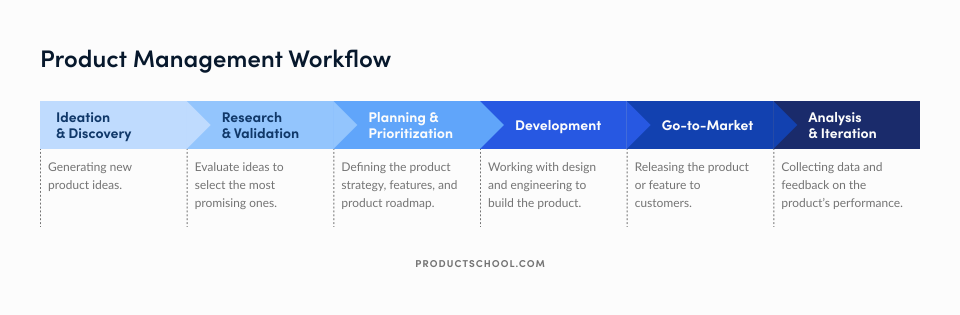
While every product-led organization’s process may vary, most product workflows are embedded in a similar set of stages that integrate into the broader product development lifecycle:
Ideation & Discovery: Generating new product ideas and identifying user problems worth solving. This often involves brainstorming, user research, and collecting customer feedback as raw material for potential solutions.
Market Research & Validation: Evaluating and refining ideas. Product teams analyze market trends, talk to users, and validate assumptions via experiments to ensure there’s real demand and a viable opportunity.
Planning & Prioritization: Defining the product strategy, features, and product roadmap. This includes writing product requirements (PRDs), setting success metrics, and prioritizing what to build first so that development aligns with business goals.
Development & Execution: Working with design and engineering to build the product. Agile practices (sprints, iterations) are commonly used to develop features, with product managers ensuring the work stays on track and meets user needs.
Launch & Go-to-Market: Releasing the product or feature to customers. PMs coordinate with marketing, sales, and support to ensure a smooth product launch, communicate value to users, and monitor initial product adoption.
Post-Launch Analysis & Iteration: Collecting data and feedback on the product’s performance. The team measures against OKRs, listens to user feedback, and iterates: fixing issues or adding improvements. This feeds back into the next cycle of ideas and enhancements.
A well-orchestrated product management workflow is ingrained in everything from idea generation to post-launch optimization, looping continuously as the product evolves.
The key is that every stage is customer-centric and data-informed. Ideas come from user needs, plans tie to strategic objectives, and outcomes are measured to inform future decisions. With this foundation in place, AI-native product teams can reduce risks and adapt quickly to change while keeping everyone aligned.

How AI is Changing Product Management Workflows
New technologies are redefining how AI product managers execute their workflow. From AI tools that draft documents to intelligent agents that perform research, these technologies are reshaping daily PM work.
Instead of changing the high-level stages of product management, AI is changing how fast and how well teams move through them.
We’re noticing how many product leaders describe AI’s impact in three major themes: simplification, augmentation, and automation.
As Karen Ng, SVP of Product at HubSpot, explained on The Product Podcast:
For us, it’s really three key components. One is simplification. Number two is all about augmentation. The third theme is really on automation. What can we do automatically?
In practice, this means AI can take over the busywork, enhance a PM’s capabilities with insights, and even handle entire tasks on its own. Let’s break down these themes and see how AI integrates into each part of the product management workflow.
Simplifying tedious product management tasks with AI
One of the most immediate ways AI improves the product management workflow is by removing friction. Product managers spend a surprising amount of time searching for information, preparing data, and summarizing inputs before any real decision-making happens. AI changes that by acting as a fast, always-on research and synthesis layer.
Instead of digging through dashboards, docs, and feedback tools, AI PMs can ask AI direct questions and get usable answers grounded in their own data. Techniques like retrieval-augmented generation (RAG) let AI pull from internal knowledge bases, product analytics tools, and documentation, so outputs reflect current reality, not generic training data.
In practice, AI simplifies work across a few common areas:
Finding answers quickly by pulling metrics, insights, or customer signals from multiple sources at once
Summarizing large volumes of feedback, interviews, or documents into clear themes
Handling lightweight admin work like meeting scheduling, status updates, or workflow hygiene
The impact is less about doing new things and more about doing fewer manual ones. When AI takes care of prep work and synthesis, product managers spend more time on judgment, trade-offs, and direction.
This is the true statement on the emerging question of whether AI will replace product managers. As Dave Bottoms, GM and VP of Product at Upwork, noted on The Product Podcast:
I think we're interestingly a long way from AI replacing people, but AI doing 50, 60, 70% of the work and then the people coming in to refine, customize, augment what exists. You're getting a work product much more quickly and efficiently.
That’s the real win: less cognitive load, more strategic focus, and a workflow that moves faster without feeling rushed.
Augmenting human insight and creativity for product manager workflow
This is where AI gets interesting. Not because it “does the job,” but because it makes a good AI-powered PM faster, sharper, and more consistent. Think of it as a co-pilot: it generates options, does first-pass analysis, and helps you see patterns, then you bring the judgment.
AI tends to augment PM work in three ways:
Idea generation that gives you more starting points, faster
Decision support that turns messy data into clearer trade-offs
User understanding that helps you summarize sentiment and spot themes at scale
On ideation (1), AI is great at producing a wide set of angles quickly. The win is not the ideas themselves. The win is that you can explore more solution space in less time, then apply your product taste and strategy to filter what matters.
On decision-making (2), AI can compress the “analysis overhead.” It can compare options, highlight risks, suggest metrics, and surface weird signals in the data you might not notice during a busy week. It won’t know your constraints unless you give them, but it can dramatically speed up the thinking.
On user empathy (3), AI can synthesize large amounts of user text (support logs, surveys, reviews) and summarize what people are frustrated about, what they’re trying to do, and where the product breaks down emotionally. That doesn’t replace real research. It helps you walk into research with better hypotheses and a cleaner map of what to investigate.
That’s augmentation in one sentence: AI drafts and analyzes. PMs decide, refine, and ship.
Automating product management workflows and exploring AI agents
Automation is the third shift, and it’s the one that changes the shape of the workflow, not just the speed of it. Simplification removes friction. Augmentation makes you sharper. Automation is where AI starts doing chunks of work end-to-end.
There are two levels to think about.
First, basic automation: repeatable PM ops that shouldn’t require human attention every time. Second, agentic AI automation: AI that can plan, take steps, and adapt as it goes.
A simple way to picture what’s getting automated:
Workflow hygiene: updates, summaries, follow-ups, and moving work forward when conditions are met
Analysis loops: pulling data, spotting changes, drafting interpretations, and suggesting next actions
Cross-tool execution: taking a goal, coordinating across systems, and producing a deliverable
The leap comes with an AI agent deployment. Frank te Pas, Head of Product, Enterprise at Perplexity, said on The Product Podcast:
Agents are a very exciting development... AI is now able to do more complicated tasks and is almost setting up a plan and applying reasoning to complete more complex tasks.
This is why advanced AI agents sit at the core of how we teach AI product managers at Product School.
Si, instead of asking AI one question at a time, you give it a job. In product work, “a job” might look like competitor monitoring and change summaries, synthesizing user feedback into themes, or turning raw findings into a first draft of a PRD or launch brief.
The AI agent you build handles the steps, and the PM reviews, corrects, and makes the actual calls.
The practical rule here is simple. Automate anything that is repetitive and has a clear definition of done. Keep humans responsible for anything that involves product taste, trade-offs, risk, and narrative. That division is what lets you move faster without letting the workflow drift off strategy.
Advanced AI Agents Certification
Design and implement adaptive, multi-agent AI systems with memory, collaboration, and risk safeguards. Deploy production-ready AI agents at scale.
Enroll now
Best Practices for AI-Enhanced Product Workflows
Integrating AI into your product management workflow can be game-changing, but it requires a thoughtful approach. Here are some practical tips and best practices to help you refine and optimize your workflow in the AI era:
Design your workflow around “decision points.” Map the 6–10 decisions that truly move the product (what problem, which segment, what bet, what metric, what trade-off) and then use AI tool to accelerate everything around those decisions. If AI makes you faster but not clearer at decision time, it’s just busier output.
Treat AI outputs as drafts, not answers. Standardize a “first pass by AI, final pass by PM” habit for docs, analyses, and summaries. This is how you get speed without losing product judgment.
Ground generation with retrieval, not vibes. Use RAG-style patterns so the model is pulling from your own sources of truth (tickets, calls, dashboards, docs) before it writes anything. If the output can’t cite where it got the facts, assume it’s unreliable.
Create a single source of truth for context. Put the product narrative, constraints, user segments, success metrics, and current roadmap assumptions in one maintained place and point AI to it. AI is only as helpful as the context you consistently give it.
Instrument “trust” like a product metric. Track where AI helps and where it hurts using simple signals or evaluation metrics: edit distance, rework rate, time-to-decision, and post-launch regret. When trust drops, narrow the scope or add constraints instead of banning AI entirely.
Use agents for workflows with a clear “definition of done.” Agents work best when the task can be objectively completed: compile a competitor update brief, summarize weekly customer signals, prep an experiment readout. If the job needs taste, strategy, or politics, keep it human-led.
Build guardrails before you scale usage. Define what AI can’t do (final prioritization calls, external claims without sources, sensitive data handling) and enforce it with templates and checklists. This keeps adoption safe while still moving fast.
Make AI a cross-functional interface, not a PM toy. The biggest gains come when design, eng, and CS are using the same AI-enabled workflow conventions. These include shared summaries, shared decision logs, and shared retrieval sources. Otherwise, you get faster silos.
Optimize for cycles, not artifacts. Don’t celebrate “AI wrote the PRD.” Celebrate, “we reached a high-quality decision in half the time.” The workflow win is faster learning loops: discover → decide → ship → measure → iterate.
Invest in prompt hygiene and reusable playbooks. Capture the prompts and workflows that consistently produce value (research synthesis, roadmap narrative, experiment plans) and turn them into team standards. This is how you move from individual productivity hacks to durable team leverage.
Embracing the Future of AI-Driven Product Management
The product management workflow has always been about balancing the art and science of building great products. AI is boosting the “science” side, but it’s also giving product managers new tools to amplify the “art” of understanding users and crafting vision.
By simplifying drudgery, augmenting our insights, and automating execution, AI can free PMs to be more creative and strategic than ever.
However, success in this new era means proactively adapting. The most effective AI native teams will be those who embrace AI in full.
They will redesign their workflows to let machines do what they’re best at (handling scale, complexity, and repetition) and let humans do what they’re best at (providing empathy, strategic thinking, and nuanced judgment).
Product Roadmap Template
Download our easy-to-use template to help you create your Product Roadmap.
Get the Template
Updated: February 11, 2026