Most product portfolios are a mess of good intentions.
You've got the legacy cash cow no one wants to touch. The shiny new AI feature everyone's excited about and a roadmap that somehow needs to serve all of them.
Here's the thing. The old frameworks for portfolio decisions (the 2x2 matrices, the gut-feel prioritization, the annual planning theater) weren't built for the speed AI is moving at. The question isn't whether AI will change how you manage your portfolio. It already is. The question is whether you're using it or just talking about it.
In this article, we'll explore how AI is reshaping portfolio decisions, which tools actually work, and what product leaders need to rethink about how they evolve their product mix.
Playbook: The Dangers of Staying Safe
Check out insights from Mastercard Gateway CPO to help you battle cumbersome processes and become truly Agile.
GET THE PLAYBOOK
What Is Product Portfolio Optimization?
Product portfolio optimization is the ongoing discipline of choosing and re-choosing the right mix of products and bets (what to start, scale, sustain, fix, or sunset) so the portfolio delivers the most value under real-world constraints.
Think revenue, margin, customer impact, risk, capacity, and time. Is it maximizing profit, increasing customer satisfaction, reducing time to market, or something else? In practice, it means aligning every SKU, feature set, and outcome-based roadmap initiative to strategy. It means allocating people and budget where they realize outsized OKRs.
AI is not a strategy. It’s an awesome tool, but you cannot take a tool and make it into a strategy. The customer need is always the strategy.
– Inbal Shani, Twilio CPO
Lastly, it means managing lifecycles across horizons (now, next, later) so the whole portfolio compounds, not just individual products.
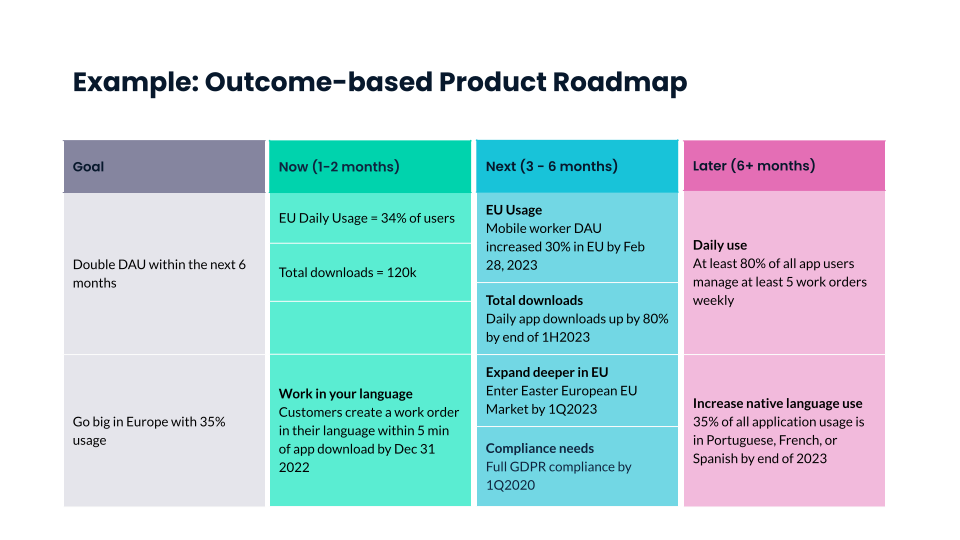
Context matters. Traditional portfolio work has been periodic and manual: spreadsheets, scorecards, expert debates, and a lot of “highest-paid opinion” energy. It works until complexity explodes.
AI tools are remodeling (pun intended) that playbook by making portfolio optimization continuous, data-rich, and testable. Predictive models surface where demand, margin, or risk will actually move next quarter. Graph and clustering techniques reveal hidden relationships across products and components, showing where variants add value and where they just add cost.
Generative AI takes all the messy data you already have (financial numbers, user behavior, sales notes, support logs, even competitor updates) and turns it into clear, connected stories. You can ask it questions in plain language, see how AI prototypes play out, then instantly adjust assumptions and run them again.
What used to be a quarterly review now becomes a living system. Real-time data flows in, portfolio insights flow out, and you can test ideas quickly before making big bets.
The complexity of modern product portfolios
Today’s portfolios often include many variants to meet diverse customer needs, which drives up production, inventory, and management costs. In fact, companies frequently see revenues rise but profits dip as portfolio complexity eats into margins.
High complexity can also hide interdependencies between products that share components or markets. Manual methods struggle here: legacy analysis techniques are time-consuming and error-prone when portfolios get large.
By contrast, AI can reveal those hidden links. Advanced graph analytics and machine-learning (so-called “product mining”) technologies analyze every product relationship in the portfolio to find clusters or bottlenecks.
For example, AI can uncover groups of products often bought together, flag low-margin outliers that drag down revenue, or suggest bundling options. In practice, such AI-driven product analytics can show which products have high volume and high margin together, or which thin-margin products could be cut with minimal sales loss.
How AI Enhances Portfolio Analysis
AI excels at exactly the tasks a portfolio manager needs. Modern generative AI tools can fuse large, disparate datasets (from ERP and CRM sales figures to market reports) and automatically reconcile inconsistencies.
They can then run deep analyses or even write the code to do so. For instance, AI systems can generate charts of product contributions, identify hidden cost drivers, and recommend pruning or re-pricing options.
Importantly, generative models can interact in natural language: managers can ask follow-up questions in plain English and instantly get updated breakdowns or scenario forecasts.
Data integration and pattern detection
The hardest part of portfolio optimization has always been messy, fragmented data. Sales metrics live in one system, product attributes in another, and customer feedback in a dozen more.
Generative AI finally closes that gap. It can merge structured and unstructured data into a unified view of your product portfolio.
With that context, AI starts detecting patterns humans typically miss: overlapping features that cannibalize sales, components driving costs up across multiple SKUs, or customer segments signaling unmet demand. This deep pattern recognition makes the portfolio management transparent again, so decisions are based on facts.
Automated analysis and reporting
Once the data is clean and connected, AI can take on the analytical heavy lifting. Generative systems can actually write the code needed to test hypotheses, generate reports, and visualize the impact of changes.
Instead of waiting weeks for analysts to model a scenario, product teams can see instant breakdowns of margin contribution, demand elasticity, or lifetime value. That means less time cleaning spreadsheets and more time interpreting what the results mean for roadmap priorities, product pricing, and resource allocation. The insight cycle (data, analysis, decision) shrinks from months to hours.
Interactive scenario exploration
Generative AI also changes how portfolio decisions happen. Product leadership can now ask open-ended questions:
“What happens to profitability if we discontinue our bottom 10 SKUs?” or
“Which product clusters grow fastest under a 5% price drop?”
From this, they can get interpretable answers within minutes. These systems let you adjust assumptions on the fly and immediately visualize the ripple effects. That’s how portfolio management becomes dynamic: a living system where real-time data flows in, hypotheses evolve continuously, and teams can A/B-test strategic moves before making big investments.
Strategy First: Put the Customer Need Ahead of the AI Tool
Start with concrete product goals: Which portfolio outcomes matter most? Is it maximizing profit, increasing customer satisfaction, reducing time to market, or something else? Only then ask how AI can help.
With that mindset, turn each goal into measurable targets and success metrics. Don’t fall into the trap of measuring “percentage of product decisions made by AI.” Instead, tie improvements to business KPIs. For example:
Productivity and speed. If the CEO’s goal is to make the engineering team more productive, pick evaluation metrics like code deploy time, bug fix turnaround, or feature cycle time. Then see if AI (e.g. code-completion or test automation) actually shortens those metrics.
Product experience. If optimizing support or engagement is key, measure customer satisfaction (CSAT), first-call resolution, or churn rate. Use AI chatbots or recommendation engines and compare the before/after CSAT scores.
Profitability and costs. For margin improvement, set targets like profit per customer segment or manufacturing cost per variant. Use AI to re-price or eliminate products and track margin uplift.
Speed to market. If time-to-launch is critical, measure weeks from idea to launch. AI tools (e.g. predictive analytics, automated planning) should shorten that timeline.
In practice, every AI-driven portfolio initiative should be framed as an experiment. Define baseline metrics (current team velocity, support load, sales, etc.), deploy the AI-enhanced process, and measure any uplift.
As Shani points out, if you don’t know how to define success metrics, there’s no one-size-fits-all answer. You must tailor metrics to each use case.
For instance, Twilio tested a conversational voice-bot and measured reduced ticket volume and higher user satisfaction compared to a legacy IVR flow. By focusing on real outcomes (e.g. time to resolution, CSAT scores, ticket deflection rate), not AI for its own sake, teams ensure AI actually boosts the portfolio’s performance.
How to Build an AI-ready Product Organization
To succeed with AI, product teams must combine domain expertise with AI know-how.
First, ensure your data and systems are integrated. Complex portfolios often involve data in CRM, ERP, PLM, and analytics tools. Without a “single source of truth,” even powerful AI can miss the mark. Invest in data pipelines or connectors (for example, customer data platforms, data warehouses, or emerging standards like MCP) to unify product, sales, and usage information.
Remember, companies need a reliable database of all product information before AI can deliver sound analysis. The Twilio platform team, for instance, emphasizes merging marketing, support, and identity data so AI models have rich context on each customer and product.
Next, think about team structure and skills. A common mistake is to silo AI in one center of excellence; instead, embed AI capability across the portfolio.
Twilio reorganized its teams around customer-facing channels, orchestration, and data/identity rather than a single AI team. Each product team is expected to identify where AI fits and work with engineers to build it. Inbal Shani stresses that PMs should themselves become fluent in AI fundamentals.
Key skills to build an AI-ready product organization
Systems thinking and technical awareness. Understand your product’s architecture (cloud platform, data stores, APIs) since AI components must integrate smoothly. Know the capabilities of tools your engineers pick (e.g. which cloud ML services or open-source models they plan to use).
AI literacy. Learn the difference between predictive models, large language models, and AI agents. For example, know how an LLM generates answers versus how a recommendation engine predicts demand. This helps you ask the right questions and guide the right solution.
Defining AI behavior. Unlike deterministic software, AI outputs can vary. AI PMs should define guardrails and behavior expectations rather than hard flows. What counts as a “good” vs. “bad” AI response? How will you detect and handle hallucinations or errors? Inbal suggests that PMs must now describe desired behavior (e.g. “answer customer tech questions with 95% accuracy within a 2-second response time”), not just fixed step-by-step flows.
AI evaluation and evaluation metrics. Be ready to set up new evaluation methods. Traditional QA doesn’t suffice for generative AI. You may need human-in-the-loop reviews, rubric-based scoring, or A/B tests to assess model outputs. (A helpful framework is to track both product OKRs and model metrics like precision or error rates.)
Cost awareness. AI workloads can be expensive. Monitor compute and data costs and in doing so choose the right AI business model. For example, how much does it cost to run your model on 10,000 queries? Keep budget constraints in mind when choosing between on-demand LLM APIs, fine-tuning vs. using a smaller model, or building your own model architecture.

Practical Tools and Techniques for Product Portfolio Optimization
Product leaders have many AI-powered tools at their disposal. Here are a few key categories to explore for product portfolio optimization:
1. Generative AI assistants for portfolio optimization
AI tools like ChatGPT for product managers, Gemini, or Anthropic’s Claude are quickly becoming strategic copilots. They can ingest massive datasets (sales logs, customer feedback, usage analytics) and generate cohesive insights that once required entire analyst teams.
Ask in plain language which product lines overlap in a product mix, which SKUs cannibalize each other, or which customer segment shows untapped potential. Some technical PMs or data PMs even feed anonymized portfolio data and let the AI write Python or SQL queries to validate hypotheses.
Rather than just speed, the real advantage is accessibility. Product leaders without a data science background can now explore advanced product analytics and scenario modeling conversationally, while analysts focus on deeper, second-order insights.
Tools like GitHub Copilot or Notion AI also accelerate repetitive analytical or reporting tasks, making every review cycle faster and more informed.
2. Graph analytics and machine learning platforms
When portfolios grow complex, understanding relationships becomes a graph problem. Graph-based ML platforms map connections between products, components, and customers to reveal interdependencies invisible in spreadsheets.
They highlight clusters that share cost structures, uncover feature overlaps, and pinpoint “anchor” products whose performance ripples through the portfolio.
Solutions in this space, like Neo4j, TigerGraph, or purpose-built product-mining systems, allow you to model complexity at scale. The payoff is clarity. You can visualize where to prune, where to consolidate, and which products contribute most to profit and user retention.
Teams that adopt these tools often discover 10–20% of their SKUs add little to no incremental value. This finding directly feeds resource-reallocation decisions.
3. Optimization solvers and AI simulation
AI-powered optimization tools turn planning into a science. Instead of debating which initiatives to fund, leaders can run constraint-based simulations that weigh strategic goals (growth, risk tolerance, innovation rate) against budget and capacity.
Platforms like Planview’s Lean Portfolio Management or even open-source solvers (in Python or Julia) can model multiple scenarios. They can show you what happens if you delay a launch, shift engineers to a faster-growing product, or re-price a low-margin line.
Monte Carlo simulations and reinforcement learning models add probabilistic realism, showing best-, base-, and worst-case outcomes so teams can choose robust strategies rather than optimistic ones. The result is more data-driven, transparent trade-offs instead of intuition-led debates.
4. Interactive BI dashboards for product portfolio optimization
BI platforms and data visualization platforms have evolved from static reporting into living analytical surfaces. Tools like Power BI, Tableau, or ThoughtSpot now embed AI that allows users to query data conversationally:
“Show products with declining margin in Europe last quarter” or,
“Which new features correlate most with user retention?”
They also surface anomalies automatically, flagging early signals of demand shifts or cost drifts. This democratizes insight: product managers, finance leads, and executives can all engage directly with the same source of truth, reducing latency between detection and action.
Integrating predictive analytics here turns dashboards into decision engines, not just visualization layers.
5. Data integration and infrastructure
All AI value rests on clean, connected data. Before introducing AI layers, teams need reliable data pipelines linking CRM, ERP, product analytics, and support systems.
Modern data infrastructure (CDPs like Segment, Snowflake or BigQuery) helps unify and label product and customer information, ensuring AI models operate on consistent definitions.
Twilio’s approach exemplifies this. Instead of centralizing AI teams, they centralized data so distributed teams could safely build their own AI features. That’s the model to emulate: AI decentralized, data unified.
Tips for Product Leaders and AI Product Managers
AI may be transforming the toolkit, but great product leadership still comes down to clarity, collaboration, and disciplined execution. Here’s how to apply that mindset when leading AI-powered portfolios.
1. Keep outcomes in focus
AI is a lever towards product OKRs. Product leaders should anchor every AI initiative in a concrete business outcome: higher profit, lower cost, faster delivery, or better customer experience.
Define what success looks like before you touch a model or tool. If the goal is to improve profitability, specify how much, in what time frame, and which segment you’re targeting.
Inbal Shani’s advice applies here: Don’t measure “AI adoption”. Measure whether the outcomes, not outputs, that it influences are moving in the right direction. That’s how you keep the hype from clouding the AI product strategy.
2. Think probabilistically
AI systems are not deterministic. They work in probabilities, not certainties and that changes how AI product managers must think. Instead of “this will happen,” it’s “this is likely to happen.” Build for variation.
Define tolerance thresholds for error and design contingency paths when models go off-script. Communicate this mindset to executives early so they understand that AI augments decision-making, not guarantees it.
When you treat model outputs as probabilistic guidance, you can make more resilient, data-informed decisions rather than chasing false precision.
3. Iterate and test quickly
The best product leaders treat AI implementation as an ongoing experiment. Start with one slice of the portfolio (say, pricing optimization or product prioritization) and run an AI-powered pilot.
Track measurable uplift, learn fast, and expand what works. Companies like Twilio do this through layered planning cycles: one stream keeps the business running, another grows existing products, and a third experiments with product innovation.
That balance lets teams test AI ideas safely without disrupting core operations. The key is tight feedback loops: experiment, measure, refine, repeat.
4. Collaborate across functions
AI-driven portfolio optimization is cross-functional by nature. Marketing owns customer data, finance owns profitability metrics, engineering owns product telemetry and none of these pieces mean much in isolation.
Encourage teams to use shared AI tools and dashboards where everyone sees the same data story. Build lightweight “AI assistants” for each function so marketing can explore customer patterns, operations can simulate costs, and engineering can predict resource needs.
But before automating anything, align on shared definitions of what counts as a “customer,” “feature,” or “value.” AI can’t fix misalignment, it only amplifies it.
5. Stay data-driven but human-led
AI brings scale, not judgment. It can rank opportunities or simulate trade-offs, but humans must decide which ones matter strategically. The best PMs use AI as decision-support, not decision-replacement.
Let models flag anomalies, visualize hidden relationships, or suggest next steps. Still, keep humans accountable for context and ethics. In practice, this means reviewing AI recommendations as a team, stress-testing the logic, and validating against qualitative insights from customers or sales. The goal is to balance data precision with human intuition.
6. Monitor the cost-benefit
AI is powerful, but it’s not cheap. Training, inference, and infrastructure all carry costs that can eat into the ROI of an initiative. Product leaders need visibility into both the impact and the expense of AI workloads.
Track usage metrics (API calls, compute hours, data storage) and benchmark them against the business gains they produce. Sometimes a simpler predictive model or rule-based system performs 90% as well at a fraction of the cost.
The smartest AI PMs know when to stop optimizing for novelty and start optimizing for efficiency.
ROI Calculator Template
Calculate ROI with this free, interactive template and built-in calculator to maximize business impact.
Get the Template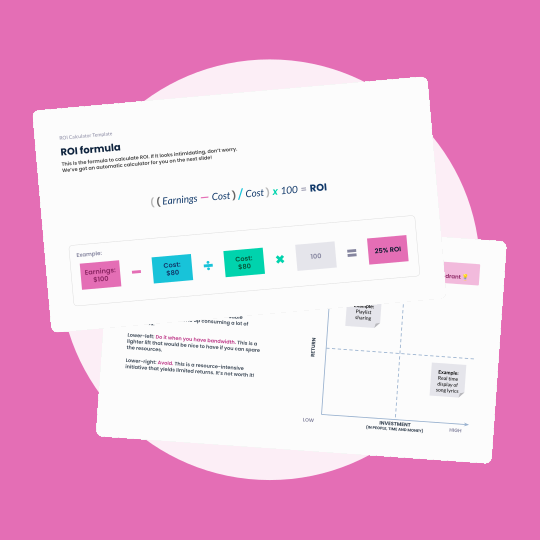
The Future of Product Portfolio Optimization
AI is amplifying fundamentals of portfolio management. Product managers who embrace these capabilities early will ship faster, prioritize smarter, and uncover opportunities that slower competitors simply won’t see.
But the real advantage comes from using AI with intention. Not as a trend to chase, but as a system that helps you make clearer, faster, and more confident calls.
At its best, optimizing a product portfolio with AI blends art and analytics. Generative AI, predictive models, and graph analytics give product leaders powerful new ways to see what’s working, what’s waste, and what’s next.
The next generation of product leaders will be those who use AI to deepen intuition, turning endless data into decisions that move the business forward.
Product Leadership Certification
Elevate your product strategy and decision-making by integrating AI-driven insights.
Enroll now
Updated: December 31, 2025