A large (and we mean large) percentage of product experiments fail. Airbnb knows it. Microsoft knows it. Amazon even celebrates it. Jeff Bezos once said (1) their success is simply “a function of how many experiments they do.”
That’s the hidden math of product discovery: the more you test, the faster you learn what doesn’t work and what truly matters to users.
In this guide, we’ll break down what makes a product experiment successful, explore different types of experiments, and share a practical framework for running them effectively. We’ll also look at how AI is reshaping the entire process and which tools can give your team an edge. Let’s get into it.
Product Experimentation Micro-Certification (PEC)™️
The Product Experimentation Micro-Certification (PEC)™️ introduces you to the essentials of designing and running high-quality experiments.
Enroll now
What Is Product Experimentation
Product experimentation is a structured way of learning what works in your product by running controlled changes with real users and measuring the impact. Instead of shipping features based on opinions or intuition, you define a clear hypothesis, choose success metrics, expose a subset of users to a new experience, and compare the results against a control.
For product teams, product experimentation is how you de-risk decisions, validate ideas early, and continually improve activation, engagement, and retention.
What is the difference between experimentation and testing?
The difference between experimentation and testing is the depth of the learning system. Experimentation is a continuous program of hypotheses, tests, and iterations that guides product strategy. Testing is a single, contained activity inside that system (for example, an A/B test, usability test, or QA check) that answers a specific question like “Does this variant perform better?” or “Does this flow work as intended?”
What Makes a Successful Product Experiment
Not every experiment will boost your metrics. In fact, most won’t. A “successful” product experiment isn’t necessarily one that confirms your hypothesis; it’s one that yields actionable insight. In practice, an experiment that disproves your idea can be as valuable as one that drives a big lift, as long as you learn why.
In his talk at ProductCon San Francisco, Gibson Biddle, former VP of Product at Netflix, reminds us that:
“Just because an experiment is a failure, doesn’t mean it wasn’t useful.”
Successful product experiments share a few key ingredients:
Clear purpose and hypothesis for product experimentation
Every experiment should start with a well-defined objective and a testable hypothesis. Ask yourself exactly what user behavior or metric you aim to influence and why you believe a certain change will move it.
If you can’t fill in the blanks of “We believe that doing X will impact Y because Z”, then the experiment isn’t grounded enough. Having a sharp hypothesis forces you to design a focused test or AI prototype and prevents random trial-and-error.
Relevant metrics for “success”:
Determine how you’ll measure the outcome before you run the experiment. Pick one primary product OKR (or a small set of 2–3) that best captures the user/business value you hope to create.
For example, if your goal is to improve user onboarding, you might track onboarding completion rate as the primary metric, plus a secondary metric like time to first key action. Defining success criteria upfront keeps everyone honest. You’ll know whether the change actually mattered.
Robust experimental design
Rigor in planning and execution separates trivial tests from impactful experiments. This means establishing a control group, selecting a large enough sample size for statistical significance, and running the test for an adequate duration.
Skimping on these basics can lead to misleading results. As a best practice, run experiments long enough to capture different usage cycles (at least a full week) and ensure your sample size yields reliable statistics. A well-run experiment controls variables and eliminates biases so you can trust the outcome, not the output.
Data-driven and unbiased decisions
In product experimentation, evidence trumps opinions. Product teams must be willing to let the data decide the path forward. That sounds obvious, but in practice it’s hard. We all get attached to our ideas.
Cultivate an experimentation culture where it’s okay if the data says an idea didn’t work. You’ll pivot without ego. Be brave enough to abandon any plans the data shows aren’t improving the product experience or moving your main metrics.
In short, successful experiments require intellectual honesty.
Product experiments should focus on user impact
The best product experiments are rooted in user needs and deliver real value. Avoid the trap of “experimenting for experimentation’s sake.”
Each test should address a genuine user pain point or opportunity that aligns with your product strategy. As Ed Macosky, CPO at Boomi, has noted at ProductCon:
Focus on your business outcomes and what you want to achieve versus the tools and technology. Too many people chase the next tech, doing science projects instead of actually making an impact in the business.
In other words, experiments should ladder up to meaningful business outcomes and customer value, not just generate interesting data.
Always tie your experiment’s results back to the product experience: Did it make the product more useful, easier, faster, more delightful? If not, even a statistically significant win might not be worth rolling out.

Iterative mindset and learning
Finally, treat product experimentation as an ongoing learning process rather than one-off projects. A single A/B test is not the end. It’s one step in a continuous cycle.
Whether an experiment succeeds or fails, extract the insights and iterate. You might run follow-up experiments to refine a winning variant or dig into why a variation failed.
Product teams that document and share experiment results build a knowledge base that informs future ideas. This learning mentality turns failures into fuel for future success.
8 Types of Product Experiments
Product teams use various approaches when conducting product experiments. While A/B tests are the poster child of product experimentation, there’s a whole spectrum of experiment types tailored to different situations.
Here are some of the most common kinds of product experiments and when to use them:
1. A/B product experiments (split tests)
A/B tests are the classic way to answer a very specific question: “Is version A or version B better for this user outcome?” You randomly split users into two groups, show each group a different experience, and compare the impact on a clearly defined metric like activation rate, click-through, or revenue per user.
The power of A/B product experiments is in their simplicity and focus. You change one meaningful thing at a time, hold everything else constant, and let the data tell you whether the new experience is actually better than the old one. This makes A/B tests ideal for decisions like: which onboarding flow creates more successful first sessions, whether a new pricing layout hurts or helps conversion, or how AI-generated content (like summaries or recommendations) affects engagement.
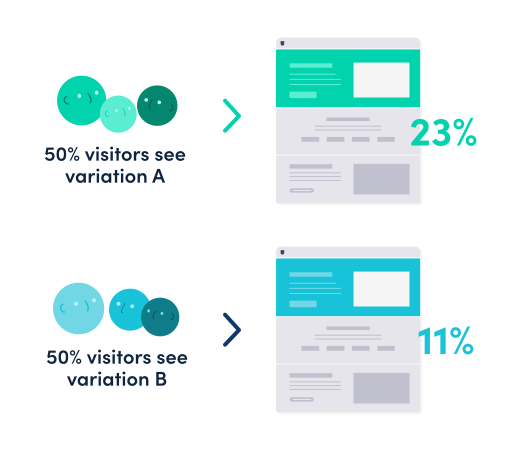
Ryan Daly Gallardo, SVP of Product at Dow Jones, described this mindset perfectly in her ProductCon talk. Instead of assuming summaries would hurt engagement, her team asked a single question: “What do AI-powered summaries do to user engagement?”
They ran a clean A/B product experiment, with half of users seeing summaries and half not. They were deliberately “not trying to confirm [their] hopes and dreams,” but open to whatever the data showed.
For AI-heavy products, A/B tests are especially valuable when you are introducing new model-powered experiences.
Turning AI Doubt into AI Strategy
Ryan Daly Gallardo, SVP of Product, Consumer at Dow Jones, reveals how to test without eroding trust, embed cross-functional safeguards, and use evidence-based design to deliver AI features that improve engagement.
Download Playbook
2. Multivariate product experiments
Multivariate product experiments expand the idea of A/B testing by allowing you to test several elements at once. Instead of just comparing version A and B, you might test multiple headlines, images, and CTAs in parallel across several combinations.
These product experiments are useful when you care about how different elements interact. Maybe a certain headline works only with a certain image, or a particular layout works only when the call to action is more direct. Multivariate product experiments help you surface those interaction effects without running a long series of isolated A/B tests.
If you are an AI product manager, you might use multivariate experiments to fine-tune how you present AI outputs (tone, length, visual hierarchy) rather than to decide whether to use AI at all.
3. Fake-door product experiments (smoke tests)
Fake-door product experiments or MVPs are designed to answer a different question: “Is there enough real demand for this idea to justify building it?” Instead of delivering the full feature, you create a small “door” in the product that users can click on, such as a new menu item, a “Try AI assistant” button, or a teaser tile for a yet-to-be-built workflow.
When users click, you can show a simple message, such as “Thanks for your interest, this is in development,” or invite them to join a waitlist.
Fake-door is ideal for early-stage AI prototypes that would be expensive to implement, such as “agentic” workflows that orchestrate multiple tools, or advanced analytics features powered by a new model. Before you spend weeks wiring up a RAG stack or building complex agent behaviors, you can cheaply validate whether users actually want this capability and what they expect from it.
4. Landing page and ad product experiments
Landing page and ad product experiments are especially useful when you want to test product positioning and value propositions rather than in-app UX. You create a simple landing page describing a proposed feature or product and drive traffic to it via email, paid ads, or in-product banners. Then you measure things like click-through rate on “Get early access” or sign-ups for a beta.
These experiments help you answer questions like: “Does this AI product idea resonate at all?” or “Which framing of our AI assistant makes users most likely to try it?”
For AI business use cases, landing page experiments are great for testing how you talk about safety, control, and value. For example, does the phrase “AI co-pilot” convert better than “AI agent”?
5. Prototype and usability product experiments
Prototype and AI prototype experiments are qualitative by nature. Instead of pushing code to production, you create a prototype and watch users try to accomplish tasks. The experiment is about whether people understand and can successfully use the product design, not about precise conversion rates.
This type of product experiment is especially important when you are introducing new mental models, such as AI agents that “act on your behalf” or RAG-powered experiences that pull from different data sources. The questions you are trying to answer are: “Do users understand what this AI thing does?”, “Do they trust it enough to use it?”, and “Where do they hesitate or get confused?”
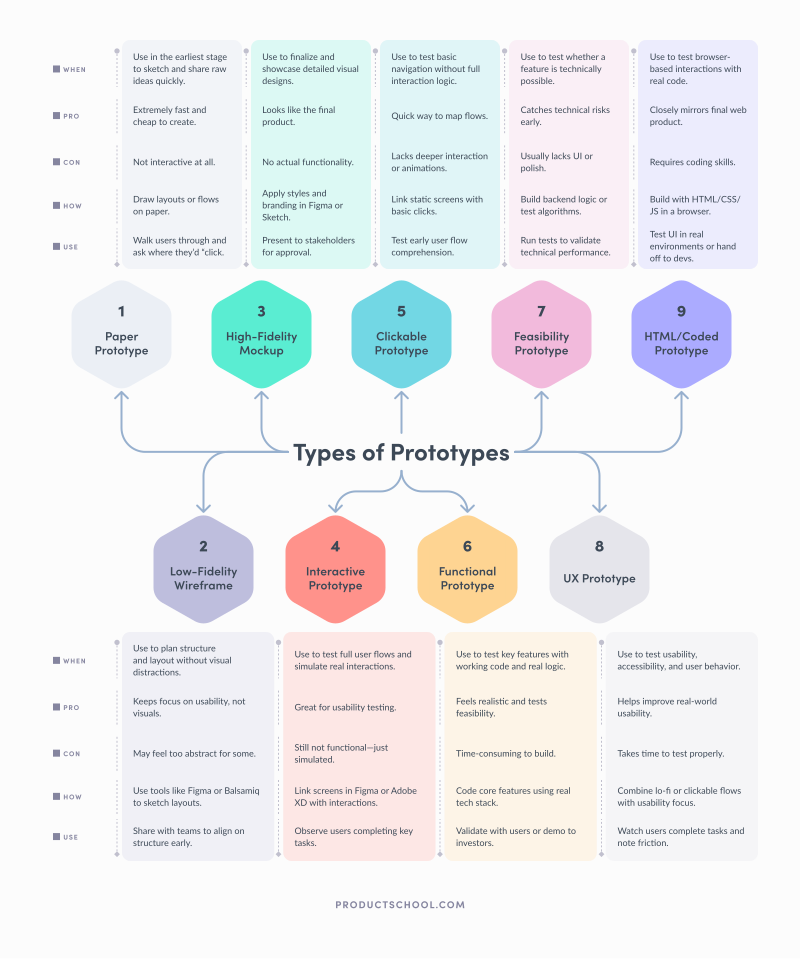
You can run moderated sessions where you observe users think aloud, or unmoderated tests where you collect screen recordings and survey responses. Even a handful of sessions can reveal consistent friction points.
6. “Wizard of Oz” product experiments (concierge MVPs)
“Wizard of Oz” product experiments are about testing the experience of a feature while you still fake the implementation behind the scenes. Users believe they are interacting with a fully automated system, but in reality, a human (or lightweight script) is doing most of the work manually.
For AI product managers and AI product owners, this is a powerful way to test ambitious ideas before your models are ready.
For instance, suppose you want to build an AI agent that audits a customer’s entire workspace and suggests optimizations. Instead of spending months building and integrating the whole stack, you can invite a small cohort into a “beta,” then manually perform the analysis and send recommendations that look like they came from an AI agent.
The experiment questions might be: “Do users find this output valuable enough to act on?”, “What level of detail and tone do they expect?”, and “How often would they want to use this?”
7. Incremental rollout product experiments (canary and beta)
Incremental rollout product experiments help you manage risk when introducing large or potentially sensitive changes. Instead of a global “big bang” release, you gradually roll out the new product experience to groups of users and monitor key metrics along the way.
A canary release typically starts by giving a small percentage of traffic (say 1–5%) the new experience while the rest stay on the old version. You monitor critical metrics (errors, latency, key conversion events, satisfaction scores) to ensure nothing is breaking or regressing. If things look stable, you ramp up to larger cohorts. If not, you roll back and investigate.
Beta programs work similarly but often with opt-in cohorts: internal employees, power users, or specific customer accounts.
These users get early access to the new experience in exchange for feedback. This is especially important for AI features that may behave unpredictably in edge cases. You can control who sees the feature, gather detailed qualitative feedback, and tweak guardrails and AI evaluations before a full rollout.
In both cases, you’re still running a product experiment. You’re comparing how the world looks before and after the change for each rollout slice, and you’re ready to stop or adjust based on the data.
8. Continuous personalization product experiments
Continuous personalization product experiments are where experimentation and AI start to blur. Instead of running a fixed-duration test and declaring a winner, you let a model continuously adapt what each user sees based on their behavior and context.
Examples include personalized content feeds, recommendation carousels, and dynamic product pricing or bundling. Under the hood, these systems are essentially running many micro product experiments at once, learning which content, offers, or layouts work best for each segment or even each individual user.
For product teams, the experiment questions shift from “Does variant B beat variant A overall?” to “Are we improving outcomes for each segment in a safe and fair way?” You still need control logic, guardrail metrics, and evaluation routines. You might run offline experiments on historical data, then limited online rollouts where you watch for regressions and bias issues.
With modern AI tooling, you can use contextual bandits or reinforcement learning to allocate experiences dynamically. But the product experimentation mindset remains the same: define what “good” looks like, design the system to explore and learn safely, and continuously evaluate whether those personalized experiences are delivering the product goals and business outcomes you intended.
Product Experimentation Framework: Step-by-Step Guide
Effective experimentation is systematic. Ad-hoc tests thrown together tend to produce murky answers. By following a repeatable framework, you ensure each experiment is rigorous and comparable, and you build team confidence in the process.
Here’s a 6-step product experimentation framework to guide you from idea to insight.
1. Define a clear product goal
Every experiment starts with a product goal in mind: what are you trying to improve for the user or the business? Identify a problem or opportunity from your data and user feedback.
For example, say you notice a drop-off in the onboarding flow. Your goal might be “Increase onboarding completion rate”. Be as specific as possible: which user segment, what part of the product experience, and what metric move would indicate success?
Ground this goal in evidence. Use quantitative data (for example, “Only 40% of new users complete onboarding, and those who don’t have 50% higher 30-day churn”) and qualitative insights (“New users report feeling confused by all the setup steps”) to justify why this goal matters.
A well-defined goal focuses your experiment on a meaningful outcome and helps get stakeholder buy-in.
2. Build your hypothesis
With a goal set, formulate a hypothesis that proposes a solution and outcome. A handy format is: “We believe that [changing X] for [users Y] will [impact Z] because [reason].”
For the onboarding example, the hypothesis might be: “We believe that reducing the number of steps in onboarding for new users will increase the completion rate because it will reduce confusion and effort.” A strong hypothesis is specific, measurable, and rooted in rationale (from user research or past observations)..
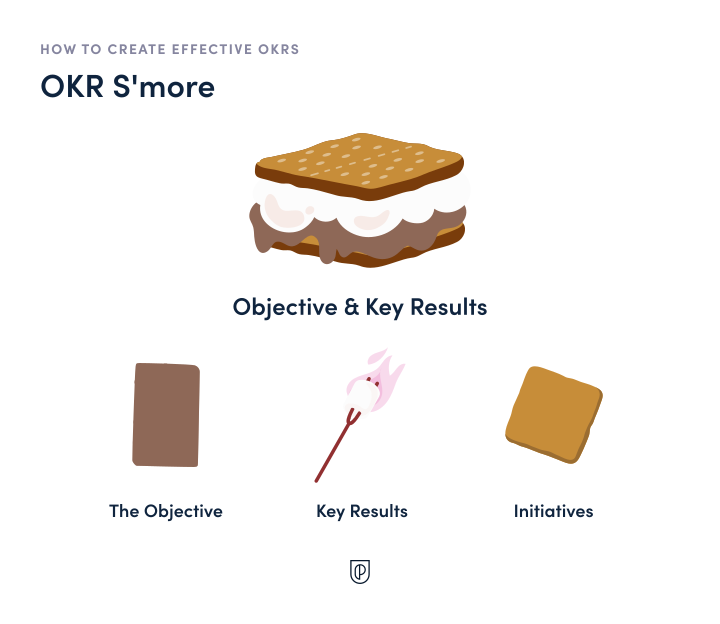
3. Choose your success metrics (OKRs)
Next, decide how you’ll measure the experiment’s impact. Tie it directly to your product goal. In our example, the primary OKR is straightforward: onboarding completion rate. You might also pick a secondary metric to watch for side effects (perhaps Customer Effort Score from a survey, to ensure the new process feels easier).
Limit the number of metrics. One or two is ideal, and avoid vanity metrics.
Setting metrics upfront guards against “result shopping” later. It also informs how you’ll design the test (for instance, how large a sample you might need to detect a change in those metrics).
Importantly, think through guardrail metrics too. Are there any metrics that should not tank as a result of this change (for example, maybe onboarding is faster, but user retention should not drop)? Define those so you can monitor for any unintended negative impacts.
Product OKR Template
Use this Product OKR template to set and track your OKRs (Objectives and Key Results). Align your team’s daily tasks with product and company strategy!
get free template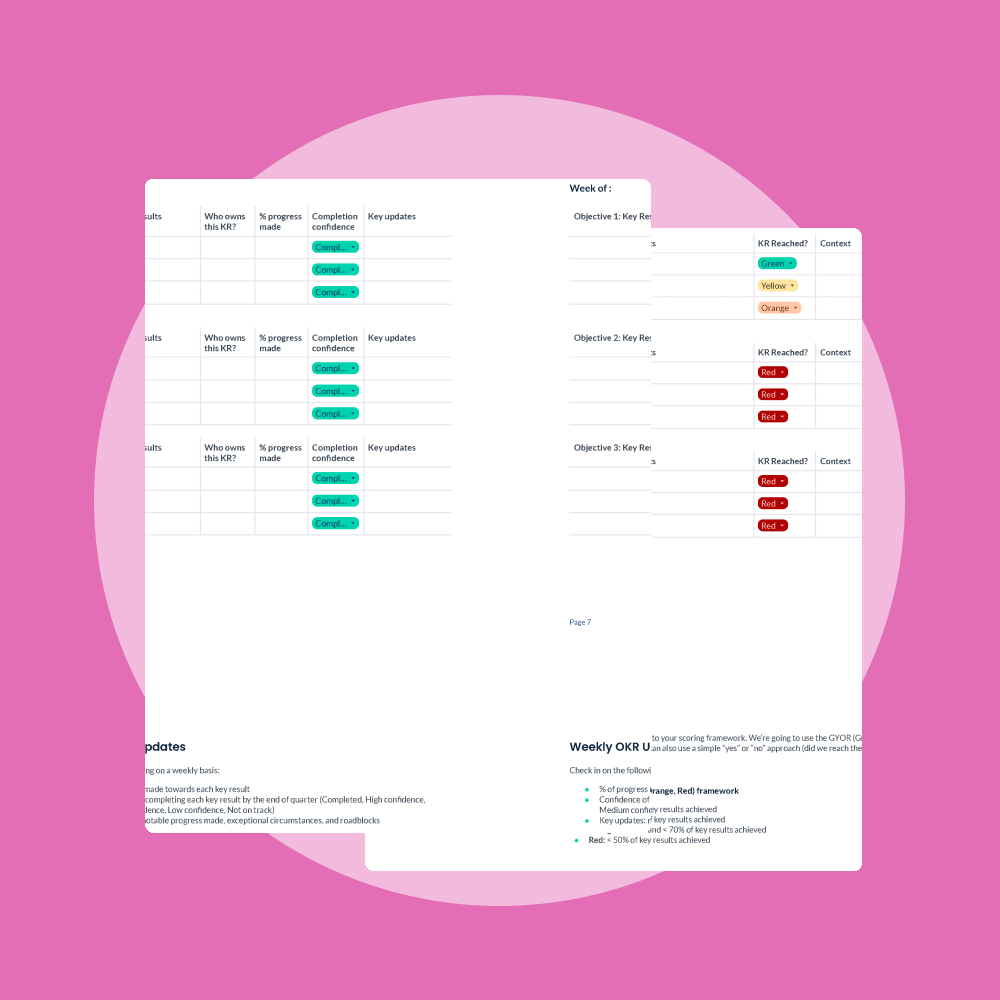
4. Design the experiment parameters
This is the planning step where you determine the logistics of the test. Decide on the experiment type (A/B test, multivariate, etc.) that best fits your hypothesis. Identify your user segments: will you test on all new users, or a certain subset?
Determine the sample size and test duration needed for statistical significance. There are calculators to help with this. The key is to ensure you have enough users and time to confidently detect a real difference if one exists.
Also plan the variants: what is the control experience vs. the test experience(s)? Document the changes in each variant clearly (for example, “Variant B removes 2 of 5 onboarding steps”).
Make sure you’ve worked through operational details: feature flags or experiment toggles to turn the change on or off, tracking product analytics events for the metrics, and so on.
By the end of this step, you should have an experiment spec that anyone on the team could read to understand exactly what will happen. Having this discipline not only ensures quality, it also makes your experiments repeatable and transparent.
5. Run the experiment
Enable your test in a controlled manner. Typically, you’d use a proddy-awarded experimentation platform like AB Tasty or Launch Darkly, or a feature flagging tool to deploy the variant to the designated user group.
While the experiment is running, monitor it for any obvious issues. It’s good practice to check early data just to verify that the test is sending traffic correctly and tracking events properly. You’re not looking at results yet, just validating the mechanics.
AI tools can help here by automatically watching key metrics for anomalies, flagging unexpected drops or spikes in near real time, and summarizing what’s happening across segments so you don’t have to constantly dig into dashboards.
If it’s a high-risk experiment, you might start at a low percentage (for example, 10% of users) and ramp up to a 50/50 split over a day or two.
Communicate with stakeholders that the test is live and remind everyone not to peek at the data too soon. Wait for the planned duration or sample size. During the run, also keep an eye on qualitative feedback channels: are users reacting to the change?
Sometimes support tickets or user comments can provide color on an experiment in flight.
6. Analyze results and learn
Once the experiment has reached significance or the planned stopping point, it’s time to crunch the numbers.
Calculate the differences in your primary OKR between the control and variant. Use statistical methods to determine if any uplift or drop is statistically significant (many experimentation tools do this for you). Did the variant achieve the goal?
For example, “Variant B increased onboarding completion from 60% to 68%, which is a statistically significant +8% lift.”
AI can accelerate this step by doing the heavy lifting on analysis: it can automatically compare control vs. variant across segments, highlight where the biggest lifts or drops occurred, and surface patterns you might miss (for example, “power users on mobile saw a strong uplift, new users on desktop did not”).
Instead of manually slicing data, product managers can ask ChatGPT questions in plain language (“Did this hurt engagement for free users?”) and get structured answers. AI can also cluster session recordings, support tickets, and open-ended survey responses into themes, helping you understand why metrics moved. For instance, grouping complaints around “confusing copy” or “slower load time.”
Also, examine your secondary and guardrail metrics for any changes. It’s critical at this stage to dig into why you got these results. If the variant won, what evidence shows why it performed better? If it lost, where in the funnel did users drop off?
You might segment results by user type or look at session recordings to understand user behaviors. This analysis turns raw data into actionable insight.
How AI Can Boost Product Experimentation
Artificial intelligence is the new superpower in the product manager’s toolkit, and experimentation is an area where AI shines. AI product managers are increasingly leveraging AI to speed up experimentation cycles, uncover deeper insights, and even automate parts of the experimental process.
Here are several ways AI is changing the game for product experimentation:
Faster analysis and pattern detection
AI tools can crunch experiment data in seconds, automatically segmenting results and surfacing where lifts or drops are happening across users, devices, or regions.
It can highlight patterns an analyst might miss (for example, “Variant B works only for mobile power users in Europe”) and flag anomalies, giving you a richer, less biased view of why a product experiment performed the way it did.
Smarter experiment design with AI predictions
In the planning stage, AI can analyze historical behavior to predict which ideas or variations are most likely to move your key metrics, so you don’t waste cycles on weak candidates.
AI can analyze thousands of past button tests and suggest the top 3 designs likely to get higher clicks for your user segment. That can save you from testing 20 random variations.
Some platforms use these models to suggest optimal variants and even simulate outcomes to inform sample sizes and test duration, making your product experiments more informed and higher leverage from day one.
Automated and adaptive experimentation
AI makes it easier to move from static A/B tests to adaptive product experiments that adjust in real time. Multi-armed bandit algorithms can automatically send more traffic to winning variants while a test is running.
Similarly, AI can monitor metrics during a test and alert you if something is statistically significant sooner than expected or if a variant is causing a metric to tank (so you can stop the experiment for safety).
Leading teams are pushing this further with autonomous agents that continuously run micro-experiments and self-optimize parts of the product.
Enhanced ideation and prototyping
Generative AI is a powerful partner for creating what you want to test: it can quickly generate copy, images, and even skeletal code for new variants, helping you spin up more product experiments with less effort.
For example, generative AI (like ChatGPT or DALL·E) can rapidly generate copy, images, or even code for test variants. Suppose you want to experiment with different onboarding tutorials. You could ask an AI to draft a few versions of the welcome text or create alternative illustrations in seconds.
At Product School, we talk a lot about AI prototyping because it changes the speed and shape of what PMs can test. Instead of waiting days or weeks for design and engineering resources, you can use AI tools that turn rough sketches or written flows into clickable UIs, generate multiple design variations in minutes, or scaffold working code for a simple experiment.
That means you can validate problem–solution fit earlier, run more product experiments with less overhead, and bring engineers into the loop only once you’ve already killed the weak ideas.
Deeper user insights with AI
AI can process the qualitative side of your product experiments at scale, summarizing thousands of open-ended survey answers, support tickets, or interview notes into clear themes and sentiments.
It can cluster feedback into topics like “confusing navigation” or “loved the new look” and even scan session replay videos to detect common struggle points, so you understand not just what changed in your metrics, but why users reacted the way they did.
Product Experimentation as Your Unfair Advantage
Great teams don’t have better ideas than everyone else. They run more, better product experiments, and learn faster than the competition. In a world of constant change, that learning speed is your real moat.
If you treat every meaningful change as a product experiment, use a clear framework, and let AI do the heavy lifting on prototyping and analysis, you stop guessing and start compounding insight.
That’s how you ship bolder ideas with less risk, build products your users actually want, and turn experimentation from a process into a permanent advantage.
Product Experimentation Micro-Certification (PEC)™️
The Product Experimentation Micro-Certification (PEC)™️ introduces you to the essentials of designing and running high-quality experiments.
Enroll now(1): https://www.fastcompany.com/3063846/why-these-tech-companies-keep-running-thousands-of-failed
Updated: December 31, 2025