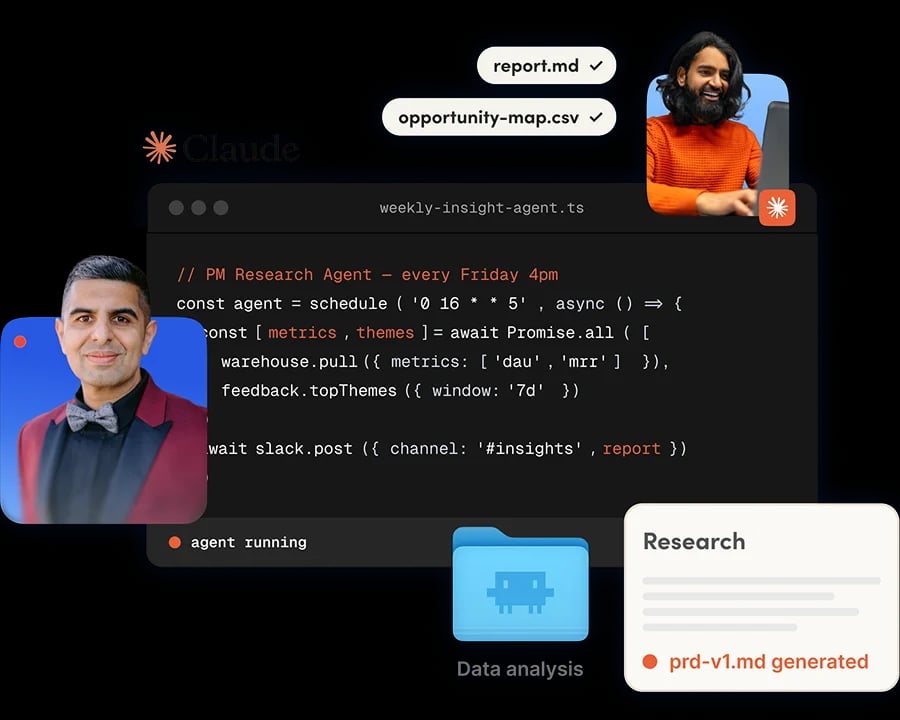
An AI Builder is a product professional who uses AI to prototype, build, evaluate, and ship — moving product thinking from documents and meetings into working artifacts. The role is emerging at the intersection of product management, design, and engineering, as AI lowers the barrier to creation for everyone on a product team.
For AI PMs, that means moving beyond prompts and into AI prototypes, workflows, AI evals, research synthesis, multi-agent systems, experiments, launch assets, and working product decisions.
The product role is moving closer to the act of making.
Workers with AI skills already earn a 56% wage premium (PwC, 2025). 66% of leaders say they would not hire someone without AI skills (Microsoft/LinkedIn Work Trend Index). The AI Builder is not a future role — it is the present hiring filter.
For a long time, product management was defined by coordination. PMs gathered inputs, aligned teams, wrote requirements, prioritized work, managed stakeholders… That work still matters. But it is no longer enough.
AI is changing the center of gravity in product. A PM can now prototype an idea, inspect implementation logic, generate product copy, summarize customer evidence, explore data, and test the shape of a feature before the usual handoff even begins.
Today, we need PMs who can make product thinking tangible. That is the AI Builder.
This article is the perfect place to begin for PMs who want to use AI to prototype, research, evaluate, and ship faster — especially those looking to move from managing work to making artifacts.
Key Takeaways
An AI Builder is a product professional who uses AI to build, prototype, test, analyze, evaluate, and ship product work faster.
AI Builders do not replace product fundamentals. They make those fundamentals more concrete by turning ideas into artifacts earlier.
The AI Builder role is emerging because PMs, designers, and engineers are converging around the ability to create with AI.
Vibe coding is one part of AI building, but the broader skill set includes AI product strategy, Claude Code, AI evals, agents, experimentation, go-to-market, and product leadership.
The strongest AI Builders combine product judgment with hands-on AI workflows. They use AI to move faster without outsourcing taste, strategy, or accountability.
AI Builder: Quick Answers
What is an AI Builder?
An AI Builder is a product professional who uses AI to prototype, analyze, evaluate, and ship product work faster. It means moving beyond managing tickets and toward creating working artifacts that help teams learn faster.
Do you need to code to become an AI Builder?
No. AI Builders need technical fluency, not full engineering skills — enough to prototype with AI tools, spot where outputs break, and collaborate well with engineers.
What tools do AI Builders use?
AI Builders use prototyping and coding assistants like Claude Code and vibe coding tools, AI eval frameworks, and analytics connectors that surface insight in natural language. The specific stack changes constantly — the durable skill is moving from product thinking to product artifact.
Is “AI Builder” a job title?
Not formally, at least not yet. Today it describes a skill set spreading across product, design, and engineering roles, but it is increasingly shaping how teams hire and define product work.
What Is an AI Builder?
AI Builder is a product professional who uses AI to move from product thinking to product artifact — prototyping, evaluating, and shipping faster than the traditional handoff cycle allows. They are not engineers. They are the first makers: the ones who create the rough version that sharpens everyone else’s thinking.
An AI Builder is a product professional who uses AI tools to build, prototype, test, analyze, and ship product work faster.
For PMs, the word “builder” can sound misleading at first. It can make the role feel like it is collapsing into engineering. But that is not a useful interpretation.
An AI Builder is not a PM pretending to be a software engineer. I see AI Builder as a PM who can at least create the first artifact that sharpens the conversation.
That artifact might be:
A clickable prototype
A working internal tool
A customer research synthesis
An AI eval plan
A dashboard query
A launch narrative
A feature flow that engineering can review
The point is that the PM no longer has to keep product thinking trapped in docs and meetings.
I described this exact shift at ProductCon London:
“We are living through weird times. Product managers think they can code and design. Designers think they can code and build products. Engineers are moving in the same direction. These roles are converging into what is now being called an AI builder. My hunch is that this will become much more official.”
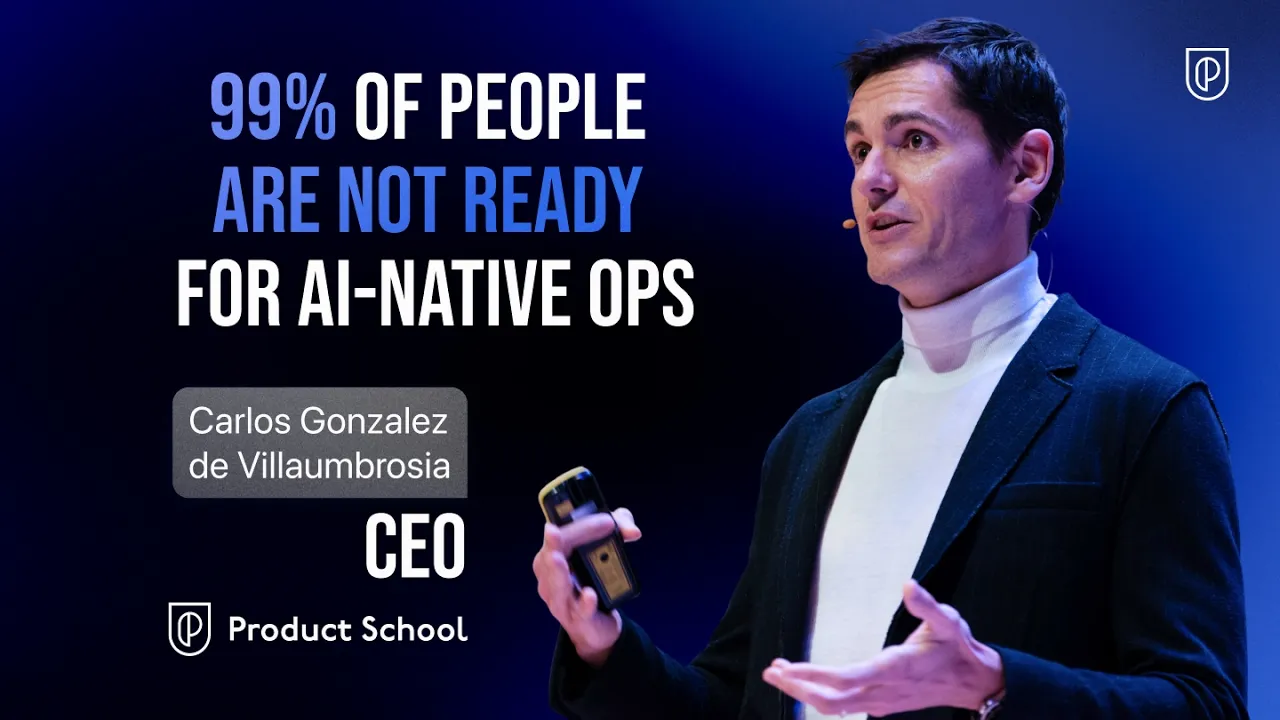
That convergence is the important part and my hunch is slowly proving to be right on the button. Product work is becoming less linear. The AI-native version is messier, but faster. PMs explore, prototype, research, evaluate, refine, and hand off stronger artifacts.
The AI Builder is the PM who knows how to work inside that mess without losing the discipline of product management.
Why AI Builders Are Emerging Now
AI Builders are emerging because the bottleneck in product is changing. For years, the bottleneck was often production capacity. The team had more ideas than product design and engineering could build. So the PM’s job was to align and protect focus.
Nowadays, AI has changed what happens before a team commits production capacity.
That is why companies are investing so heavily in AI capability, but still struggling to convert it into maturity. McKinsey’s 2025 Superagency report found that almost all companies are investing in AI, but only 1% say they have reached AI maturity. The gap is not just a tooling gap, but a capability gap.
This is where the AI Builder becomes valuable.
Companies do not only need people who can buy AI tools. They need people who can turn those tools into better AI operating models, better decisions, and faster learning. The AI Builder is one answer to that gap.
AI Builder vs. Product Manager: What Actually Changes?
The difference between an AI Builder and a traditional Product Manager is proximity to creation.
A traditional PM owns the problem, priorities, roadmap, stakeholders, and outcomes. An AI Builder still owns those things. The difference is that they can also create early artifacts that help the team learn faster.
What I mean by this is that they do not wait for every idea to become a ticket. Rather, they build enough to clarify the idea before the ticket exists.
That changes the quality of collaboration. A PM who brings a working prototype to engineering is not saying, “Please ship this exactly as I made it.” They are saying, “Here is the shape of the intent. Now let’s make the real version better.”
That is a very different handoff.
Area | PM (pre-AI) | AI Builder |
Idea validation | Writes briefs and gathers feedback | Builds rough artifacts to test assumptions faster |
Technical fluency | Learns constraints mainly through engineering conversations | Uses AI tools to inspect, prototype, and reason closer to the system |
Research | Summarizes interviews, tickets, and market signals manually | Uses AI to synthesize signals faster and ask better follow-up questions |
Delivery | Turns product decisions into tickets and alignment docs | Creates clearer specs, prototypes, evals, and workflows before handoff |
Strategy | Defines priorities and tradeoffs | Connects strategic choices to artifacts the team can inspect |
Leadership | Aligns teams around decisions | Builds enough to make decisions easier to understand and challenge |
Identity | Manages the product | Builds the product |
Speed matters, but speed alone is not the strategic advantage. The advantage is reducing ambiguity earlier. A strong AI Builder uses the best AI tools for PMs to create better input for the team’s judgment.
From Vibe Coding to the Full AI Builder Stack
Vibe coding is the most visible AI Builder skill because it produces something tangible.
Instead of describing a product idea in a document and waiting for someone else to make it real, a PM can use AI to create a rough working version. It might be a landing page, onboarding flow, internal dashboard, workflow automation, feature prototype, or small product experience.
Stakeholders react differently to artifacts than they do to abstractions.
A prototype exposes assumptions that a PRD can hide.
A rough flow reveals missing states.
A working demo forces people to confront the actual user experience instead of debating the concept in theory.
Simon Kubica, CEO at Alloy and former Atlassian product leader, put it directly at ProductCon New York:
“Vibe coding really is the new product management. Building not just prototypes, but actually shipping features that you can hand off to your development team to review and push out to customers, is going to become more and more central to our roles.”
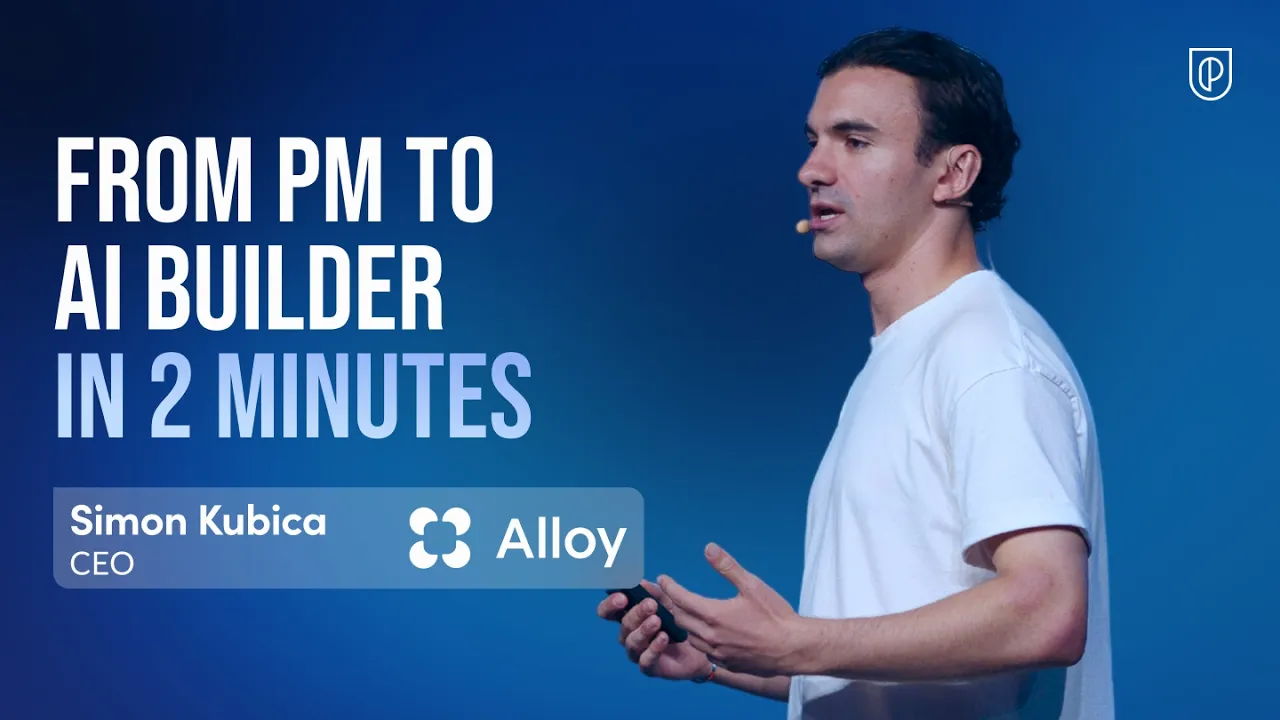
Vibe coding is becoming part of how product ideas get shaped, tested, and communicated. But it needs guardrails. The PM who vibe codes with strong product judgment can make strategy visible earlier.
Vibe coding is only the beginning
Building faster creates a second problem: every other part of the product loop has to speed up too.
If PMs can prototype in hours, they cannot wait weeks for insight. If teams can generate five product variants, they need faster ways to evaluate which one deserves attention. If AI can ship more experiments, teams need stronger judgment about what to measure, what to ignore, and what counts as real learning.
So, the AI Builder skill set expands beyond coding. And I described at ProductCon London when I said the following.
Vibe coding is just the beginning. We’re entering the phase of vibe research because coding speed is starting to outpace insight generation. MCP connectors are enabling seamless integration between analytics tools like Amplitude and tools like Claude Code, Codex, or Cursor.
Product managers will no longer need to log into analytics platforms, generate dashboards, or struggle through the technical steps. They will be able to prompt in natural language, even through interfaces like Slack, and get the insights they need.
That is vibe research, or vibe analytics. The AI Builder is not only the PM who can create a prototype. It is the PM who can compress the full learning loop:
Build faster
Research faster
Analyze faster
Evaluate more rigorously
Experiment sooner
Launch with sharper positioning
Feed the learning back into the roadmap
The Key Skills You Need to Become an AI Builder
Tools change quickly. The durable skill is knowing how to move from product thought to product artifact with speed, judgment, and discipline.
Product School’s course catalog reflects that reality. The path is a broader skill stack that encompasses product fundamentals, AI product management, Claude Code as the most powerful tool at the moment, vibe coding, AI evals, advanced agents, experimentation, go-to-market, AI product strategy, and product leadership.
Each skill gives the AI Builder a different kind of leverage.
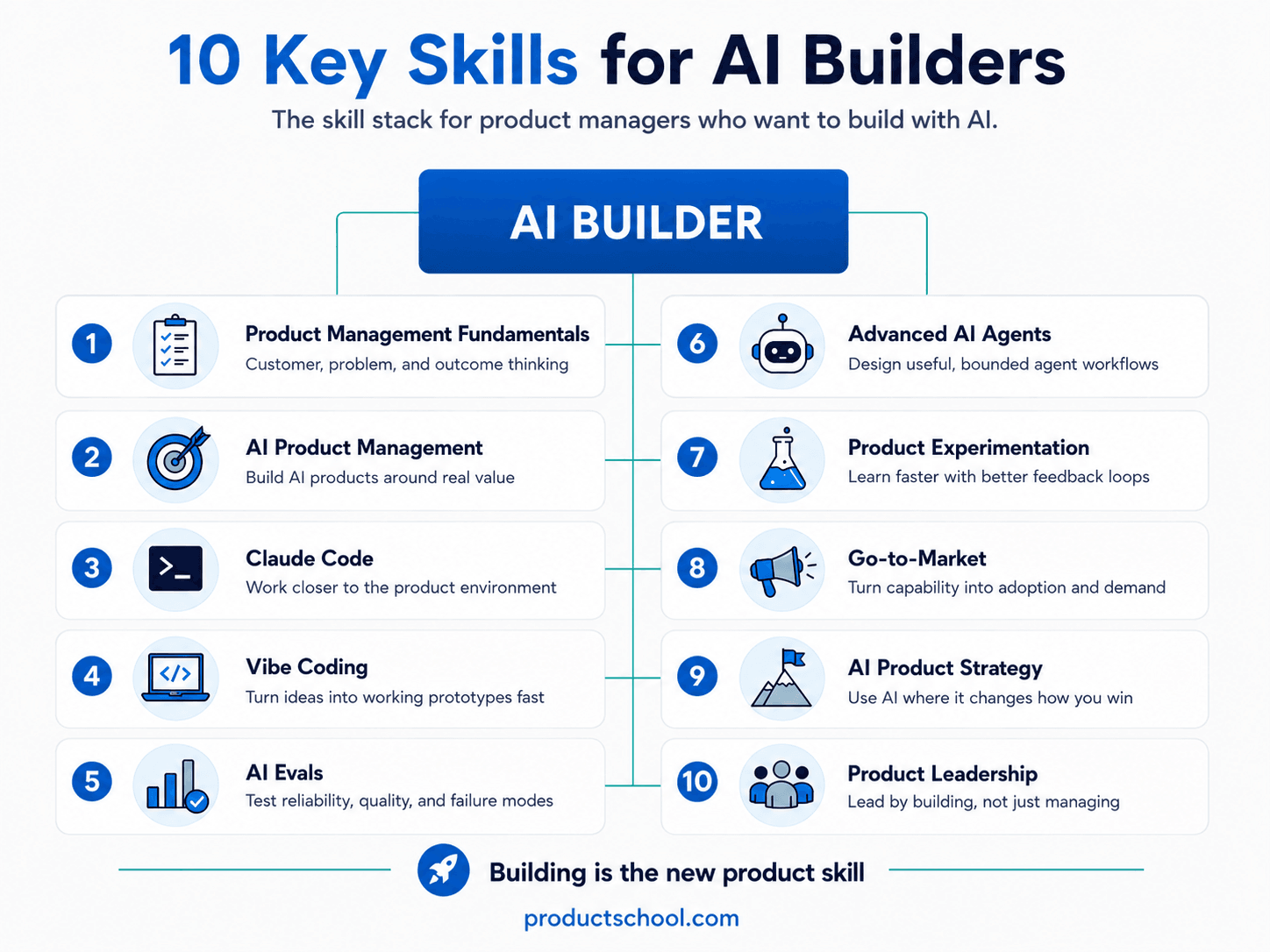
1. Product management fundamentals
AI Builders still need strong product fundamentals.
This is the part people skip when they get too excited about tools. Simply because AI makes weak product judgment easier to scale.
If the PM does not understand the customer, the problem, the business goal, the tradeoff, or the metric that matters, AI simply helps them build the wrong thing faster. Product fundamentals are the base layer:
stakeholder alignment,
product sense, and
outcome thinking.
If a person is not starting with this foundation layer, they’re basically a fool with a tool.
We are teaching this foundation in the Product Management course because AI only creates leverage when the PM already knows how to, well, manage the product.
2. AI product management
AI Builders need to understand how AI changes product value.
AI-powered products behave differently from traditional software. They can be probabilistic and context-sensitive. They’re known to be inconsistent, surprisingly useful, and occasionally wrong in ways that are hard to predict.
You see how that foundation layer matters as much for an AI PM?
AI Product Management is the skill of identifying where AI creates real customer value and where it only adds novelty. A good AI Builder asks, “Where does AI change the user’s ability to achieve the outcome?”
Product School teaches this in the AI Product Management course, where PMs build a rock-solid foundation in AI and learn the essential terminology, technology, and frameworks needed to begin their AI journey.
3. Claude Code
AI Builders need tools that let them move closer to the product environment. Claude Code is a crucial part here because it gives PMs a way to work with codebases, prototypes, specs, tests, and technical artifacts without pretending to be engineers. It makes product thinking inspectable in a real environment.
Sure, Claude Code can help write code. But the deeper value is that it reduces the distance between product intent and implementation reality. A PM can explore how a feature is structured, understand what might be hard to change, generate a prototype, inspect edge cases, or prepare a stronger handoff to engineering.
That is a new kind of technical fluency. It is the fluency of understanding enough to help engineers build from there.
Product School teaches this in the Claude Code course because PMs need to understand how this powerful tool can help them prototype, analyze, and work closer to technical execution. And yes, this one teaches you to build as you learn — live, applied, and structured around the PM workflow you already have.
4. Vibe coding
AI Builders need to create working prototypes without waiting for a traditional build cycle. That is the practical value of vibe coding. It gives PMs a way to move from the idea to “here is something we can react to” much faster.
This matters because many product debates are really artifact problems. People are not disagreeing because the idea is bad. They disagree because everyone is imagining a different version of it.
A rough prototype changes that. It gives the team something to inspect, challenge, improve, and reject if needed.
That does not mean PMs should ship whatever the model generates. Vibe coding is strongest when it improves the quality of the handoff. It lets PMs bring engineering and design a clearer first draft, not a final answer.
At Product School, we teach this in the Vibe Coding course, where PMs learn how to build end-to-end applications faster, regardless of their technical background.
5. AI evals
AI Builders need to know how to evaluate non-deterministic systems.
In normal software, the same input usually produces the same output. In AI systems, the output can vary, degrade, hallucinate, overfit to examples, or appear correct while missing the real user need.
That changes the PM’s job and now they have to ask:
What does a good answer look like?
What failure modes are unacceptable?
Which edge cases matter most?
What should the system refuse to do?
How will we know the model is improving?
This is why evals are becoming a core AI Builder skill. A PM who can evaluate AI is much more valuable because they can help the team decide whether the thing is reliable enough to ship.
Of course, AI evals are also a part of our course stack. The AI Evals Certification equips Product Managers with the frameworks and playbooks to lead in this new era. You’ll learn how to define “good” beyond accuracy, design evals that surface hidden risks, and integrate gating mechanisms into CI/CD pipelines.
6. Advanced AI agents
AI Builders need to understand agentic workflows. AI work is moving from single prompts to systems that can plan, use tools, call APIs, retrieve context, collaborate with other agents, and complete multi-step workflows.
For PMs, the skill is learning how to scope agent behavior. That means knowing:
What goal the agent should pursue
Which tools it can access
What it should never do
When it needs human approval
How success and failure will be evaluated
Where the system needs guardrails
This is where product judgment becomes especially important. Agents can create leverage, but they can also create invisible complexity. A poorly scoped agent may take the wrong action, use the wrong data, or optimize for the wrong goal. AI builders need to be aware of this.
Product School teaches this in the Advanced AI Agents course, where PMs learn how to orchestrate multi-agent systems that can reason, collaborate, and automate complex workflows.
7. Product experimentation
AI Builders need faster feedback loops. When building gets cheaper, experimentation becomes more important, not less.
That may sound counterintuitive. If AI lets teams build more quickly, it can feel like the obvious move is to ship more. But faster building only creates value if the team also learns faster. Otherwise, AI just helps you produce more untested ideas.
Product experimentation, including our course, gives AI Builders the discipline to separate movement from progress. It helps them define the hypothesis, choose the right metric, design the test, understand the segment, and decide what evidence is strong enough to change the roadmap.
A feature can feel magical in a controlled setting and fail in the messy reality of user behavior. The AI Builder uses experimentation to keep speed honest.
8. Go-to-market
Shipping into the market is where I saw many, many technical builders fall short. They can create a great prototype, but they struggle to explain why it matters, who it is for, and how it should reach customers.
Product building does not end when the feature works. The market still needs a clear story. Sales needs a reason to care. Customer success needs to understand the change. Users need to see value quickly. Product marketing needs positioning that does not collapse into generic AI language.
This is a major AI Builder skill because AI is making it easier to create features that sound impressive but feel indistinguishable.
If you’re technically sound but still lack the experience in launching products and seeing them succeed, the Go-to-market Course is just the place to begin.
9. AI product strategy
AI Product Strategy is the skill of deciding where AI should actually change the business. That includes questions like:
Where can AI create a better customer outcome?
Where can AI reduce friction in a workflow that users already care about?
Where can AI improve margins, speed, personalization, or scale?
Where does AI create defensibility?
Where is AI just a feature wrapper?
So, you’re not “embedding AI”, or whatever the lingo says you’re doing, but building with AI strategically.
If you want to be an AI builder who changes the product’s ability to win in the real market, the AI Product Strategy course is for you.
10. Product leadership
AI Builders need to lead by building. At one point, though, building becomes an easy part, and “leading” becomes a thing that’s actually stopping you, your team, and the entire product-led organization. Don’t mind me saying this, but both parts of the equation are super crucial.
I shared one important thought at ProductCon London, and I will repeat it here again:
At one point, I had to make sure that every single person on my leadership team, myself included, was a builder. What I mean by builders is that we are player-coaches.
We can’t just expect to manage people and ask them to do things we’re not willing to do ourselves. Every member of the leadership team is building. Of course, leadership still means managing work through people. But they are builders first and foremost.
That is the cultural change behind the AI Builder movement. The best product leaders will not only sponsor AI transformation from a distance. They will model it. They will know enough to build, enough to challenge shallow outputs, enough to evaluate risk, and enough to coach teams through the shift.
At Product School, we teach this in the Product Leadership course because AI-native leaders need to model the builder mindset, not just ask their teams to adopt it.
The AI Builder Loop: From Idea to Shipped Learning
This is the AI Builder loop — the workflow that separates AI-native product teams from teams that are just using AI tools.
The AI builder workflow is moving from idea to evidence with less waste. AI helps PMs create the first artifact sooner, but the artifact only matters if it sharpens the next decision.
A useful AI Builder loop looks like this:
Step | What the PM does | What AI helps with | What good looks like | Watch out for |
1. Find the customer problem | Start with a real user need, pain point, or workflow breakdown. | Summarize research, cluster support tickets, review sales calls, and surface repeated customer language. | The team can clearly say who has the problem, when it happens, and why the current solution fails. | Starting with “where can we use AI?” instead of “what customer problem deserves a better solution?” |
2. Build the first artifact | Turn the idea into something people can react to. | Generate a prototype, mockup, workflow, internal tool, demo, PRD draft, or feature flow. | The artifact makes the idea inspectable. People can point to what works, what breaks, and what is missing. | Mistaking a polished AI-generated demo for a validated product direction. |
3. Generate insight | Use the artifact to ask better questions. | Compare user feedback, analytics, interview notes, competitive signals, and internal context. | The PM learns something that changes the decision, not just something that confirms the original idea. | Using AI to create more summaries without producing a sharper product judgment. |
4. Evaluate the system | Define what “good enough” means before users depend on it. | Draft eval criteria, test cases, failure categories, edge cases, refusal rules, and quality thresholds. | The team knows which outputs are acceptable, which failures are dangerous, and what needs human review. | Treating AI quality as a vibe check instead of a product requirement. |
5. Test with real users | Put the artifact, workflow, or feature in front of the right users. | Create experiment plans, segment users, summarize responses, and compare behavior across variants. | The team measures behavior, not just reactions. Users either adopt, ignore, misuse, or reject the solution. | Letting a convincing demo or positive stakeholder feedback stand in for real product signal. |
6. Package the value | Turn the capability into a clear story customers can understand. | Draft positioning, release notes, onboarding flows, sales enablement, lifecycle messaging, and GTM assets. | Customers understand what changed, why it matters, and how to get value from it. | Shipping an impressive capability that sounds like every other AI feature in the market. |
7. Feed learning back into the roadmap | Decide what to build, cut, improve, or test next. | Synthesize learnings, update roadmap options, identify risks, and draft decision memos. | The next roadmap decision is sharper because the team learned from an artifact, not an abstract debate. | Producing more output without changing priorities, strategy, or product direction. |
The important shift is that AI Builders do not use AI only at the production stage. They use it across the full product loop.
What AI Building Is Not
AI Builders are product professionals who use AI to close the gap between thinking, making, learning, and shipping.
AI Builders are not PMs pretending to be engineers.
They are not prompt jockeys.
They are not people who ship whatever the model generates.
They are not exempt from product fundamentals.
They still need taste. They still need a strategy. They still need customer understanding. They still need to know when not to build.
The AI Builder is the PM who builds enough to make everyone else’s job clearer. That is the whole job.
Why Companies Will Hire More AI Builders
Companies will hire more AI Builders because they reduce cycle time and use one thing that every company in the world will use at one point: AI. And, they will be the ones who use it well.
The labor market is obviously moving in that direction.
PwC’s 2025 Global AI Jobs Barometer found that workers with AI skills earn a 56% wage premium compared with workers in the same roles without AI skills. It also found that skills in AI-exposed jobs are changing 66% faster than in less exposed jobs.
That matters because companies are starting to expect AI fluency inside existing roles.
Microsoft and LinkedIn’s Work Trend Index found the same hiring signal from the employer side: 66% of leaders said they would not hire someone without AI skills, and 71% said they would rather hire a less experienced candidate with AI skills than a more experienced candidate without them.
AI skills are becoming part of the hiring filter. And AI Builders, in particular, will help teams:
Test product ideas before full engineering investment
Produce clearer handoffs to design and engineering
Build internal tools and prototypes faster
Turn customer signals into decisions faster
Understand AI product risk and evaluate quality
Lead AI-native workflows across functions
How to Start Becoming an AI Builder
The best way to become an AI Builder is not to overhaul your whole role at once.
Start with one workflow you already own.
Pick one recurring product workflow. Choose PRDs, research synthesis, prototypes, experiment plans, data exploration, launch assets, or stakeholder updates.
Use AI to produce a better first artifact. Do not try to transform everything in week one. Make one part of your work faster, clearer, or more useful.
Build enough technical fluency to collaborate better. You do not need to become an engineer. But you should understand how AI tools generate artifacts, where they break, and how technical teams evaluate quality.
Learn evals before you trust outputs. Speed without evaluation creates risk. The more AI enters the product experience, the more PMs need to understand quality, reliability, and failure modes.
Turn repeatable work into a system. Move from one-off prompts to reusable workflows, templates, agents, and standards.
Choose a structured learning path. Product School’s course catalog gives PMs a practical path across product management, AI product management, Claude Code, vibe coding, AI evals, agents, experimentation, go-to-market, leadership, and AI strategy.
When you’re ready to commit to the full progression, you can explore the full AI Builder path at Product School.
The goal is to become the kind of PM who can move from idea to artifact to evidence faster than the old process allowed. Our course selection can help you walk this path regardless of where you are at your journey as a PM.
The Future PM Is A Builder
The future AI PM will not be measured only by how clearly they write strategy, manage stakeholders, or prioritize roadmaps.
Those things still matter. But they will no longer be enough.
The next generation of PMs will be expected to build. Because every PM will need to make product thinking more concrete, testable, and useful before the traditional build cycle begins.
Updated: June 8, 2026