The best product management certification in 2027 is the one that proves what your next role needs. First, an exam-based credential such as PDMA's NPDP proves you know a recognized body of practice. A live, practitioner-led program like Product School's, on the other hand, proves you can produce product work with expert feedback.
Full disclosure: I run Product School, which offers five of the 15 programs below. I've described ours with the same fields and caveats as everyone else's.
I've grouped 15 programs by the goal they serve instead of ranking them. Use the quick picker if you already know your goal, or jump to the comparison table if you want the numbers side by side.
Key Takeaways
Product management certifications prove different things. Exam-based credentials test what you know, course certificates document training you completed, and live cohort programs show work you produced with feedback.
PDMA's New Product Development Professional (NPDP) has the most demanding requirements on this list: an approved application with references, a 200-question exam administered by Prometric, and renewal every three years.
Scrum.org's PSPO I costs $200 per attempt, requires 85% on 80 questions in 60 minutes, and doesn't expire; Scrum Alliance's CSPO is earned by completing a 16-hour class, with no exam.
IBM's AI Product Manager Professional Certificate on Coursera is a 10-course program that takes about three months at 10 hours a week and is included with Coursera Plus.
Free product management certifications exist: Pendo's Product Management Basics certification is free, takes about 2.5 hours, and awards a badge.
Instructor-led programs cost more: eCornell's facilitated certificate is $3,900, and each Product School live certification is $2,999, or $4,999 a year for all 12 with an Unlimited Membership, in exchange for instructor involvement that self-paced certificates don't offer.
Product School's live certifications follow the shift from PM to AI PM: beyond fundamental product management certification and AI Product Management, separate three-week courses cover Claude Code for PMs, AI evals, and agentic workflows, each ending in a final project an instructor grades.
In my experience, hiring managers weigh shipped work above credentials, so the most useful certification is one that leaves you with an artifact you can show.
What Is a Product Management Certification?
A product management certification is a credential from a training provider, professional body, or university showing that you completed product management training or passed an assessment of product management knowledge.
The term is used loosely, so it helps to separate two things. A certificate of completion documents the training you finished. A certification in the strict sense means passing an assessment set by an independent body and usually renewing it over time.
Most course providers, Product School included, call their completion credentials certifications. This is fine as long as you know which kind you're buying. The programs in this guide fall into four types:
Type | What it proves | Cost (verified examples) | Examples |
Exam-based professional credentials | You know a recognized body of product practice | NPDP: $200 application (non-members) plus $250 exam. AIPMM CPM: $1,500 self-study course with exam voucher | PDMA NPDP, AIPMM CPM |
Agile product owner credentials | You know the product owner role in a specific framework | PSPO I: $200 per attempt. CSPO and SAFe POPM: course fees set by trainers | PSPO I, CSPO, SAFe POPM |
Self-paced and university certificates | You completed structured study with graded work | Free (Pendo), subscription (Coursera, Udacity), $3,900 (eCornell) | IBM, Microsoft, Pendo, Udacity, eCornell |
Live, practitioner-led certifications | You produced product work with expert feedback, alongside a cohort | $2,999 per Product School certification, or $4,999 a year for all 12 with an Unlimited Membership | Product School's Foundations, AI Product Management, Claude Code for PMs, AI Evals, and Agentic Workflows & Loops |
Which Product Management Certification Fits Your Goal?
Match the credential to the job you want it to do:
To prove your knowledge through an independent exam: PDMA's NPDP if you have product development experience, or AIPMM's Certified Product Manager.
To work as a product owner on a Scrum team: Scrum.org's PSPO I if you prefer an exam, or Scrum Alliance's CSPO if you prefer a live class.
To work inside an organization that runs SAFe: the SAFe Product Owner/Product Manager (POPM) certification.
To start at low cost with a recognizable brand: IBM's AI Product Manager Professional Certificate on Coursera.
To build AI product vocabulary in a Microsoft-based enterprise: Microsoft's AI Product Manager Professional Certificate on Coursera.
To try product management for free: Pendo's Product Management Basics certification.
To add a university name to your résumé: eCornell's Product Management Certificate.
To build AI products in a live cohort with practitioner feedback: Product School's AI Product Management certification.
To learn product fundamentals live before your first PM role: Product School's Product Management Foundations.
To run your own research synthesis, metric checks, and prototypes with Claude Code: Product School's Claude Code for PMs.
To own the quality of an AI feature and decide what ships: Product School's AI Evals certification.
To design AI agents and decide how much autonomy they get: Product School's Agentic Workflows & Loops.
Product Management Certifications Compared (2027)
Certification | Type | Format and time | Cost | Assessment | Renewal |
AIPMM Certified Product Manager (CPM) | Exam-based | Exam, with optional self-paced or live prep | $1,500 self-study course with exam voucher; live courses priced by partners | Exam | Not stated on AIPMM's CPM page |
PDMA New Product Development Professional (NPDP) | Exam-based | Application review, then a 200-question computer-based exam (remote or test center) | $200 application for non-members, plus $250 exam | Exam administered by Prometric | Every 3 years ($150 members, $200 non-members) |
SAFe Product Owner/Product Manager (POPM) | Agile role | Course with a training partner, then exam | Course fee set by partner (includes first two exam attempts) | 45 questions, 90 minutes, 82% to pass | At least 12 CEUs a year |
Scrum Alliance Certified Scrum Product Owner (CSPO) | Agile role | 16-hour live class with a certified trainer | Set by each trainer | No exam | Every 2 years ($100 plus continuing education units) |
Scrum.org Professional Scrum Product Owner I (PSPO I) | Agile role | Online exam; course optional | $200 per attempt | 80 questions, 60 minutes, 85% to pass | None (lifetime) |
IBM AI Product Manager Professional Certificate | Self-paced certificate | 10 courses, about 3 months at 10 hours a week | Coursera subscription (included with Coursera Plus) | Graded course assessments | None |
Microsoft AI Product Manager Professional Certificate | Self-paced certificate | 5 courses | Coursera subscription | Graded course assessments; ACE credit-recommended | None |
Pendo Product Management Basics Certification | Free certificate | Self-paced, about 2.5 hours | Free | Optional exam | None |
Udacity AI Product Manager Nanodegree | Self-paced certificate | About 18 hours of intermediate content | Udacity subscription (monthly or four-month bundle) | Projects with expert feedback | None |
eCornell Product Management Certificate | University certificate | 6 facilitated online courses, about 3 months | $3,900 | Facilitated coursework; 36 PMI PDUs | None |
Product School: Product Management Foundations, AI Product Management, Claude Code for PMs, AI Evals, and Agentic Workflows & Loops | Live cohort | 3 weeks part-time; 12 live hours in six 2-hour sessions | $2,999 each; Pro Membership $3,999 a year (1 included); Unlimited Membership $4,999 a year (all 12) | Instructor-graded final project (PASS/FAIL); at least 80% attendance | None |
Prices were checked on each provider's site prior to the date of the last blog post update. Providers change pricing often, so confirm before you enroll.
How I Chose and Checked These Certifications
I started from the question a hiring manager asks: What does this credential actually prove?
I then checked each program on the provider's own site, including list price, format, time commitment, how you're assessed, and whether the credential expires. Programs are grouped by the goal they fit best and listed alphabetically within each group, except ours, which follow the order I'd take them. The order isn't a ranking.
I haven't taken every program. My first-hand view is limited to Product School's certifications, which is exactly why I've held them to the same standards as everyone else's. The criteria were what the credential proves, how rigorous the assessment is, and the time and cost. I also checked how much live feedback you get, how much of the curriculum covers AI product management, and whether you'll have to pay to renew.
Best Exam-Based Product Management Certifications
These credentials test what you know against a published body of knowledge, however you choose to prepare.
1. AIPMM Certified Product Manager (CPM)
Best for PMs who want a vendor-neutral, exam-based credential that travels across employers and industries.
AIPMM sells preparation through authorized training partners. Its CPM page lists Productside's self-study course, exam voucher included, at $1,500, while live courses are priced by each partner.
The prep course has no formal prerequisites, and the exam covers the product life cycle from concept through product launch and portfolio strategy. The page also lists a $500 exam-only voucher, though that listing is labeled for AIPMM's Brand Manager exam, so confirm with AIPMM before you buy.
The drawback for AI-focused readers is the fact that the prep course's AI section isn't part of the official exam.
2. PDMA New Product Development Professional (NPDP)
Best for experienced PMs who want the most demanding independent credential on this list. PDMA reviews an application with your resume and at least three references before you can book a 200-question exam, which Prometric administers remotely or at a test center.
The application costs $200 for non-members (it's free for PDMA's Premium, Academic, and Corporate members), the exam costs $250, and you renew every three years for $150 as a member or $200 otherwise. The body of knowledge spans product strategy, portfolio management, the new products process, teams, tools and key metrics, market research, and lifecycle management.
The drawback is that it's the slowest to start. PDMA asks for 10 to 15 business days to process an application.
Best Product Owner Certifications for Agile Teams
These credentials certify the product owner role inside a specific agile framework, which is exactly what Scrum and SAFe teams tend to ask for.
3. SAFe Product Owner/Product Manager (POPM)
SAFe is best for PMs and product owners in organizations that run the Scaled Agile Framework.
Scaled Agile now offers it as an AI-Empowered SAFe Product Owner/Product Manager. You take the course with a training partner, then a 45-question, 90-minute exam with an 82% pass mark, and your first two attempts are included in the course fee if you take them within 60 days. About 12% to 14% of the exam now covers applying AI to product roles.
The drawback: its value is concentrated inside SAFe organizations.
4. Scrum Alliance Certified Scrum Product Owner (CSPO)
CSPO is best for PMs whose employers ask for CSPO specifically, or who would rather learn in a live class than prepare for an exam.
You earn it by completing a 16-hour live class with a Scrum Alliance trainer, with no exam. Each trainer sets the course price. You renew every two years with a $100 fee plus Scrum Education Units.
The drawback: there is no exam, and it certifies class completion only.
5. Scrum.org Professional Scrum Product Owner I (PSPO I)
PSPO 1 is best for product owners on Scrum teams who want a tested, low-cost credential. Scrum.org charges $200 per attempt for an 80-question, 60-minute online assessment with an 85% pass mark. No course is required, and the certification never expires.
The drawback: it's scoped to the product owner role in Scrum, so it signals less outside Scrum teams.
If you're choosing between the last two, PSPO I proves knowledge through an exam, costs less, and never expires, while CSPO gives you a live class with a trainer and renews every two years.
Best Low-Cost and Free Product Management Certificates
These self-paced options cost the least and ask the least of your calendar. This makes them a sensible first step or a way to add AI vocabulary.
6. IBM AI Product Manager Professional Certificate
IBM's course is best for beginners and career switchers who want a recognizable brand at a subscription cost. The Coursera program has 10 beginner-level courses, takes about three months at 10 hours a week, and is included with Coursera Plus.
The drawback: assessment is automated within the courses, so you won't get live feedback on your work.
7. Microsoft AI Product Manager Professional Certificate
Best for PMs in Microsoft-based enterprises who want to build AI product vocabulary. The five-course Coursera program is ACE credit-recommended, which is uncommon among product management certificates.
The drawback: its focus on Microsoft tooling matters less if your company runs a different stack.
8. Pendo Product Management Basics Certification
Best for anyone testing whether product management suits them before paying for anything. Pendo's certification is free, takes about 2.5 hours, includes an optional exam, and awards a badge.
The drawback: on its own, it carries little hiring signal, so treat it as a first step.
9. Udacity AI Product Manager Nanodegree
Best for PMs who want reviewed AI-native project work at their own pace. The Nanodegree covers about 18 hours of intermediate content, assumes product management basics and basic descriptive statistics, and includes projects with expert feedback. It's sold through Udacity's all-access subscription, monthly or as a discounted four-month bundle.
The drawback: you pay for as long as you take, so the total cost depends on your pace.
Best University-Backed Product Management Certificate
A university name carries weight with some employers, especially in enterprise and regulated industries.
10. eCornell Product Management Certificate
Best for readers who want a university name on the credential, or PMP holders who can use the professional development units.
The eCornell program costs $3,900 for six facilitated online courses over about three months, awards a Cornell Tech certificate, and carries 36 PMI PDUs.
The drawback: it's one of the pricier options here, so it makes the most sense when the Cornell name matters to your employer.
Best Live, Practitioner-Led Product Management Certifications
These five are Product School's live certifications, so read this group knowing I run the company. Each gets the same fields as every other entry, including a drawback.
We built the lineup around one shift: product managers are slowly becoming AI product managers.
In my experience, it starts with using AI in your own work, then moves to owning AI features, agent architecture, and the evals that decide what ships. Our guide to the AI product manager role covers the difference between using AI and building AI products.
The hiring signal is moving faster than most teams. LinkedIn's January 2026 Labor Market Report found that US jobs requiring AI literacy grew 70% year over year. Yet in my May 2026 analysis of the AI operating model, I estimated that more than 80% of product teams are still at Level One, with AI tools adopted but no meaningful business results yet.

That gap is why every course below ends with work you can apply on the job. I've listed them in the order I'd take them.
What all five have in common:
Instructors: Working product leaders with at least five years in product, the minimum our 2026 course catalog sets. Upcoming cohorts list principal and group PMs, product leads, and AI product leads at Meta, Apple, Amazon, Google, Uber, and Chime.
Format: Three weeks of live online classes in six two-hour sessions (12 live hours), with recordings. Classes average about 20 students, so the instructor has time to review your work.
Assessment: You build six artifacts in a repo you keep, and your instructor grades the final project PASS/FAIL. The catalog also requires at least 80% attendance.
Cost: $2,999 per certification. A Pro Membership is $3,999 a year with one live certification included, and an Unlimited Membership is $4,999 a year with all 12, plus 1:1 coaching and a ProductCon ticket.
Limits: There's no independent exam, and the courses aren't credit-bearing. California's Bureau for Private Postsecondary Education approves us to operate, which means we meet the state's minimum standards, but, as all other private-held certifications, we're not accredited by an agency recognized by the U.S. Department of Education. We also don't offer career or job placement services, and 12 live hours is a short course, so the value depends on applying your final project to real work.
11. Product School: Product Management Foundations Certification
Best for aspiring PMs, career changers, and product-adjacent people such as consultants and founders who want the fundamentals taught live.
Product Management Foundations requires no PM experience, though our catalog asks for a college degree or equivalent. It covers discovery, metrics, roadmaps, experimentation, and go-to-market, with AI used as a discovery co-pilot and for prototyping, and ends with a go-to-market presentation built from six artifacts, including a PRD and a prototype. Listed instructors include Ian Kaczer, Principal Product Manager at Meta, and Faran Najam, AI Product Leader at Chime.
I still put fundamentals first. When AI makes a prototype cheap, deciding which problem deserves one becomes the scarce skill.
The drawback: it's an introduction, so if you already work as a PM, start with AI Product Management instead.
Product Management Foundations Certification
Use the most popular certification to learn the core skills, mindset, and tools to become a great Product Manager in the age of AI, and ship products people actually use.
Enroll now
12. Product School: AI Product Management Certification
Best for working PMs, ideally with a year or more in the role, who design and ship AI-powered products. No engineering background is assumed.
AI Product Management is the course built for the shift itself. Its six sessions cover prompting, validating AI opportunities and technical feasibility, specifying the harness around the model, AI-native user experience, agentic workflows, and evals and guardrails, and the final project takes a case product called Juno from spec to ship. Listed instructors include Sandra Cuya, Product Lead at Uber; Rohit Reddy, AI Product Lead at Meta; and Debankur Naskar, Group Product Manager at Apple. We strongly advise taking it before any of the three specialist courses below.
The drawback: six topics in six sessions means breadth over depth, which is why the specialist courses exist.
AI Product Management Certification
Adopt an AI-first mindset: design AI-native UX, build agents, define modern PRDs, and ship trustworthy AI-powered products.
Enroll now
13. Product School: Claude Code for PMs Certification
Best for working PMs who want to answer their own data, research, and prototyping questions instead of waiting on engineering.
Claude Code for PMs was built for product managers from the ground up, and no coding experience is assumed. You teach Claude Code your product with a CLAUDE.md file, analyze large sets of customer documents, check a metric against the rows behind it, turn a brief into a working prototype, and save a check as a skill that runs on a schedule. Faran Najam, AI Product Leader at Chime, is the listed instructor. It isn't entry-level, and we strongly advise AI Product Management first.
This is the most hands-on version of the shift: the PM who checks the number and builds the prototype personally.
The drawback: you'll also need a paid Claude plan or a Claude Console account, which the course fee doesn't cover. The course also centers on one tool, so expect some translation if your team uses another.
Claude Code for Product Managers
Claude Code is already changing how the best PMs work — at Stripe, Linear, and the fastest-moving teams in tech. Use the AI tool reshaping product work to prototype, analyze, and ship, before a ticket is written.
ENROLL NOW
14. Product School: AI Evals Certification
Best for PMs and leads who own the quality of an AI feature and the call on whether it ships.
I think of evals as the place where an AI PM's definition of "good" becomes a test a release has to pass. AI Evals moves from failure-mode discovery for chatbots and agents to calibrated eval suites, a CI eval gate in GitHub Actions that blocks bad releases, and closed-loop evaluation in production. Listed instructors are Debankur Naskar, Group Product Manager at Apple, and Jaswanthi Meganathan, AI Product Leader at Google.
The drawback: it assumes a solid understanding of AI in a product context, so take AI Product Management first. It also pays off mainly if AI sits in your core product flow.
AI Evals Certification
Learn to build trusted AI products. Design eval suites, integrate CI/CD gates, monitor drift and bias, and lead responsible AI adoption.
Enroll now
15. Product School: Agentic Workflows & Loops (Advanced AI Agents Certification)
Best for PMs, senior PMs, and leads who will own AI agents in production.
Agents change what a PM specifies: how much the system decides on its own, and when it has to stop. Agentic Workflows & Loops opens with restraint, scoring each decision on reversibility, blast radius, and measurability before handing it to an agent. Later sessions cover bounded loops with stop conditions, subagents only where they earn their cost, context design, trajectory evals, and an autonomy dial for widening trust over time. Nnanna Enyi, Principal Product Manager at Amazon, is the listed instructor.
That restraint is warranted. Gartner predicted in June 2025 that more than 40% of agentic AI projects will be canceled by the end of 2027, citing escalating costs and unclear business value.
The drawback: it's the most advanced of the five. We strongly advise AI Product Management first and recommend Vibe Coding, and I'd take AI Evals before it too, so budget for more than one course.
Agentic Workflow & Loops Certification
Orchestrate a fleet of AI agents executing your product work 24/7. An autonomous operating system of skills and workflows that frees you for higher-impact work.
Enroll now
How to Choose the Right Product Management Certification
A good choice comes down to five checks.
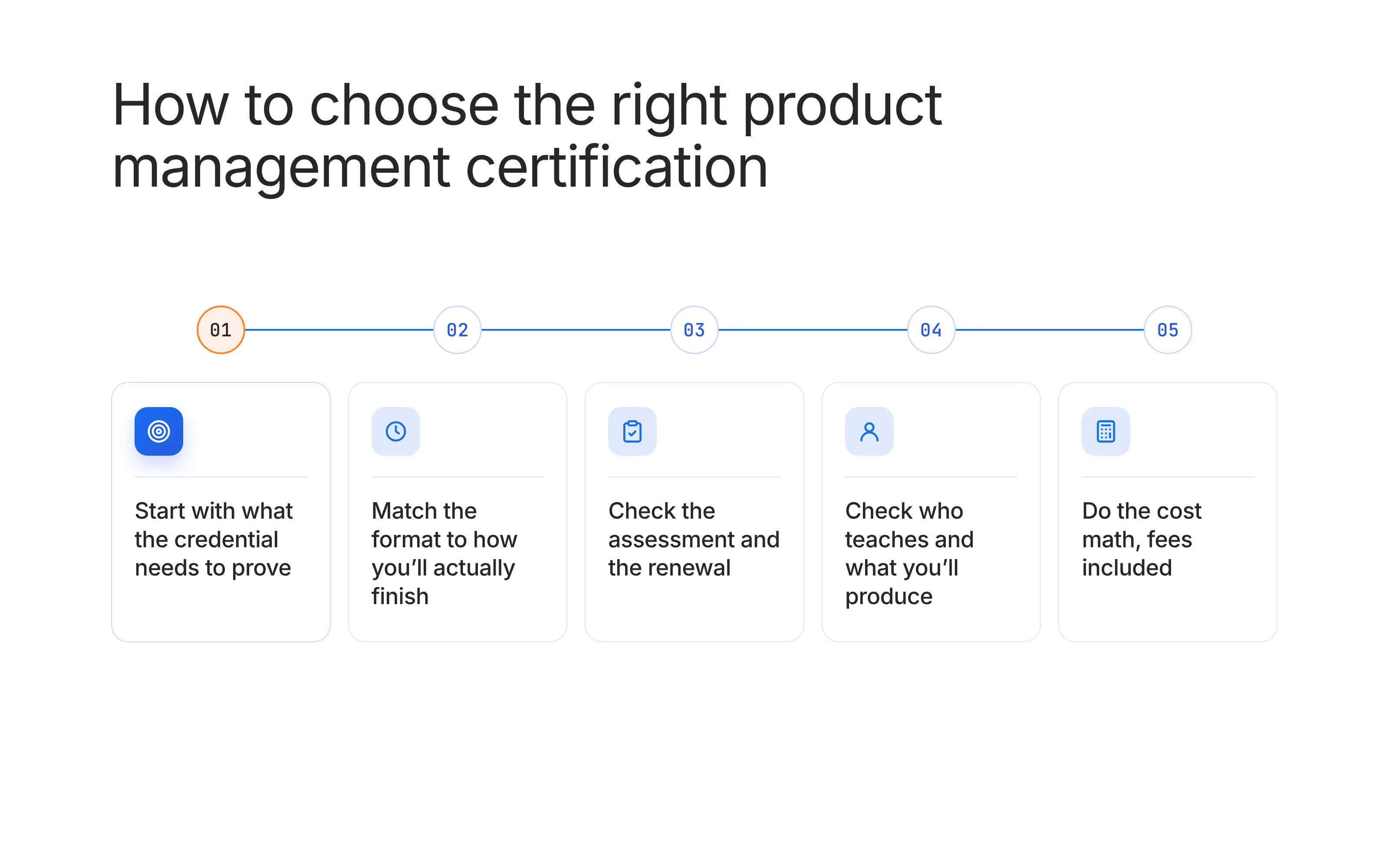
Start with what the credential needs to prove
Write down what you want the certification to do for you. If a job posting asks for PSPO or CSPO, the decision is made. If you want to prove your knowledge to an employer that values standards, pick an exam. If you want to change what you can do at work next month, pick a program where you produce something and get feedback on it.
For most PM roles nowadays, part of what you need to prove is that you can work with AI. As Elena Verna, who leads growth at Lovable, put it on the ProductCon stage: "Platform shifts are everywhere. Your product roadmap includes something related to AI, I'm sure. Otherwise, you're living on the moon, or your CEO is not paying attention."
Match the format to how you'll actually finish
Self-paced programs suit people who can protect study time every week and want to keep costs low. Live cohorts add deadlines, a peer group, and someone reviewing your work, which helps if your calendar usually wins.
Pick the format you'll complete.
Check the assessment and the renewal
An exam proves knowledge, a graded project shows you can apply it, and attendance shows you showed up. Check which one you're paying for, and whether you'll pay again to keep it: CSPO renews every two years, NPDP every three, and PSPO 1 never.
Check who teaches and what you'll produce
Look for named instructors with current product roles and a deliverable you keep, such as a PRD, a prototype, or an evaluation plan you can walk through in an interview.
Do the cost math, fees included
Add application fees, subscriptions, membership renewals, and exam retakes to the list price. A $200 exam, a $3,900 certificate, and a $4,999 annual membership buy very different things, so compare what you get per dollar as well as the total.
Before you enroll, check that:
The price is published, including any application or renewal fees.
The assessment rules are published: exam, project, or attendance.
The instructors are named, with current product roles.
You'll finish with a deliverable you can keep and show.
The renewal terms are clear.
The refund policy is published.
Pick the Credential for What It Proves
Choose the certification for what it proves, check how it's assessed and what it really costs, and favor programs that leave you with work you can show. David Hsu, CEO of Retool, put the bigger reason well in a Product School webinar: "As a Senior PM, I think the faster the industry is changing, the more important it is to stay on top."
If a live, AI-focused program fits your goal, our AI Product Management certification is built for working PMs, and Product Management Foundations is the place to start if you're new to the role. A certification can sharpen specific skills and give you proof of work. None of them hands anyone the job.
Updated: November 17, 2026