The best courses for product managers in 2027 build AI fluency first, then the supporting skills that decide whether AI output becomes a good product decision: data analytics, UX, technical literacy, pricing, writing, and negotiation. If you're new to the role, start where this list does, with the fundamentals in our live Product Management Certification.
Full disclosure: I run Product School, and the first eight courses below are ours. I've described them with the same fields as the other 16, drawbacks included.
This list is about skills. If you need an exam-based credential that employers screen for, such as PSPO I or NPDP, our guide to the best product management certifications covers those.
Best Courses for Product Managers: The Shortlist
Best place to start: Product School's Product Management Foundations, a three-week live course in which you carry one product from problem to launch plan and keep six artifacts, including a PRD and a prototype.
Best for becoming an AI product manager: Product School's AI Product Management Certification, which covers prompting, feasibility, the harness around the model, AI-native UX, agents, and evals in six live sessions.
Best for building with AI: Product School's Vibe Coding for shipping a live product, or Claude Code for PMs for answering your own research and data questions.
Best free AI course: Anthropic's AI Fluency: Framework & Foundations, which takes about three to four hours and is free, certificate included.
Best data analytics courses for product managers: UC Davis's SQL for Data Science for querying data yourself, paired with Udacity's free A/B Testing course, co-taught by Google Fellow Diane Tang.
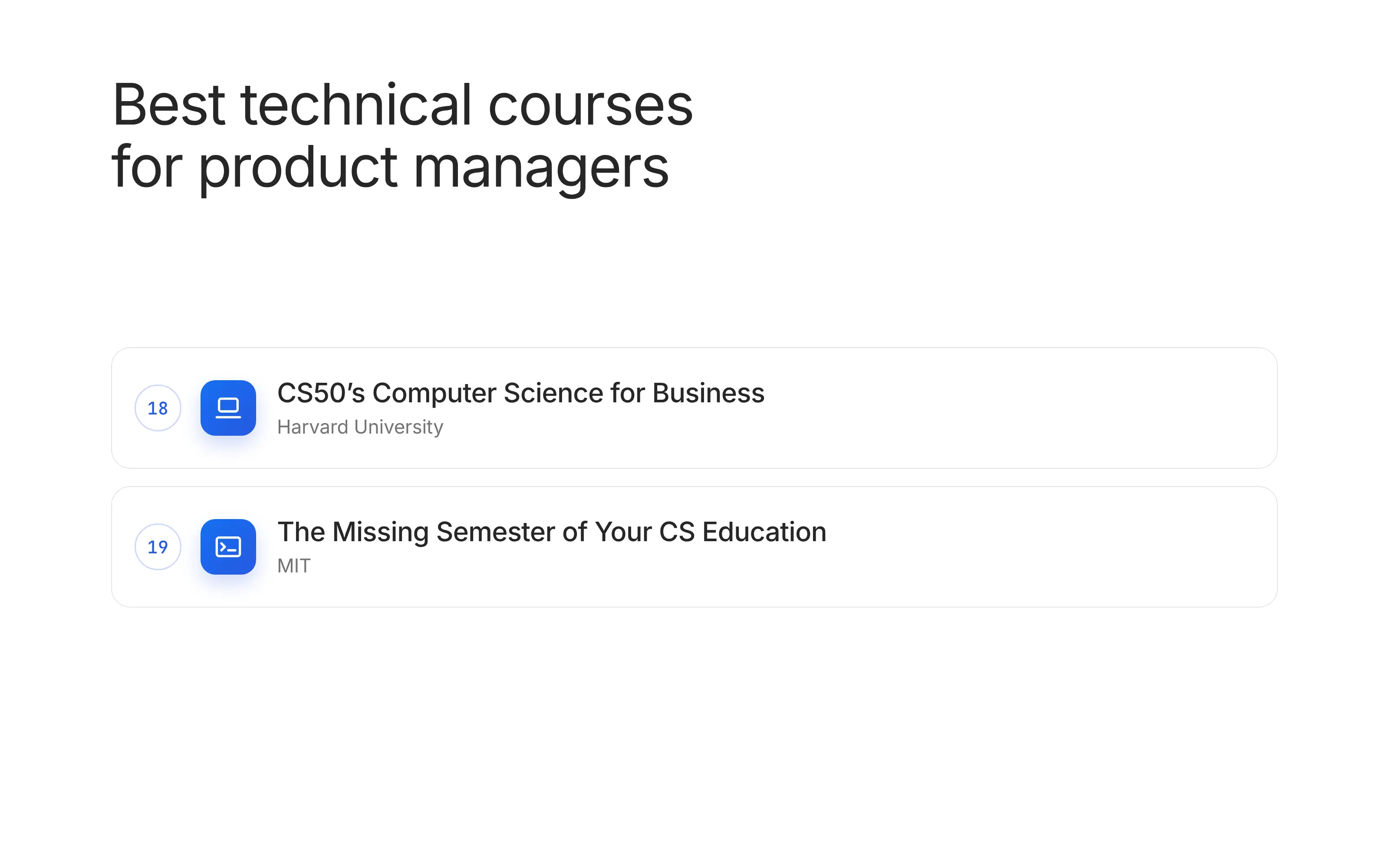
Best for technical literacy: Harvard's free CS50's Computer Science for Business, which Harvard says is designed for managers, product managers, founders, and decision-makers.
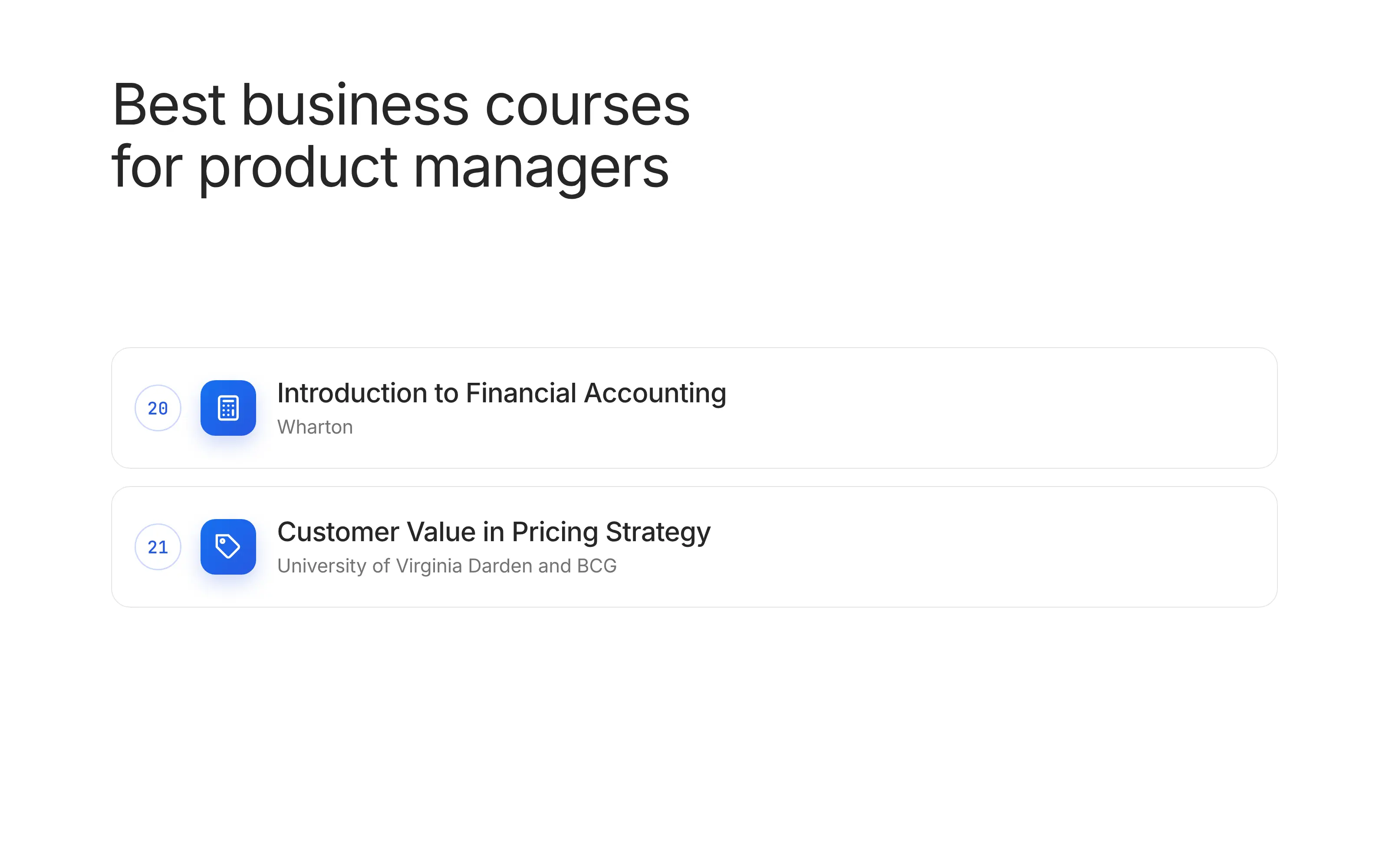
Most underrated skill to train: Pricing, through the University of Virginia and BCG's Customer Value in Pricing Strategy.
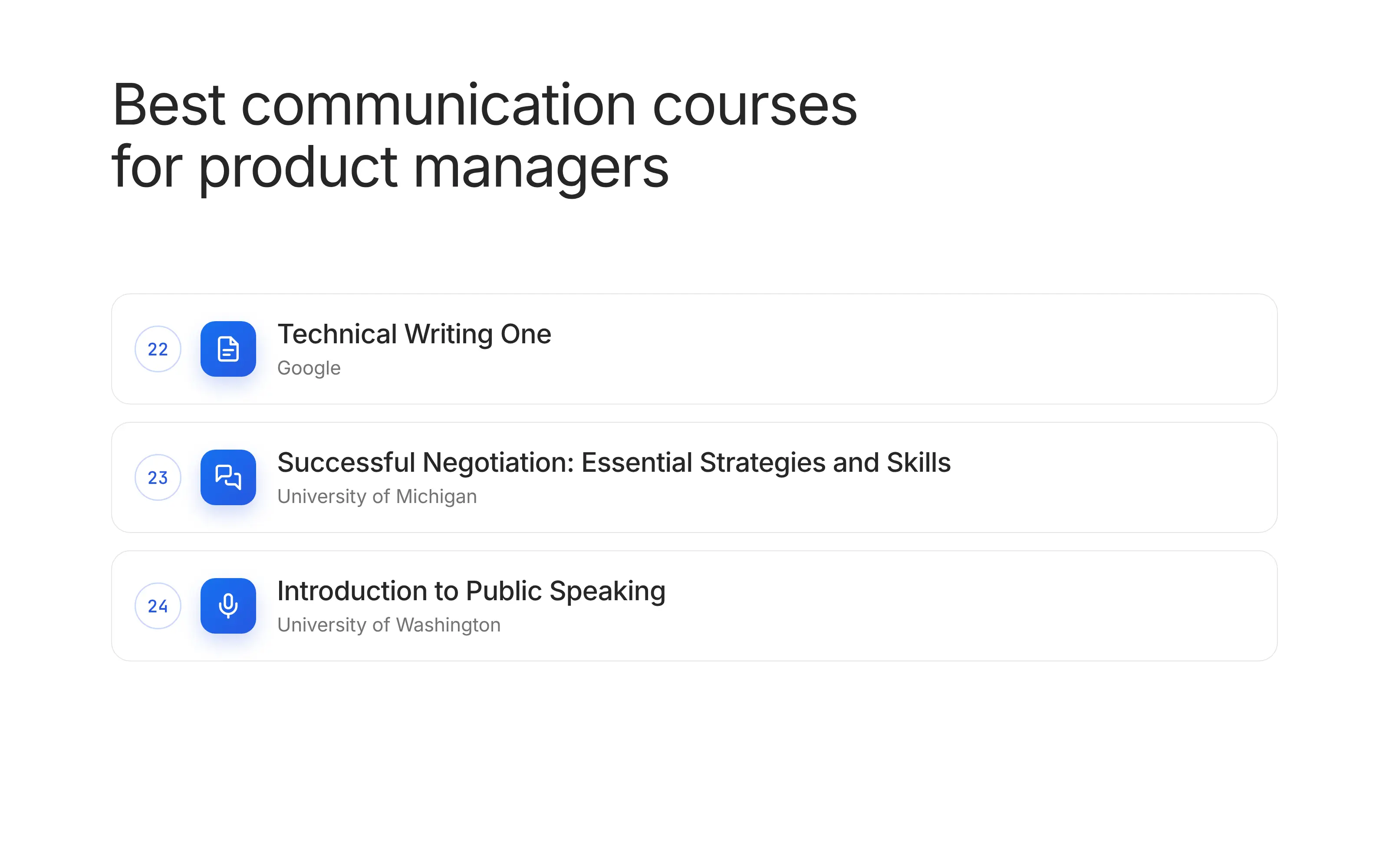
Best for writing: Google's free Technical Writing One, the same course Google engineers take, with about two hours of self-paced lessons.
Best for negotiation: The University of Michigan's Successful Negotiation, rated 4.8/5 by more than 20,000 reviewers on Coursera.
Which PM Skill Each Course Builds
# | Course (provider) | PM skill it builds | Level | Price |
1 | Product Management Foundations (Product School) | Product fundamentals, from discovery to go-to-market | Beginner | $2,999 |
2 | AI Product Management (Product School) | AI product management | Intermediate | $2,999 |
3 | Vibe Coding (Product School) | Building and shipping with AI | Intermediate | $2,999 |
4 | Claude Code for PMs (Product School) | AI-assisted research, metric checks, and prototyping | Intermediate | $2,999, plus a paid Claude plan |
5 | AI Evals (Product School) | AI quality and ship decisions | Advanced | $2,999 |
6 | Agentic Workflows & Loops (Product School) | Designing AI agents | Advanced | $2,999 |
7 | AI Product Strategy for Leaders (Product School) | AI strategy and business cases | Advanced | $2,999 |
8 | Product Analytics & Experimentation (Product School) | Growth analytics, experiments, and pricing validation | Intermediate | $2,999 |
9 | AI Fluency: Framework & Foundations (Anthropic) | Working with AI day to day | Beginner | Free |
10 | Generative AI for Everyone (DeepLearning.AI) | Scoping generative AI projects | Beginner | Free to start |
11 | Machine Learning Crash Course (Google) | Machine learning fundamentals | Beginner to intermediate | Free |
12 | SQL for Data Science (UC Davis) | Querying data | Beginner | Free to start |
13 | Introduction to Statistics (Stanford) | Statistical thinking | Beginner | Free to start |
14 | A/B Testing (Udacity, with Google instructors) | Experiment design | Beginner | Free |
15 | Amplitude Academy (Amplitude) | Product analytics tools | Beginner | Free |
16 | Foundations of User Experience (UX) Design (Google) | UX fundamentals | Beginner | Free to start |
17 | Introduction to Web Accessibility (W3C) | Accessibility | Beginner | Free to audit, $99 certificate |
18 | CS50's Computer Science for Business (Harvard) | Technical literacy | Beginner | Free |
19 | The Missing Semester of Your CS Education (MIT) | The terminal, Git, and agentic coding tools | Beginner | Free |
20 | Introduction to Financial Accounting (Wharton) | Financial literacy | Introductory | Free to start |
21 | Customer Value in Pricing Strategy (UVA Darden and BCG) | Pricing | Beginner | Free to start |
22 | Technical Writing One (Google) | Writing specs and docs | Beginner | Free |
23 | Successful Negotiation (University of Michigan) | Negotiation | Beginner | Free to start |
24 | Introduction to Public Speaking (University of Washington) | Presenting | Beginner | Free to start |
"Free to start" means you can enroll on Coursera at no cost, while full access and a certificate come with Coursera Plus ($59 a month or $399 a year) or a certificate purchase.
The Product Manager Skills That Matter Most in 2027
AI fluency is the skill I'd train first in 2027, because it changes how every other PM skill gets used. You'll query data through an AI assistant, prototype with an AI builder, and write specs an agent will act on.
Product managers are already ahead of most functions. LinkedIn's January 2026 report found that 10% of US members in product management list AI skills, tied with engineering for the highest share, against a 3% average across all US members. The market pays for it, too. PwC's 2026 Global AI Jobs Barometer, which analyzed more than a billion job ads in 27 countries and territories, found jobs requiring specific AI skills growing roughly eight times as fast as the overall jobs market (69% against 9%), with an average wage premium of 62% for AI skills.
The clearest shift is who's expected to build. As I said in my ProductCon London talk, product, design, and engineering roles are converging into what's being called an AI builder. If you're a PM, basically, you need to learn to build.
AI skills also go stale quickly. Aparna Sinha, VP of Product at Vercel, told the ProductCon audience that "building in AI is like building in an earthquake," since the best model can change several times a day. So plan to refresh your AI skills at least once a year.

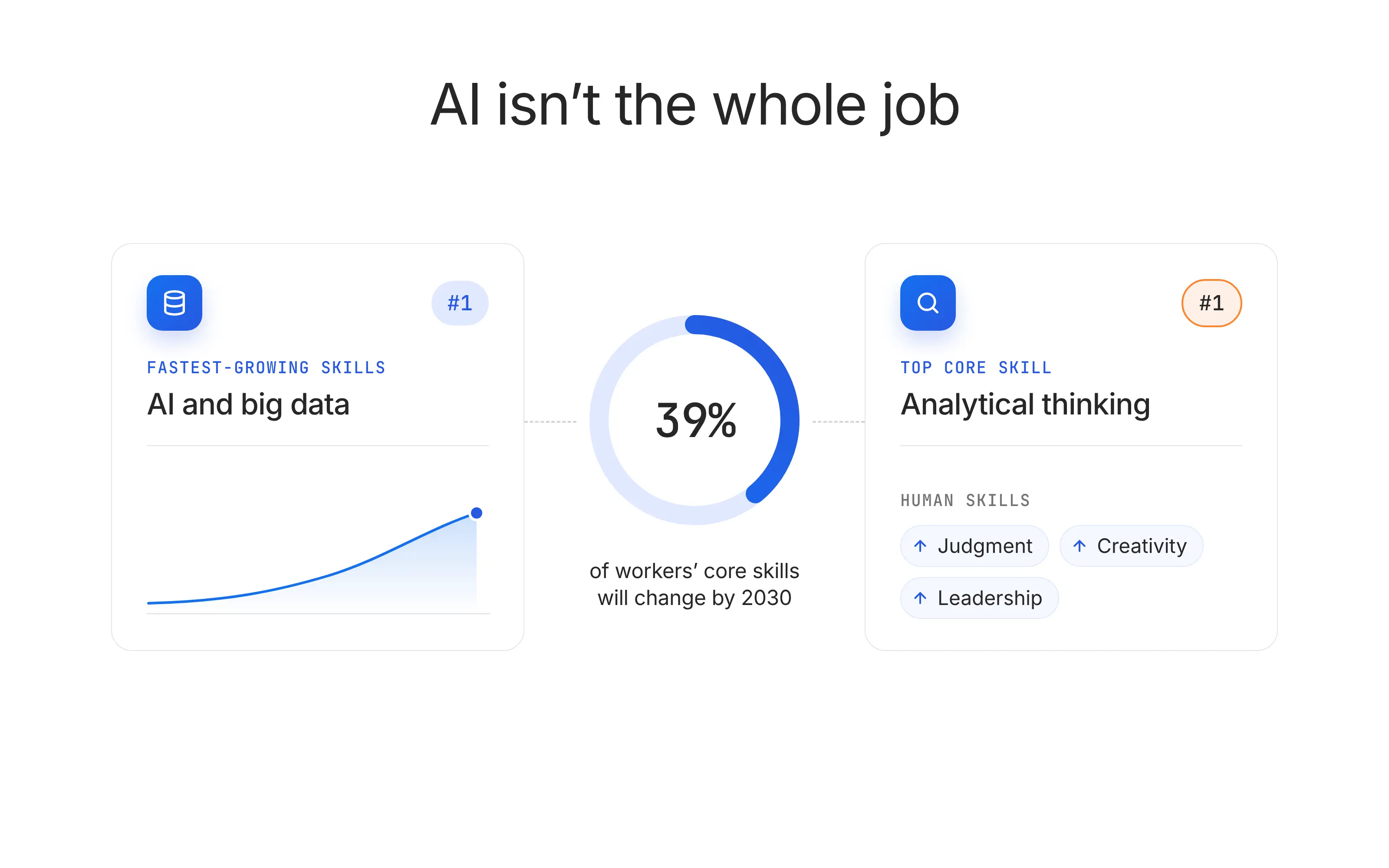
AI isn't the whole job, though. PwC found AI is increasing the emphasis on human skills such as judgment, creativity, and leadership. The World Economic Forum's Future of Jobs Report 2025 expects 39% of workers' core skills to change by 2030, ranks AI and big data as the fastest-growing skills, and still puts analytical thinking at the top of the core skills employers want.
Here's how the skills that matter in 2027 map to the courses below. Our guide to product manager skills covers the full set.
AI product judgment: Deciding what AI should and shouldn't do in your product, and how you'll know it works. Courses 2, 5, 6, 7, and 10.
Building with AI: Turning an idea into a working prototype or live product yourself. Courses 3, 4, and 19.
Everyday AI fluency: Delegating work to AI, describing the task well, and judging what comes back. Courses 9 and 11.
Data analytics: Checking the number an AI tool hands you before you act on it. Courses 8, 12, 13, 14, and 15.
UX judgment and accessibility: Judging AI-generated screens and making sure everyone can use them. Courses 16 and 17.
Technical literacy: Understanding systems well enough to direct engineers and AI agents. Courses 18 and 19.
Business acumen: Reading financials and pricing AI features whose costs grow with usage. Courses 7, 20, and 21.
Writing: Specs and prompts clear enough for people and agents to act on. Course 22.
Influence: Negotiating and presenting to people you don't manage. Courses 23 and 24.
How I Chose These Courses
Most lists of the best courses for product management stop at PM fundamentals. I included those, then went looking for the supporting skills PMs usually don't sign up for.
I picked each course for the skill it builds, then checked it on the provider's own page: price, level, time commitment, and what you produce. Ratings come from named review sites: usually the platform that hosts the course, such as Coursera or Udacity, Class Central where the platform shows none, and Course Report and G2 for Product School.
Prices, ratings, and enrollment counts were checked in November 2026 and change often, so confirm them before you enroll.
Best Product Management and AI Courses From Product School
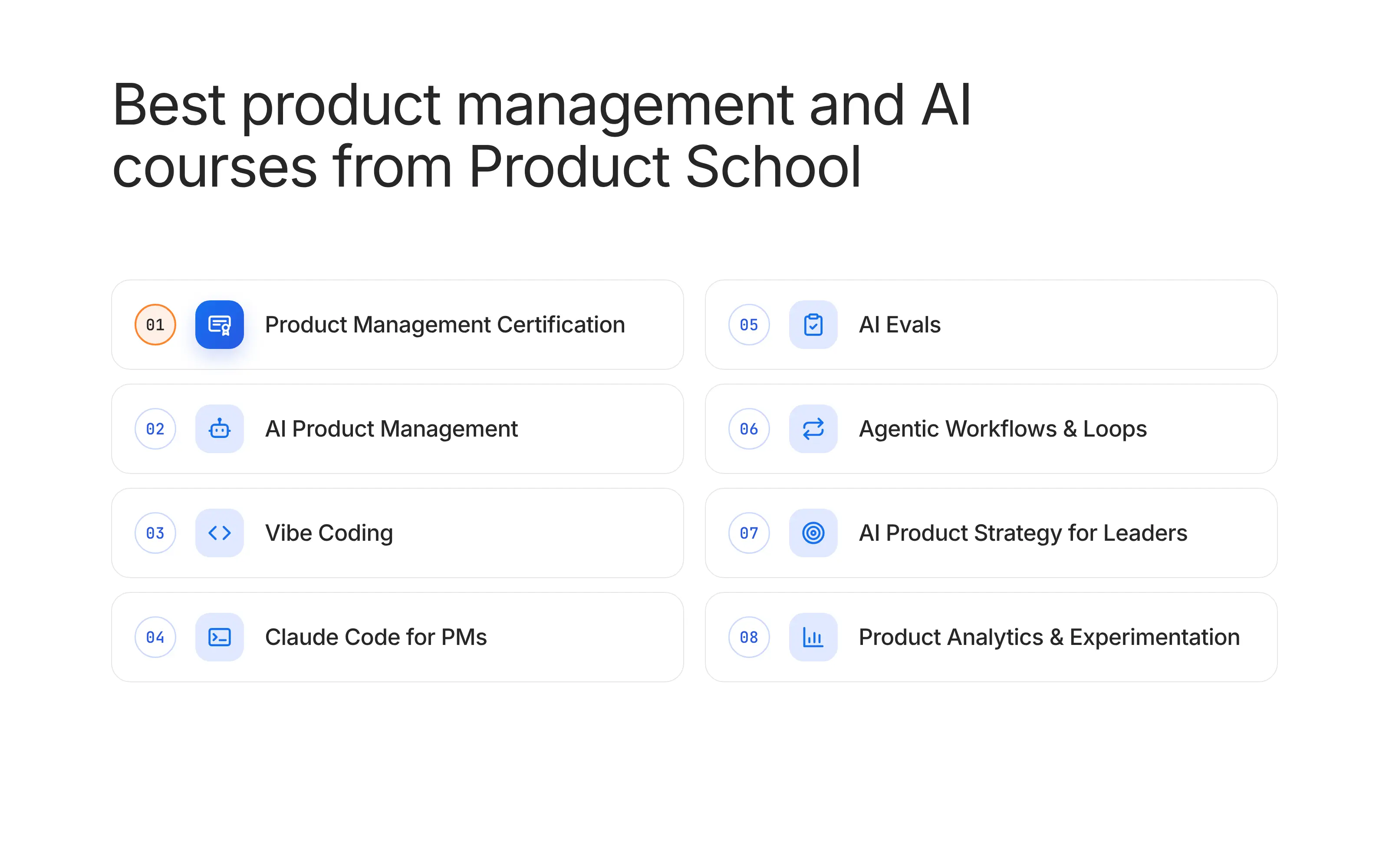
We designed these courses this way: fundamentals first, then AI product management, then the hands-on and specialist skills AI PMs increasingly own, from prototyping to AI evals and AI agents. Our guide to the AI product manager role explains how that role differs from using AI at work.
What all eight share:
Format: Three weeks of live online classes in six two-hour sessions (12 live hours), about 20 students per class, and recordings.
Output: Six artifacts in a repo you keep, ending in a final project your instructor grades.
Instructors: Working product leaders. Upcoming cohorts list instructors from companies including Amazon, Apple, Google, Meta, and Uber.
Price: $2,999 per course. A Pro Membership is $3,999 a year with one live course, and an Unlimited Membership is $4,999 a year with all 12, plus on-demand courses, 1:1 coaching with a product leader, and a ProductCon ticket.
Ratings: Product School holds 4.8/5 across 218 reviews on Course Report and 4.5/5 across 65 reviews on G2. Course Report lists several of our AI courses but doesn't show ratings for them yet.
Limits: There's no independent exam, and 12 live hours is a short course. You'll get the most out of it by applying the final project to your own product.
1. Product Management Certification (Product School)
Best thing about this course is that in three weeks, you carry one product from problem to launch plan and keep all six artifacts, from the value proposition to a PRD, a prototype, and a go-to-market strategy.
Product Management Certification (Foundations) is our live course for new and aspiring PMs, a revamp of our Product Manager Certification with AI-assisted discovery, rapid prototyping, and experimentation. Sessions cover product thinking, qualitative discovery, metrics, roadmaps and PRDs, experiments, and go-to-market, on a practice product or your own.
AI makes it cheap to build the wrong thing quickly, which is exactly why I'd learn problem selection and metrics before tools.
Best for: Aspiring PMs, career switchers, and product-adjacent people such as consultants and founders.
Pluses: No PM experience required; one product carried end to end gives you portfolio work; small classes mean an instructor actually reviews your artifacts.
Minuses: It's an introduction, so working PMs should start with AI Product Management. Free resources cover some of the theory, so you're paying for structure, feedback, and the artifacts.
Rating: 4.5/5 on Course Report (28 course reviews, most of them for earlier versions of the course).
Level: Beginner; no prior PM experience required.
Price: $2,999, or included with a Pro or Unlimited Membership.
Product Management Foundations Certification
Use the most popular certification to learn the core skills, mindset, and tools to become a great Product Manager in the age of AI, and ship products people actually use.
Enroll now
2. AI Product Management (Product School)
Best thing about this course: It covers the whole AI PM job in one build, taking a single case product, Juno, from prompting and feasibility to agents, evals, and guardrails.
AI Product Management is the course at the center of that path. Its six sessions cover AI-first execution with prompting, validating AI opportunities and technical feasibility, specifying the harness around the model, designing AI-native user experiences, deploying agentic workflows, and measuring quality with evals and guardrails. We strongly advise taking it before Vibe Coding, Claude Code for PMs, AI Evals, or Agentic Workflows & Loops.
Best for: Working PMs, ideally with a year or more in the role, and senior PMs guiding teams through AI-native development.
Pluses: No engineering background assumed; it covers strategy and execution together; it sets up every specialist AI course on this list.
Minuses: Six topics in six sessions means breadth over depth. Complete beginners should take Foundations first.
Rating: No course-level rating on review sites yet; Product School overall holds 4.8/5 on Course Report.
Level: Intermediate; best suited to people with PM experience.
Price: $2,999, or included with a Pro or Unlimited Membership.
AI Product Management Certification
Adopt an AI-first mindset: design AI-native UX, build agents, define modern PRDs, and ship trustworthy AI-powered products.
Enroll now
3. Vibe Coding (Product School)
Best thing about this course: Built in exclusive partnership with Lovable, it takes you past the prototype to a live, deployed product connected to real databases and APIs.
Vibe Coding is the upgraded version of our AI Prototyping Certification. Sessions move from fast prototyping and risk-based validation through prompt chaining, production specs, and full-stack logic to measuring performance, and the final project ships your product end to end. No coding experience is assumed.
Best for: PMs, senior PMs, and founders who want to test ideas with working software.
Pluses: You finish with a live URL; the spec you write is one engineering can execute against; the skill maps to the live prototyping rounds some AI-first companies now run in
.
Minuses: Not entry level, since we strongly advise AI Product Management first. It's built around one partner tool, so expect some translation if your team uses another.
Rating: No course-level rating on review sites yet; Product School overall holds 4.8/5 on Course Report.
Level: Intermediate; not an entry-level course.
Price: $2,999, or included with a Pro or Unlimited Membership.
Vibe Coding Certification
Go from idea to prototype in minutes. Build, debug, and scale AI prototypes with the latest tools to integrate APIs securely and hand off to engineering fast.
Enroll now
4. Claude Code for PMs (Product School)
Best thing about this course: No coding experience is assumed, yet by the end you're verifying metrics, inspecting codebases, and turning descriptions into prototypes yourself.
Claude Code for PMs teaches you to onboard Claude Code to your product, listen to customers at scale, verify product metrics, inspect codebases without coding, turn descriptions into prototypes, and automate recurring workflows. The final project is a prompt library built from six artifacts. If your team works in OpenAI's tools, Codex for PMs follows the same six-module curriculum with Codex. We covered why this matters in Claude Code for product managers.
Best for: Working PMs who want to answer their own research and data questions without waiting on engineering.
Pluses: Built around PM work instead of developer tutorials; you leave with reusable workflows; the Codex version lets you match your company's stack.
Minuses: You also need a paid Claude plan or an Anthropic API account, which the course fee doesn't cover. It isn't entry level, and we strongly advise AI Product Management first.
Rating: No course-level rating on review sites yet; Product School overall holds 4.8/5 on Course Report.
Level: Intermediate; for working PMs with solid fundamentals.
Price: $2,999, or included with a Pro or Unlimited Membership, plus your own Claude subscription.
Claude Code for Product Managers
Claude Code is already changing how the best PMs work — at Stripe, Linear, and the fastest-moving teams in tech. Use the AI tool reshaping product work to prototype, analyze, and ship, before a ticket is written.
ENROLL NOW
5. AI Evals (Product School)
Best thing about this course: You build a CI eval gate, the automated check that stops an AI release from shipping when it fails your quality bar.
AI Evals moves from modern eval metrics and failure-mode discovery to calibrated eval suites, the CI gate, online and closed-loop evaluation at scale, and a culture of responsible AI. The final project ships a recommendation for a case product, Ascend IQ. Our guide to AI evals for product managers explains why evaluation has become a core PM skill.
Best for: PMs and leads who own the quality of an AI feature and the call on whether it ships.
Pluses: It replaces gut-feel launch debates with a quality bar the team agrees on in advance; it covers evaluation after launch as well as before.
Minuses: It isn't entry level. We strongly advise AI Product Management first and recommend Vibe Coding experience, and it pays off mainly when AI sits in your core product flow.
Rating: No course-level rating on review sites yet; Product School overall holds 4.8/5 on Course Report.
Level: Advanced.
Price: $2,999, or included with a Pro or Unlimited Membership.
AI Evals Certification
Learn to build trusted AI products. Design eval suites, integrate CI/CD gates, monitor drift and bias, and lead responsible AI adoption.
Enroll now
6. Agentic Workflows & Loops (Product School)
Best thing about this course: It starts with restraint: before you automate anything, you decide where the agent line falls and how much blast radius each decision can carry.
Agentic Workflows & Loops, also called our Advanced AI Agents Certification, moves from drawing the agent line and turning a prompt into a worker to orchestrating with restraint, engineering context, setting bounds with evals as the PRD, and using an autonomy dial to widen trust over time. The final project deploys a case agent, Cortex, end to end.
Best for: PMs, senior PMs, and leads who will own AI agents in production.
Pluses: It treats evals as the spec for agent behavior; it gives you a shared vocabulary for autonomy decisions that leadership can follow.
Minuses: It's one of our most advanced courses. We strongly advise AI Product Management first and highly recommend Vibe Coding, so budget for more than one course.
Rating: No course-level rating on review sites yet; Product School overall holds 4.8/5 on Course Report.
Level: Advanced; for intermediate and advanced PMs.
Price: $2,999, or included with a Pro or Unlimited Membership.
Agentic Workflow & Loops Certification
Orchestrate a fleet of AI agents executing your product work 24/7. An autonomous operating system of skills and workflows that frees you for higher-impact work.
Enroll now
7. AI Product Strategy for Leaders (Product School)
Best thing about this course: Every session answers a question your board will ask, from defensibility to margin, and admission by manual approval means you learn alongside experienced product leaders.
AI Product Strategy for Leaders is for people accountable for product outcomes. Sessions cover what to build and how fast you'll know it works, defensibility, whether a feature makes money or erodes margin, user trust, what breaks at scale, and how to fund and pitch the strategy. The final project is a strategy repo you present.
Best for: Senior, principal, lead, and staff PMs, group PMs, directors and VPs of product, and founders and executives.
Pluses: You learn alongside peers at your level; it centers the margin and defensibility questions that feature-level courses rarely reach.
Minuses: Only experienced product leaders are admitted. The focus is strategy, so pair it with a hands-on course if you also want to build.
Rating: No course-level rating on review sites yet; Product School overall holds 4.8/5 on Course Report.
Level: Advanced; requires approval.
Price: $2,999, or included with a Pro or Unlimited Membership.
AI Product Strategy for Leaders
By the end, you will possess a board-ready AI Strategic Roadmap and Governance Framework, positioning you not just as a product builder but as the executive leader driving your company’s transformation.
ENROLL NOW
8. Product Analytics & Experimentation (Product School)
Best thing about this course: It runs the full growth funnel in six sessions, from acquisition and activation to retention, advanced experimentation methods, and pricing validation.
Product Analytics & Experimentation covers product-led growth, acquisition and activation flows, retention and engagement, sharpening hypotheses with data, advanced experimentation methods, and validating pricing and monetization strategies. The final project is a growth strategy you present for a case company, FinWise.
Best for: Working PMs, senior PMs building experimentation into team culture, and people in growth, marketing, or data roles who want a PM's view.
Pluses: It ties analytics to growth decisions; a full session on pricing and monetization links the numbers to revenue.
Minuses: PM experience is required. The focus is analysis and decisions, so add a SQL course, such as number 12, if you want hands-on querying.
Rating: No course-level rating on review sites yet; Product School overall holds 4.8/5 on Course Report.
Level: Intermediate; not an entry-level course.
Price: $2,999, or included with a Pro or Unlimited Membership.
Product Analytics and Experimentation
Accelerate revenue growth through data-driven experimentation. Pair analytics with trustworthy experiments, and use AI to surface the insights that sharpen your decisions.
ENROLL NOW
Best AI Fluency Courses for Product Managers
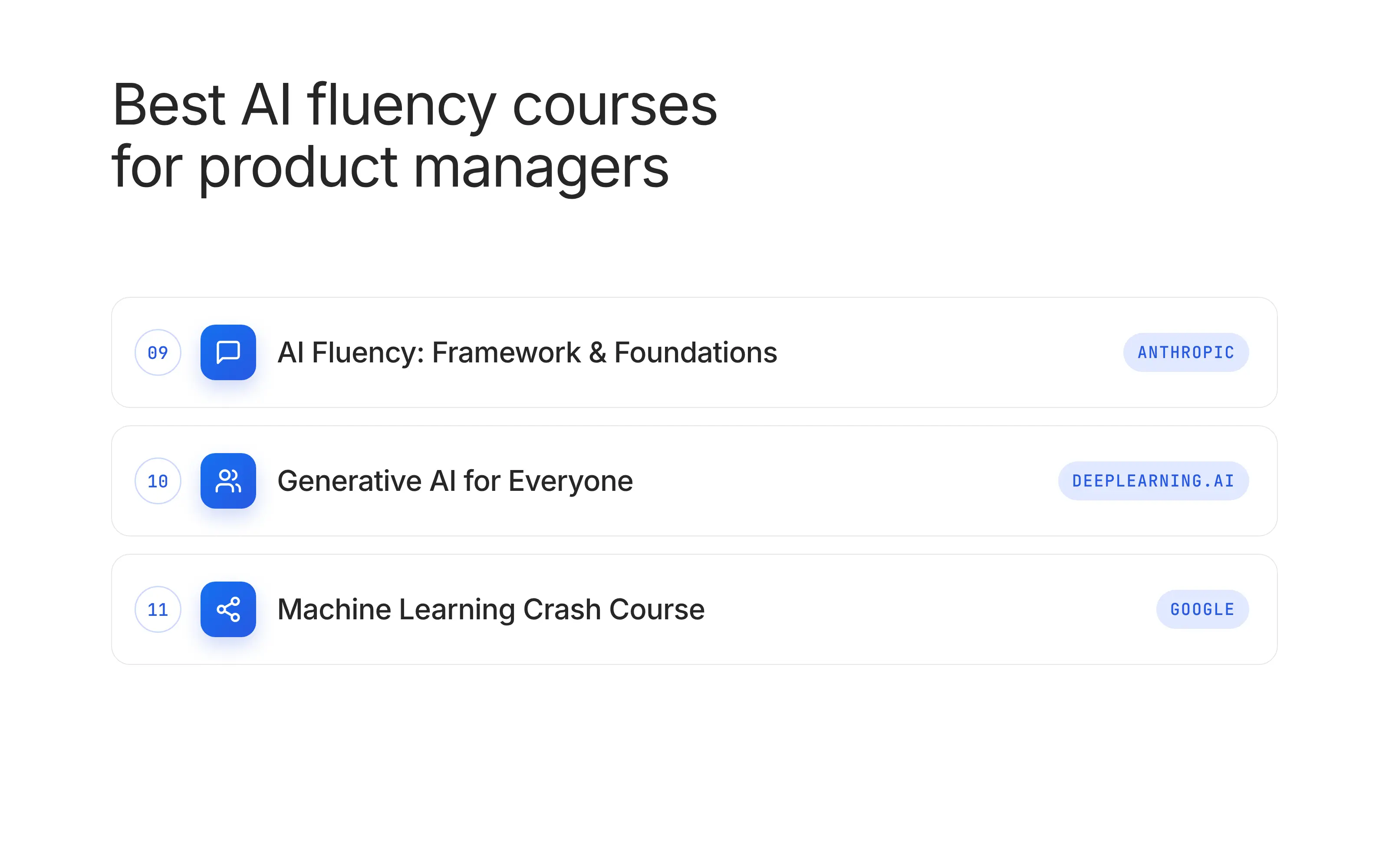
These three build AI fluency at little or no cost. They pair well with any of our AI courses, and they're a sensible first step if you're not ready to commit to a live course.
9. AI Fluency: Framework & Foundations (Anthropic)
Best thing about this course: It's free from the first lesson to the certificate, takes about three to four hours, and comes from Anthropic, the company behind Claude.
Anthropic built AI Fluency: Framework & Foundations with professors Rick Dakan of Ringling College of Art and Design and Joseph Feller of University College Cork. It's organized around their 4D framework (delegation, description, discernment, and diligence) and covers how generative AI works, prompting techniques, and the loop between describing a task and judging the result. It's also available on Coursera.
Best for: Any PM who uses AI daily and wants a repeatable way to decide what to hand off and how to check it.
Pluses: Free and short; the materials are openly licensed under CC BY-NC-SA 4.0; the framework applies to any AI assistant you use.
Minuses: It's about working with AI well, so it won't cover building AI features into a product.
Rating: 4.7/5 on Coursera (194 reviews).
Level: Beginner.
Price: Free, including the certificate.
10. Generative AI for Everyone (DeepLearning.AI)
Best thing about this course: It's taught by Andrew Ng, co-founder of Coursera and founding lead of the Google Brain team, whose Coursera courses have reached more than 10 million learners.
Generative AI for Everyone explains how generative AI works and what it can't do, then spends a full module on generative AI projects: the project lifecycle, cost, retrieval-augmented generation (RAG), fine-tuning, choosing a model, and tool use and agents. The last module covers how AI changes jobs and workflows and what responsible AI means in practice.
Best for: PMs who need to scope, cost, and explain generative AI projects to stakeholders.
Pluses: About six hours; no AI or coding background needed; it covers trade-offs such as RAG versus fine-tuning that come up in roadmap discussions.
Minuses: It's an overview, so you won't build anything. Full access and the certificate require Coursera Plus or a certificate purchase.
Rating: 4.8/5 on Coursera (5,392 reviews).
Level: Beginner.
Price: Free to start on Coursera.
11. Machine Learning Crash Course (Google)
Best thing about this course: It's free, it's from Google, and the refreshed version adds a module on how large language models work, from tokens to Transformers.
Google says millions of people have relied on Machine Learning Crash Course since 2018. Its 12 modules cover regression and classification, working with numerical and categorical data, neural networks, embeddings, LLMs, production ML systems, AutoML, and ML fairness. The module estimates add up to roughly 13 to 14 hours.
Best for: PMs who work with ML or data science teams and want to follow how models are trained, evaluated, and deployed.
Pluses: Free; self-contained modules let you skip what you already know; the fairness module covers auditing a model for bias, which matters once you own an AI feature.
Minuses: Exercises use Python and some algebra and statistics, which slows down non-technical readers. It explains models more than the product decisions around them.
Rating: Not rated on major review sites.
Level: Beginner to intermediate.
Price: Free.
Best Data Analytics Courses for Product Managers
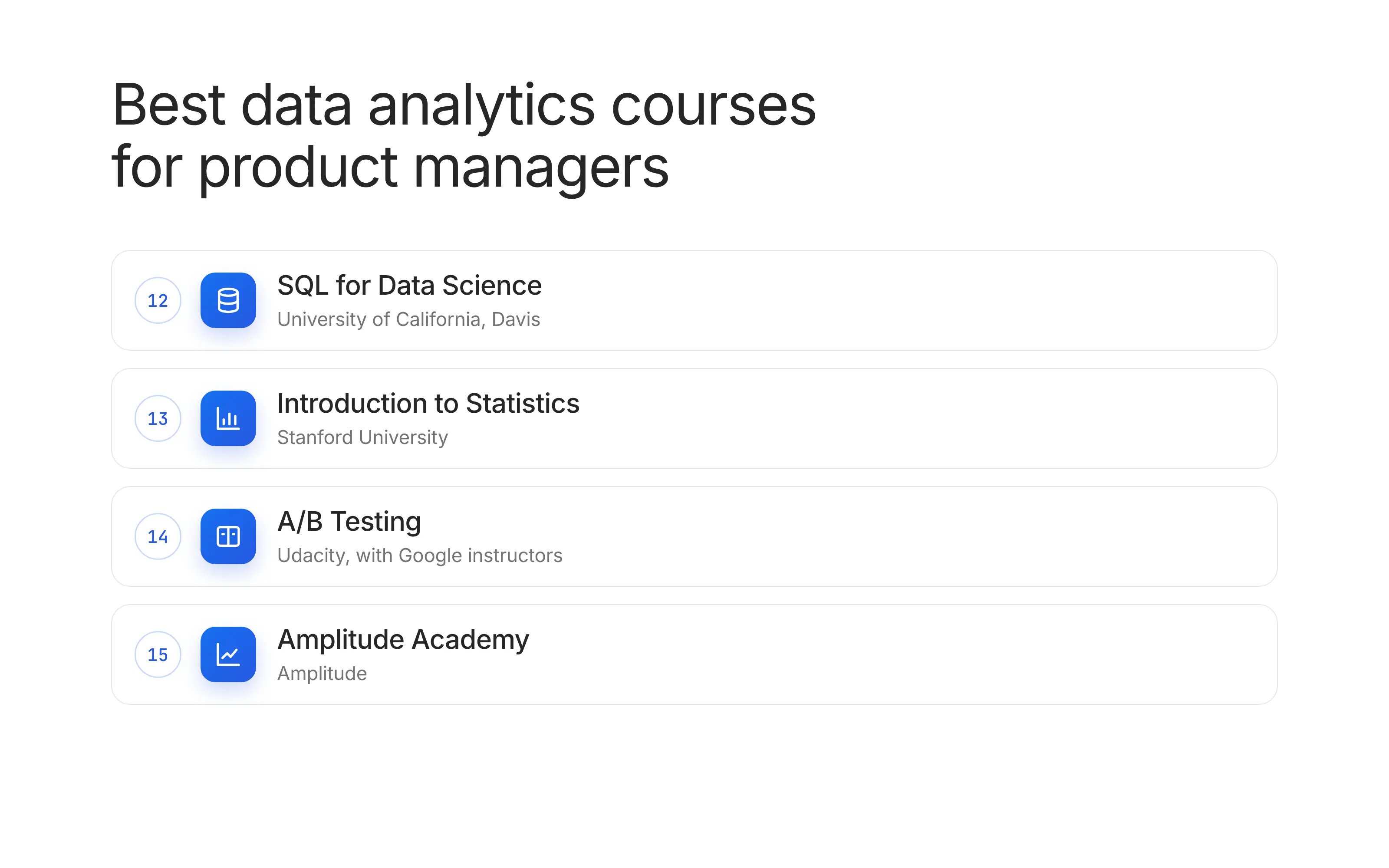
Data analytics is the supporting skill I'd train right after AI, because AI tools have made writing a query cheap and checking it the scarce part. Our guide to data skills for PMs ranks those skills, and data analysis for product managers covers the basics.
These four courses cover the core of data analytics for product managers: querying, statistics, experiments, and product analytics tools. For a live, PM-specific option, our Product Analytics & Experimentation course is number 8 above.
12. SQL for Data Science (University of California, Davis)
Best thing about this course: It takes you from your first query to joins and subqueries in about 15 hours, and more than 730,000 learners have enrolled.
Taught by Sadie St. Lawrence, SQL for Data Science takes you from selecting and retrieving data through filtering, sorting, and calculating, to subqueries and joins, and finally to modifying and analyzing data. Coursera's module estimates add up to about 15 hours.
Best for: PMs who want to answer first-order product questions themselves and check the SQL an AI assistant writes for them.
Pluses: It starts from zero; joins and subqueries get a full module, and that's where a lot of plausible-looking wrong answers come from.
Minuses: It's built for aspiring data scientists, so you'll translate the examples into product questions. Kaggle's Intro to SQL, which runs on Google BigQuery, is a shorter, free alternative.
Rating: 4.6/5 on Coursera (17,240 reviews).
Level: Beginner; no prior experience required.
Price: Free to start on Coursera.
13. Introduction to Statistics (Stanford University)
Best thing about this course: You get Stanford statistics in about 13 hours, including randomized experiments, tests of significance, and the multiple-comparisons problem.
Guenther Walther's Introduction to Statistics covers descriptive statistics, sampling and randomized experiments, probability, the normal approximation, regression, confidence intervals, significance tests, resampling, categorical data, ANOVA, and multiple comparisons across 12 short modules.
Best for: PMs who read experiment results and dashboards and want to know when a change is real.
Pluses: Short modules; it covers the concepts behind every A/B test readout; the multiple-comparisons module explains why checking many metrics at once produces false wins.
Minuses: It doesn't use product examples or cover A/B testing by name, so pair it with number 14.
Rating: 4.6/5 on Coursera (4,307 reviews).
Level: Beginner.
Price: Free to start on Coursera.
14. A/B Testing (Udacity, with Google instructors)
Best thing about this course: It's free, and it's co-taught by Google Fellow Diane Tang, co-author of Trustworthy Online Controlled Experiments: A Practical Guide to A/B Testing.
A/B Testing is taught by three Google instructors: Diane Tang, Engineering Fellow Carrie Grimes, and Caroline Buckey. Tang co-wrote Trustworthy Online Controlled Experiments (Cambridge University Press, 2020) with Ron Kohavi and Ya Xu. The five lessons cover A/B testing basics, policy and ethics for experiments, choosing and characterizing metrics, designing an experiment, and analyzing results.
Best for: PMs who run or review experiments and want results that hold up.
Pluses: Free; experiment ethics gets its own lesson; metric choice gets a full lesson, which is where many tests go wrong before they start.
Minuses: Udacity lists no prerequisites, but the analysis lessons lean on statistics, so number 13 is a good warm-up. It covers classic product experiments, so testing AI features needs extra methods such as offline evals.
Rating: 4.7/5 on Udacity (75 reviews).
Level: Beginner, per Udacity.
Price: Free.
15. Amplitude Academy (Amplitude)
Best thing about this course: Its learning paths tagged for product managers take about an hour each, and you practice in Amplitude's demo environment instead of watching slides.
Amplitude Academy is Amplitude's free training hub. Paths tagged for product managers include Getting Started with Amplitude Analytics and Getting Started with Amplitude Experiment, about 1.5 hours each, plus hour-long paths on retention and engagement, monetization, and acquisition. Short courses cover funnel analysis, behavioral cohorts, retention analysis, test plans, and feature flags, and finishing a path earns a badge.
Best for: PMs who want hands-on practice with funnels, cohorts, retention, and experiments in a real analytics tool.
Pluses: Free; short enough to finish in an afternoon; the concepts transfer to other analytics tools.
Minuses: It teaches one vendor's product, so it's most valuable if your team already uses Amplitude.
Rating: Not rated on major review sites.
Level: Beginner.
Price: Free.
Best UX and Accessibility Courses for Product Managers
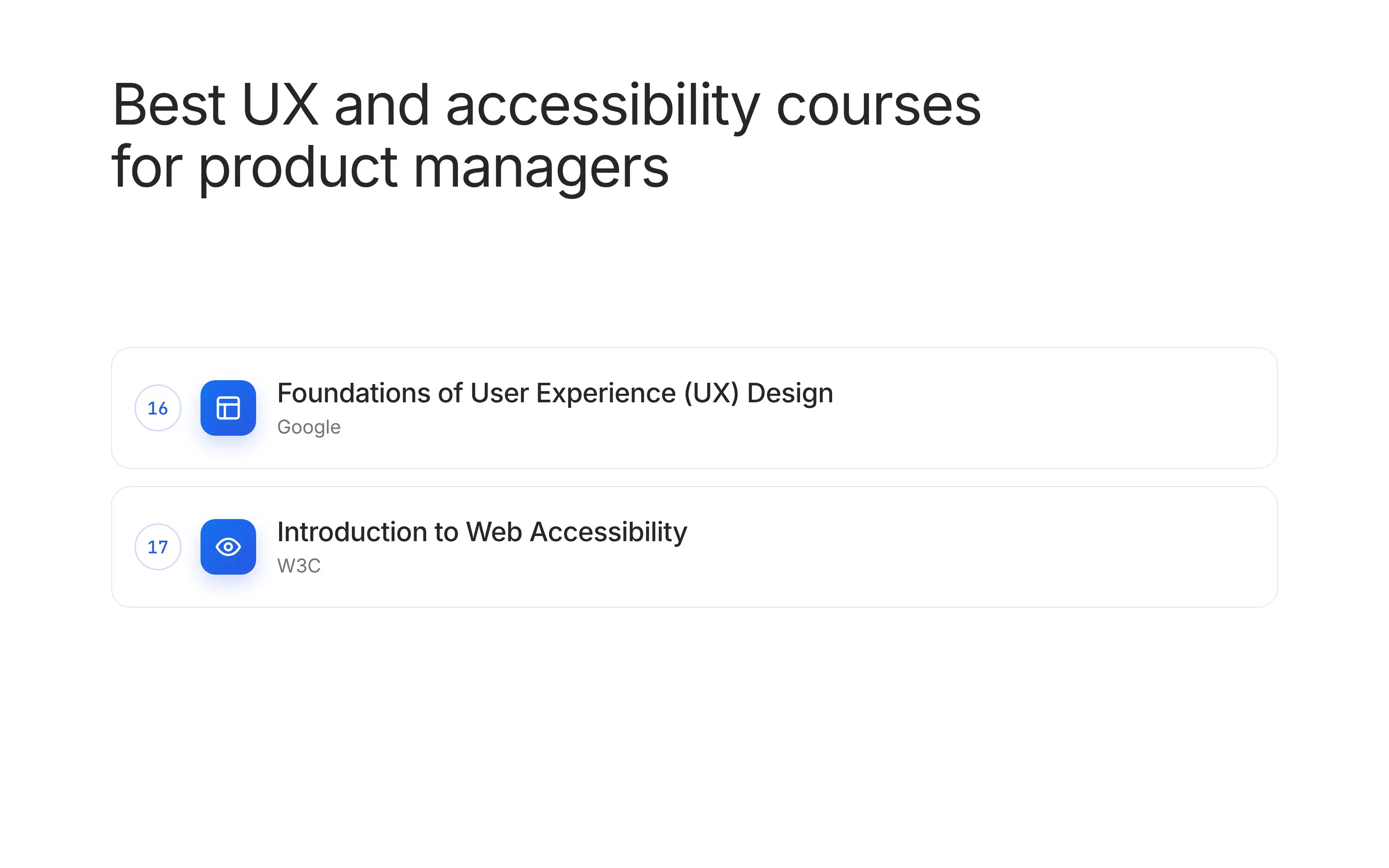
AI can generate a screen in seconds, which makes judging the screen a bigger part of the PM's job. These two courses cover the fundamentals of good UX and the accessibility standards your product may now be legally required to meet.
16. Foundations of User Experience (UX) Design (Google)
Best thing about this course: It's the most-reviewed course on this list, rated 4.8/5 across nearly 76,000 reviews, with more than 1.7 million learners.
Foundations of User Experience (UX) Design is the first of seven courses in Google's UX Design Professional Certificate, and you can take it on its own. Its four modules introduce UX design, how UX designers think, design sprints, and the portfolio project. Coursera's module estimates add up to about 12 hours.
Best for: PMs who work with designers and want a shared vocabulary for user-centered design and design sprints.
Pluses: Short; no experience needed; the design sprint module maps onto how product teams run discovery.
Minuses: It's the first step of a designer's certificate, and the later courses go deeper than most PMs need.
Rating: 4.8/5 on Coursera (75,998 reviews).
Level: Beginner.
Price: Free to start on Coursera.
17. Introduction to Web Accessibility (W3C)
Best thing about this course: It comes from the W3C, the organization that sets web standards, and auditing the full course is free.
Introduction to Web Accessibility, which the W3C also calls Digital Accessibility Foundations, covers how people with disabilities use digital technology, the business case, accessibility principles and standards, basic checks, and how to build accessibility into design and development. Optional tracks include project and organizational management. The W3C estimates 16 to 20 hours, at four to five hours a week, and updated the course page in October 2026.
I'd put accessibility on more PM roadmaps than it is today. The European Accessibility Act has applied since June 28, 2025, setting EU-wide accessibility requirements for many digital products and services.
Best for: PMs whose products serve the public, especially EU customers, and anyone who owns design or QA standards.
Pluses: Designed for non-technical learners as well as developers, with project managers named in the audience; the coding material is optional.
Minuses: It's longer than most picks here, and the verified certificate costs extra.
Rating: 4.3/5 on edX (78 ratings, as listed on Class Central).
Level: Beginner; designed for technical and non-technical learners.
Price: Free to audit; $99 for a verified certificate.
Best Technical Courses for Product Managers
Technical literacy for PMs used to mean speaking engineering's language. Now it also means directing and checking the AI agents that write code. These two courses cover the concepts and the tools.
18. CS50's Computer Science for Business (Harvard University)
Best thing about this course: Harvard built it with you in mind: the course page says it's "designed for managers, product managers, founders, and decision-makers."
David J. Malan's CS50's Computer Science for Business is the business version of Harvard's introductory CS50 course. Its nine weeks cover interpreting information, algorithms, data structures, programming, artificial intelligence, the internet, the web, databases, and security, with cloud computing, scalability, and privacy along the way.
Best for: Non-technical PMs who want to understand how the software they manage actually works.
Pluses: Free to take as OpenCourseWare, with a free CS50 certificate if you score at least 70% on every problem set and the final project; a full week on AI.
Minuses: Nine weeks of material is a real commitment, and the edX verified certificate costs extra.
Rating: 4.6/5 on Class Central (17 reviews).
Level: Beginner.
Price: Free; an optional verified certificate is sold through edX.
19. The Missing Semester of Your CS Education (MIT)
Best thing about this course: MIT's 2026 edition added a lecture on agentic coding and folds AI tools into the rest of the course.
The Missing Semester teaches the tools most computer science programs expect students to pick up on their own. The 2026 lectures, taught in January, cover the shell, the command-line environment, development tools, debugging and profiling, version control with Git, packaging and shipping code, agentic coding, and code quality.
Best for: PMs starting to work with AI coding agents in the terminal who want to feel at home in the command line and Git.
Pluses: Free; short lectures; current as of 2026.
Minuses: It's built for computer science students, so some lectures go deeper than PMs need, and there's no certificate.
Rating: Not rated on major review sites.
Level: Beginner.
Price: Free.
Best Business Courses for Product Managers
AI changed product economics. A traditional feature costs little to serve once it ships, while an AI feature can cost money every time someone uses it, which puts reading financials and pricing features firmly in the PM's job. For positioning, messaging, and packaging, our Go-to-Market Certification covers the launch side.
20. Introduction to Financial Accounting (Wharton)
Best thing about this course: Wharton's Brian Bushee teaches you to read a balance sheet, an income statement, and a cash flow statement in about 16 hours, and more than 8,500 reviewers rate it 4.7/5.
Introduction to Financial Accounting covers the balance sheet, accrual accounting and the income statement, cash flows, and ratio analysis, ending with a final exam.
Best for: PMs who present business cases or own part of a P&L and want to follow the finance conversation.
Pluses: Clear structure; ratio analysis helps you read the health of the business you work in.
Minuses: It's accounting, so it won't teach unit economics or pricing directly. Pair it with number 21.
Rating: 4.7/5 on Coursera (8,573 reviews).
Level: Introductory.
Price: Free to start on Coursera.
21. Customer Value in Pricing Strategy (University of Virginia Darden and BCG)
Best thing about this course: It's co-taught by Jean-Manuel Izaret, BCG's global leader for its Marketing, Sales & Pricing practice.
Customer Value in Pricing Strategy was developed at the University of Virginia's Darden School of Business with Boston Consulting Group. It covers understanding customer value, implementing value-based pricing, measuring customer preferences, and the psychology behind purchase decisions. It's the second course in a four-course pricing specialization.
I'd put pricing on every senior PM's list. Few PMs ever study it, yet it decides whether an AI feature with real usage costs makes money.
Best for: PMs who influence pricing, packaging, or monetization, especially for AI features whose costs grow with usage.
Pluses: Value-based pricing fits features whose worth differs by customer; the preference-measurement module gives you methods you can run.
Minuses: About 15 hours. Cost economics, competition, and a practice case live in the specialization's other three courses.
Rating: 4.8/5 on Coursera (380 reviews).
Level: Beginner.
Price: Free to start on Coursera.
Best Communication Courses for Product Managers
The human skills PwC's 2026 research flagged (judgment, creativity, and leadership) show up in a PM's week as writing, negotiating, and presenting. If you lead a product team, our Product Leadership Certification covers alignment and executive influence.
22. Technical Writing One (Google)
Best thing about this course: Google describes it as "the same technical writing courses that Google engineers take," and the self-paced lessons take about two hours.
Technical Writing One covers word choice, active voice, clear and short sentences, lists and tables, paragraphs, audience, and documents. Google aims it at engineers and at engineering-adjacent roles such as product managers, and organizations can run a facilitated in-class version.
I'd call writing the most underrated AI skill on this list. A spec, a prompt, and an instruction file for an agent all succeed or fail on how clearly they're written.
Best for: PMs who write PRDs, specs, and prompts that people and AI agents act on.
Pluses: Free; about two hours; short units you can apply to your next doc the same day.
Minuses: The examples come from engineering documentation, so you'll translate them to PRDs, and the in-class half needs a facilitator.
Rating: Not rated on major review sites.
Level: Beginner.
Price: Free.
23. Successful Negotiation: Essential Strategies and Skills (University of Michigan)
Best thing about this course: More than 1.6 million learners have enrolled, more than 20,000 reviews average 4.8/5, and the final module has you negotiate live.
George Siedel's Successful Negotiation walks through planning a negotiation strategy, key tactics, closing with a contract, and evaluating the outcome, then has you practice in an interactive experience and live negotiations.
Best for: PMs who negotiate scope, timelines, and resources with stakeholders, or contracts with vendors and partners.
Pluses: Highly rated; the planning framework works for internal trade-offs as well as contracts; you practice instead of only watching.
Minuses: The contract focus means you'll adapt some lessons to internal negotiations. Plan on about 14 to 20 hours.
Rating: 4.8/5 on Coursera (20,158 reviews).
Level: Beginner.
Price: Free to start on Coursera.
24. Introduction to Public Speaking (University of Washington)
Best thing about this course: It ends with a final speech of your own, and more than 2,300 reviewers rate it 4.7/5.
Matt McGarrity's Introduction to Public Speaking covers how speeches work, making ideas compelling and memorable, illustrating and delivering them, and managing speaking anxiety, ending with your final speech.
Best for: PMs who present roadmaps, launch plans, and recommendations to leadership.
Pluses: Practical; about 13 hours; useful for interviews and product reviews alike.
Minuses: It's general public speaking, so you'll adapt it to product reviews and demos.
Rating: 4.7/5 on Coursera (2,337 reviews).
Level: Beginner.
Price: Free to start on Coursera.
How to Pick Your Next Course
Pick the course that closes the gap costing you the most right now. Answer each question with a yes or a no. Every no points to a course.
Can you build and test a working prototype of an idea without filing a ticket? (Courses 3, 4, and 19)
Can you say what "good enough to ship" means for your AI feature, as a test your team agrees on? (Courses 2 and 5)
Could you verify the number in your last metrics update against the raw data? (Courses 12 and 13)
Did your last experiment have a primary metric and a sample size set before launch? (Courses 13 and 14)
Can you explain what your AI feature costs per use and how it's priced? (Courses 20 and 21)
Would your product pass a basic accessibility check? (Course 17)
Could an engineer, or an AI agent, act on your last spec without a follow-up meeting? (Course 22)
Can you hold your position on scope when a senior stakeholder pushes back? (Courses 23 and 24)
If you answered no to the first two, start with AI Product Management. If you're new to product management, take Foundations before any of them.
Learn the Skill Your Next Decision Needs
The right course is the one that closes the gap you'll hit next. For most PMs, nowadays, that means AI first, then whatever your AI work exposes: the query you can't check, the spec an agent misreads, the feature you can't price.
If you're new to the role, start with Product Management Foundations. If you already work as a PM, our AI Product Management Certification is the course I'd take next, and an Unlimited Membership covers all 12 of our live courses if you want the whole path. A course gives you practice and something to show for it. The skill only becomes yours when you use it on your next real decision.
Updated: November 17, 2026