The senior PM technical interview at AI-first companies now includes live AI prototypes, vibe-coding rounds, agentic architecture questions, and Meta’s new “Product Sense with AI” round for IC6+ candidates. These are the formats that didn’t exist in the 2024 interview prep guides. Now they are big time.
In 2024, a senior candidate could walk into Meta or Stripe with strong product sense and a few well-rehearsed trade-off examples and leave with an offer. In 2026, that same candidate may leave wondering why the room went cold after the interviewer asked about AI evals or how they would prototype the idea in 45 minutes.
I wrote this article for senior+ PM candidates: Senior PMs, Lead PMs, Group PMs, AI PMs, and IC6+ candidates preparing for technical rounds at AI-native companies. If you need broader mid-level prep, start with our guide to AI PM interview questions. Here, we’ll focus on what changed, the new formats one by one, what separates a senior answer from a mid-level one, how to prepare, and how to self-assess. Let’s get started.
Key Takeaways
The senior PM technical interview now tests judgment with AI, not just knowledge about AI.
Live prototype-building and vibe-coding rounds reward candidates who can scope, prompt, critique, and ship under time pressure.
Agent system design interviews test whether senior PMs can reason about tools, memory, orchestration, evals, fallbacks, and human oversight.
Senior candidates are expected to discuss AI trade-offs directly, including precision versus recall, latency versus quality, autonomy versus control, and safety versus speed.
The strongest candidates use AI as a thinking partner, while weaker candidates use it to outsource judgment.
What Changed About Senior PM Interviews (and Why)
The job changed.
AI front-runners are not hiring senior PMs to write cleaner PRDs for deterministic software. They are hiring product leaders to make decisions inside probabilistic systems. There, the product can be right 91% of the time and risky in ways that do not show up in a normal product sense framework.
Microsoft’s 2025 Work Trend Index gives the market signal behind the interview shift. 81% of leaders expect AI agents to be moderately or extensively integrated into their company’s AI strategy in the next 12–18 months, and 78% plan to hire for new AI roles.
The hiring bar is not where it used to be, obviously.
When the work was mostly about user problems and product roadmap judgment, the interview tested those things. Everyone’s leaning heavily towards AI now. Now you need to understand model behavior, evals, latency, data quality, agent autonomy, tool use, safety trade-offs, and whatnot.
In 2026, the interview is increasingly designed to find out whether you are using AI to sharpen your thinking or using it to hide the fact that you do not have much thinking to offer.
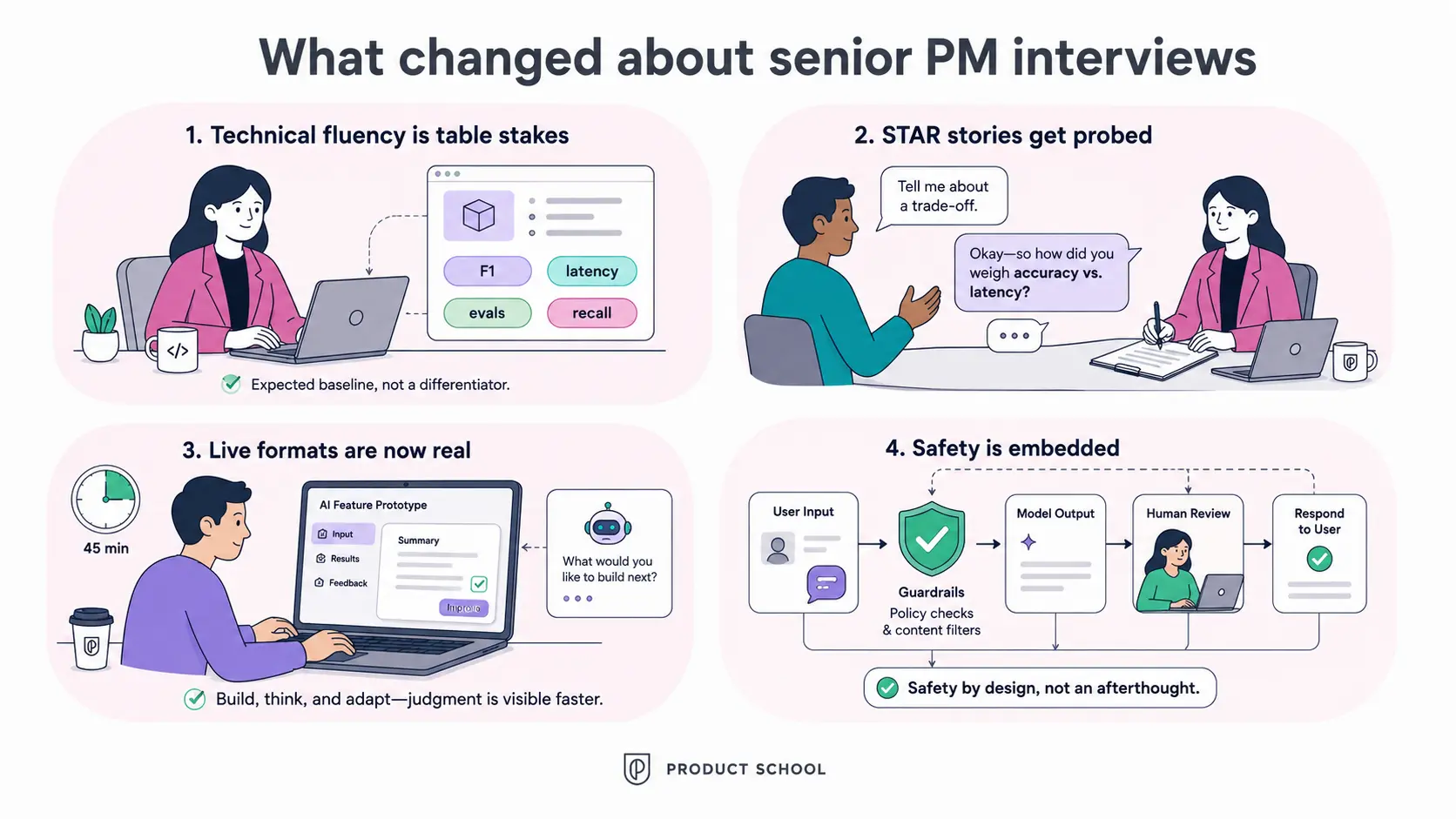
1. Technical fluency is table stakes
Senior PMs are no longer expected to sound technical in the stakeholder-friendly sense. They are expected to understand enough technical substance to stay in the conversation when the interviewer asks about F1 score and post-launch monitoring.
I remember asking David Hsu, CEO at Retool, a question in our 1-on-1 webinar when he said: “As a Senior PM, I think the faster the industry is changing, the more important it is to stay on top. You need to build yourself and check whether you’re doing it with the latest advancements.” David Hsu, CEO at Retool,
There is a big difference between: “I’d have to check with engineering.”
And: “I’d ask engineering for the current F1 score, but the reason I care here is that F1 balances precision and recall. In this use case, I may actually overweight recall because missing a high-risk case is more expensive than creating a false positive.”
2. Classic behavioral STAR stories do not survive AI-specific probing
The old senior PM behavioral answer had a familiar rhythm: situation, tension, action, impact. In AI-first interviews, the STAR story is now only the opening bid.
The follow-up is where the real interview starts.
“Tell me about a trade-off” becomes: “Describe a time you chose between model quality and serving latency, and explain the technical reasoning.”
“Tell me about a failed launch” becomes: “How did you know the model was degrading in production?”
“Tell me about stakeholder conflict” becomes: “What did you do when legal, engineering, and data science disagreed on the right threshold for release?”
A senior candidate has to carry the technical texture of the work. The panel is listening for proof that you drove the AI product decision.
Can you name the architecture?
Can you explain the eval?
Can you describe the failure mode?
Can you connect the technical decision to business impact?
Can you say what you sacrificed?
Many interviews sound senior until the interviewer asks one layer deeper.
3. Live formats are now real, and they expose judgment faster
The most uncomfortable change is that some senior PM candidates are asked to build something. They are being asked to build prototypes in roughly 45 minutes using the best AI tools like Cursor, Bolt, or Lovable. In fact, vibe coding is a real interview round that is catching candidates off guard, especially those who have never used these tools under pressure.
Meta’s Product Sense with AI format is a product sense case in which candidates are expected to use AI during the interview. They are assessed on how they leverage the tool across product motivation, segmentation, targeting, and solution development.
In 45 minutes, the panel sees how you scope, prompt, decide, recover, edit, explain, and ship. It sees whether you can turn ambiguity into a small working artifact. It sees whether you can spot when the AI gives you something plausible but wrong.
Think of it like this. The weak candidate uses AI as a vending machine: prompt goes in, answer comes out, candidate nods. The strong candidate understands AI is useful, productive, occasionally brilliant, and absolutely not allowed to drive without supervision.
4. AI safety moved from a separate ethics checkbox to embedded product judgment
I like to see AI safety as the product thinking now.
In AI products, safety is upstream. It shapes the user segment, the AI use case, the level of autonomy, the eval design, the launch criteria, and the decision of whether AI belongs in the product at all.
Senior AI PM interviews increasingly probe for safety inside normal product reasoning. It’s now a judgment test.
Therefore, if you reach minute 40 of an AI product case and safety has not come up, you have probably told the panel something you did not mean to say. You have told them you still think safety is someone else’s lane.
The danger is that AI fails convincingly. And the more capable the system becomes, the more important the boundaries become. Autonomy without constraint is not product innovation but a risk wearing a product roadmap hoodie.
I love it when candidates say:
“This is where I would limit autonomy.”
“This is where I would require human review.”
“This is where false negatives are more dangerous than false positives.”
“This is where the model should explain uncertainty instead of pretending confidence.”
“This is where we need monitoring after launch, not just evals before launch.”
“This is where we should not use AI at all.”
The New Format Map: What Senior PMs Actually Face
The senior PM technical interview is now a stack of formats.
Some, like product sense, behavioral, architecture, values, still look familiar from the outside. But AI has changed what those formats are actually testing.
A product sense round now tests whether you can think with AI without letting AI think for you.
A behavioral round now tests whether you really shipped the AI system or merely sat near the team that did.
A technical round now tests whether you understand the shape of a multi-agentic system well enough to reason about autonomy, evals, latency, fallbacks, and human oversight.
The interview is asking Senior PMs to stop being technically ornamental.
They do need to understand what they are asking the system to do, where it can fail, what trade-offs they are making, and when the best product decision is to not use AI at all.
Here are the five formats senior+ candidates need to be ready for.
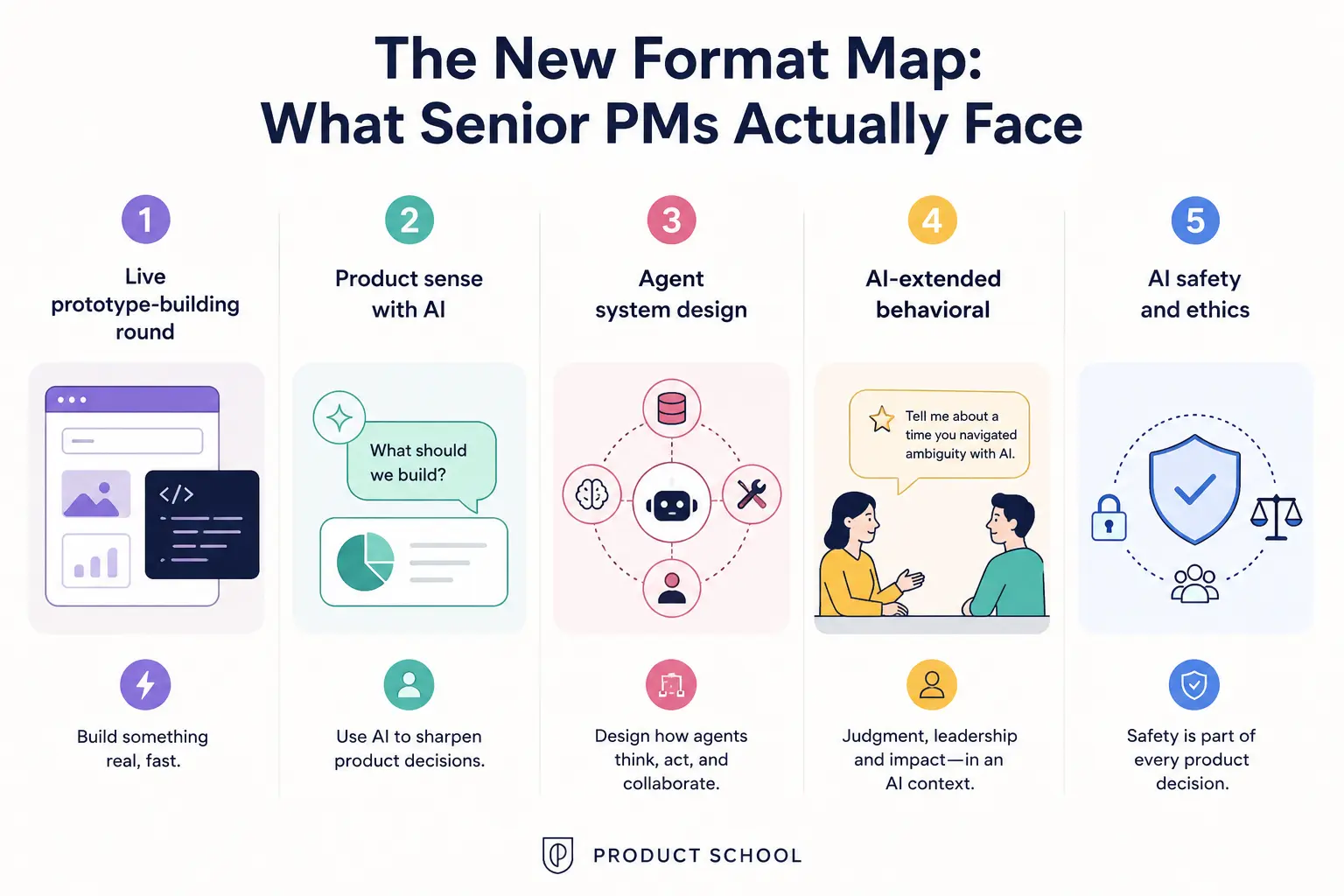
Format 1: The live prototype-building round
Live prototype-building has appeared most visibly in reported AI-first PM interview loops and in Product Sense with AI format.
Candidates are expected to use AI tooling during the interview. The exact company list will keep changing, so do not over-index on one company name. The durable pattern, however, is that senior PMs are being asked to turn product thinking into a working artifact, not just talk about what they would build.
The product sense format expects candidates to use AI while moving through product motivation, segmentation, targeting, and solution development.
This round tests whether you can compress product judgment into action. Can you take an ambiguous prompt, narrow it fast, choose a small enough scope, use an AI coding tool, critique the output, and ship something coherent before time runs out?
That shift tracks with what Abhinav Kasliwal, AI product and technology leader at Amazon, called out in Product School’s webinar on building production-ready GenAI products: “Most product teams are adding AI features, but very few are actually shipping AI-powered outcomes.”
In a live round, the panel tries to mitigate the risk of you making the same mistake. It sees whether you over-scope. It sees whether you prompt clearly. It sees whether you notice when the AI gives you something plausible but wrong.
What good looks like
Good candidates start by reducing the surface area. They define the user, the job, the core interaction, and the smallest working version that proves the idea. Then they use AI to accelerate execution, not to outsource the decision.
They narrate trade-offs as they go: why this flow, why this data input, why this fallback, why this ugly-but-working version is better than a polished, incomplete one. The artifact needs to prove that the candidate can steer.
What bad looks like
Bad candidates treat the tool like a vending machine. They freeze when the model hallucinates a function, generates broken logic, or builds the wrong user flow. The worst signal is passive acceptance. A senior PM can ship an ugly prototype and still pass. A senior PM cannot let the AI drive and call that product leadership.
Format 2: Product sense with AI
The clearest reported example is Meta’s Product Sense with AI round. It is a product sense case where candidates are expected to use AI during the interview and are assessed on how they leverage the tool across the normal product-sense components.
This format still tests product sense:
user motivation,
segmentation,
problem framing,
solution quality,
prioritization, and
The difference is that AI is now inside the process. The interviewer is watching how you use it.
What good looks like
Strong candidates use AI like a fast sparring partner. They prompt it for inputs, not conclusions.
For example: “Give me five possible segments for this product, but include the likely motivation, adoption barrier, and risk for each.”
Then they critique the output. They discard weak segments. They synthesize. They explain why they are choosing one direction over another. The panel sees a candidate who can increase their surface area of thinking without surrendering their judgment.
What bad looks like
Weak candidates use AI as a replacement brain. They ask broad questions, accept generic answers, and let the model’s structure become their structure.
That might look sophisticated for two minutes, especially if the prompts sound impressive. But the moment the interviewer asks, “What would you reject?” the answer collapses. Product Sense with AI is testing whether prompting improves your judgment.
The senior move here is restraint. A good senior PM uses AI where it creates leverage: widening the option set, finding edge cases, stress-testing assumptions, comparing segments, or generating a quick AI prototype. They keep ownership of the decision.
Format 3: Agent system design
Agent system design shows up in companies building agentic products, product workflow automation, AI assistants, developer tools, enterprise AI, and internal productivity platforms. It may be labeled “product architecture,” “technical product design,” “AI system design,” or simply a case about designing an AI feature. Basically, you are being asked to reason about an AI system that can call tools, take actions, use the RAG system, and fail in non-obvious ways.
This round tests whether you understand the difference between an AI feature and an AI system. That means the product question becomes:
What tools can the agent access?
What data can it see?
What actions can it take?
Where does it need memory?
What happens when it is uncertain?
What gets evaluated before launch? What gets monitored after launch?
When does a human need to step in (human-in-the-loop)?
OpenAI’s agent guidance frames agent design around model selection, tool design, orchestration, guardrails, and deployment, while Anthropic’s agent guidance emphasizes simple, composable patterns over unnecessary framework complexity. Use these as product judgment inputs.
What good looks like
Strong senior candidates draw a system. They define the user goal, the agent boundary, the tools, the data sources, the decision points, the handoff moments, and the failure modes. They name trade-offs early: latency versus quality, autonomy versus control, cost versus accuracy, recall versus precision, flexibility versus governance.
They also distinguish between flows that should stay deterministic and flows where agentic behavior actually adds value.
What bad looks like
Weak candidates describe every agent as ChatGPT with tools. They skip evals and permissions. They skip memory and monitoring.
As building gets cheaper, the hard part moves from creating software to managing, governing, monitoring, and making sure the software does the right thing. In agentic systems, that becomes the product problem.
Format 4: AI-extended behavioral
AI-first companies still want to know how you handle conflict, ambiguity, leadership, failure, and cross-functional tension. But now the follow-up questions are more technical because the work is more technical.
The AI-extended behavioral round tests whether you actually made the product decisions you claim to have made. Classic STAR stories are not enough. “I aligned stakeholders and launched the feature” is the beginning of the answer, not the answer. The panel wants to know what kind of AI system you shipped and what you changed after launch.
For instance, the inquiry I’d make to candidates goes something along the lines of:
“Tell me about a time an AI feature degraded after launch. How did you detect it, and what did you do?”
What good looks like
Strong candidates tell behavioral stories with technical substance. They name the model or system pattern at a useful level. They know what engineering pushed for, what data science pushed for, what legal or trust teams were worried about, and what decision they made as the PM.
The answer needs to carry proof of close proximity.
Here’s what I imagine a senior answer to sound like:
“We initially optimized for precision because false positives created too much manual review. But after looking at missed cases, we realized false negatives were more expensive for enterprise customers. So we changed the threshold, added a human review queue for borderline cases, and tracked both customer escalation rate and reviewer load after launch.”
That would tell me the candidate was at work.
What bad looks like
Weak candidates tell 2024 stories with AI nouns added. They say “we used machine learning,” but cannot explain what the model did. They say “we improved accuracy,” but cannot say accuracy of what, measured how, against which baseline, or with what trade-off.
At the senior level, that reads as adjacency. Maybe you were in the room. The panel is trying to decide whether you led the product decision or narrated it afterward.
Format 5: AI safety and ethics, embedded or dedicated
Safety can appear as a dedicated value or an AI ethics conversation, but the more important version is embedded across product sense, system design, and behavioral rounds.
Jeetu Patel, President and Chief Product Officer at Cisco, similarly argued on The ProductCon that: “Security and safety are not looked at as being at odds with productivity. It's actually looked at as a prerequisite of productivity.”
Google’s 2026 Responsible AI Progress Report describes AI responsibility as a lifecycle issue spanning research, model development, deployment, post-launch monitoring, and remediation.
The core question is: “Can we trust you to make product decisions when the system can be useful, fluent, wrong, and harmful at the same time?”
What good looks like
Strong candidates bring up safety before being asked.
They say where autonomy should be limited.
They say where human approval is required.
They say where the model should express uncertainty.
They say what should be logged.
They say what should be monitored after launch.
They say which users or use cases should be excluded from the first release.
Here’s what I imagine a good senior PM answer sounds like:
“For this first version, I would not allow the agent to take irreversible actions. It can prepare the workflow, but a human needs to approve anything involving money movement, medical advice, legal language, or customer termination.”
What bad looks like
Weak candidates treat safety as a checkbox. They finish the case, then add, “Of course, we’d also think about bias and privacy.” That is not enough. Bias and privacy are design constraints.
The worst version is the candidate who only sees safety when the interviewer asks. If you get 40 minutes into an AI product case without mentioning trust or human oversight, you have probably told the panel you still think safety belongs to another team.
At senior level, that is a problem.
What Separates a Senior Answer From a Mid-Level One
A mid-level candidate can learn the words: evals, latency, agents, hallucinations, precision, recall, guardrails. A strong senior candidate knows what those words force you to decide.
That is the actual bar. And that is where seniority shows up.
1. Senior candidates name trade-offs explicitly
Mid-level candidates describe what they would build. Senior candidates describe what they would sacrifice and why. That distinction sounds small until you hear both answers in an interview.
“I’d build an AI assistant that helps users find the right information faster.” Pretty much common sense, right?
I would expect a senior PM to say something like: “I’d optimize for recall over precision in the first version. False negatives are more expensive here. If the assistant misses a critical policy exception, the user makes the wrong decision. A few false positives are annoying, but they are reviewable.”
That is a different level of thinking.
The senior candidates are naming the operating logic behind the solution. They understand that every product decision creates a trade-off somewhere:
accuracy versus latency
cost versus quality
autonomy versus control
personalization versus privacy
speed versus trust
In AI products, these trade-offs become the product.
A cheaper model may be good enough for summarization but dangerous for high-stakes recommendations. A more autonomous agent may create leverage in low-risk workflows and unacceptable risk in financial, medical, legal, or compliance-heavy contexts.
2. Senior candidates introduce evals before being asked
Mid-level candidates wait for the interviewer to ask how they would measure success. Senior candidates bring evals into the answer because they know AI products do not become real until you define what “good enough” means.
A mid-level candidate might say: “We’d measure whether users complete the task faster.” That’s fine. But it’s not enough.
I would expect a senior PM to say something like: “We’d measure task completion and time saved, but before launch, we need an eval set that reflects real user requests, edge cases, and failure modes. I’d want labeled examples for correctness, hallucination rate, unsafe output, and escalation accuracy. Otherwise, we’re just shipping a fluent demo.”
That is the difference. Classic product metrics tell you whether users like the experience. AI evals tell you whether the system deserves to be trusted in the first place.
Senior candidates understand that an AI feature needs multiple layers of measurement:
task success
output quality
hallucination rate
Latency
user trust
cost per successful task
escalation or human-review rate
post-launch degradation
Evals are not a technical appendix. They are the bridge between a demo and “this is safe enough, useful enough, and reliable enough to put in front of users.”
3. Senior candidates stay coherent under technical probing
The senior candidate does not need to pretend to be an ML engineer. But they do need to stay in the conversation without collapsing into hand-waving. The interview starts when the panel probes.
“What metric would you use here?”
“What does F1 tell you?”
“What happens if latency doubles?”
“Would you optimize for precision or recall?”
“What’s your fallback if the model confidence is low?”
“Where does the human come into the loop?”
A mid-level candidate hears “F1 score” and either guesses or pivots back to “working with the data science team to figure that out.”
A solid senior candidate can say: “F1 combines precision and recall, so I’d use it if we care about balancing false positives and false negatives. But I would not rely on it alone here. If false negatives are much more expensive, I’d look at recall separately and set the threshold based on the risk of missed cases.”
This is what hiring managers expect from you: a product answer (not an engineering answer) with a technical spine. It’s not about whether you can implement the metric. It is checking whether you understand what kind of decision the metric represents.
This is where many experienced PMs accidentally reveal a gap. They have led technical teams for years, but they have learned to speak around the system rather than through it. Just don’t say you can improve the quality without being able to explain what quality, risk, or performance means in the system being discussed.
Senior answer: “If latency is above three seconds, the assistant may still be accurate but feel unusable in this workflow, so I’d consider a faster model for first-pass drafting and reserve the stronger model for high-confidence review or edge cases.”
4. Senior candidates treat AI as a tool, not a magic answer
Mid-level candidates often assume the interviewer wants more AI. Senior candidates know the better answer is sometimes less AI. That is one of the easiest ways to spot maturity.
A mid-level candidate might say: “We’d use an AI agent to automate the approval workflow.”
Sounds modern. Also possibly reckless. I would expect a senior PM to say something like: “I’d use AI to summarize the request, classify the risk level, and recommend the next action. But I would keep the final approval deterministic because this is a compliance workflow and the audit trail matters more than flexibility.”
AI is useful when the problem involves ambiguity, language, synthesis, personalization, or decision support. It is often the wrong choice when the job requires consistency, auditability, clear rules, low cost, or zero tolerance for invented answers.
Senior candidates separate the product into parts:
where AI creates leverage
where AI should assist but not decide
where deterministic rules are safer
where human review is required
where the feature should not exist yet
A senior PM proves seniority by knowing when a boring workflow is better. For example, a policy lookup probably does not need a generative answer that might hallucinate. It may need better search, filters, source citations, and a short summary with strict grounding.
5. Senior candidates demonstrate judgment when AI is wrong
In live formats, AI will eventually give you something flawed. That is exactly the point of the interview. The hiring staff wants to see whether you notice.
A mid-level candidate often treats AI output as progress: “Great, this gives us a good starting point.” And sure, sometimes it does. Sometimes it just gives you a polished version of the wrong idea.
A senior candidate should be able to say something like: “This is visually close, but the core flow is wrong. The user needs to compare options before taking action, and this jumps straight to the recommendation. I’m going to simplify the UI and rebuild around the decision point.”
That is a much stronger signal than getting a perfect output on the first try. The model will produce things that look finished before they are correct. It may generate a clean interface with weak logic. It may skip the edge case that matters most. It may invent an API, ignore a constraint, over-automate a sensitive action, or optimize for the happy path.
Senior candidates know how to supervise the output. They check:
Does this actually solve the user problem?
Did the AI change the scope without me noticing?
Is the workflow logically correct?
Are the risky actions constrained?
Is there a fallback?
Are we making the product look more capable than it is?
That is the difference between using AI and being led by AI.
The strongest candidates are able to say “No, this is wrong,” and I like hearing that more often than not.
How to Prepare for the New Formats
The mistake is preparing for these interviews as if they were knowledge tests. They are not.
At the senior level, the panel is testing whether you can still make good product decisions when AI creates plausible nonsense and compresses the distance between idea and artifact. Your prep should reflect that.
1. Build something real with AI tools
You need to build something small enough to finish and real enough to break.
A support triage tool
A policy lookup assistant
A meeting summarizer with source citations
A lightweight agent that drafts follow-up emails from CRM notes
The point is to build the muscle the interview actually tests: prompting, inspecting, rejecting, narrowing, fixing, and shipping.
And please keep this in mind as a helpful rule of thumb. If you would not be willing to show the prototype to another PM, it does not count as practice.
Our Vibe Coding certification fits naturally here because it helps PMs translate product thinking into functional builds. That is the new practical skill: shaping a working artifact that proves the idea and gives the team something real to evaluate.
Vibe Coding Certification
Go from idea to prototype in minutes. Build, debug, and scale AI prototypes with the latest tools to integrate APIs securely and hand off to engineering fast.
Enroll now
2. Practice the 45-minute scope
The biggest mistake in live prototype rounds happens in the first 10 minutes. I’ve seen candidates overscoping because they want to look senior. They add onboarding, personalization, dashboards, analytics, multi-step workflows, and all the bonuses you can think of.
Then they show nothing coherent.
Practice taking a classic product sense prompt and turning it into one narrow AI-powered workflow in 45 minutes. A good 45-minute scope might be:
User input
AI recommendation
Source or reasoning display
Human review
Fallback state
That is enough because the panel does not need to see your ambition (usually). The right companies are really looking to reveal your judgment.
This is where Product School’s AI Product Management Certification connects. The certification is built around helping PMs bridge product management and AI so they can build AI-powered products that create real customer value.
3. Get fluent in evals vocabulary
I’ll be blunt here. Know what accuracy, precision, recall, F1, latency, groundedness, faithfulness, hallucination rate, and human escalation rate mean well enough to use them in a product conversation.
But, and this is huge, the goal is to explain the trade-off.
For example: “I care about recall here because missed high-risk cases are more expensive than false positives.”
That is much stronger than: “We would improve model accuracy.”
Our AI Evals Certification is the natural fit here because it focuses on eval suites, failure-mode analysis, and trust frameworks for AI products that need to scale.
4. Read AI failure post-mortems
Good candidates study success stories. Great candidates study failures. Read cases where AI products hallucinated, degraded after launch, produced harmful outputs, exposed sensitive data, or failed because users did not trust them. You are building pattern recognition.
When asked about an AI assistant for customer support, a candidate who has studied failures will naturally mention source grounding, escalation, confidence thresholds, monitoring, and user trust. A candidate who has only studied success stories will talk about automation and efficiency.
5. Practice with multiple AI tools, not just ChatGPT
If you have only used ChatGPT as a PM, your interview behavior will show it.
Do spend time with ChatGPT. But don’t look past the Claude Code for PMs, Perplexity, and at least one coding-specific tool such as Cursor, Bolt, Lovable, or v0. Each tool has a different rhythm.
Some are better for reasoning.
Some are better for research.
Some are better for code generation.
Some are better for quick UI scaffolding.
You should know when product teams should use AI agents or AI in general, depending on the use cases. The senior move is knowing which tool to use for which job. In a live round, that might sound like: “I’ll use the coding tool to scaffold the prototype, but I’ll use the model separately to pressure-test edge cases and failure modes.”
If you want structured practice here, our Claude Code for PMs course is built for exactly this shift. It helps product managers move from simply prompting AI to using AI coding tools to prototype, test, and sharpen product ideas.
Claude Code for Product Managers
Claude Code is already changing how the best PMs work — at Stripe, Linear, and the fastest-moving teams in tech. Use the AI tool reshaping product work to prototype, analyze, and ship, before a ticket is written.
ENROLL NOW
6. Practice saying no to AI
Take 10 product prompts and force yourself to answer: “Where should we not use AI here?” That question builds senior judgment.
Maybe the approval flow should stay deterministic.
Maybe the policy lookup should use a search with citations instead of a generative answer.
Maybe the agent should draft but not execute.
Maybe the first version should classify risk and route to a human instead of completing the task end-to-end.
A senior PM who knows when not to use AI is more credible than a candidate who turns every prompt into an agent..
7. Prepare the production story behind the prototype
Senior candidates prepare the second layer: what happens after the prototype works? For every practice prototype, write a one-page production plan:
What data does this need?
What are the main failure modes?
What evals would prove it is good enough?
What should stay human-in-the-loop?
What would you monitor after launch?
What would make you kill or roll back the feature?
This is where seniority shows. Anyone can vibe-code a demo now. Fewer candidates can explain what it would take to turn that demo into a product users can trust.
A Self-Assessment For Senior PM Candidates
Use this 7-Question Senior PM Technical Interview Test to pressure-test whether you are ready for AI-first interview formats, not just classic product sense and behavioral rounds.
When was the last time you shipped an AI feature with a measured eval, and can you name the metric, the baseline, and the result?
Could you build a working prototype of an AI-powered workflow in 45 minutes if asked tomorrow?
Can you name two trade-offs you would make when designing an agent system, and explain the conditions under which each trade-off is correct?
Have you read at least one post-mortem on an AI feature failure in the last 90 days, and can you explain what product judgment it changed for you?
Can you describe a time you pushed back on engineering, data science, legal, or leadership on an AI-specific concern, and explain the technical substance of the disagreement?
Do safety considerations show up naturally in your product reasoning, or do you save them for a separate “responsible AI” answer at the end?
If an interviewer asked, “What’s the F1 score on this kind of model?” could you answer directly, or at least explain what trade-off F1 measures and why it would or would not matter in that product context?
The Senior PM Technical Readiness Score
Use this framework to score whether you are actually ready for senior PM technical interviews, not whether you feel ready.
The rule is simple: do not score confidence. Score evidence. If you cannot point to an artifact, a shipped decision, a practice rep, or a specific story, your score is lower than you think.
Scoring criteria
Score | What it means | How to think about it |
0 | No evidence | You understand the concept vaguely, but you have no real example, artifact, or practice rep. |
1 | Conceptual fluency | You can explain the idea in conversation, but you have not applied it under realistic pressure. |
2 | Practiced competence | You have done the work in practice or in a low-stakes environment and can explain your reasoning clearly. |
3 | Interview-ready proof | You have shipped it, practiced it under time pressure, or can tell a specific story with metrics, trade-offs, and consequences. |
The self-evaluation table
Readiness area | The question to ask yourself | What a 3/3 answer looks like | Score |
AI evals | When was the last time I shipped or evaluated an AI feature with a measured eval? | You can name the metric, the baseline, the result, and what decision changed because of it. For example: “We tracked hallucination rate and escalation accuracy, then changed the launch threshold because high-risk cases were underperforming.” | 0–3 |
Live prototyping | Could I build a working AI-powered workflow in 45 minutes tomorrow? | You have practiced building small prototypes with AI tools under time pressure and can scope one workflow tightly: input, AI output, review, fallback. | 0–3 |
Agent trade-offs | Can I explain two agent system trade-offs and when each one is correct? | You can reason clearly about autonomy vs. control, latency vs. quality, cost vs. accuracy, memory vs. privacy, or flexibility vs. governance — and connect each trade-off to a product context. | 0–3 |
Failure pattern recognition | Have I studied AI product failures recently? | You can reference at least one failure pattern from the last 90 days and explain what it changed in your product judgment: hallucination, unsafe output, model degradation, bias, privacy exposure, or poor adoption. | 0–3 |
Technical pushback | Can I describe a time I pushed back on an AI-specific technical concern? | You have a concrete story where you challenged engineering, data science, legal, or leadership on a technical product issue: eval quality, model choice, latency, data readiness, safety, fallback design, or release threshold. | 0–3 |
Embedded safety judgment | Does safety show up naturally in my product reasoning? | You bring up safety before being prompted. You can say where to limit autonomy, require human review, monitor failures, add source grounding, or avoid AI altogether. | 0–3 |
Technical composure | Can I stay coherent when probed on metrics like F1, precision, recall, or latency? | You do not need to implement the metric, but you can explain what decision it represents. For example: “F1 balances precision and recall, but I’d inspect recall separately if false negatives are more expensive.” | 0–3 |
How to interpret your score
Total score | What it means | What to do next |
0–7 | You are not ready for senior AI-first technical loops. | Start with fundamentals: eval vocabulary, AI product sense, and hands-on tool practice. |
8–13 | You can probably talk about AI, but your answers may collapse under probing. | Build proof. Do 45-minute prototype reps, write eval plans, and prepare technical behavioral stories. |
14–17 | You are credible, but there are visible gaps. | Find your weakest two areas and drill them until you have examples, not opinions. |
18–21 | You are close to interview-ready. | Practice under realistic pressure: timed prototyping, technical follow-ups, and senior-level trade-off questions. |
The New Bar Is Judgment With AI
The candidate who can explain the F1 score gets in the door. The candidate who can think alongside AI under pressure, has deep, pragmatic knowledge, and is resourceful gets the job.
That bar may feel unusually technical today, but it will not stay unusual for long. The formats showing up in AI-first companies now will spread into mainstream senior PM hiring as more products get AI components.
The prep that works for Meta CP today is likely the prep that will work for many senior PM roles in 18 months.
If you want to build that foundation deliberately, start with AI Product Management Certification and pair it with Vibe Coding for PMs. One builds the strategic AI product judgment. The other builds the hands-on muscle to turn judgment into something real.
Updated: October 8, 2026