Most winning product teams have one thing in common: they treat data like a product. Numbers tell you what’s happening, and qualitative signals tell you why. You need both.
This article provides a clear definition of quantifiable metrics, what qualitative metrics add, how they differ, and 12 quantitative performance measures with formulas and use cases.
We’ll finish with how qualitative and quantitative metrics power AI-driven product decisions and your current product analytics setup.
FREE Product Analytics Micro-Certification
Are you struggling to translate data into decisions? Become the data-savvy Product Manager every team need with our free micro-certification in Product Analytics.
Enroll Now
What Are Quantitative Metrics? (Quantifiable Measures)
Quantitative metrics are measurable, numerical indicators that tell you how your product or business is performing. In other words, they are “quantifiable measures” of outcomes or behaviors.
These metrics are expressed in hard numbers (percentages, dollar values, amounts, and other figures), making them objective and easy to compare. Common examples include conversion rates, revenue figures, churn percentages, and usage counts.
If you can count it or calculate it, it likely falls under quantitative metrics.
For example, the number of daily active users, the monthly recurring revenue of a SaaS product, or the percentage of customers who click a particular button are all quantitative metrics.
They provide concrete data that helps answer questions like
“How many users did we acquire?”
“What was our revenue growth this quarter?”
“What percentage of trial users converted to paying customers?”
Because they are grounded in numbers, quantitative metrics enable apples-to-apples comparisons over time or across different user segments.
Why are quantitative metrics important?
Quantitative metrics offer an objective way to track progress and success. With clear numerical targets, product teams can set benchmarks (e.g. “reduce churn to 3%” or “increase conversion by 10%”) and measure whether their initiatives are working.
Quantitative data reveals patterns and trends over large sample sizes. It excels at answering “what is happening?” in your product. For example, a spike in support tickets or a drop in daily active users will show up in the numbers and flag that something needs attention.
Because of this objectivity and scale, quantitative metrics are often the backbone of Key Performance Indicators (KPIs) and OKRs in businesses. They let you monitor performance over time and benchmark against industry standards or competitors.
Quantitative metrics alone don’t tell the whole story
They can show what is happening, but not always why. For instance, your product analytics might reveal that only 20% of users who sign up for your SaaS product become active users after a week. Certainly, a concerning number. But the raw metric won’t explain why the other 80% dropped off.
That’s where qualitative metrics come in. It’s also worth noting that focusing solely on numbers can sometimes be misleading without context. For example, a high page view count looks good until you realize most visitors bounced in a few seconds. Despite these caveats, quantitative metrics are indispensable because they provide clarity and accountability.
What Are Qualitative Metrics?
While quantitative metrics deal in numbers, qualitative metrics focus on the qualities and characteristics behind those numbers. These are measures of subjective aspects like user opinions, feelings, and experiences.
Qualitative metrics capture insights that are not directly quantifiable. They help explain the “why” behind the “what.” In practice, qualitative data comes from sources like user interviews, open-ended survey responses, focus group observations, customer support conversations, product reviews, user research, and so on.
Instead of asking “how many users clicked X,” a qualitative approach asks “what did users feel about X, and why did they behave that way?”
A qualitative metric might be something like overall customer satisfaction gleaned from interviews, the level of user delight with a new feature (as described in feedback comments), or the themes that emerge from analyzing dozens of app store reviews.
Qualitative metrics are recorded in words or categorizations
Yes, words rather than pure numbers. For example, you might categorize feedback into themes (usability, product pricing, feature requests, etc.) and count mentions, or rate sentiment as positive/negative. The data is fuzzier than straightforward analytics, but it provides depth and context that numbers alone can’t.
As you see, they go beyond numbers and statistics to understand the factors that contribute to performance. In short, qualitative metrics gather the stories behind the stats.
Common sources of qualitative metrics
User interviews and focus groups: Direct quotes from users about what they like or dislike, which features confuse them, etc.
Open-ended survey responses: E.g. responses to “How would you improve our product?” or “What did you think of your onboarding experience?”
Customer reviews and testimonials: The tone and content of reviews can indicate strengths or pain points (e.g. “Lots of features but very complex to use” is a qualitative insight).
Support tickets and chat logs: Patterns in customer complaints or questions can reveal qualitative issues (e.g. many users expressing frustration about a workflow).
Usability testing observations: Seeing a user struggle with a task in a usability test provides qualitative feedback on UX problems that pure metrics (like time on task) only partially reflect.
Why do qualitative metrics matter?
Qualitative metrics matter because they capture nuances that pure numbers often overlook. Human experiences are complex. Two users might both use a feature 5 times a day (quantitatively identical usage), but one is delighted and the other is annoyed. Those emotions will determine whether they stick around.
Qualitative insights help you understand customer motivations, preferences, and pain points. They answer, “Why are users behaving this way?” For instance, if your quantitative metrics show a drop in engagement after a certain user onboarding step, qualitative feedback (like user interviews) might reveal that the step is confusing or not valuable to users, explaining the drop-off.
Qualitative metrics offer a holistic view of performance by filling in the story behind the data. They are especially useful for product discovery and PX improvement. By listening to users in their own words, product teams can uncover unmet needs or emotional drivers that wouldn’t surface in a spreadsheet. As a result, qualitative metrics drive empathetic, user-centered decisions.
Qualitative metrics are subjective and harder to measure consistently
Personal biases can creep in when interpreting interview results, and it’s not feasible to get detailed feedback from every user. Qualitative data collection (interviews, analysis of comments, etc.) is often time-consuming and doesn’t scale as easily as automated product analytics.
Because it’s not in neat numeric form, qualitative data can be tricky to summarize or benchmark. Despite these limitations, its value is undeniable. When combined with quantitative data, it provides crucial context.
Quantitative vs. Qualitative Metrics: Key Differences, Pros, and Cons
Both quantitative and qualitative metrics are essential for a complete understanding of your product, but they serve different purposes. Let’s compare quantitative vs. qualitative metrics across various dimensions to highlight their differences and appropriate uses.
This bullet list below summarizes the core distinctions:
Dimension | Quantitative metrics | Qualitative metrics |
Nature of data | Numerical data such as counts, percentages, dollar figures, and other measurable quantities | Descriptive data such as words, observations, and sentiments |
Story it tells | What is happening and how much, for example conversion rates or churn percentages | Why it is happening and why, including reasoning, motivations, and emotions behind the numbers |
Collection methods | Structured methods like analytics tracking, logs, closed-ended surveys, and A/B tests | Unstructured methods like interviews, focus groups, open-ended surveys, and user observations |
Analysis techniques | Statistical analysis using formulas, dashboards, and data visualizations | Thematic analysis through categorization, sentiment analysis, and pattern recognition |
Pros | Objective, scalable, and suitable for benchmarking and tracking over time | Provides depth and context by capturing nuances and surfacing user needs or emotions |
Cons | Can oversimplify or miss context and usually shows what changed but not why | More subjective and harder to scale and can be biased, time-consuming, and harder to compare |
Best use cases | Setting benchmarks and KPIs and tracking measurable growth or performance | Exploring improvements, understanding pain points, refining UX, and diagnosing issues |
Examples | Conversion rate, churn rate, revenue, daily active users, load time, NPS score | User interview insights, support ticket themes, app store review sentiment, NPS follow-up comments |
Quantitative vs. qualitative metrics: It’s not one or the other
Quantitative metrics shine in performance tracking. They give you hard evidence of how your product is doing and whether changes cause improvement or decline. They are the backbone of data-driven product management, product experimentation, and helping prioritize areas that need attention (e.g., a rising churn percentage signals a retention problem to investigate).
The strength of quantitative data is its precision and objectivity. “The feature A/B test increased conversion by 5 percentage points” is a clear, actionable finding.
On the other hand, qualitative metrics excel at diagnosis and product discovery. They provide the color commentary behind the stats. Using qualitative research, you might discover that users churn not because they don’t need your product, but because they found the setup too complicated. That’s a nuance a churn rate can’t reveal on its own.
Qualitative insights often inspire solutions and product innovations that pure numbers wouldn’t suggest. For example, hearing multiple users describe a workflow as “confusing” or “frustrating” (common words in feedback) points directly to a product experience issue to fix.
Key Quantitative Performance Measures: 12 Metrics to Drive Growth
In the product realm, there are many numbers you could track, but a handful of quantitative performance measures tend to be the most impactful for growth. Below is a list of 12 essential quantifiable metrics (with their formulas and context) that AI product managers and product leaders often rely on to gauge success.
These include metrics for user acquisition, conversion, engagement, revenue growth, and financial efficiency. For each metric, we’ll define it, provide a formula or example of how to calculate it, and discuss why it matters.
1. Monthly recurring revenue (MRR)
Monthly Recurring Revenue is the lifeblood metric for SaaS businesses. It measures the predictable revenue you can expect each month from subscriptions. MRR aggregates all the recurring subscription charges for your paying users in a given month.
For example, if you have 100 customers on a $50/month plan and 50 customers on a $100/month plan, your MRR = (100 × $50) + (50 × $100) = $10,000 + $5,000 = $15,000 for that month.
Formula: MRR = Number of Customers x ARPU
MRR is a core product-led growth metric. It tells you, in dollars, how your revenue is growing (or shrinking) month over month. Unlike one-time sales, recurring revenue reflects the stability and health of a subscription business.
By monitoring MRR closely, you can spot trends: e.g., an upward trajectory indicates healthy growth, while flat or declining MRR may signal issues with churn or sales.
2. Customer acquisition cost (CAC)
Customer Acquisition Cost (CAC) measures how much you spend, on average, to acquire a new customer. It includes all marketing and sales expenses (ads, salaries, tools, and content production) divided by the number of new paying customers gained in a given period.
For example, if you spent $50,000 in a quarter and added 100 new customers, your CAC would be $500.
Formula: CAC = Total sales and marketing costs ÷ Number of new customers acquired
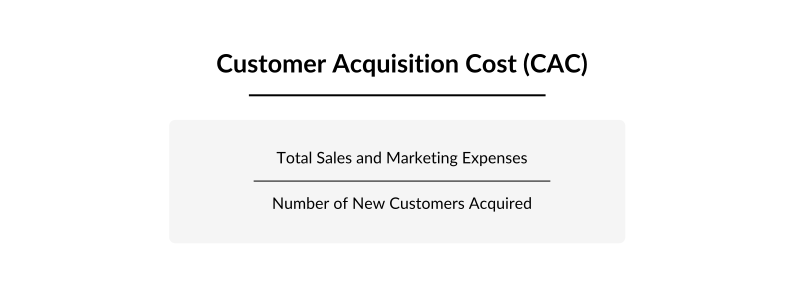
CAC is the ultimate efficiency metric. It shows whether your growth is sustainable and if your acquisition strategy makes financial sense. When paired with Lifetime Value (LTV), it tells you if each customer generates more revenue than they cost.
3. Customer lifetime value (LTV)
Customer Lifetime Value (LTV) estimates how much revenue a single customer generates over their entire relationship with your product. It connects revenue and retention into one figure that represents long-term profitability.
For example, if a customer pays $100 per month and your monthly churn rate is 5%, the LTV would be $100 ÷ 0.05 = $2,000.
Formula: LTV = Average revenue per customer ÷ Customer churn rate
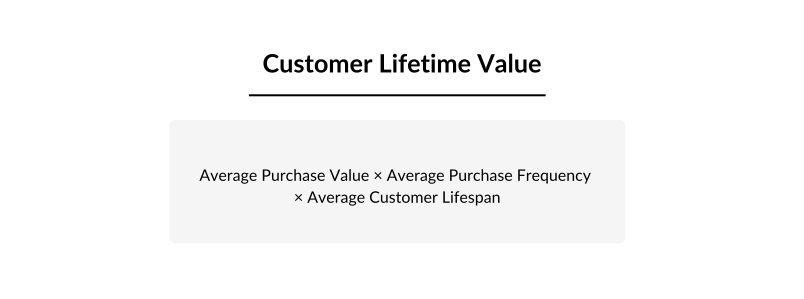
LTV reveals whether your business model is sustainable. It shows how much value each customer brings compared to what you spend to acquire them. A high LTV means strong retention and loyal customers who continue to buy, upgrade, or renew. Tracking it over time helps gauge product-market fit, pricing effectiveness, and overall customer health.
4. Conversion rate (trial-to-paid)
Conversion rate tracks how many users who start a free trial or freemium plan become paying customers. It measures how effectively your product communicates value and moves users from curiosity to commitment. For example, if 1,000 users start a trial and 200 upgrade, your conversion rate is 20%.
Formula: Conversion rate = (Number of users who converted ÷ Number of users who started trial) × 100

A high conversion rate signals a strong onboarding experience and clear product-market fit. A low one suggests friction, unclear value, or poor targeting. Monitoring it helps identify bottlenecks in activation and improve trial experiences that drive revenue growth.
5. Activation rate
Activation rate shows how many new users reach the point where they experience your product’s core value for the first time—the “aha” moment. The definition of activation depends on the product: for instance, creating a project in a task management tool or sending a message in a chat app.
Formula: Activation rate = (Number of new users who complete the activation event ÷ Number of new sign-ups) × 100
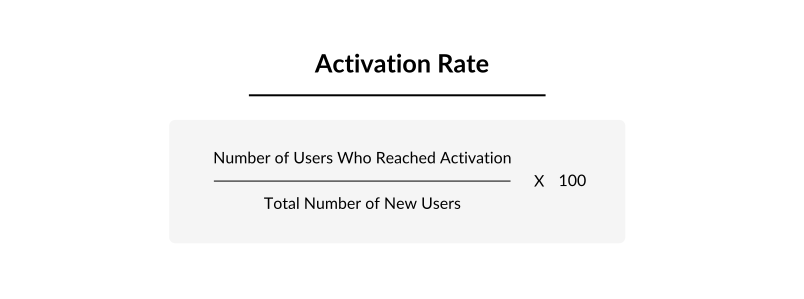
This metric indicates how well your onboarding flow turns sign-ups into engaged users. A high activation rate means users quickly see value and are more likely to convert and stay. A low rate points to confusing UX or weak onboarding. Improving activation is one of the fastest ways to boost retention and long-term growth.
6. Retention rate
User retention rate measures the percentage of customers who stay active or subscribed over a given period. It reflects how consistently your product delivers value and whether customers are satisfied enough to stick around.
Formula: Retention rate = (Customers at end of period who were also customers at start ÷ Customers at start of period) × 100
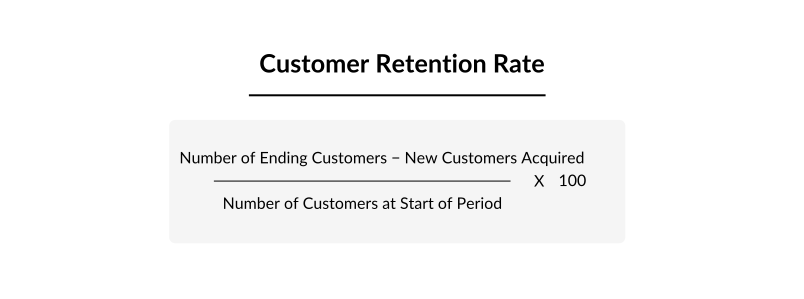
Strong retention is a sign of healthy product-market fit and customer satisfaction. Tracking it over time helps detect early churn trends and evaluate the impact of new features or updates. High retention compounds growth; low retention signals product or experience issues that need urgent attention.
7. Churn rate
Churn rate shows the percentage of customers who stop using or paying for your product within a specific period. It’s the inverse of retention and reveals how quickly you’re losing users or revenue. For example, if you start the month with 1,000 customers and 20 cancel, your churn rate is 2%.
Formula: Churn rate = (Customers lost during period ÷ Customers at start of period) × 100

Churn is one of the clearest indicators of product health. Even strong acquisition can’t offset rapid churn for long. Tracking it regularly helps identify if customers are leaving due to poor onboarding, weak engagement, or competitive alternatives. Reducing churn directly improves LTV and sets the stage for sustainable growth.
8. Daily active users / Monthly active users (DAU/MAU)
DAU and MAU measure how many unique users engage with your product daily and monthly. Together, they show the size and frequency of your active user base. The DAU/MAU ratio, often called “stickiness,” indicates how often monthly users return. For instance, if you have 5,000 DAU and 20,000 MAU, your ratio is 25%.
Formula: DAU/MAU ratio = (Daily active users ÷ Monthly active users) × 100

These metrics help gauge engagement and habit formation. A high DAU/MAU ratio means users find consistent value and return frequently. A low one suggests infrequent use or weak product pull. For most SaaS and consumer apps, DAU/MAU trends are an early signal of retention, loyalty, and long-term growth potential.
9. Feature usage rate
Feature usage rate measures how many active users engage with a specific feature during a defined period. It helps identify which functionalities drive the most value. For example, if 3,000 out of 10,000 monthly active users used Feature X, the feature’s usage rate is 30%.
Formula: Feature usage rate = (Users who used the feature ÷ Total active users) × 100
It highlights adoption and product fit at the feature level. High usage suggests strong utility or visibility, while low usage may mean users don’t know about it or don’t find it valuable. Tracking feature usage helps prioritize roadmap decisions, improve onboarding, and refine features that truly impact engagement and retention.
10. Net Promoter Score (NPS)
Net Promoter Score measures customer loyalty by asking how likely users are to recommend your product on a scale from 0 to 10. Scores of 9–10 are promoters, 7–8 are passives, and 0–6 are detractors. Subtracting detractors from promoters gives your NPS. For instance, if 50% are promoters and 20% are detractors, NPS = 30.
Formula: NPS = (% of promoters) – (% of detractors)

NPS offers a quick snapshot of customer satisfaction and long-term retention potential. A high score means users are satisfied and likely to refer others, while a low one signals product or service pain points. It’s best used as a trend metric—if it drops, it’s time to dig into feedback and understand why.
11. Net profit margin
Net profit margin shows how efficiently a business turns revenue into actual profit after all expenses. It reflects the financial sustainability of your model, not just growth in top-line numbers.
Formula: Net profit margin = (Net profit ÷ Total revenue) × 100
This metric indicates whether your growth is healthy or simply expensive. High margins show efficiency and operational control, while low or negative margins suggest high costs or unsustainable growth tactics. For product leaders, it’s a reminder that scaling usage or revenue only matters if profitability follows.
12. Growth rate
Growth rate measures how quickly your customer base or revenue is increasing over a set period. It’s one of the simplest yet most revealing indicators of momentum.
Formula: Growth rate = ((Value at end of period – Value at start) ÷ Value at start) × 100
Growth rate reflects the overall trajectory of your product. Consistent, steady growth signals market fit and execution strength. Sudden slowdowns point to saturation, retention issues, or competition. It’s a north-star metric for assessing long-term scalability and performance.
Quantitative and Qualitative Metrics in AI-Powered Product Analytics
In the era of AI and advanced product analytics, product teams have powerful new ways to leverage both quantitative and qualitative data.
AI product managers, those building AI-driven products or using AI tools in product management, are finding that combining metrics with machine learning techniques can uncover deeper insights and automate decision-making support.
Here’s how quantitative and qualitative metrics play a role in AI-powered product management:
AI for quantitative data analysis
AI and machine learning tools can process vast amounts of quantitative data automatically. They detect anomalies, uncover correlations, and forecast trends without manual dashboard digging.
For instance, predictive models can flag customers likely to churn based on usage and engagement patterns, helping teams act before it happens.
AI for qualitative data analysis
AI-powered language models and NLP systems now make sense of large volumes of qualitative feedback. They summarize user interviews, classify support messages by sentiment, and surface recurring complaints or requests.
This helps product teams understand user sentiment at scale, turning unstructured comments into actionable insights.
Quantitative and qualitative data for RAG systems
Retrieval-augmented generation (RAG) lives on good data. Quantitative metrics help you decide what to index and how to rank results, while qualitative signals like support tickets, docs, and user feedback become the knowledge base the model retrieves from.
Together, these quantitative and qualitative metrics shape what the AI can recall, how relevant the answers are, and which gaps in documentation you need to fill.
AI prototyping with real product data for product growth
AI prototyping becomes far more useful when it runs on real product data instead of synthetic examples. Early prototypes can plug into event logs, feature usage, and sampled qualitative feedback to simulate flows like in-product assistants, recommendations, or smart alerts.
This gives AI PMs and AI product owners a quick signal on whether an idea is actually useful in the context of their data and users. This helps them make sound decisions that will eventually end up as product growth.

Combining both for a full picture
AI’s biggest advantage is linking the “what” from quantitative data with the “why” from qualitative signals. It can correlate low NPS scores with specific feature usage patterns or identify that an increase in engagement coincides with more positive sentiment.
By merging these perspectives, product teams gain faster and deeper clarity on user behavior.
AI in product decision workflows
AI can also support product prioritization and forecasting. Some systems weigh quantitative impact scores with qualitative user sentiment to recommend which features to build next or simulate outcomes of strategic changes.
This data-informed assistance helps PMs make better, faster product decisions while keeping human judgment at the core.
The Power of Quantitative Metrics
Metrics aren’t just numbers. Metrics are the story of your product in motion. Quantitative metrics show the pulse of growth; qualitative ones explain its rhythm. Together, they help teams see both direction and depth.
For modern product leadership, especially those shaping AI-driven products, the edge lies in mastering both. Measure what matters, interpret what moves people, and you’ll build better products.
AI Evals Certification
Learn to build trusted AI products. Design eval suites, integrate CI/CD gates, monitor drift and bias, and lead responsible AI adoption.
Enroll now
Updated: December 30, 2025