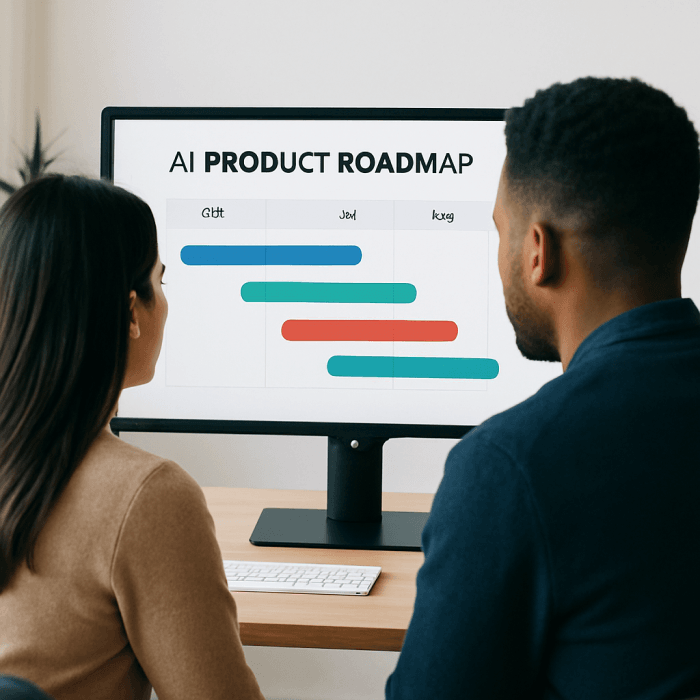
The surge in AI adoption over the past several years demonstrates that AI implementation is delivering tangible business impact. In fact, Stanford data confirms that 83% of organizations that have invested in AI report seeing ROI (1). It’s a clear signal that tying AI initiatives to concrete outcomes pays off.
Indeed, AI fuels business growth in a way that is unheard of up until this point. Let’s see how you reap the rewards with 6 tried-and-true ways to use AI for business growth.
Level up on your AI knowledge
Based on insights from top Product Leaders from companies like Google, Grammarly, and Shopify, this guide ensures seamless AI adoption for sustainable growth.
Download Guide
Benefits of AI in Business and the Impact of AI on Business
AI helps only when it moves the numbers that matter. Below is a crisp, outcomes-first list you can plug into a plan or a board slide. Each benefit includes the primary metric to watch so you can prove impact, not just promise it.
Higher revenue growth from personalization and relevance
Serve the right product or message to the right person, increase conversions and average order value. Track lift in conversion rate, AOV, LTV.Lower customer acquisition cost and smarter spend
Use predictive targeting and creative optimization to stop wasting impressions. Track CAC, cost per qualified lead, ROAS.Faster cycle times across the funnel
Automate routine work, accelerate content, analysis and delivery so teams ship sooner. Track time to market, time to first value, lead response time.Better decision quality at scale
Replace guesswork with models that detect patterns humans miss, from product pricing to promotions. Track decision accuracy, forecast error, promo ROI.Operational cost savings without cutting quality
Automate Tier-1 support, invoice processing, document review and QA. Track cost per ticket, cost per transaction, straight-through processing rate.Improved customer experience and retention
Resolve issues instantly, personalize user onboarding, recommend the next best action. Track CSAT, NPS, churn rate, repeat purchase rate.Inventory and supply stability
Forecast demand more accurately, balance stock and reduce waste. Track stockout rate, on-shelf availability, inventory turnover, working capital.Risk reduction and compliance readiness
Monitor models for drift and bias, log decisions, enforce access controls. Track model error drift, exception rate, audit pass rate.Team effectiveness and focus
Give teams copilots for drafting, summarizing and retrieval so they spend time on high-leverage tasks. Track hours saved, cases per agent, tickets per FTE.Data leverage and knowledge discovery
Turn scattered docs and systems into instant answers for staff and customers. Track search success rate, time to answer, self-serve rate.
AI pays for itself when every use case is tied to a clear product OKR and a small controlled test. Pick one benefit, set a baseline, run a two-to-four week pilot, and scale only when the needle moves.
How to Use AI in Business: Six Proven Strategies for Growth
AI drives real business outcomes only when it solves a focused problem tied to a measurable metric. The six strategies below represent the fastest, highest-ROI paths to revenue growth, cost efficiency, and better customer outcomes.
1. Artificial intelligence in marketing, examples, and metrics
AI in marketing typically delivers its biggest wins in two areas, personalization and content production. When done well, it increases engagement, improves product adoption, and accelerates go-to-market steps.
Personalization is the clearest proof point. Take Netflix’s recommendation engine, which tailors viewing suggestions to each user. This AI system helps Netflix keep people watching, reduce cancellations, and protect recurring revenue growth.
According to company estimates, personalized recommendations save around $1B per year in avoided churn, which is massive for a subscription business. The key metric here is user retention (or churn rate), because every percentage point of saved churn compounds into long-term revenue.
Now compare that to how AI agents accelerate execution. Finastra, a global B2B financial software company, used Microsoft Copilot to overhaul its marketing production workflow. What previously took three months to concept, draft, and prepare now takes up to 50% less time. With AI handling first drafts, summaries, research, and analysis, the marketing team ships campaigns significantly faster without lowering their quality bar.
To highlight the difference in outcomes:
Netflix: AI drives engagement and retention, protecting revenue and lowering churn
Finastra: AI drives speed and throughput, getting to market faster and increasing output capacity
What these examples have in common is not just the workflow, but the mindset. The teams didn’t chase novelty or generic “AI digital transformation.” They tied AI directly to a business lever, chose the right metric, and optimized relentlessly around it.
One focused on retention. The other focused on cycle time. Both unlocked tangible, defensible business value.
In practice, this is the playbook for marketing teams considering AI: start with a measurable growth lever, deploy on the narrowest possible surface area, and scale only after the KPI proves it. Personalization, lifecycle messaging, and content velocity are usually the highest-ROI entry points, especially for teams looking for fast, compounding wins.
2. AI applications in sales, copilots, and deal execution
AI in sales is most effective when it increases pipeline velocity, win rate, and rep productivity. The biggest gains come from two capabilities: predicting where to focus and accelerating execution.
The first is AI-powered lead scoring and prioritization. Instead of relying on gut feel, AI models analyze patterns in past conversions, customer behavior, and account activity to highlight which prospects are most likely to close.
This shifts your team from chasing everything to working the right opportunities at the right time. In one widely cited case, Grammarly saw an 80% increase in conversion to paid plans after adopting AI-driven lead scoring. The KPI to monitor here was conversion rate by segment and win rate by rep.
The second capability is AI copilots for deal execution. These assistants plug directly into your CRM, email, and call workflows to summarize meetings, write first-draft follow-ups, surface insights, and recommend next best actions.
This eliminates admin drag and keeps deals moving without relying on memory or manual updates. Tools in this category are already proving their value. Early adopters report 30%+ win-rate improvement by keeping every deal on track and every rep focused on the moments that matter.
A simple way to break down where AI adds lift in the sales funnel:
Top of funnel, better qualification, cleaner prioritization, higher conversion to opportunity
Mid funnel, faster follow-ups, stronger product messaging, higher demo-to-proposal progression
Late funnel, next-best action suggestions, fewer stalled deals, higher close rate
To get started, teams don’t need a full transformation. Start by enabling AI lead scoring in your CRM and roll out a copilot to a small group of reps. Define one target evaluation metric, like win rate uplift or average days-in-stage reduction, and run a 4–6 week pilot.
If the data moves, scale it. If it doesn’t, revise the model inputs or actions and try again.
3. Application of artificial intelligence in dynamic pricing and promos
Dynamic product pricing is one of the fastest ways AI can impact revenue growth and margin. Instead of relying on fixed price lists or manual rules, AI models adjust prices or discounts in real time based on demand, inventory, seasonality, and competitor signals. When executed with the right guardrails, this strategy uncovers price points humans rarely find, helping businesses increase revenue without hurting conversion.
This is why airlines, ride-sharing platforms, hotels, and large retailers depend on AI-driven pricing engines. The same capability is now accessible to mid-market companies through out-of-the-box tools and lightweight models.
In practice, AI can raise average order value, improve sell-through rates, and boost profit margins by fine-tuning prices continuously instead of a few times per quarter.
A simple way to break down where AI pricing delivers lift:
Revenue and profit: increases margin during high demand, protects volume during slow periods
Inventory efficiency: avoids overstock and markdowns by adjusting prices before it is too late
Promo ROI: personalizes discounts so you give the minimum viable discount to each segment, not a blanket promotion
Real-world results show how powerful this can be, as reported by Master of Code. Retailers using AI pricing frequently see high single to double-digit lifts in promotional performance and margin improvements of up to 10%. This is especially true in low-margin categories where every basis point matters.
One case study reported a 13% lift in AOV during peak periods simply by letting an AI model adjust prices dynamically instead of relying on static pricing decisions.
For product teams looking to start fast, the playbook is straightforward. Pick a single e-commerce category or SKU family, implement AI pricing recommendations within a controlled price band, and run an A/B test against the current pricing approach.
Monitor revenue uplift, sell-through, and price elasticity for 2–4 weeks, then decide whether to scale. Make sure to set guardrails up front: no drastic price swings, clear rules for customer fairness, and compliance with applicable pricing regulations.
4. AI in customer support, automation with quality
AI in customer support should do two things at once, reduce costs and improve the product experience. The most effective approach is to automate high-volume, low-complexity questions while keeping humans focused on the situations where judgment, empathy, or negotiation actually matter.
Modern conversational AI can now resolve a large share of routine tickets instantly. This includes password resets, account questions, order status, basic troubleshooting, returns, and policy guidance. Done right, this leads to faster response times, higher first-contact resolution, and meaningful deflection from Tier 1 queues.
For example, leading support teams using advanced AI chatbots report 50%+ instant resolution rates and dramatic jumps in deflection (sometimes from 10% to 60%+ in the first weeks). Zilch pushed bot deflection from ~10% to 65% in one week after switching to Intercom’s AI
In parallel, AI copilots can assist human agents by summarizing tickets, drafting replies, and suggesting relevant knowledge-base content, reducing handle time and improving consistency.
A simple breakdown of where AI delivers lift in support:
Self-service automation, instant answers for FAQs and repeatable workflows
Agent assistance, faster replies, better quality, and less context-switching
Operational efficiency, lower support volume, lower cost per ticket, shorter queues
The implementation path is straightforward. Start by identifying your 5–10 most repetitive support questions and train an AI bot on your existing knowledge base. Set clear guardrails, require seamless human handoff, and track three core metrics during rollout: deflection rate, average response time, and CSAT.
Run a short pilot on a limited surface area and expand only when the data proves lift. From there, continuously refresh the bot with new answers and monitor performance just as you would monitor a live agent.
5. Artificial intelligence and business forecasting for supply and demand
AI-driven forecasting helps companies avoid the two costliest supply mistakes: stockouts that lose revenue and overstock that traps cash. Instead of relying on spreadsheets, intuition, and quarterly planning cycles, AI models continuously analyze sales history, seasonality, local trends, and external signals like weather or promotions to predict demand with far higher accuracy.
The result is simple: more product in the right place at the right time, and less capital locked in inventory you do not need.
The business impact is well-documented. Levi’s used AI demand sensing to detect emerging regional trends and reallocate inventory before stockouts occurred, cutting waste and improving availability. FLO, a major retailer, boosted on-shelf availability from 71% to 94%, reduced out-of-stocks from 15% to 3%, and gained 2.7% in revenue by improving replenishment decisions.
These numbers matter because retail and e-commerce margins are thin. Small forecasting gains compound directly into profit. Where AI creates lift in forecasting:
Fewer lost sales, by predicting stockouts before they happen and moving inventory early
Higher inventory turnover, by reducing “just-in-case” stock and freeing up working capital
More stable operations, by planning labor, production, and logistics with confidence
The implementation path is straightforward. Start with one category or product line where you have 1–2 years of historical data. Run an AI tool using a cloud forecasting service (such as AWS Forecast or Google Vertex AI Forecasting) and compare its prediction to your current manual forecast.
Expand the model by adding external signals, for example, weather data, promo calendars, or macro demand indicators, to improve accuracy. Then build a feedback loop, retraining the model as new sales data arrives to protect against drift.
Three metrics determine whether AI forecasting is working. These are forecast error reduction, inventory turnover, and service level (stock availability). If you see forecast error drop, availability rise, and inventory levels stabilize or shrink, the model is doing its job.
SuperAGI industry study estimates that retailers lose ~10% of annual revenue to stockouts due to lack of inventory. Even cutting that loss in half creates a measurable win that finance leaders will pay attention to.
6. AI for business knowledge search and discovery
AI-powered knowledge search helps teams find information in seconds instead of hours, which makes it one of the highest-leverage productivity wins available to operators today. Most companies are drowning in tribal knowledge and scattered documents, and employees pay the price.
Research shows that the average knowledge worker spends 3.6 hours per day searching for information, which compounds into lost output and slower decision-making across every function.
Instead of digging through folders, Slack threads, Notion pages, and email archives, AI can index company knowledge and answer questions in plain language. This can take the form of an enterprise search engine or an internal AI chatbot that acts as a self-serve helpdesk for employees (IT, HR, product documentation, policies, support playbooks, etc.).
On the customer side, the same idea powers AI-driven FAQ and search, letting users get instant answers without opening a ticket or waiting for support. Where AI creates lift in knowledge discovery:
Faster internal answers, less time searching, and more time executing
Fewer support requests, as customers and employees self-serve
Better decisions, because teams rely on shared truth, not outdated files or guesswork
If you’re interested in implementing AI, start by connecting your knowledge sources (wikis, PDFs, support docs, SOPs, sales decks) into a single AI-powered search tool. Platforms like Azure Cognitive Search, Elastic with vector search, or LLM-based internal bots can get you there quickly.
Test it on your top 20 recurring questions and measure search success rate, time-to-answer, and reduction in “Where do I find…?” support tickets. Over time, add more data sources and introduce permission-aware access so sensitive data stays protected.
The long-term payoff is cultural as much as operational. AI-driven knowledge systems break down silos, reduce duplicate work, and make teams faster, more confident, and more aligned. Customers benefit too. They experience fewer delays, fewer handoffs, and better experiences that support user retention and repeat purchase.
Challenges of Implementing AI in Business and Regulation
Implementing AI is not just a technical problem. The real blockers are data, evaluation discipline, compliance, and change management, and companies that ignore these foundations struggle to scale beyond pilots.

AI and business data readiness challenges
Most AI failures come from weak data foundations rather than weak models. If the source data is messy, scattered, or poorly governed, even the best model will fail in production.
Before building anything, product teams should identify the core tables and fields driving the use case, fix obvious issues such as duplicates and missing values, and apply simple data standards for formats, refresh cadence, and ownership.
Access should be controlled through central permissions with clear audit trails and rules for handling sensitive data. The smartest approach is to build a thin end-to-end pipeline for one use case, prove value quickly, then harden and expand. Data quality, lineage, and access need to be treated as the first sprint of any AI roadmap, not an afterthought.
AI evaluation metrics and drift monitoring in business
Evaluation of AI performance is not a one-time checkpoint. Once a model goes live, it must be monitored the same way you would monitor a product metric or product OKR. Teams should track performance offline using a stable golden test set, while also monitoring live inputs and outputs for drift, latency, and sudden accuracy drops.
The most effective companies connect model health to business impact, not just technical scores, and define clear thresholds for when to retrain, roll back, or fall back to a simpler rule-based system.
Assigning a clear model owner, maintaining a lightweight registry, and reviewing results on a regular cadence prevents slow deterioration that can quietly harm the business over time.
Artificial intelligence and business regulation: Compliance basics
Regulation in the U.S. is fragmented, so the most practical approach is to manage compliance by AI use case. Each automated decision should have clear documentation of what it does, how it was tested, and what protections are in place.
Marketing claims must be truthful and backed by evidence, credit and pricing decisions require transparent reasoning, and hiring workflows must be checked for bias with clear recourse paths. High-impact use cases (especially those affecting health, safety, or financial outcomes) need defined oversight, change control, and ongoing testing.
Strong vendor agreements, basic privacy safeguards, and a simple, one-page AI risk register per use case are often enough to stay audit-ready and reduce legal exposure.
AI and business change management: Skills and adoption
Technology is rarely the barrier; AI implementation and adoption are.
Will AI Replace Human Workers?
Dave Bottoms, GM and VP of Product at Upwork, also aligns with Kevin on The Product Podcast:
I think we're interestingly a long way from AI replacing people, but AI doing 50, 60, 70% of the work and then the people coming in to refine, customize, augment what exists. You're getting a work product much more quickly and efficiently.
AI will not replace most human workers in product management or even software engineering outright. But it will replace tasks, workflows, and entire ways of working. In practice, AI behaves far more like a super-assistant than a full substitute.
It takes over routine, repetitive, and analytical work, while the strategic, creative, and human-centric parts of the job remain squarely in human hands. Just like spreadsheets didn’t replace accountants and CRMs didn’t replace sales teams, AI will reshape jobs, not erase them.
The real shift is competitive, not existential. One is far less likely to lose one’s job to AI, and far more likely to lose it to a colleague who knows how to use AI better. Roles will evolve, workflows will compress, and expectations will rise. Workers who embrace AI will move faster, make better decisions, and increase their impact. Workers who ignore it will fall behind, not because they are less intelligent, but because they will be operating at a structural disadvantage.
AI still cannot set product vision, interpret nuance, build trust, make judgment calls, read a room, or own outcomes when things go sideways. It cannot negotiate, motivate, or lead. Humans will continue to define the “why” and “who,” while AI accelerates the “what” and the “how.” In short, AI will automate the busywork, but humans will continue to own direction, accountability, and meaning.
The Future of AI for Business
AI is no longer a moonshot or an experiment. It is a lever for revenue, efficiency, and velocity. But it is a lever only for companies disciplined enough to tie AI to real outcomes. The winners will be the teams that treat AI as a force multiplier, build on clean data foundations, measure impact relentlessly, and develop the human skills that machines cannot replicate.
Growth will come from using AI to solve specific problems that move the metrics that matter. Think higher retention, faster execution, lower costs, better decisions, and better products. The pattern is now clear: automate the repetitive, accelerate the creative, and protect the human strengths that drive strategy, judgment, empathy, and leadership.
Because AI will not replace great people. It will amplify them.
So start small. Choose one business outcome. Ship one AI-powered workflow end-to-end. Measure the impact. Then scale what works. If you do that, AI starts becoming a competitive advantage.
AI Training for Product Teams
Master the new Product Playbook and turn AI experiments into scalable, revenue-driving initiatives with product-focused team training from Product School.
Learn more
(1): https://hai.stanford.edu/ai-index/2025-ai-index-report
Updated: December 10, 2025