Today, the global artificial intelligence market is projected to be worth nearly $760 billion. Despite this massive scale, the amount of revenue being captured through new AI features is still small and uneven.
So for product teams, the hard question isn’t if AI matters. The question is how to turn AI into a reliable business model.
In this article, we explore how to monetize AI. We’ll mull over business models, the early signals of ROI, the challenges in monetizing AI, and what product teams need to think about when designing AI-enabled features that actually pay.
Level up on your AI knowledge
Based on insights from top Product Leaders from companies like Google, Grammarly, and Shopify, this guide ensures seamless AI adoption for sustainable growth.
Download Guide
Monetizing AI Features: Challenges and Considerations
Adding AI to a product can create new value, but capturing that value has challenges. Traditional flat fees or per-seat product pricing often miss the mark when AI usage (and cloud costs) can vary widely.
Customers then worry about unpredictability. They wonder what if an AI feature suddenly generates a huge bill? Transparency becomes critical. On the other side, some buyers have concerns about data privacy or reliability, even though many say they like the idea of AI.
And of course, a new AI feature means change for users. Our experience shows that scaled product adoption often requires significant training and support investment (roughly three times the development cost) to stick.
Consideration #1: Value realization
Monetizing AI starts with proof of value. Customers pay when they can clearly see what an AI feature does for them. If an AI assistant reduces manual work or speeds up output, quantify it.
An efficiency claim like “reduces time by 30 percent” becomes much more persuasive when expressed in hours and dollars. Without a clear link to business impact, even great AI features feel optional.
Product teams can reinforce value by highlighting:
Measurable time savings
Reduced operational workload
Before-and-after comparisons users can feel
This is why ROI calculators, benchmarks, and short product demos are powerful in AI monetization. They make invisible value visible, fast.
Consideration #2: Cost predictability
AI usage can be highly uneven from customer to customer. One account might generate ten times more requests, tokens, or compute loads than another. If the monetization strategy is too flat, heavy users create cost risk, and light users feel overcharged.
To build trust and reduce friction, give customers pricing clarity through:
Usage-based meters (per token, per request, per minute, etc.)
Dashboards that show real-time consumption
Clear allowances or caps that prevent runaway bills
Cost transparency is a monetization feature in itself. When customers understand what they are paying for, and why, they are far more willing to scale usage.
Consideration #3: Customer expectations
AI users expect end-to-end outcomes, not half-steps. Paywalls that block core functionality frustrate buyers and harm perceived value. For example, an AI assistant that can draft an email but requires an add-on to send it undermines trust and slows product adoption.
A more effective monetization approach is to align pricing with:
The level of capability (basic vs advanced)
The level of automation (assistive vs fully autonomous)
The quality of outcomes, not outputs, delivered
This approach lets customers move up the value ladder instead of feeling locked out of it.
Consideration #4: Competitive dynamics
As Elena Verna, head of growth at Lovable, noted on ProductCon, “The cost of software development is dropping with AI. Now everybody can create a software app.” Simple, standalone features (forms, schedulers, dashboards) are easy to copy or rebuild. That means simple functionality alone is no longer defensible or monetizable.
To stay competitive and protect AI revenue, focus on:
Complex workflows that are hard to replicate
Unique data, insight, or proprietary models
Deep, sticky use cases tied to daily operations
In the AI era, defensibility becomes part of the monetization strategy.

Consideration #5: Distribution shifts
The traditional growth playbook is breaking. Search traffic is fragmenting, social platforms downrank outbound links, and AI chat interfaces now answer questions without sending users to products.
As distribution shifts, monetizing AI requires product-led discovery instead of marketing-led discovery.
Winning teams will rely more on:
In-product engagement loops that drive product adoption and upsell
Word-of-mouth moments triggered by delightful AI outcomes
Value-first experiences that convert inside the product, not outside it
As Elena Verna put it: “Having a great product is not enough. Product plus distribution is what actually creates a great company. We acquire customers, we activate them, we monetize them, and we retain them.”
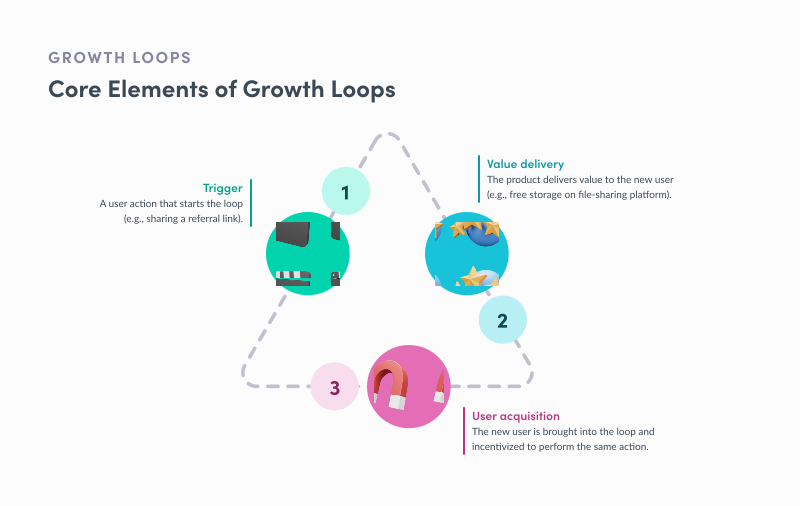
In other words, AI monetization must plug into a self-reinforcing growth loop (including trigger, value delivery, user acquisition), not a single paywall.
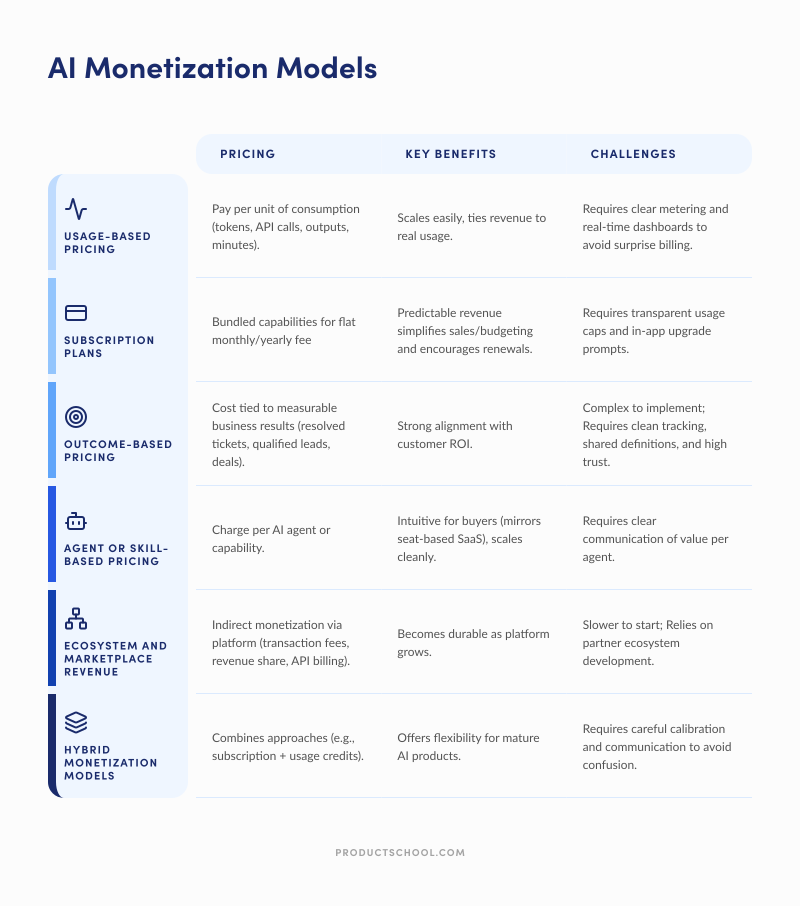
Monetizing AI: Core Pricing and Revenue Strategies
Nearly half of companies with GenAI features still aren’t monetizing them, and the rest are scattered across a handful of experimental models. That’s a clear sign the market is still very fresh.
This chart is exactly why it’s critical for product teams to start thinking seriously about sustainable monetization now, before costs scale faster than revenue and ad-hoc pricing locks them into weak economics.
There is no universal model that works for everyone. Most successful companies test, blend, and evolve their strategy over time, based on usage patterns, product complexity, and AI ROI alignment.
1. Usage-based pricing
With usage-based product pricing, customers pay per unit of AI consumption, such as tokens, API calls, generated outputs, or automation minutes. The benefit is fairness. Heavy users pay more. Light users pay less. This keeps revenue tied to real usage and makes it easy to scale.
Product teams should ensure:
Clear pricing meters
Dashboards that show consumption in real time
Cost ranges for typical usage, so customers don’t fear surprise billing
This model works best when usage is easy to measure and when value increases naturally the more a customer uses the AI.
2. Subscription or tiered plans
Subscription models bundle AI capabilities behind predictable monthly or yearly plans. A plan might include a usage allowance that resets each period, with additional usage available for purchase if needed.
Teams use this model when:
Simplicity and predictability matter more than precision
They want to align AI pricing with existing SaaS plans
AI is a core part of the everyday workflow
This model benefits sales conversations, budgeting, and long-term renewals. It becomes even more effective when paired with transparent usage caps and in-app upgrade prompts.
3. Outcome-based pricing
Outcome-based pricing ties cost to measurable business results such as resolved support tickets, qualified leads, closed deals, or automated workflows completed.
This approach works well when:
The workflow and outcome are highly specific
The value is easy to measure
The customer cares deeply about the end result, not the mechanism
The upside is strong alignment with customer ROI. The downside is complexity. It requires clean tracking, shared definitions, and higher trust between vendor and buyer.
4. Agent or skill-based pricing
Agent-based models charge customers per AI agent, assistant, or skill. For example, one plan may include a basic assistant that drafts content, while a higher plan unlocks advanced reasoning, workflow execution, or autonomous actions.
This model is useful when:
AI use cases are modular and can be sold as building blocks
Capabilities naturally separate into tiers or roles
The AI feels like a “virtual seat,” replacing or augmenting human effort
It’s intuitive for buyers because it mirrors traditional seat-based SaaS pricing, and it scales cleanly in enterprise environments.
5. Hybrid monetization models
Hybrid models combine two or more approaches, such as subscription plus usage, or usage plus outcome pricing. Many AI companies land here over time because it balances predictability with fairness.
Examples include:
A subscription plan that includes monthly usage credits
Outcome pricing, but only after a base subscription
Usage billing with a cost ceiling for predictability
Hybrid models require more careful communication, but they give product teams the most flexibility as AI usage matures and expands.
6. Ecosystem and marketplace revenue
In platform environments, product teams can monetize AI indirectly by enabling others to build on top of their ecosystem. Revenue may come from transaction fees, marketplace listings, API billing, revenue share, or partner-led installs.
This model works best when:
The product integrates deeply with other tools
The company owns a workflow or data layer that others want access to
Partners can create meaningful value on top of core AI capabilities
Ecosystem monetization is slower to start, but becomes extremely durable as the platform grows.
Measuring AI ROI: Early Signals That Prove Monetization Potential
Inbal Shani, Chief Product Officer and Head of R&D at Twilio, summed this up during her Product AI conversation on The Product Podcast:
You need to measure outcomes that matter. A CEO might say, ‘I want my engineering teams to ship faster. I want my support teams to handle more tickets. I want marketing to deliver more targeted campaigns.’ Those are measurable outcomes: productivity, automation, customer satisfaction, time-to-resolution. Then you ask: how can AI help us achieve these? And you measure the impact against those business outcomes. You define success by the business or customer outcome, not by whether AI was used.
In other words, AI ROI isn’t its own category. It shows up in the same metrics your business already cares about, just at a different scale.
Before a team can monetize AI, it must prove the feature drives product OKRs. The strongest ROI signals come from a combination of adoption, efficiency, revenue impact, and customer sentiment.
Most successful AI product teams set targets in three categories: usage, performance, and financial impact. Below are the leading indicators to track in the first 30, 60, and 90 days.
Adoption and usage
The first ROI checkpoint is simple: Are users engaging with the AI feature on a recurring basis, not just testing it once? Features that eventually monetize typically show consistent repeat usage.
Track metrics such as:
Percentage of active users who use the AI feature at least once per week
Number of AI actions per user per day or per session
Feature retention from week one to week four
Sample targets to aim for:
At least 25 to 35 percent of active users engaging in the first month
At least 10 percent repeat weekly usage by week four
Steady week-over-week usage growth rather than a post-launch drop-off
If product adoption is below these thresholds, focus on onboarding and discoverability before attempting monetization.
Efficiency and workflow impact
AI adoption only matters if it creates measurable efficiency. Efficiency metrics not only justify monetization but also help determine pricing confidence.
Track:
Execution speed improvements (for example, content creation time reduced from 20 minutes to 3 minutes)
Throughput lift (for example, support teams resolving 30 percent more tickets per agent)
Reduction in manual steps or clicks
Target outcomes:
At least 20 to 40 percent faster execution of core tasks
At least 10 to 25 percent increase in throughput for frequent workflows
These numbers are strong enough to justify upgraded plans, expand seats, or introduce usage-based pricing tied to real productivity gains.
Revenue and upsell impact
To prove a monetization path exists, track how AI influences both direct and indirect revenue.
Focus on:
Conversion lift on plans that include AI features
Expansion revenue from accounts that activate AI
Close-rate improvement when AI is used in product demos
Target signals:
At least 10 to 20 percent higher conversion for AI-inclusive plans
Visible uplift in average revenue per account using AI features
Clear sales feedback that AI is a decision factor
If AI influences buying decisions, monetizing it becomes far easier and less risky.
Customer satisfaction and sentiment
AI features that reduce effort or produce better outcomes should improve sentiment quickly. If customers love the feature, they will pay for it. If they don’t, any pricing model will feel like friction.
Track:
NPS score changes after AI launch
Satisfaction scores specific to AI workflows
User comments mentioning time-saving or quality improvements
Targets to watch for:
A positive NPS or CSAT shift within 30 to 60 days
Qualitative feedback that explicitly references value or saved time
User requests for more AI scenarios, automations, or capacity
Demand signals matter as much as data here.
Investment versus adoption
AI features require investment not just in modeling but in enablement, change management, and onboarding. Many organizations underestimate this.
Use a simple ratio:
For every 1 unit of investment in building the feature, expect up to 2 to 3 units of investment in activation, training, and support
If adoption lags, do not monetize yet. Improve discoverability, onboarding flows, and in-product education first.
How to apply these signals to monetization decisions
Once the signals above start trending positively, monetization becomes straightforward. If they fit, you can borrow these thresholds as your internal gate:
Feature adoption is above 25 percent
Workflow speed improves at least 20 percent
Sentiment is neutral or improving
Usage is repeated, not one-time
Accounts with AI show stronger revenue or retention patterns
If three or more of these conditions are true, PMs can confidently move to pricing experiments such as:
Gating advanced AI functionality
Adding AI credits to paid plans
Usage-based billing
Outcome-based pricing for high-impact workflows
Steps to Monetize AI in Your Product
A practical roadmap for product teams include:
Identify high-value AI use cases. Start with scenarios where AI clearly solves a problem. Talk to your users: what tasks do they wish were faster or smarter? Validate ideas with quick AI prototypes before full product development.
Instrument usage from day one. Add product analytics to the AI feature to capture usage patterns. Track how often it’s used, by whom, and in what contexts. Without this data, you can’t measure impact or optimize pricing.
Choose and test a pricing model. Based on the use case, pick an initial strategy (subscription, usage-based, outcome, etc.). Consider experiments (for example, A/B testing usage fees in a pilot group) to gauge sensitivity. Be ready to adjust as you learn what customers accept.
Communicate value clearly. When launching AI features, tie them to OKRs. Provide examples: “This AI chat can reduce your support backlog by X%, saving you Y dollars.” If possible, give customers a way to calculate their own ROI (e.g. an online calculator).
Iterate from data. Monitor the metrics above. If users aren’t adopting, investigate why. Is the feature hard to find, or is the product pricing off? If costs exceed returns, optimize the model or adjust tiers. Use real feedback to refine both AI product strategy and pricing.
Invest in change management. Simple AI tools still need user enablement. Offer tutorials, quick-start guides, or demos so customers learn how to get the most out of the AI. The faster they see value, the sooner they’ll be willing to pay for it.
Looking Ahead: AI Business Models and Best Practices
These six strategies help product teams shape durable AI business models, improve ROI, and create defensible monetization paths.
1. Build platform ecosystems to monetize AI
Turning a feature into a platform creates durable revenue beyond licenses. If partners can extend your AI with apps, connectors, or workflows, you unlock new ways to monetize AI without shouldering every use case yourself.
Launch a metered API with clear limits, keys, and pricing. Add AI credit packs for bursts
Seed a small marketplace: 10–20 high-utility add-ons that solve specific jobs to be done
Offer a 90-day partner program with SDKs, reference apps, and co-marketing templates
Set revenue shares and listing tiers; review security, AI eval quality, and support SLAs
Track partner-sourced pipeline, attach rate of add-ons per account, and % of ARR via ecosystem
2. Evolve pricing experiments for monetizing AI
There is no single perfect model. Treat pricing like a product: test, measure, iterate. Start simple, add nuance as usage and AI ROI become clearer.
Run 2×2 tests: flat plan vs plan+credits, and low anchor vs high anchor
Ship an in-product cost estimator so buyers see forecasted spend before committing
Set soft and hard caps with proactive alerts; offer grace usage to reduce bill shock
Guard gross margin with per-unit floors (tokens, calls, minutes) and automatic model routing
Watch expansion revenue, AI feature adoption by plan, and unit economics per workflow
3. Earn trust and reliability to unlock AI ROI
Trust is part of the AI business model. Reliability, privacy controls, and explainability increase willingness to pay, especially in regulated or high-stakes workflows.
Publish AI SLOs (latency, success rate, fallbacks) and show real-time status in-app
Add human-in-the-loop for risky actions; require confirmations for irreversible steps
Give admins controls: data retention, redaction, region pinning, and audit logs
Run regular evals on accuracy, safety, and drift; route to safer models when confidence drops
Measure support tickets per 1,000 AI actions, policy exceptions, and time-to-resolution
4. Adopt new metrics that prove AI ROI
Traditional SaaS KPIs miss the full picture. Add AI-specific measures that connect cost to outcomes so you can price fairly and defend value.
Input metrics: cost per 1,000 tokens, calls per task, average latency
Output metrics: quality score by task type, success rate on first attempt
Outcome metrics: minutes saved per user per week, throughput lift per role
Financial metrics: ARPU uplift for AI tiers, gross margin per automated task, payback on AI add-ons
Pick one north-star (for example, “minutes saved/user/week”) and tie paywalls to thresholds
5. Create defensible moats for AI business models
Generic AI is easy to copy. Your revenue growth stays safe when your product is hard to replace (through unique data, deep workflow integration, and brand-level delight).
Build proprietary datasets via opt-in telemetry and labeled feedback loops
Integrate across the stack (docs, CRM, ticketing, BI) so your AI lives where work happens
Bias the roadmap toward complex, high-utilization workflows that competitors can’t clone
Ship fast with visible cadence; reliability and velocity are part of the moat
Track moat health: utilization of complex features, switching-cost proxies, retention of power users
6. Use growth loops as a distribution to how to monetize AI in-product
Distribution has shifted. Rely less on external channels and more on product-native loops that compound product adoption and revenue growth.
Design delight moments that trigger sharing and referrals right after AI success
Convert inside the product: targeted upsells when users hit value or usage limits
Reward advocates with extra AI credits or advanced capabilities
Monitor loop strength: invites per active user, conversion from invite, and revenue per loop cycle
The Future of Monetizing AI
Monetizing AI is about building a product that delivers repeatable outcomes, compounds through usage, and earns the right to charge because it demonstrably improves how customers work.
The companies that win will be the ones that treat AI as a system, one that ties value to outcomes, distribution to usage loops, and pricing to measurable ROI.
The strategy from here is straightforward:
Ship AI that removes friction from real workflows, not novelty ones
Measure the impact with clear ROI signals, not vanity metrics
Monetize at the moment of proven value, not before it
Build defensibility through data, distribution, and ecosystem, not features
Evolve pricing through experimentation, not assumptions
As Elena Berna reminded us on stage, growth comes from the tight connection between product and distribution. In the era of AI, that connection becomes even more powerful and even more valuable to those who master it.
The opportunity in front of us is massive, but so is the responsibility: to build AI that is profitable, defensible, and trusted. The teams that achieve all three will do more than monetize AI.
AI Evals Certification
Learn to build trusted AI products. Design eval suites, integrate CI/CD gates, monitor drift and bias, and lead responsible AI adoption.
Enroll now
Updated: December 31, 2025