Every day, the executives who decided to keep asbestos in Johnson & Johnson's baby powder walked past the same lobby. Carved into 10-foot limestone blocks were the words: "We put patients, doctors, and nurses first."
They read it. They kept walking. Thousands of people got cancer.
This is not a story about bad people. It is a story about structural corruption — the process by which an organization's incentive structures and governance mechanisms gradually make betrayal more rational than integrity, regardless of what the values say on the wall.
As Eric Ries, creator of The Lean Startup, argues in our recent conversation on The Product Podcast: "We have this force that is destroying organizations, not because they are failures, but precisely because they're successful. Because the more successful an organization becomes, the more valuable it is as a target."
If you're building something worth protecting, especially now when AI ethics are crucial, you need to understand that force and build against it structurally. This piece is for product leadership, founders, and builders who want to understand why structurally healthy companies drift and what to put in place, from wherever you sit, to stop it.
Key Takeaways
Product ethics failure is usually structural, not moral. It happens when metrics, incentives, governance, and release systems reward behavior that conflicts with the company’s stated values.
AI makes product ethics failure faster and harder to contain because misaligned decisions can become automated, personalized, and repeated across every user interaction.
The model is the honest version of your incentive structure. If a product rewards engagement, retention, or conversion without enough constraints, AI will optimize for those outcomes regardless of the mission statement.
Values statements do not protect users. Product ethics becomes real only when values are translated into product constraints, guardrail metrics, escalation rights, launch gates, and post-release accountability.
Trust is a product asset, but it can also become a target for extraction. The more users trust a product, the more dangerous it becomes when the company’s incentives drift.
Product leaders need a product ethics operating system. The work is to define who the product refuses to betray, what the system is not allowed to optimize, and who can stop a launch when harm appears.
The strongest AI product leaders will treat ethics as product infrastructure. They will build it into roadmap reviews, model evaluations, experimentation, release discipline, and incident reviews before the product scales.
Success Is a Target, Not a Shield
The companies most at risk of structural corruption are the trustworthy ones, precisely because trust is what makes betrayal profitable.
This is the paradox that most builders never see coming. The more consistently your company delivers on its promises, the more your customers stop verifying that you still do. The more value you create, the more valuable you become as something to extract from.
Success makes you a better target for corruption.
How fiduciary duty became a business model
Sol Price understood this better than anyone, and it still cost him his company.
In the 1950s, Price founded FedMart on a principle most retailers would have considered commercial suicide: fiduciary duty to the customer. Meaning, a legal and ethical obligation to put the customer's interests before the company's own.
In practice, this meant capped margins. FedMart would never mark up a product more than 14%.
It meant above-market wages, because Price believed the people serving customers should care about serving them.
It meant total pricing transparency. When a competitor ran a below-cost ad to undercut FedMart on a product, Price didn't match the price quietly. He posted the competitor's ad in his own store with a sign telling customers to go buy it there instead.
Customers noticed. Over two decades, FedMart built the kind of trust that is genuinely rare in retail. If FedMart said it was the lowest price, people believed it. They had repeatedly proven it would rather lose a sale than exploit the belief.
The Paradox: Trust makes betrayal more profitable
This is where the paradox bites.
By the early 1970s, FedMart's investors had noticed something that Sol Price either hadn't seen or had chosen to ignore. Customers trusted FedMart so completely that they had stopped price-checking. This meant FedMart could almost certainly raise prices, and most customers wouldn't notice.
The trust Sol had spent twenty years building had become an asset the company wasn't monetizing. To the investors, this looked like money left on the table. To Sol, it looked like a betrayal of everything the company stood for.
They fought about it for years. In 1975, Sol Price arrived at work to find the locks had been changed. The investors had won.
It is important to be precise about what the investors got wrong. They were not wrong that the trust was exploitable. They were wrong that exploiting it was a sound long-term strategy. FedMart's value was never really in its stores, its supplier contracts, or even its customer base.
It was in the system.
Once the investors took control and reversed those commitments, the system stopped working. Within seven years, they drove the company into liquidation. The goose was dead.
Sol Price started over, moving into the office directly above FedMart headquarters and launching Price Club, built on the same ethos. One of the people who left FedMart to join him was a stockboy-turned-executive named Jim Sinegal. A few years later, Sinegal left to start his own company. That company eventually merged with Price Club to become Costco.
The ethos survived. But Sinegal had learned something from watching what happened to FedMart that Sol Price never fully solved: ethos alone is not enough. If the values aren't protected by structure (legal, operational, and governance structure) the investors will find the locks eventually. That is the problem the rest of this article is about.

Why Values Without Structure Are Product Ethics Theater
Most product-led organizations in 2026 have a version of the credo. It lives in the onboarding deck. It's on the about page. Some teams have it in their Notion workspace. A few have it framed in the office even...
Almost none have it in the corporate charter.
In an AI operating model, the gap between stated values and structural enforcement is closing faster than most product leaders are prepared for.
Johnson & Johnson spent decades discovering the hard way: Robert Wood Johnson II carved the company's four-principle hierarchy (patients and nurses first, employees second, communities third, shareholders last) into 10-foot limestone blocks in the corporate lobby.
He fired his own cousin for violating it. While he was alive, the credo had teeth because he was the teeth. When he died, the teeth went with him.
By the 1990s and 2000s, J&J was in scandal after scandal. Most damning, as per Reuters, litigation documents revealed the company had knowingly kept asbestos in baby powder for decades, weighed whether to disclose to the FDA.
As Eric Ries, who has informed us on this story on The Product Podcast, puts it: "The people who did this, who put asbestos in baby powder, walked by the credo every day on their way to work that said, 'We put patients, doctors, and nurses first.' How is this possible?"
The answer is values-performance decoupling. It’s the organizational state in which a company's stated values and its actual incentive structures have diverged so completely that the values function as decoration rather than direction.
The credo was still on the wall. But everything that actually shaped behavior (OKRs, bonus structures, quarterly targets, promotion criteria) pointed somewhere else entirely.
In organizations, what gets measured gets managed. What gets managed becomes the culture. What's on the wall becomes wallpaper.
Why This Is a Product Ethics Crisis Right Now
This is the operating condition of most product-operating models today. AI is making it structurally worse in three specific ways.
#1 AI compresses the time between a misaligned decision and consequences
A product team that ships a feature optimized for engagement over user wellbeing used to have months before the harm compounded.
Recommendation algorithms, persuasive defaults, and dark patterns now operate at a scale and speed where product ethics failure can go from a single product roadmap decision to a regulatory investigation within a product cycle. The tolerance for values-performance decoupling has seemingly shrunk.
European Commission has preliminarily found TikTok’s “addictive design” in breach of the Digital Services Act. The FTC alleged that Amazon used dark patterns to enroll consumers into Prime without consent and make cancellation difficult, affecting “millions” of consumers.
#2 AI exposes the gap between what product teams say they optimize for and what the system does
When a model is trained on engagement proxies, it optimizes for engagement, regardless of what the product vision doc says about user empowerment. The model is the honest version of your incentive structure.
For many product leaders, the first time they’ve seen their organization’s real values reflected back at them clearly has been in the behavior of their AI systems. It is not always a flattering mirror.
McKinsey’s 2025 State of AI survey found that 88% of organizations now use AI regularly in at least one business function, but only about one-third have begun scaling AI programs across the enterprise. Separately, McKinsey’s AI trust research found that only about 30% of organizations reach a mature level in strategy, governance, and agentic AI architecture controls.
In other words, AI adoption is moving faster than the governance structures meant to keep incentives aligned.
Advanced AI Agents Certification
Design and implement adaptive, multi-agent AI systems with memory, collaboration, and risk safeguards. Deploy production-ready AI agents at scale.
Enroll now
#3 The accountability surface has expanded dramatically
Shareholders could ignore a values-performance gap for years when harm was slow. Regulators, journalists, and users now have AI-powered tools they use for model audits, explainability requirements, whistleblower protections, algorithmic impact assessments.
These tools make structural misalignment visible in ways it never was before.
The OECD’s AI Incidents and Hazards Monitor was created specifically to document AI incidents and hazards as evidence for policymakers, and OECD analysis found that media-reported AI incidents more than tripled from 2022 to 2025, rising from an average of 92 reports per month to 324.
The EU AI Act, for instance, doesn’t ask what your company values. It asks what your system does specifically. Non-compliance with prohibited AI practices can trigger fines of up to €35 million or 7% of worldwide annual turnover, whichever is higher.
The product leaders who treat this as a compliance problem will spend the next five years in reactive mode. The ones who treat it as a structural design problem will build organizations that don’t need to react, because the structure keeps the values and the incentives pointed in the same direction.
AI Makes Misalignment Operational, Not Occasional
AI product ethics failure happens when a misaligned product decision becomes a system behavior. In AI product governance, the question is “What is the system now repeating, personalizing, and optimizing at scale?”
The old version of product ethics failure was episodic. A team made a questionable trade-off, shipped it, watched the numbers, and maybe corrected course after user complaints, churn, press attention, or legal review. That cycle was flawed, but at least it had friction.
AI removes much of that friction.
A recommendation system does not need to wait for the next roadmap review to amplify a bad incentive.
A pricing model does not need to ask the product team before it learns which nudges drive higher conversion.
A feed-ranking system does not read the company mission before deciding which content keeps people scrolling.
It follows the objective function, the proxy metric, the reward model, the ranking rule, and the feedback loop.
That is why AI dramatically compresses the time between a misaligned decision and its consequences. A human team can rationalize a trade-off once. An AI system can repeat that trade-off millions of times, across millions of users, while continuously learning how to make it more effective.
The system optimizes what the company actually rewards
AI does not optimize what a company says it values. It optimizes what the company has made legible to the system.
If the measurable goal is engagement, the system will look for engagement.
If the reward signal is conversion, it will look for conversion.
If the ranking model is tuned around retention, it will find the behaviors, prompts, surfaces, and emotional triggers that keep people coming back.
The system is doing exactly what the organization asked it to do.
This is where product leaders need to be precise. “User wellbeing” is not an AI constraint unless it is translated into product requirements, guardrails, model evaluations, experimentation rules, and escalation paths.
Eric Ries, author of The Lean Startup and Incorruptible, makes a version of this point when he talks about why successful organizations become vulnerable. In his words:
“The more successful an organization becomes, the more valuable it is as a target.”
In the AI era, the target is not only the company. The target is the trust the company has earned. Once users trust a product, they stop checking every default, every recommendation, every prompt, every price, every consent flow. That trust becomes an asset.
If the company’s incentives are healthy, the asset compounds. If the incentives are misaligned, the asset becomes something the system can quietly extract from.
Why engagement proxies become ethical risk multipliers
Engagement optimization becomes dangerous when the proxy is allowed to stand in for the purpose of the product.
There is nothing inherently unethical about measuring engagement. Product leaders need to know whether people find value in what they build. The risk begins when engagement becomes the highest-ranking truth in the system, especially when AI is allowed to personalize the path toward it.
A notification strategy that once annoyed users can become a personalized interruption engine.
A feed-ranking decision that once favored popular content can become a behavioral prediction system optimized for emotional stickiness.
An onboarding flow that once nudged people toward activation can become a personalized pressure sequence.
A cancellation flow that once added friction can become an adaptive retention trap.
A product experiment that once tested willingness to pay can become a model that learns which users are least likely to notice or resist a worse deal.
So, the question I use to nudge product teams into right thinking is: “What is the system allowed to learn?”
A product leader in the AI world needs to ask that question before the metric moves, not after the harm appears. When an AI system learns that anxiety increases session frequency, does the organization treat that as a growth opportunity or a governance signal?
That is where AI product governance becomes product work, not compliance work. The ethical surface area is no longer outside the product. It is inside the ranking logic, the default settings, the AI evaluation set, the experiment design, and the trade-off review.
I lean heavily on Jeetu Patel’s words whenever I think about this: “Security and safety are not looked at at odds with productivity. It's actually looked at as a prerequisite of productivity.”
The highest-leverage move is to start treating engagement optimization as a system with constraints.
Engagement with agency is different from engagement through compulsion.
Retention through value is different from retention through friction.
Conversion through clarity is different from conversion through confusion.
AI makes those distinctions operational. Product leaders have to do the same.
AI Evals Certification
Learn to build trusted AI products. Design eval suites, integrate CI/CD gates, monitor drift and bias, and lead responsible AI adoption.
Enroll now
The Model Is the Honest Version of Your Incentive Structure
AI exposes the gap between what product teams say they optimize for and what their systems actually optimize for. The model becomes a mirror of the organization’s real priorities because it learns from what the company repeatedly rewards.
Most companies do not wake up one day and decide to betray users. The drift is usually smaller and more ordinary. A team says it stands for empowerment, but the dashboard rewards time-on-platform. A health app says it supports wellbeing, but the product loop rewards streak anxiety.
Values-performance decoupling is the gap between a company’s stated values and the product behaviors it repeatedly rewards under pressure. AI makes that gap visible because the model does not care which values were most eloquently described in the strategy deck. It learns from the incentive structure as it is encoded in data, goals, constraints, and evaluation criteria.
That is why Eric Ries and I both think one of the most important leadership skills in 2026 will be the ability to translate values into system requirements. Product leaders will increasingly manage products that make decisions without waiting for human judgment.
Why AI reveals Values-Performance Decoupling
The hardest part of product ethics is not getting people to agree with values in the abstract. Most teams already agree that user trust or wellbeing matters, don’t they?
The hard part is deciding what happens when those values conflict with a metric that has a target attached to it.
Thomson Reuters Institute reporting on AI governance found that while 71% of companies with AI strategies include ethical principles, there is still a major execution gap between policy and practice. That is the pattern product leaders should pay attention to: principles are spreading faster than operating mechanisms.
In the Product Podcast conversation, Ries gives a devastating example from Johnson & Johnson. The company had a credo that put patients, doctors, and nurses first, and employees walked past that credo every day. Yet the incentives of the business eventually pointed somewhere else. Ries asks:
“The people who did this, who put asbestos in baby powder, walked by the credo every day on their way to work that said, ‘We put patients, doctors, and nurses first.’ How is this possible?”
The AI version of that question is simple: How can a company say it puts users first while training systems to exploit their attention, confusion, fear, loneliness, or inertia?
The answer is the same. The written value and the operating value were not the same. The stated value lived in language. The operating value lived in incentives.
What your metrics say when your mission statement is silent
Next generation of product ethics cannot be built around values statements alone. It has to be built around metric design.
For practical purposes, I would ask product leaders to audit three layers:
The declared value: What do we say this product is for?
The rewarded behavior: What user and system behaviors actually improve our metrics?
The constraint layer: What are we unwilling to optimize, even if it improves the metric?
The third question is where real AI product governance begins. Without constraints, every value eventually becomes negotiable. With constraints, values become part of the product architecture.
A wellbeing product might decide that streaks cannot be optimized if they increase shame or anxiety.
A marketplace might decide that seller velocity cannot outrank buyer safety.
A consumer app might decide that notification engagement is only valid if users retain clear control over frequency and timing.
A subscription business might decide that retention gains from cancellation friction are not legitimate retention.
These decisions are product decisions. They determine what the system is allowed to learn, what the team is allowed to celebrate, and what the organization is allowed to call success.
The Product Ethics Operating System
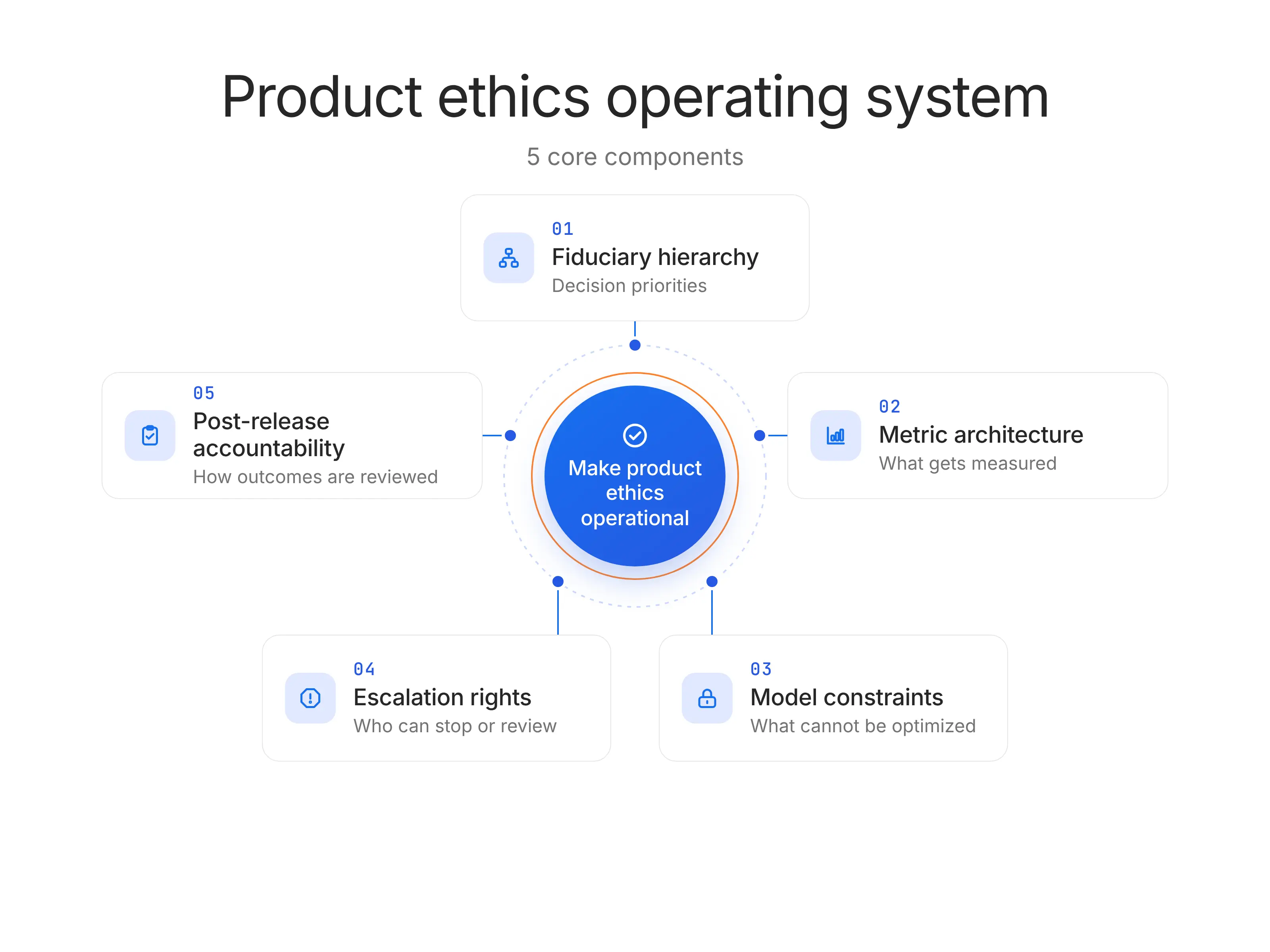
A product ethics operating system is the set of rules, metrics, constraints, rights, and review loops that keeps product ethics from depending on individual courage. It turns product ethics failure into something the product-led organization can detect, block, review, and improve.
I do not think product leaders need another ethics checklist. A checklist asks whether the team considered harm. An operating system changes who gets to decide when harm is detected.
In 2026-27, the most important product ethics work will happen in roadmap reviews, AI evaluations, product launch gates, product experimentation design, incident reviews, and executive trade-off conversations.
The product ethics operating system has five components:
https://docs.google.com/document/d/1a13L_3Q6Pi9U1U3BQvQ9XuwlbF6W-VL6ug2UidLJEsw/edit?usp=sharing
Fiduciary hierarchy
Metric architecture
Model constraints
Escalation rights
Post-release accountability
1. Start with a fiduciary hierarchy
The first best practice is to define who the product refuses to betray, even when the metric says betrayal would work.
A fiduciary hierarchy is a ranked order of obligation. It answers a question: when customer wellbeing, revenue, growth, employee pressure, and investor expectations collide, whose interest has priority?
For a product team, this has to show up in trade-off rules.
A strong fiduciary hierarchy should define:
Who comes first in high-stakes product decisions
Which user harms are never acceptable as growth tactics
Which customer outcomes outrank short-term business metrics
Who has authority to interpret the hierarchy when teams disagree
Which executive owns the hierarchy when a launch is commercially attractive but ethically weak
For example, a marketplace might say buyer safety outranks seller velocity. A health app might say psychological wellbeing outranks streak completion. A financial product might say user comprehension outranks conversion speed.
The point is to make the trade-off order explicit before the dashboard creates pressure.
2. Design metric architecture, not just success metrics
The second best practice is to stop treating product metrics as neutral.
Metrics are instructions. In an AI-enabled product, they are also training signals, ranking signals, experiment signals, and promotion signals. If the metric architecture is wrong, the system will learn the wrong lesson faster than the organization can explain its values.
A product ethics operating system could separate metrics into four categories:
Value metrics: what proves the user is genuinely better off
Business metrics: what proves the product is economically working
Guardrail metrics: what prevents the business metric from becoming extractive
Harm metrics: what detects user confusion, compulsion, exclusion, manipulation, or loss of agency
To stay quite literal and practical:
Do not approve an engagement metric unless the team also defines the user agency guardrail.
Do not approve a customer acquisition metric unless the team also defines the comprehension guardrail.
Do not approve a retention metric unless the team also defines the friction and cancellation guardrails.
Just try to ask your team if the number moved in a way you are willing to defend?
3. Encode model constraints before optimization begins
The third best practice is to define what the model is not allowed to optimize.
This is where AI product governance becomes product architecture. A model should not simply inherit the company’s growth goal. It should inherit the company’s boundaries.
Before launch, teams should document:
The primary optimization goal
The proxy metrics used to represent that goal
The behaviors the model is not allowed to encourage
The user groups that require heightened protection
The thresholds that trigger human review
The tests that prove the system respects those limits
For example, a recommendation system may optimize relevance but not emotional dependency. A pricing model may optimize willingness to pay but not exploit confusion or urgency.
The key question is simple: what would be a “successful” model behavior that we would still consider unacceptable? If the team cannot answer that question, the product may not be ready for scale.
4. Give teams escalation rights, not just escalation channels
The fourth best practice is to give people the right to slow down, block, or re-scope a launch when the product violates the operating system.
Most companies already have escalation channels. Very few have escalation rights.
A channel lets someone raise a concern. A right changes the decision. That is the difference between ethics as feedback and ethics as governance.
A product ethics operating system should define:
Who can pause a launch
What evidence is required to trigger review
Which risks require executive sign-off
Which risks require legal, policy, data science, security, or user research review
Which decision rights belong to product, and which belong outside product
How dissent is documented when leadership overrides a concern
This is especially important for AI product strategies because harms often appear as weak signals before they become incidents.
A researcher notices a vulnerable user pattern.
A data scientist sees a model exploiting a proxy.
A support team sees complaints that do not yet show up in aggregate metrics.
An AI PM sees that the experiment “works” only because users are confused.
The organization should not depend on whether that person feels brave enough to object. The operating system should make objection part of the job.
5. Build ethics into the release system, not the poster
The fifth best practice is to make product ethics a launch condition.
A values statement says what the company believes. A release system decides what the company ships. When those two are disconnected, the release system always wins.
For every meaningful launch, especially AI-enabled launches, the team should be able to answer:
What user outcome are we improving?
What user behavior are we optimizing?
What harm could the system learn to create?
What guardrails prove the outcome is legitimate?
What post-launch signal would force us to roll back?
Who owns the decision if growth improves and trust declines?
This should be part of the same release discipline that product teams already use for QA, security, privacy, reliability, and experimentation.
If ethics only appears after the product is built, it will arrive as a blocker. If ethics is built into the release system, it becomes a design constraint.
Jeetu Patel, President at Cisco, makes this point clearly in the context of AI and cybersecurity on The Product Podcast, and it couldn’t align more with product ethics: “What used to be that security was kind of a thing that you would have as an afterthought, you have to have security baked into the way in which you build product today, baked into the way in which companies are operating the entire environment.”
6. Review incidents like product failures, not PR problems
The final best practice is to treat product ethics incidents as system failures.
When a product creates harm, the question is, “What did our system allow, reward, miss, or normalize?”
A strong post-release accountability loop should review:
Which metric created the pressure
Which constraint failed or did not exist
Which team saw the signal first
Whether the escalation path worked
Whether leadership overrode a warning
What must change in the metric, model, process, or governance rights before relaunch
This is how product ethics becomes durable. They focus on improving the system that shaped the decision.
7. Values statement vs. product ethics operating system
Values Statement | Product Ethics Operating System |
Says what the company believes | Defines how product decisions are made |
Lives in decks, onboarding, and culture pages | Lives in metrics, launch gates, model constraints, and reviews |
Depends on individual interpretation | Assigns decision rights and escalation authority |
Asks teams to consider harm | Blocks or changes launches when harm crosses a threshold |
Measures intent | Measures behavior, outcomes, and incidents |
Works when pressure is low | Is designed for moments when pressure is high |
I know that at first glance, the product ethics operating system may seem as a bureaucracy. But, in actuality, it’s infrastructure.
It gives product leaders a way to protect users, teams, and the business from the predictable failure mode of successful companies.
Whatever you do, you don’t improve the metric at the expense of a long-term mission. It will cost you eventually and consequences, based on the examples that we saw, can be dire.
The Structural Integrity Diagnostic for Product Leaders
A product ethics checklist is only useful if it changes the next product decision. This AI product governance checklist helps product leaders identify whether a roadmap item has enough structural integrity to ship, or whether the team is accumulating governance debt.
Use this product governance framework before AI roadmap reviews, quarterly planning, executive updates, model launches, growth experiments, and any release where the system will automate, personalize, rank, recommend, price, approve, deny, or nudge user behavior.
The goal is to make sure the team knows what it is optimizing, what harm the system could hide, who can stop the launch, and what user outcome the company refuses to trade for growth.
Six questions to ask before the next AI roadmap review
# | Diagnostic question | What a strong answer includes | If the answer is weak, do this |
1 | What are we optimizing? | A clear primary metric, the user outcome it represents, and the proxy risk if the metric is misread | Rename the metric, add a user-outcome metric, or block the roadmap item until the team can explain the optimization target |
2 | What user outcome would we refuse to trade for growth? | A specific non-negotiable, such as user comprehension, safety, autonomy, privacy, wellbeing, fairness, or trust | Add a product constraint that defines what growth is not allowed to cost |
3 | What harm could the system hide while the dashboard improves? | A list of hidden harms, such as confusion, compulsion, exclusion, over-personalization, false confidence, or silent user burden | Add guardrail metrics and qualitative review before launch |
4 | What is the model, workflow, or experiment not allowed to optimize? | A documented constraint on unacceptable behavior, even if that behavior improves engagement, retention, revenue, or efficiency | Add model constraints, experiment stop rules, or manual review thresholds |
5 | Who has authority to slow, block, or escalate the launch? | A named decision owner and a clear escalation path outside the immediate growth or feature team | Assign escalation rights before the roadmap review continues |
6 | What post-release signal would force us to review, roll back, or redesign? | A defined incident threshold, review cadence, rollback owner, and customer-impact review process | Add a release gate and post-launch accountability plan |
How to score the diagnostic
Score each question from 0 to 2.
Score | Meaning |
0 | We cannot answer this with evidence |
1 | We have a partial answer, but no clear owner, metric, or release gate |
2 | We have evidence, an owner, a metric or constraint, and a decision rule |
Total score | Interpretation | Recommended action |
10 to 12 | Strong structural integrity | Proceed, but keep post-release monitoring active |
7 to 9 | Moderate governance risk | Proceed only after closing the highest-risk gaps |
4 to 6 | Significant governance debt | Do not scale until decision rights, metrics, and constraints are clarified |
0 to 3 | Product ethics failure likely | Stop the launch, redesign the operating model, and escalate to leadership |
The scoring rule is simple: if the team cannot answer with evidence, it does not have governance at this point in time.
What to do when the answers are uncomfortable
Uncomfortable answers are a sign that the product governance framework is working.
The worst outcome is not discovering risk. The worst outcome is discovering risk and treating it as a communication problem instead of a design problem.
When the diagnostic exposes a gap, translate it into one of four actions:
If the gap is... | The action should be... | Example |
No clear optimization target | Metric change | Replace “engagement” with “completed task with user control retained” |
No clear non-negotiable | Product constraint | “The model cannot optimize for repeat use by increasing anxiety or dependency” |
No clear decision owner | Governance assignment | Name who can block launch on user-wellbeing grounds |
No clear post-release trigger | Release gate | “If complaint rate rises above X or vulnerable-user impact appears, launch pauses for review” |
The point is to turn discomfort into a decision. Each weak answer should produce a missing owner, a metric change, a release gate, or a redesigned product constraint.
Product Ethics Is Now Product Infrastructure
The future of product ethics will be decided by the companies whose systems still make the right decision when growth, pressure, competition, and AI acceleration all point the other way.
That is the uncomfortable lesson behind every story in this article:
Trust is an asset, and successful companies become tempting targets for extracting from that trust.
Values statements do not protect users unless they are backed by governance, metrics, constraints, and decision rights.
AI makes product ethics failure faster because it turns incentives into continuous execution.
The model does not optimize your mission. It optimizes what your organization has made measurable and rewardable.
Product ethics becomes durable only when it is built into roadmap reviews, release gates, metric architecture, model constraints, escalation rights, and post-release accountability.
If a team cannot answer what it is optimizing, what harm the system could hide, who can stop the launch, and what user outcome it refuses to trade for growth, it is already accumulating governance debt.
This is why Eric Ries believes product ethics has to move from the language of morality into the language of product architecture.
Not because morality does not matter. It does. But morality alone does not survive the operating conditions of a scaled product organization.
Dashboards create pressure.
Incentives create gravity.
AI removes friction.
And once a harmful system is live, it does not wait for the next leadership offsite to clarify the company’s values.
The product leaders who understand this will have an advantage. They will treat ethics as a design constraint that improves the product before it ships.
If this is the kind of AI product leadership you want to build, this is exactly what we teach in Product School’s AI for Product Managers Certification.
AI Product Management Certification
Adopt an AI-first mindset: design AI-native UX, build agents, define modern PRDs, and ship trustworthy AI-powered products.
Enroll now
The course is designed for PMs who want to become front-running AI product leaders, not just users of AI tools. You’ll learn how to identify AI opportunities, work with technical teams, build AI-powered products, and, just as importantly, embed ethics into the product itself through better metrics, constraints, evaluation practices, and governance.
Updated: November 2, 2026