"To get real value from AI at work, you need three things: All of your systems connected in one place, skills that encode how your company operates, and the discipline to delegate aggressively (even when it feels faster to do it yourself)."
That is how Jaime DeLanghe, Slack's CPO, closed ProductCon New York.
She used her stage time for a live, unscripted demo of her actual daily workflow as a CPO. What she walked through was less a Slack product tour and more a working model of how a modern CPO operates when AI is in the loop.
This article picks up the three citable principles from her talk (connect, build skills, delegate) and turns them into a product leadership playbook you can apply to any connected AI platform. It’s ideal for product managers and product leaders who want a concrete, transferable model for how AI can restructure their daily workflow.
AI Product Strategy for Leaders
By the end, you will possess a board-ready AI Strategic Roadmap and Governance Framework, positioning you not just as a product builder but as the executive leader driving your company’s transformation.
ENROLL NOW
TL;DR: How CPOs Use AI
The CPO workflow is becoming an AI workflow. A modern CPO restructures the day around what AI can do across connected systems.
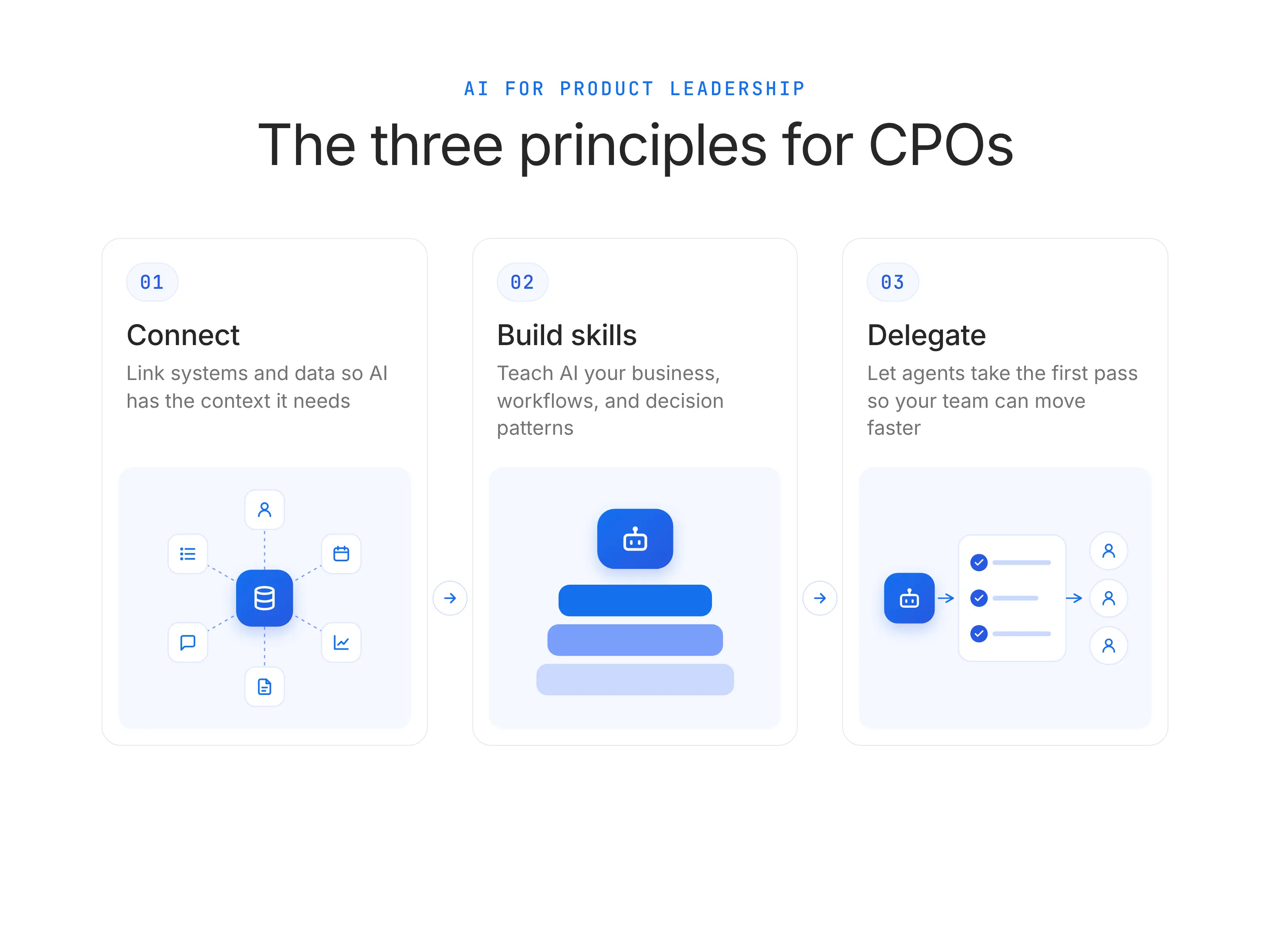
Jaime DeLanghe's framework has three parts. Connect your systems so the AI has access to your data. Build skills so the AI knows how your company operates. Delegate aggressively so the AI takes the first pass.
Connection is the precondition. AI that cannot see your conversations, project tracker, customer data, and calendar is working blind. Real productivity comes from agents that can read across the stack.
Skills are markdown files that codify company knowledge: incident summaries, deal briefings, and CPO daily briefs. They turn a general-purpose model into a company-specific one without engineering resources.
Delegation is the hardest principle. Even seasoned leaders who try AI, feel uncomfortable letting go of the first pass and revert to doing everything themselves.
The architecture is people + agents + platforms. The value of AI is proportional to its access to your business.
The skill set is teachable. The same prompt engineering and context engineering ideas that power consumer-facing skills are covered in Product School's AI Product Management Certification and Advanced AI Agents Certification.
Why the CPO Job Is Nothing Like You Imagine
Most PMs and AI builders dream about the CPO role. Make the calls, set the vision, drive the team. Jaime opened her talk by puncturing that fantasy in the most honest way I have seen at a product conference.
"Every day I wake up to 50 browser tabs. I've got meetings starting before work even starts… my EA and I are going to try to schedule bathroom breaks. But I'm committed as a mom of two to keeping my evenings free. So, enter AI."
That single sentence is what earns the rest of the talk. Jaime is not a product leader walking us through a glossy transformation story. She is a real person under genuine pressure, telling other product people what is actually working.
CPO context is the extreme version of the modern PM job
A Chief Product Officer is jumping between a customer call, a board prep, a partner conversation, a one-on-one, and a strategy review in the space of a morning.
If AI does not work for that workload, it does not work. If it does work, the same pattern scales down to senior PMs, group PMs, and anyone running parallel workstreams.
That is the lens I want you to read this article through. Not "what tools does Jaime use" but "what model of working does she now run on."

The Three Principles for CPOs: Connect, Build Skills, Delegate
Jaime DeLanghe's framework for getting real value from AI at work rests on three principles: connect all your systems so the AI has access to the data it needs, build skills so the AI knows your business specifically, and delegate aggressively so the agent takes the first pass instead of you. Together, these three principles form a complete operating model: connection is the precondition, skills are the customization layer, and delegation is the habit that turns the other two into compounding leverage.
Here are the three principles in her own words and what they mean in practice.
1. Connect all your systems
"In order to get a lot out of your AI, you need to connect all of your systems. You need to have an AI that really understands who you are, it understands your business, and it also understands how your team works."
The first lesson is the simplest and the most often skipped. AI is only as useful as the data it can access. If your conversations live in one tool, your project tracker in another, your customer data in a third, and your calendar in a fourth, your AI is working blind.
This is the connected systems principle. It is the precondition for everything else in the playbook. An AI-native workflow is an ecosystem in which the data, the people, the AI agents, and the platforms can talk to each other.
Slack is one example. Microsoft Copilot inside Microsoft 365 is another. Claude Code with custom MCPs is a third. The architecture matters more than the brand.
2. Build skills
A skill, in this context, is a markdown file with structured instructions that encode company-specific knowledge. Think of it as a codified version of how your company operates.
These include:
Incident response
Deal briefings
CPO daily briefs
Onboarding checklists
Skills turn a general-purpose model into a company-specific one without an engineering budget. The same incident summary skill produces the same structured output whether the CPO runs it or a junior engineer does. That consistency is product judgment encoded in a file.
This is the same idea that powers AI agents for PMs. Skills are the consumer-facing form of context engineering, which is one of the core competencies in the AI Product Management Certification and the Advanced AI Agents Certification.
Advanced AI Agents Certification
Design and implement adaptive, multi-agent AI systems with memory, collaboration, and risk safeguards. Deploy production-ready AI agents at scale.
Enroll now
3. Delegate aggressively
The third principle is the hardest. Most leaders try AI and feel uncomfortable letting go of the first pass. As a result, they revert to doing the work themselves.
The leaders who fall behind in the AI era will be the ones who try it, feel a flash of discomfort, and pull the work back.
The discipline is to let the agent take the first pass on everything you reasonably can. Then you edit with scrutiny and attention to detail.
How Jaime DeLanghe Actually Starts Her Day (With AI)
The live demo was a tour through her real morning. Rather than cataloguing every feature, what matters here is the shape of the workflow itself, because seeing how a CPO actually moves through a day with AI is more useful than any abstract framework.
This is a real example of the role in action, and the point is not to replicate it exactly but to let it inform how you think about structuring your own.
The proactive morning brief
Jaime starts in a Today view that aggregates calendar, to-dos, and activity across her connected systems. She then asks the assistant for a "peek at my day." The assistant pulls from Slack, calendar, Jira, and other systems, and synthesizes what actually needs her attention.
The PM application: what would it mean to start your day with an AI that already knows your top three blockers? Most PMs spend the first hour reconstructing context that already exists in their tools. A proactive brief flips that.
The incident deep-dive without reading the scrollback
A tier-one incident, code-named Project Fusion, had hit the team overnight. 14% peak error rate. 14,000 sessions affected. Three hours and forty minutes to resolution.
Instead of scrolling back through Slack and clicking through Jira tickets, Jaime asked the assistant for the synthesis. What she got back was a structured incident summary, a dynamic chart, and a postmortem canvas. The AI did not just retrieve information. It composed a usable artifact.
The PM application: how much of your week is spent reconstructing context that already exists in your tools? For most senior PMs and CPOs, the honest answer is "a lot."
Writing in your voice, not AI voice
Jaime is an English major. She is particular about voice and tone, especially in a message marking her first 100 days as CPO. She did not want it to sound AI-written.
So she asked the assistant to draft in her voice, based on her own message history and context. The assistant drafted it, then handed it back to her for review before sending.
That is the correct mental model for AI-assisted communication. The AI is not replacing your voice. The PM keeps the final edit. Strong human-in-the-loop design at the personal level.
Competitive research to PowerPoint without leaving Slack
Mid-meeting, Jaime asked the assistant to do competitive research across the web and build a PowerPoint deck. From inside Slack. While she was in a Google Meet. The assistant accessed Google Meet context, looked at her Google Calendar, ran the research, and produced the deck.
The lesson is that the value of AI scales with how many of your platforms it can touch. Each new connected platform expands what you can delegate.
Catching up on a meeting mid-meeting
Jaime asked the assistant to catch her up. The assistant could see her desktop, knew she was in a meeting, read the context of what had been discussed, and gave her talking points plus a reminder that her team was still waiting on a decision from her.
This is context awareness. It is the difference between an assistant who responds to questions and one who knows what you are in the middle of.
What Skills Actually Are and Why Every Team Should Build Them
The four skills that are useful for CPO’s workflows are a daily brief, a deal briefing, a deal coach, and an incident summary. Each one was a markdown file with structured instructions. Each one produced a consistent, structured output.
Here is the part most leaders miss. Skills can be built by anyone. Jaime even demonstrated asking the assistant to build a skill for itself. You do not need an engineering team. You need someone willing to write down how the work is actually done.
There are four reasons this matters for any product organization.
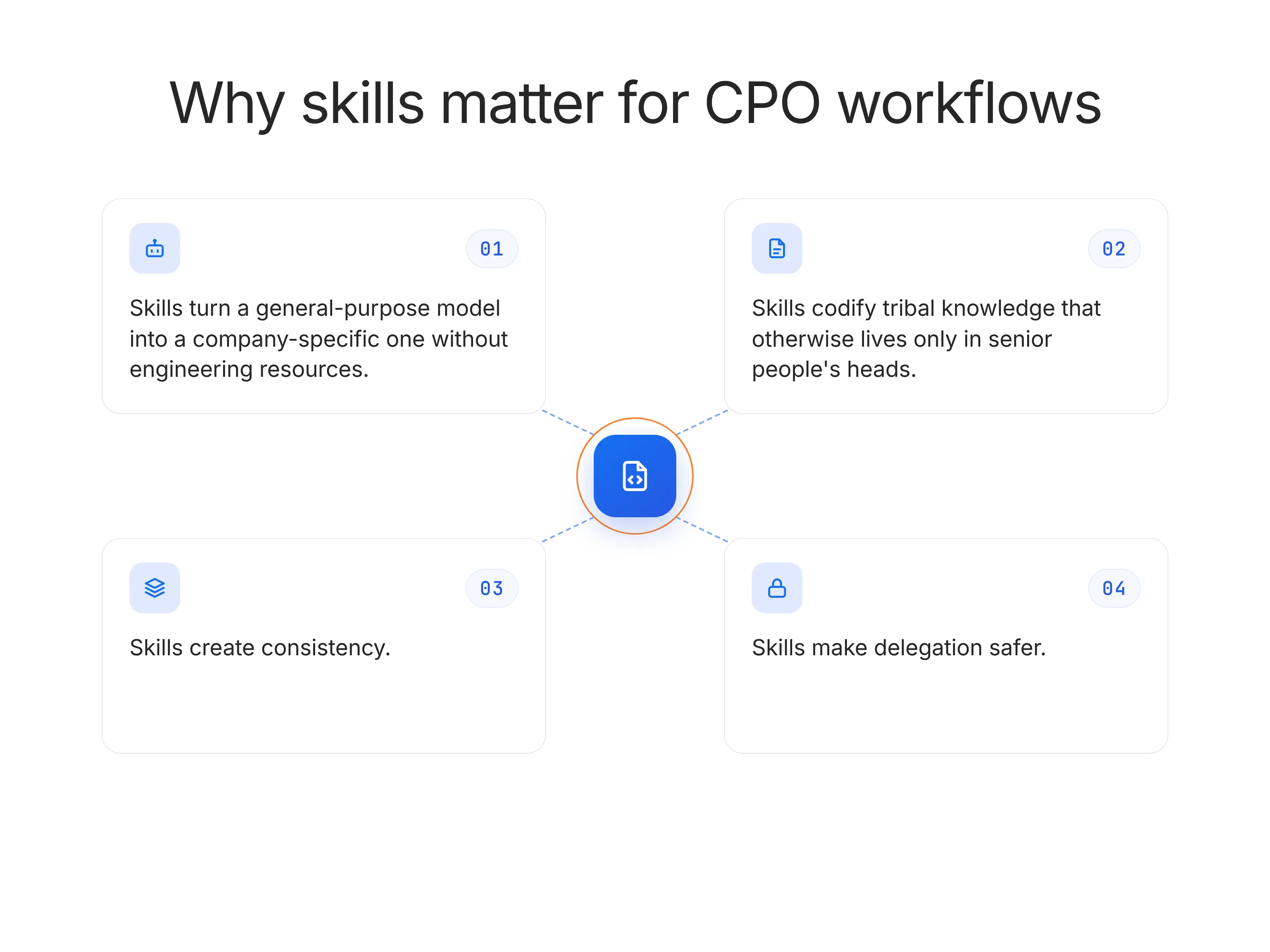
Skills turn a general-purpose model into a company-specific one without engineering resources. The model already knows English. The skill teaches it your business.
Skills codify tribal knowledge that otherwise lives only in senior people's heads. A junior engineer running the incident summary skill produces the same artifact a CPO would.
Skills create consistency. If your incident summary always has the same structure, your team can scan it faster and trust what they are reading.
Skills make delegation safer. A well-written skill includes the constraints, the format, and the expected output. The leader letting go of the first pass has something concrete to inspect.
Jaime made the connection to delegation plain:
"I'm super busy. You might have noticed I didn't do any prompt engineering in any of this. I basically talked to Slackbot like it was my teammate or my assistant, my co-worker. I don't have time to set anything up, and so I like to leverage skills that my team builds for me."
The takeaway is that prompt engineering is not the consumer-facing layer. Skills are.
The PM who learns to design skills for their team is doing the same work, at a slightly different abstraction, as the AI PM who learns to scope an agent. Both come down to context engineering.
The Delegate Aggressively Principle Is the Hardest One
If I had to bet on which principle most leaders will fail at, this is the one.
Jaime said it plainly during the demo:
"If I could have had Slackbot take over this full demo, I probably would have done that halfway through."
That is a CPO at one of the world's most-watched product companies, in the middle of a live ProductCon keynote, saying she would happily have handed the stage to an AI agent.
The instinct cuts the other way. Most leaders, especially senior ones, have built careers on being the person with the answer. The default reflex when AI takes a first pass is to look at the output, find it imperfect, and decide it is faster to do it yourself.
That reflex is the failure mode. The agent's first pass needs to be a serviceable starting point that you can edit. The compounding return on delegation comes from doing it consistently, not from being delighted with the first output.
This is also why product leaders who only sponsor AI from a distance get stuck. The leaders who pull ahead are the ones who model the workflow themselves. They delegate to the agent the way they want their team to.
The People + Agents + Platforms Equation
"You need to have all of your people, all of your employees, all of your partners, all of your customers collaborating in a place where your AI can access that data. You need all of your agents working in a place with all of your people. And then finally, you want to connect every platform together."
So, there are three layers here:
People in one place
Agents working alongside the people
Platforms connected to the agents
This is a vendor-neutral architectural principle. The value of AI is proportional to its access to your business. You can run it in Slack, Microsoft 365, a custom internal app, or any other surface. The architecture is what matters.
For product leaders, that goes beyond personal productivity. The companies that win the AI era will be the ones whose people, agents, and platforms are in the same place.
This is the AI operating model question, and it is increasingly the AI product strategy question too.
The CPO Workflow Is Becoming an AI Workflow
The most useful thing about Jaime's talk was that she did not try to make it look clean. The demo broke. She rerouted. The reroute itself was a demonstration of the playbook. That is what AI-assisted product leadership actually looks like.
If you take three things from this, take these.
Connect your systems first. The AI is only as good as the data it can see, and the leverage of every other principle scales with what you connect.
Build skills as a habit. Treat them as the standard operating procedures of an AI-native company. They are how you make tribal knowledge inspectable, repeatable, and delegable.
Delegate aggressively. The leader who edits the agent's first pass beats the leader who restarts it from scratch every time.
If you want to develop this skill stack the way Jaime's team has (context engineering, agent design, AI evaluation, and product strategy with AI in the loop) start with the AI Product Management Certification, and deepen it with the Advanced AI Agents Certification and the AI Product Strategy Certification.
The CPO job will keep getting harder. The 50 browser tabs are not going anywhere. But the playbook is now clear, and Jaime DeLanghe just walked you through it.
Product Management Foundations Certification
Use the most popular certification to learn the core skills, mindset, and tools to become a great Product Manager in the age of AI, and ship products people actually use.
Enroll now
Updated: October 26, 2026