Most product-led growth playbooks were written for a world where humans did all the sensing, deciding, and nudging. That world is gone.
In McKinsey’s latest global survey, 78% of companies say they now use AI in at least one business function. That’s a massive jump from just a couple of years ago (1).
The problem is that many product teams still treat AI like a feature. Meanwhile, the companies with the strongest PLG strategies are using AI to build self-reinforcing value loops: systems where every action a user takes makes the product better.
In this piece, we’ll unpack how AI is transforming product-led growth, drawing on insights from experts in AI growth and real examples from trailblazing products to show what it looks like to evolve from AI features to AI-powered platforms.
2025 Product Transformation Playbook
Check out the latest product trends with insights from Product School CEO Carlos Gonzalez de Villaumbrosiaon everything from growth experiments and leaner orgs to AI adoption and emotionally intelligent leadership.
GET THE PLAYBOOK
AI And The New Era Of Product-Led Growth
Product-led growth has been the dominant story in B2B SaaS for a while. However, AI is quietly changing the game.
The best examples of PLG are no longer asking “what AI feature can we ship,” they are asking “how do we turn AI into an engine that keeps making the product better and the business bigger.” In that world, every user interaction is converted into an input that goes back into the system.
How AI personalized product experience
AI finally lets products behave less like static software. We like to think about it as a living, responsive assistant that works with users one-on-one. Interfaces can adapt to how different users think, work, and navigate, instead of forcing everyone through the same linear user flows. Over time, the product starts to feel like it “gets” you.
Think about what happens when AI has access to a user’s documents, tasks, past behavior, and preferences. On the surface, you might see smarter suggestions or cleaner default templates. Underneath, the system is building a profile of what “good” looks like for that specific user or team. It’s reordering menus, surfacing the right features at the right time, and removing clutter that gets in the way.
This is where products become sticky. Users are not just staying because of a feature list. They are staying because starting work with your product feels faster, easier, and more relevant than starting anywhere else.
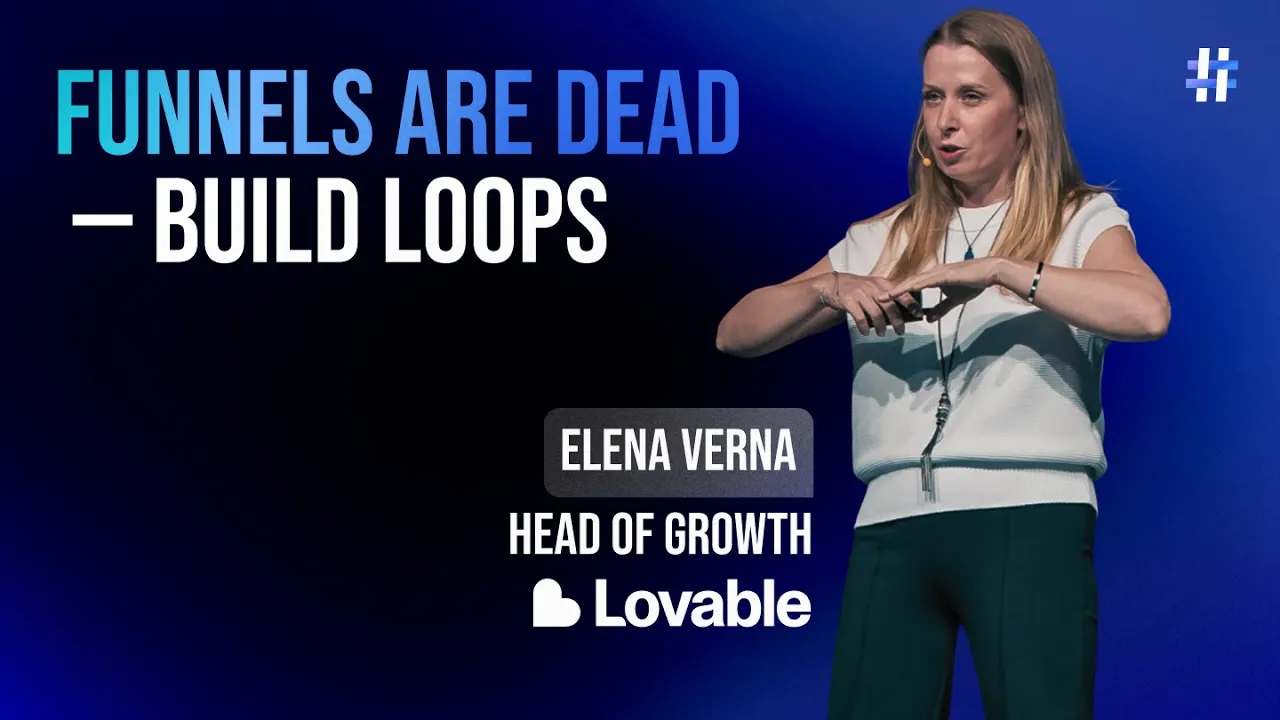
As Elena Verna, the Head of Growth at Lovable, puts it on The ProductCon:
You need to give users more reasons to stay than just product, because now the functionality can be very easily built by any of your customers.
That emotion is what keeps people from churning when a competitor copies your feature set.
How AI turns actions into growth loops
Fastest growing companies all have one thing in common, and that is they grow via growth loops. A loop is a closed ecosystem that continues to compound itself like a flywheel.
— Elena Verna, the Head of Growth at Lovable, at ProductCon
Classic PLG already relies on growth loops. You know, one user takes an action (trigger) that increases usage (value delivery), which finally pulls in another user (user acquisition).
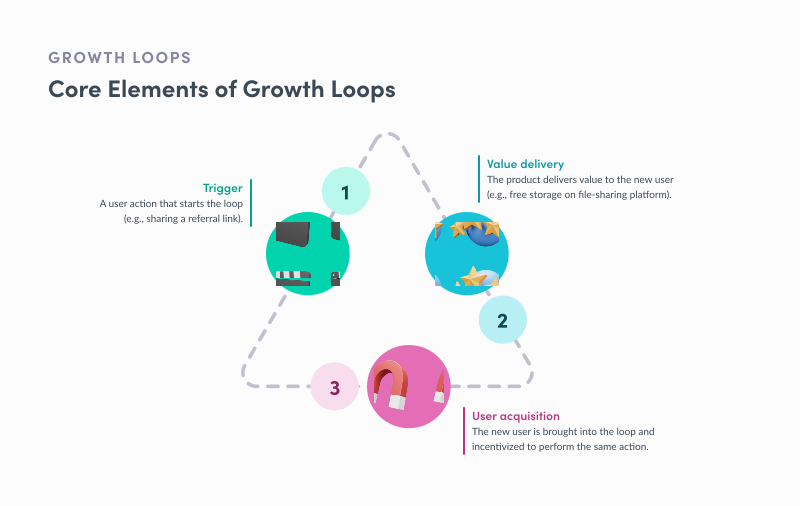
AI lets you be much more precise and creative about when and how those three components of a loop fire. Instead of generic “invite your team” banners, you can trigger referral, collaboration, or upgrade moments based on what someone just accomplished.
For example, when a user finishes a complex workflow, AI can detect that this was a meaningful milestone. Then, it can proceed to execute the entire loop on its own and refine it as time goes by.
It looks for the right moment to nudge them to share a template, invite collaborators, or export something that carries your watermark into other tools. Done well, these prompts feel like a natural next step in the work, not a growth hack bolted on at the end.
Over time, that logic compounds. The more your AI understands what success looks like in your product, the better it gets at spotting those high-intent moments and turning them into user acquisition, expansion, or user retention.
Growth becomes less about blasting campaigns at the top of the funnel and more about amplifying the value that is already happening inside the product.
How AI creates compounding network effects for PLG
Every interaction with an AI-powered product can make the product better for everyone else. This is the heart of data network effects. Each query, each action, each resolution gives your models more signal about what users are trying to do and what “good” output looks like in your particular domain.
In practice, that can show up as more accurate recommendations, smarter default settings, or assistants that learn domain-specific language over time.
A workspace tool that sees thousands of teams running similar ceremonies will get better at suggesting board structures, agendas, and automation rules. A sales platform that sees millions of emails will get better at drafting messages that actually land.
The key is that competitors cannot simply copy this by cloning your UI or replicating a feature. They would need the same volume and richness of product data, the learning curve that comes with product experimentation, and the same time for their models to learn.
That is where AI stops being a checklist item and starts becoming a moat. Your product improves as your user base grows, and that improvement is very hard to fast-follow.
Examples of AI-Powered Product Platforms
AI-native PLG is not theoretical anymore. A handful of products are already using AI to turn their product into the main growth engine. Let’s look at a few of them and how they’re rewiring acquisition, activation, and retention from inside the product.
Notion: Turning a workspace into an AI operating system
As you all know, Notion started as a flexible docs-and-databases tool. Right now, Notion AI is turning it into an operating system for knowledge work. Inside the same workspace, users can now search, generate, summarize, analyze, and chat with their content instead of bouncing between tools.
The newest wave is Notion 3.0 AI agents, which can run multi-step workflows across many pages at once. They can do things like updating project trackers, rewriting docs to a new standard, or pulling highlights from research.
That moves Notion beyond “AI writer inside a note” into “AI that orchestrates your entire knowledge graph.” For the PLG strategy, this is huge. Once teams wire their processes into Notion and AI agents start doing real work for them, the cost of switching away explodes.
From a growth-loop perspective, every new document, database, and integration increases the value of AI inside Notion. More data gives better answers; better answers pull more work into Notion; more work makes the AI even more useful.
As Elena Verna points out again:
Having a great product does not equal a great company. The product plus distribution is what actually creates a great company.
Miro: AI as an intelligent canvas for product collaboration
Miro, one of the Proddy Award winners, has positioned itself as an “AI-powered visual workspace” for product design teams. Their AI now helps with things like generating user stories or diagrams from text, cleaning up messy boards, clustering sticky notes from product discovery sessions, and turning raw input into structured canvases.
Recent launches around Intelligent Canvas and AI-powered document creation aim to remove friction between messy ideation and structured outputs like PRDs, product roadmaps, or architectures. Miro is also letting enterprise customers “bring their own AI” via OpenAI or Azure OpenAI.
AI product managers can utilize this because the intelligence can run on a company’s own models and data, which matters a lot for large product orgs.
For PLG, the play is clear. The more your team runs rituals in Miro (discovery, design sprints, roadmaps, retros), the more AI can observe patterns and accelerate those workflows.
AI turns “another collaboration tool” into the default space where product work starts, gets organized, and is reused. That is a defensible loop: templates and historical boards make AI smarter for existing users, and the experience of “the board just understands what we are doing” drives word of mouth for
Figma: Using AI to connect design, code and distribution
Figma’s AI strategy is all about collapsing the distance between ideas, design files, and production code. At Config 2024, Figma announced Figma AI and features like AI-powered content generation, visual search, and smarter asset discovery to speed up everyday design work.
More recently, Figma introduced Figma Make. It’s a prompt-to-app tool that can turn natural language into coded AI prototypes. They also extended their Model Context Protocol server so AI agents and IDEs can work directly with the underlying design code.
In 2025 they also acquired Weavy and launched Figma Weave, a node-based system that lets designers chain multiple AI models and editing tools together to generate and refine images, motion, and video assets inside Figma.
This is classic PLG platform thinking. Every new team that centralizes product design, prototyping, and now AI-assisted build in Figma makes Figma the place where product development happens.
As more assets, flows, and code-aware prototypes live there, AI becomes uniquely capable of helping that organization ship. That is hard for a competitor to copy because it is not just about features; it is about years of accumulated collaboration data, patterns and integrations.
Or, as Elena Verna would say, it is not enough to have a nice tool. You need the ecosystem and loops that make it the obvious default for your users to stay.
How to Build a Defensible and “Growable” AI-Driven Product
These trends mean product teams must rethink their PLG strategy. Elena warns that “AI is collapsing old distribution channels” (like SEO and social), so products must fend for themselves with built-in loops. The new focus is on building platform-level moats.
Key approaches include:
1. Accelerate AI-driven product growth & development
If AI is changing the product, it has to change how you ship the product, too. Elena Verna calls this out directly:
Option number one for a moat is velocity of development. This is absolutely a new moat that can be unlocked with what I call AI-native employees...huge things every single week if not every couple of days.
At Lovable, that means small teams using AI by default for specs, code, design, and launch assets. It also means shipping Practically, AI-powered product managers do three things differently:
First, they assume every task has an AI-accelerated path. Specs start as AI drafts, designs start from AI-generated variants, and engineers pair program with models instead of starting from a blank file.
Second, it reduces cross-functional dependencies so one person (or a very small pod) can take a change from idea to production. AI fills in the gaps where you used to need another team.
Third, it treats velocity as a product decision, not just an engineering metric: what you work on is shaped by how quickly you can learn from it.
For PLG teams and growth product managers, this matters because speed compounds. The faster you ship experiments into user onboarding, product pricing, collaboration flows or AI assistants, the faster you discover new loops that actually drive self-serve growth.
And once you can out-ship competitors consistently, that speed becomes a moat in itself. Every release adds more product surface area, more data, and more chances to embed distribution directly into the experience.
2. Invest in brand and delight
Today, “brand” is no longer a logo and a color palette you hand off to marketing. It is the feeling your product leaves people with after they ship a feature, run a workshop, or close their laptop for the day. As Elena puts it,
Tools and our products can no longer be utilitarian. They have to invoke an emotion in the customer.
For AI products, that emotional bar is even higher. AI can feel cold, opaque, or downright scary if the product experience is clumsy. That means every touchpoint (from how you explain AI decisions, to the empty states, to how you handle errors) has to be intentionally designed to feel helpful, respectful, and on-brand.
At Lovable, Verna says, “the fastest way to fix anything is to say this experience is unlovable,” and that’s a good mental model. If it feels off, you don’t ship it, no matter how smart the underlying model is.
Operationally, this is where product and design have to own a brand as much as marketing. Define what “delight” looks like in your AI flows and bake those rules into patterns.
Then close the loop. Watch session replays, read qualitative feedback, and treat every “this feels magical” comment as a signal of a working growth loop, because those are the moments that drive screenshots in Slack channels, LinkedIn posts, and word of mouth.
3. Leverage data as a strategic moat
AI products without a data strategy are just nice demos. The real leverage comes when you treat user data as a long-term asset.
In the AI + PLG equation, your goal is simple. Every meaningful interaction should make the product smarter for that user and, ideally, for the whole network. That means designing your product so it captures rich, structured signals by default (not just clicks, but intents, OKRs, and context). Over time, those signals train your models to recognize what “success” looks like and to steer users toward it faster.
There is also a defensive side. Verna calls out how Salesforce locked down Slack data to block tools like Glean from building value on top of it, using that data as a competitive lever. You do not have to go nuclear, but you should be intentional about what data stays inside your ecosystem, what can be exposed via APIs, and how that shapes your defensibility.
For AI product managers, this is not just a backend concern. It is a product design problem. You need clear consent flows, understandable explanations of how data is used, and real controls for teams that want to opt models in or out of certain datasets.
Get that right, and you unlock the good side of “memory is sticky”: users lean in because every project they run through your product makes the next one easier, more accurate, and more valuable.
4. Harden your ecosystem and integration moat
If AI is commoditizing individual features, the obvious response is to stop behaving like “just a tool.” This is where the ecosystem really matters. The point is making your product the place where everything else plugs in.
For AI-era PLG, that means two concrete things. First, you design your product to sit in the middle of a customer’s workflow, ingesting data from the tools they already use and pushing value back out. Deep, opinionated integrations (not just “we have a Zapier connector”) create more reasons to start work in your product and fewer reasons to leave it.
Second, you give third parties room to build on top of you: APIs, app stores, extension points, even model hooks. The more other builders invest in your ecosystem, the harder it becomes for a customer to rip you out.
Verna’s warning is blunt:
If you are just a completely standalone product with no data hook, with no brand, with no velocity in shipping, it’s really hard for a user to stay.
In an AI world where customers can rebuild simple functionality on a low-code platform for $25 a month, your defensibility comes from everything wrapped around the core feature: the integrations, the partner network, the data flows, and the community using them.
Get that right, and you are building the default environment where work and growth naturally happen.
Where AI Product-Led Growth Goes From Here
AI is not a feature race you can win by shipping one more assistant or one more “magic” button. It is a structural shift in how products create, capture, and compound value.
The teams that will win are the ones who treat AI as infrastructure for growth loops. They will ship faster, build on real data moats, harden their ecosystems, and make their products so lovable that users become their primary distribution channel.
If you are leading the product today, that is the bar.
Transform Your Team With AI Training That Delivers ROI
Product School's AI training empowers product teams to adopt AI at scale and deliver ROI.
Learn more
(1): https://www.mckinsey.com/~/media/mckinsey/business%20functions/quantumblack/our%20insights/the%20state%20of%20ai/2025/the-state-of-ai-how-organizations-are-rewiring-to-capture-value_final.pdf
Updated: January 21, 2026