So you’ve put together an incredible team, you’ve built the world’s best product, and you've integrated the AI into your company culture. Plus, you have a solid product marketing strategy, and you’re ready to send it out into the world and get it to the people.
But how exactly are you going to achieve that? Will you launch it in the app store and on your website and just…pray?
Hopefully, you’ve got more of a plan than that, a plan called your Go-To-Market strategy. Here’s all you should know to keep on winning with market entrances.
Product Launch Checklist
Launch is a critical time that can make the difference between product success and failure. Use this checklist to make sure nothing falls through the cracks.
DOWNLOAD CHECKLIST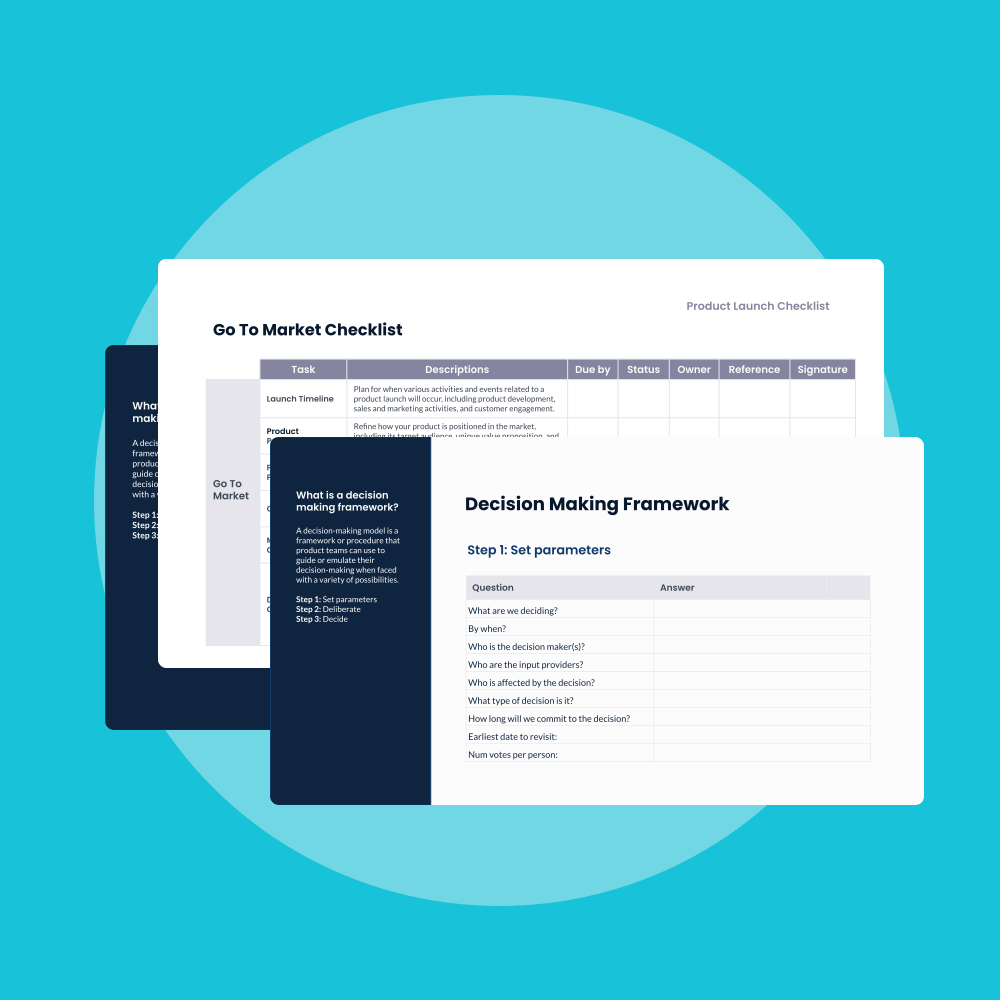
What Is a Go-to-Market Strategy?
A go-to-market (GTM) strategy is the way your company turns a product bet into real, measurable outcomes in the market. It is not just a launch checklist or a marketing calendar. A modern GTM strategy is a cross-functional approach that answers four big questions:
Who are we targeting now, and why them?
What problem are we solving for them, and how is our product the best way to solve it?
How will we reach, convert, and support them across product, marketing, and sales?
How will we know if it is working, and when do we change course?
Lisa Kamm, Head of Product and Design at Dow Jones, noticed how product teams are “held accountable for everything” but usually without direct authority over budgets, teams, or every decision.
A good GTM strategy is one way to close that gap. It makes ownership explicit, focuses everyone on outcomes instead of tasks, and creates transparency around why you are making specific bets.
In her ProductCon talk, Kamm pushes PMs to think in terms of outcomes, not outputs: instead of asking “did we launch?”, ask “did this product launch strategy create the outcome we expected?”. That is the core mindset behind a strong GTM strategy.
How go-to-market connects strategy and execution
GTM lives at the intersection of company strategy and day-to-day delivery.
On one side, you have long-term product goals: where the business wants to win, what segments matter, and how the product portfolio is supposed to grow. On the other side, you have teams shipping features, campaigns, and experiments every week.
A go-to-market strategy connects those two layers by:
Translating business goals into clear market and customer choices
Aligning product decisions with a specific value proposition and narrative
Coordinating how product, product marketing, sales, and customer success will move in sync
Defining the metrics that will tell you if the strategy is paying off
Kamm describes this as being accountable on three fronts at once: to customers, to stakeholders, and to the business. For GTM, that means:
Accountable to customers: solving real problems for clearly defined users and buyers.
Accountable to stakeholders: communicating in their language so they understand the trade-offs you are making and why.
Accountable to the business: balancing short-term revenue pressure with long-term sustainability.
When you actually need a go-to-market strategy
You do not need a formal GTM playbook for every small UI tweak. But you absolutely need one when you are making meaningful bets that change who you serve, how you sell, or how you make money.
Typical moments where a GTM strategy is essential:
Launching a new product or major new module
Entering a new market or targeting a new segment
Repositioning an existing product for a different use case
Introducing a new product pricing or AI monetization model
Rolling out a major feature that has its own product adoption and revenue expectations
In fast-moving, AI-driven product environments, GTM is a living strategy built on data, product experimentation, and, increasingly, AI-powered insight:
Using product and market data to refine who you go after first
Using AI tools to explore positioning angles and test messages across channels
Using real-time feedback from sales, support, and usage to adjust your GTM in weeks, not quarters
That is also where Kamm’s point about transparency becomes critical. A modern GTM strategy should make it easy to “go back and show how you got somewhere and why you made the trade-off decisions you did.” When the assumptions, goals, and results are visible, it is much easier to adapt your GTM without losing trust or ownership.
What Is Included in a Go-to-Market Strategy?
A go-to-market strategy includes clear choices about your target market and segments, your product positioning and value proposition, your pricing and packaging, and the channels you’ll use to reach and convert customers. It also defines the operating model behind it all: who owns what, how teams are enabled, and which revenue and success metrics you’ll use to measure and iterate on the strategy.
A useful way to think about GTM is as a set of decisions you make on purpose instead of by accident. Those decisions fall into a handful of core components. If any one of them is vague, you feel it later in poor product adoption, messy deals, or confused teams.
A modern GTM strategy, especially in AI-heavy, SaaS environments, usually includes at least these pieces.
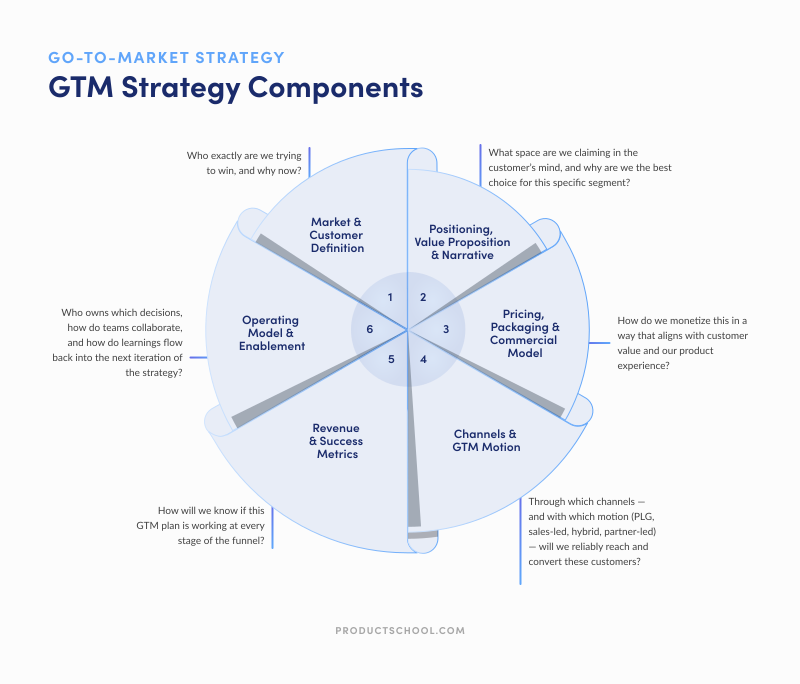
1. Market and customer definition
Every strong GTM starts with a very specific “who” and a very specific “why now”.
Instead of going “after enterprises” or “SMBs”, you are choosing a segment where you have a real shot at winning. You need a clear industry, company size, region, or business or use case where your product has a structural advantage. Inside that, you define:
Ideal customer profiles (ICPs) at the company level
Buyer and user personas at the individual level
The problems, jobs, and triggers that actually move them to act
Today, this is more about living segmentation. You pull from product usage, CRM data, and even AI-assisted clustering to see which segments respond best to your message and motion. If this component is weak, everything downstream tends to sprawl.
2. Positioning, value proposition, and narrative
Positioning is the slot you claim in your customer’s mental market map: the category you play in, the alternatives you are compared against, and the reason you are the better choice for this specific context.
The value proposition turns that into something concrete:
What outcomes or product OKRs do you improve?
How do you do it differently?
Why is your product the fastest, safest, or most effective way for this customer to get there?
The narrative brings it to life across channels: your headline on the homepage, the way your sales team opens a product discovery call, the way your product-led onboarding explains the first win.
In practice, modern teams use AI tools here not to “invent” positioning, but to explore variations of messaging, stress-test clarity, and quickly adapt copy for different personas and channels.
3. Pricing, packaging, and commercial model
Here you decide things like:
What you charge for (users, usage, seats, credits, features)
How you bundle capabilities into tiers or plans
Whether you lead with free, trial, freemium, or paid-only
How you can monetize the AI part of the equation
What discounts, contract lengths, and upsell paths make sense
Increasingly, GTM decisions here are driven by data. Teams use product experimentation, AI prototyping, cohort analysis, and AI-assisted revenue modelling to understand price sensitivity and forecast impact.
For product managers and AI PMs, this component is also where you align the product experience with the commercial model.
4. Channels and GTM motion
Next, you define how you will actually reach and convert the people you care about. At a high level, this is your GTM motion:
Sales-led: outbound, demos, multi-stakeholder deals
Product-led: self-serve signup, in-product upgrades, usage-driven expansion
Hybrid: self-serve for smaller customers, sales-assisted for larger ones
Partner-led or ecosystem-led: marketplaces, integrations, resellers
Within that motion, you pick the channels that matter most for this launch: search, paid, content, events, outbound SDRs, partner plays, in-product prompts, and so on.
This is where automation and AI can have an outsized impact. Instead of manually stitching together campaigns, modern GTM teams use:
AI-augmented outbound to tailor outreach at scale
Automated in-product campaigns based on user behaviour
Recommendation systems to surface the right next step to the right user
5. Revenue and success metrics
This component defines how you will judge success for this launch, across:
Acquisition metrics: signups, demo requests, qualified pipeline, CAC
Activation and adoption metrics: time-to-value, activation rate, feature adoption
Revenue metrics: ARR added, ACV, win rate, conversion from trial or POC
Retention and expansion: logo retention, NRR, expansion rate
The point is not to track everything. It is to pick a small, coherent set of metrics that match the intent of your GTM.
6. Operating model and enablement
The operating model and enablement component answer questions like:
Who owns the GTM strategy, and who owns execution day to day?
How do product, marketing, sales, and customer success make decisions together?
What enablement do sales and success teams need to tell the story and handle objections?
How are learnings fed back into the product roadmap and the next GTM cycle?
This is where the framework mindset becomes concrete. Instead of hiding behind RACI charts, you define shared goals, joint ownership across product, design, and engineering, and clear escalation paths when trade-offs get hard.
In a modern, AI-fluent organization, this component increasingly includes the shared tools and data sources teams use: the GTM dashboards everyone sees, the AI assistants plugged into call transcripts and support tickets, the experiment backlog that cuts across product and marketing.
A Step-by-Step GTM Framework for Product Teams
A good go-to-market strategy framework is not there to impress your execs. It is there to help your team make better bets, faster, with clear accountability. Think of this as a practical, flexible sequence you can reuse for every major launch, rather than a rigid checklist you fill once and forget.
Lisa Kamm, Head of Product and Design at Dow Jones, talks a lot about “clarity of outcomes” and shared ownership. She asked at ProductCon:
How many times have you been in meetings where people are looking at metrics while they haven’t even worked through what success looks like? Be sure you've got those and be sure that you're using consistent language.
A strong GTM plan does exactly that. It turns a vague “we’re launching soon” into a shared, testable plan for how this product will land in the market and what success really means.
1. Align on objectives and choose your go-to-market model
Every strong GTM strategy starts with a very simple question that too many teams skip: What are we trying to achieve with this launch, in this time frame, for this product?
You decide whether this go-to-market plan is about net new revenue growth strategy, expansion in existing accounts, activation of current users, entering a new segment, or defending share against a competitor.
Different product OKRs lead to very different GTM strategies. “Did you launch?” is not an objective. Kamm is blunt about this: you need to care about “did it have outcomes?”.
Once you have clear product goals, choose the go-to-market model that matches reality. Are you running a classic sales-led motion with demos and long cycles, a product-led motion with self-serve signups and in-product upgrades, a hybrid model, or a partner-led approach?
At this stage, write the objectives down, agree who is accountable for them, and make sure they are visible to everyone who will touch the GTM plan. Kamm talks about the danger of “unclear ownership,” where everyone feels involved but no one feels responsible. Your first step is to avoid that trap.
2. Define ICPs, personas, and segments for your go-to-market plan
The second step in GTM planning is to sharpen your definition of “who this is for” right now. You are not defining your total addressable market. You are defining the specific ideal customer profiles and buying personas this go-to-market strategy is built around.
Free User Persona Template
Get to know your users to build the right solution for the right audience.
Get Yours Now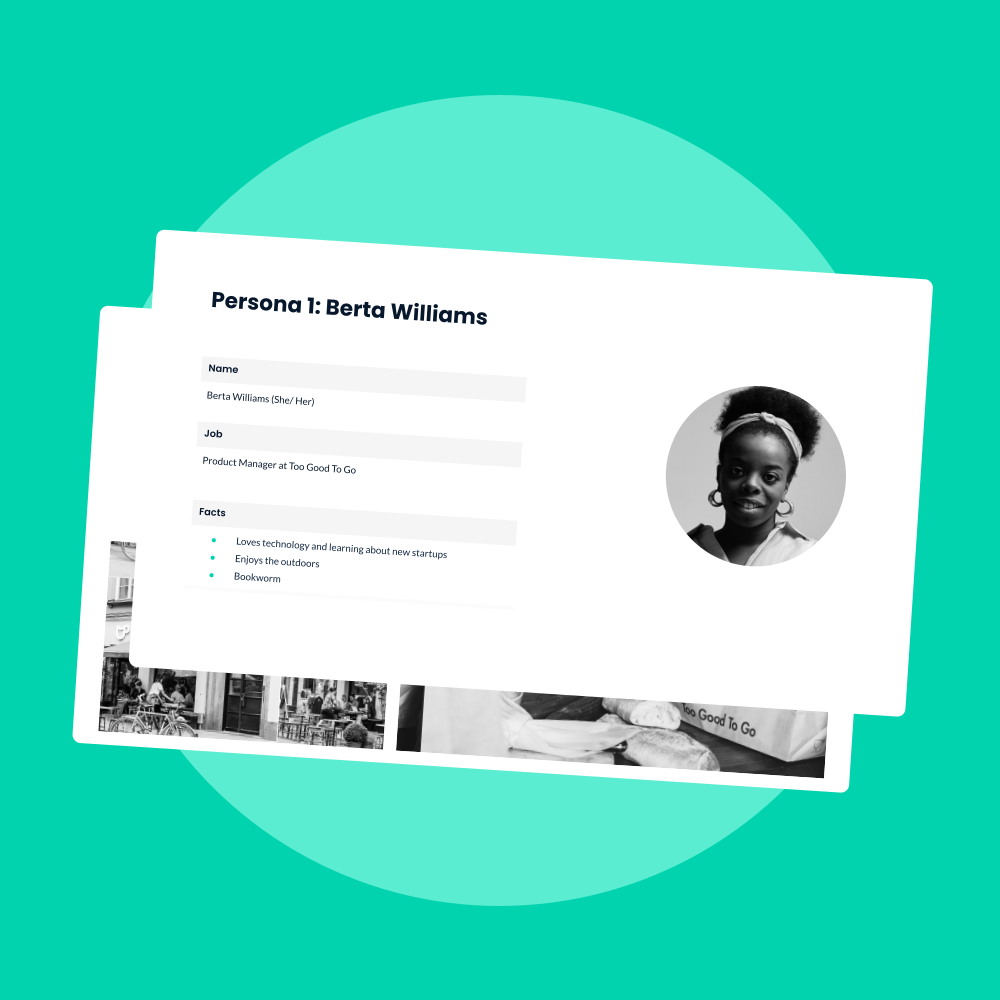
Start at the company level: which industries, sizes, regions, and tech stacks are you prioritising for this launch, and why? Then move to the individual level:
Who is the buyer, who is the user, and who are the influencers in the decision?
What problems, jobs, and triggers are actually making them look for solutions?
Modern GTM strategy components do not stop at static persona decks. This is where AI tools become useful. You can mine product usage, CRM data, support tickets, and sales calls to see which segments activate faster, retain better, or respond to specific messages. Simple clustering or propensity models can help validate whether the segments you have in your slides are the same segments that exist in your data.
The output of this step is a focused description of the segments and personas you will prioritise, the pains and outcomes that matter most to them, and the signals you will use to identify them in the wild. If you cannot explain this clearly, your go-to-market marketing strategy will become generic and expensive very quickly.
3. Map the market and competition for your go-to-market strategy
Next, you zoom out and look at the landscape you are stepping into. This is where you sanity check your GTM plan against the market. Not in a theoretical way, but in a way that informs specific choices. Here’s what we mean by this.
You look at the obvious competitors, but also at substitutes and non-consumption.
What else might your customer “hire” to solve this problem?
Where are you clearly better, and where are you behind?
What open space exists in product pricing, product positioning, or audience that your go-to-market model can exploit?
Here, AI can help you avoid a shallow “we read three analyst reports” view of the market. You can track competitor releases, pricing changes, and messaging shifts semi-automatically. You can analyse reviews, social posts, and call transcripts to see what customers actually complain about and praise.
The goal of this step is a short, sharp point of view that says: “In this GTM strategy, we will win by being the best option for this specific problem, for this specific group, against these specific alternatives, and here is the evidence.”
That point of view should shape later decisions about channels, pricing, and campaigns.
4. Craft your product's go-to-market strategy, positioning, and messaging
Once you know your audience and your arena, you decide how you want to be understood. This is where you turn the elements of a go-to-market strategy into a coherent story.
Positioning is the slot you choose in your customer’s mental market map. Are you the safest choice, the fastest way to value, the most flexible platform, the opinionated tool that does one thing better than anyone else?
You do not need to be everything. You do need to be something specific for someone.
Your messaging then turns that position into language people can actually repeat. You define the core promise, the proof points, and the key benefits for each primary persona and use case.
In a modern GTM plan, AI is a practical helper here. You can use it to generate variations of headlines, email intros, in-product prompts, and ad copy, then test those variants across segments and channels to see what resonates.
Lisa Kamm talks about the importance of “unified metrics and language.” This is where language really matters. If sales, product, and marketing are all telling slightly different stories about what the product is and why it matters, your go-to-market strategies will fragment quickly.
Your job is to create a messaging architecture that is simple enough to remember and flexible enough to adapt.
5. Design pricing, packaging, and trials
Now you bring money into the picture. A go-to-market strategy is incomplete unless it is explicit about how this offer will be sold and monetised.
You define how you charge: by user, by usage, by seat, by feature bundle, or by some hybrid. You decide how to package capabilities into plans, and what each tier is really for. You choose whether this GTM plan leads with free, freemium, timed trials, proof-of-concepts, or paid only as a monetization strategy.
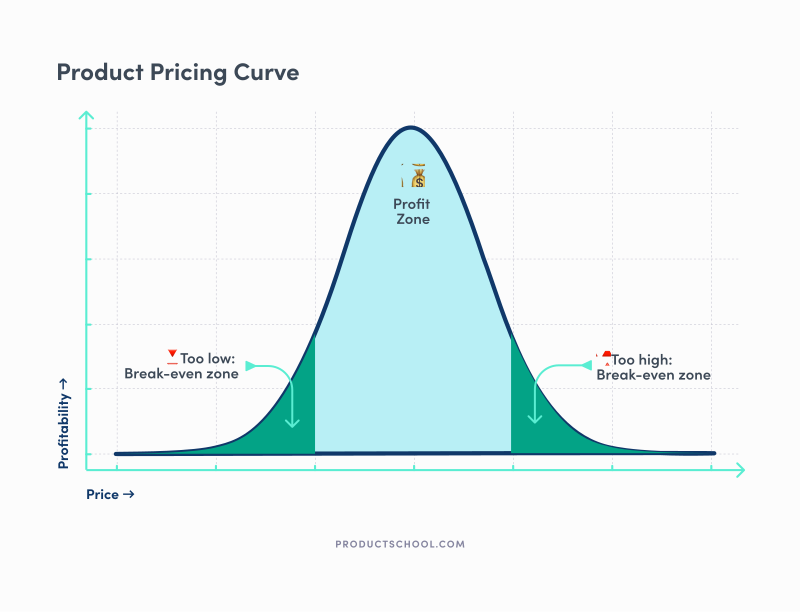
Also, try to establish a product pricing curve in advance. Estimate where you beak-even zone is and how to crawl beyond the profit margin.
This is another place where AI and data can push you beyond guesswork. You can analyse historical deals to see which combinations of features, prices, and segments correlate with higher win rates and better user retention. You can run controlled experiments on trial length, paywall timing, or usage limits, and use the results to refine your go-to-market models.
From a product point of view, you make sure the product experience matches the commercial motion. If your model depends on a high-converting free trial, your product-led onboarding, in-product education, and upgrade prompts are not “nice to haves.” They are central to your GTM strategy.
6. Plan your go-to-market channel strategy and campaigns
With the core offer defined, you decide how you will reach people and move them through the critical user journey from awareness to product adoption. This is your go-to market channel strategy.
You choose a small set of primary channels based on where your ICPs actually are and how they prefer to buy. That might be search, paid social, outbound email, in-product notifications, events, integrations and marketplaces, partner co-marketing, or a mix. The point is to choose deliberately, not to “be everywhere.”
Then you sketch the path: what someone sees first, what they do next, and what signals they give off at each step. Here, you can use AI to personalise outbound messages, to trigger in-app nudges based on behaviour, or to route leads to the right motion based on fit and intent.
A go-to-market strategy framework is only useful if it translates into actual campaigns and sales plays people can run. So for each key channel, document what good looks like, who owns it, and how success will be measured.
7. Orchestrate the launch and rollout waves
Now you move from theory into execution. You give your GTM plan a calendar and an owner.
First, you confirm the launch owner and the core triad or squad that will own outcomes, not outputs. Seek for accountability across product, engineering, and product design. And for a good reason, because the same principle applies here: if only one function “owns” the launch, you will feel the gaps when things get complicated.
Then you decide how you will roll out. Many product go-to-market strategies now use waves:
Internal alpha – A very early version used only by your own team or a small group of internal users to catch obvious issues and validate basic value.
Private beta – A more stable version given to a small set of invited customers to test the product in real-world conditions and gather deeper feedback.
Limited release for one segment – A controlled launch to a specific target segment (e.g. one industry or region) to prove the go-to-market model before scaling.
General availability – The product is officially “live” and available to all target customers through your normal channels.
Follow-up campaigns – Ongoing marketing and sales plays after launch to drive deeper adoption, upsell, and awareness among segments you have not reached yet.
Each wave has its own goals, its own feedback loops, and its own decision points about whether to expand, adjust, or pause.
8. Measure, learn, and iterate on your GTM plan
Finally, you make sure that your GTM strategy is not a one-shot event. It becomes a loop.
Before launch, you define a small set of key metrics that map directly to your objectives. For example, qualified pipeline and win rate for an enterprise push, or activation and expansion for a PLG motion. You decide what you will look at in week one, month one, and quarter one, and how often you will review the data together.
You combine quantitative metrics with qualitative signals from sales calls, support tickets, user research, and in-product feedback. AI is particularly useful here. It can mine large volumes of calls and tickets to surface patterns in objections, confusion points, and unexpected success stories that would be hard to see manually.
Then you make changes. You adjust pricing, tighten ICPs, change channels, revise messaging, and tweak in-product experiences.
When you treat your go-to-market plan as a repeatable cycle instead of a one-time launch artefact, each release gets a little smarter. Over time, your go-to-market strategies start feeling like a compound advantage.
Who Owns Go-to-Market Strategy?
Short answer: No single person “owns” the whole thing. But someone does need to own the orchestration of the GTM strategy. That usually depends on your company’s size, maturity, and GTM strategy.
Let’s walk through the nuance.
In most modern product-led companies, there are three main players around a go-to-market strategy: Product Team, Product Marketing, and Sales/CS (with RevOps and leadership shaping the guardrails). If GTM feels messy in your org, it’s usually because ownership across these groups is fuzzy.
This illustration shows how product management and product marketing work side by side on the same playing field.
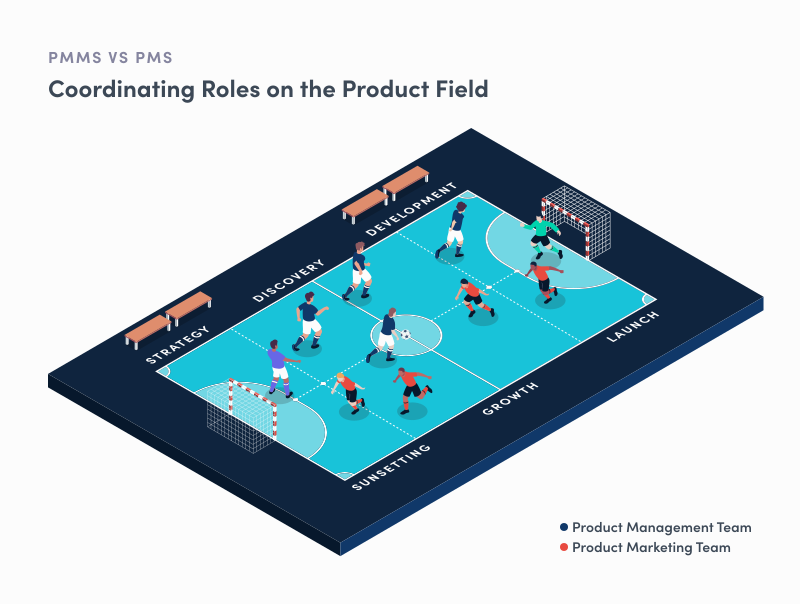
Another useful way to think about it is:
Product owns what you’re building, why it matters, and who it’s for
Product Marketing owns how the story is told and brought to market
Sales and Customer Success own how that story turns into revenue and retention
The GTM strategy sits right in the middle of all three.
When product owns most of the GTM
In earlier-stage startups or lean teams, there often isn’t a dedicated product marketing manager yet. In that case, the Product Manager usually owns most of the GTM strategy by necessity. That typically means the PM is the one who:
Defines the launch goals and success metrics
Sharpens the ICP and use cases for this launch
Works with founders or sales to shape product pricing and packaging
Writes (or co-writes) the positioning and messaging
Partners with whoever is doing “marketing” to decide channels and campaigns
This can work very well if the PM has strong communication skills and a decent marketing instinct. It can also burn them out if they’re trying to both scale discovery/delivery and own all go-to-market planning.
When product marketing owns the GTM strategy
Once a company has a PMM or a small product marketing team, GTM strategy usually shifts into their lane. In that setup, Product Marketing often becomes the GTM lead. They don’t do everything, but they are accountable for the end-to-end plan and whether it hangs together. Practically, that looks like:
Partnering with PM to translate product strategy into a clear GTM narrative
Defining the launch tiers and GTM model (sales-led, PLG, hybrid) for each initiative
Leading the decisions on channels, campaigns, and launch moments
Coordinating with sales, CS, and RevOps on enablement and playbooks
Making sure key metrics, dashboards, and feedback loops are in place
The Product Manager is still deeply involved. They bring the user insight, roadmap context, and product constraints. But the PMM is the one saying, “Here is the GTM plan, here’s who’s doing what, and here’s how we’ll know if it worked.”
The role of sales, CS, and RevOps
Even with a strong PM and PMM, your go-to-market strategy will fail if sales and customer success aren’t treated as co-authors. They’re the ones closest to the deals and renewals, so they see the real frictions first.
Their part in owning GTM looks like:
Sales: validating ICPs, refining talk tracks, giving live feedback on objections and pricing, and running the plays the GTM plan defines
Customer Success: spotting adoption issues early, surfacing which value props actually land post-sale, and helping define the “landing” criteria for a successful release
RevOps: making sure systems, routing, attribution, and reporting reflect the GTM model you’ve chosen
How to Measure GTM Success
Measuring GTM success is about agreeing upfront what “good” looks like, instrumenting for it, and being honest when the results tell a different story. The easiest way to approach it is to look at three horizons: before launch, at launch, and long after launch.
Pre-launch validation metrics for your go-to-market strategies
Before launch, you’re not looking for scale. You’re looking for signs that your GTM plan isn’t built on wishful thinking.
You want to see real people from your ICP leaning in: signing up for a waitlist, joining discovery calls, playing with AI prototypes, or responding to early access invites. Depth matters more than volume here. If you have even basic product analytics enabled, you’ll see whether these early users hit an “aha” moment, return unprompted, or drift away.
Weak signals don’t mean you cancel. They mean you launch with eyes open and adjust your GTM strategy accordingly.
Launch and early adoption metrics in your GTM strategy
Once you go live, the question becomes: “Is this landing the way we expected?”
This is where marketing data and product analytics should merge. If they live in separate dashboards, you’re flying blind. You’re watching who comes in, how much they cost to acquire, and whether they actually do the behaviors that match your product’s promise.
Activation matters more than signups. Instead of celebrating account creation, track the handful of actions that show someone is getting real value. If your GTM strategy promises “faster reporting,” measure how quickly new users create and share a report.
Long-term revenue and efficiency metrics (LTV, CAC, NRR)
If the launch goes well, the next question is tougher: “Is this GTM motion good for the business?”
This is where you zoom out. Look at CAC and payback period, average deal size, net revenue retention, and lifetime value. Patterns here tell you whether you’re building a sustainable motion or just burning through people who churn after user onboarding.
Product analytics helps you segment all this: trial users vs demo users, campaign A vs campaign B, onboarding flow 1 vs flow 2. Different motions produce different quality customers and you want to know which ones compound.
Using qualitative feedback to refine your go-to-market plan
Numbers tell you what happened. Qualitative feedback tells you why.
Sales calls, CS tickets, user interviews, in-app surveys, community threads. They reveal the moments where your GTM promise and user reality don’t quite match. AI can help here by summarizing patterns across hundreds of conversations so you’re not drowning in raw notes.
The point isn’t to label your GTM plan as “good” or “bad.” It’s to feed what you learn into the next version: tighten your ICP, clarify your messaging, fix onboarding gaps, adjust product pricing, or shift channels.
Kamm talks about the value of someone saying: "Here’s what went wrong, here’s why, and here’s what I’m changing."
That’s the exact mindset GTM measurement requires. Treat it as a feedback loop (not a verdict) and every launch gets sharper. Over time, you don’t guess whether a product will resonate. You have a system that tells you early and often.
Learn Go-to-Market Strategy From Practitioners
Great GTM is muscle memory. The teams that consistently land products in the market are running a repeatable playbook shaped by real launches, real failures, and real customer insight.
If you want to build that level of instinct, the fastest path is learning directly from practitioners who’ve done it at scale. You want to listen to people who’ve owned the trade-offs, navigated the messy cross-functional work, and delivered outcomes instead of slide decks.
Our revamped GTM certification is built exactly for that. It turns everything you’ve read here into hands-on practice: real GTM plans, real market analysis, real feedback, and real frameworks you can use the moment you’re back at your desk.
Because at the end of the day, a go-to-market strategy is something you learn to do well and then do again, better, every time.
Go-to-Market Certification
Create a winning GTM plan. Craft standout positioning, design messaging that sells, analyze markets, and drive post-launch momentum, all while leveraging the latest AI-first strategies.
Enroll now
Updated: January 7, 2026