Your team has already “adopted AI”. The question that actually matters now is not whether people are using it, but whether that usage is accumulating into anything your organization gets to keep.
I call the distance between those two things the compounding gap. It’s the gap between individual AI use, which is now nearly universal, and organizational AI capability, which (oddly) remains rare.
That gap is the single most expensive thing in enterprise AI right now, and almost nobody is measuring it.
This piece is for product leadership and product teams who have rolled out AI tools and are now being asked what they got for it. By the end, you'll have a diagnosis of why adoption stalls, the mechanism that makes it compound, and a concrete set of moves to run this quarter.
Key Takeaways
AI adoption is no longer the bottleneck. 88% of organizations now use AI in at least one business function, according to McKinsey's State of AI 2025.
Value remains rare. Only 39% report any enterprise-level EBIT impact, and roughly 6% qualify as high performers with more than 5% of EBIT attributable to AI.
High performers and laggards use the same models, which means the gap is organizational rather than technological.
The strongest predictor of AI value is fundamental workflow redesign, yet only about one in five adopters have redesigned any workflow.
Demand is not the problem. Two-thirds of office professionals have used AI at work believing it was against policy, which means the adoption energy already exists and is simply ungoverned.
Adoption metrics like seat counts and token usage measure activity. The metrics that matter measure whether corrections, context, and decisions are being captured and reused.
What AI Adoption Actually Means
AI adoption is usually defined as the share of people or teams actively using AI tools. This likely explains why so many organizations report high adoption while struggling to show impact.
A more useful definition is the share of work where AI is genuinely part of how the work gets done, and where the output of that work improves the system for next time.
Usage is a snapshot, adoption is a behavior, and capability is what accumulates.
Most organizations measure the first, hope for the second, and assume the third follows automatically. It does not.
Three terms worth separating before we go further, because they get used interchangeably in board decks and they mean completely different things:
Seat adoption: How many people have been given access to a tool. This measures procurement, not behavior.
Active usage: How many people actually open the tool in a given week. This measures habit, but says nothing about whether the work is meaningful.
Workflow integration: How much of a real process now runs through AI, with the process itself redesigned around it. This is the only one of the three that correlates with business outcomes.
If you want the fuller picture of what it means to build a team around this from the ground up, we covered that in AI native: What it means and how to get there. This piece assumes that definition and goes after a narrower question for AI Product Leaders: why so much AI usage produces so little that lasts.
AI Product Strategy for Leaders
By the end, you will possess a board-ready AI Strategic Roadmap and Governance Framework, positioning you not just as a product builder but as the executive leader driving your company’s transformation.
ENROLL NOW
The AI Adoption Paradox: Near-Universal Usage, Rare Value
AI usage has become close to universal while measurable business value from AI usage has stayed unmeasured. That gap is the defining problem of enterprise AI in 2026. The numbers are not ambiguous about this.
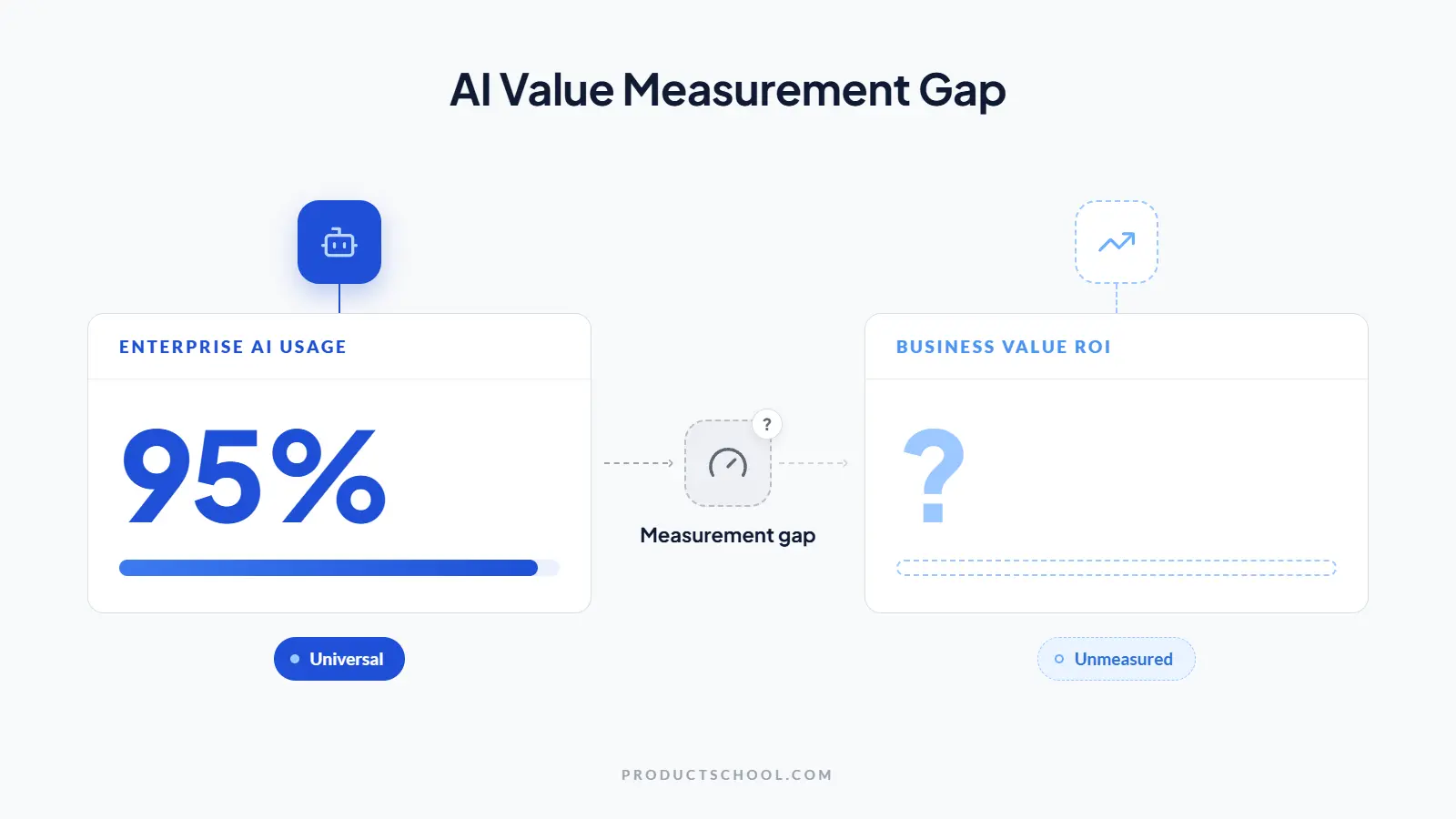
McKinsey's State of AI, published in November 2025, found that 88% of organizations report regular AI use in at least one business function. On a surface level, misleadingly, adoption has essentially been achieved.
Now the other side of the same survey. Just 39% report any EBIT impact at the enterprise level, and most of those put the figure below 5%. Nearly two-thirds of organizations have not yet begun scaling AI across the enterprise at all.
I want to be precise here, because this statistic gets mangled constantly. This is not zero return. It is small, rare, and hard-to-attribute return, which is a more useful and more damning finding than zero would be.
Zero would suggest the technology does not work. Small and rare suggests the technology works and the product organizations around it do not.
The pilot problem behind the numbers
MIT's Project NANDA report, The GenAI Divide: State of AI in Business 2025, sharpened this debate. Based on 52 structured executive interviews, 153 survey responses, and analysis of more than 300 public AI deployments, it found that roughly 95% of enterprise generative AI pilots produced no measurable profit-and-loss return.
That 95% figure has traveled further than any other statistic in enterprise AI, so it deserves an honest caveat. The study was preliminary, was not peer reviewed, and has been criticized for its sample size and a measurement window of roughly six months, which is short for judging a transformation. Treat the exact number as directional rather than precise.
What survives the criticism is the direction and the diagnosis. MIT's researchers attributed the failures not to model quality but to what they called a learning gap. In other words, it’s the inability of both tools and organizations to retain feedback, adapt to context, and improve over time.
High performers and laggards are using the same models
Nobody in that 6% is winning because they got early access to a better frontier model. The models are a commodity available to everyone with a credit card. It means every bit of the performance difference lives in how the work around the model is organized.
That should be encouraging, because organizational problems are the kind product leaders are actually equipped to solve.
Why AI Adoption Stalls: The Compounding Gap
AI adoption stalls when individual usage never becomes organizational capability. It’s the scenario where the corrections, context, and decisions produced by that usage are never captured anywhere the system can reuse them. Everyone gets faster in isolation, and the company gets nothing.
Arnab Bose, Chief Product Officer at Asana, described the mechanism so well at The ProductCon New York that I have not struggled to remember it. "People are getting access to this super-genius genie in Claude or ChatGPT, but they're chatting with it. Each individual is copy-pasting data in and out. None of those decisions are making it back into a context graph that will create that compounding benefit."
Nobody in that description is doing anything wrong. They are using a powerful tool competently, in the only way the organization has made available to them. Still, the value evaporates the moment they close the tab.
Individual productivity gains don't add up to organizational capability
Here is the version of this I see most often in product organizations. A PM uses AI to draft a PRD in forty minutes instead of three hours. Real time saved, genuinely useful, and completely invisible six weeks later.
Nothing about that transaction makes the next PRD easier for anyone else on the team. It does not teach any system what a good PRD looks like at this specific company, with this specific customer base and these specific constraints. It does not change how the team decides what to build.
The multiplication leadership expects never happens, because individual time savings are additive at best. Twelve people each saving two hours a week does not produce a step change in what the organization can do. It produces twelve people with slightly more slack, which quietly gets absorbed into meetings.
Why fragmented context breaks the compounding loop
Work scattered across disconnected tools and isolated chat sessions gives any AI system a fragmented view of what is actually happening. Fragmented context measurably degrades what these systems can do.
We went deep on this mechanism in our piece on production AI architecture and agent composition, where controlled research found frontier models degrade as context grows more fragmented. The same physics apply at the organizational level. If your company's actual knowledge lives in thirty disconnected tools and a thousand private chat histories, no system can assemble a coherent picture from it.
The workflow redesign gap
Layering AI onto an existing workflow gets you a faster version of the old workflow. It does not get you a different workflow, and the difference between those two things is the difference between a 4% efficiency gain nobody can attribute and a genuine step change.
If your product development process still has the same eleven steps it had in 2023, with AI making four of them faster, you have automated the old thing rather than built the new one.
12 AI Adoption Tips for Product Teams
These are ordered roughly by sequence. The first four matter more than the remaining eight combined. Where a tip touches ground covered earlier in this piece, I've focused on the concrete mechanics of doing it, not the argument for why it matters.1. Measure workflows, not seats
Stop reporting AI adoption as a percentage of activated licenses. Start reporting it as a list of workflows or AI agent orchestrations that would visibly break if AI were switched off tomorrow.
Run the switch-off test on anything you're tempted to call adopted.
If turning the tool off wouldn't be noticed within a week, or wouldn't measurably hurt the work, it's not adoption. Keep a live, one-page list of workflows that pass this test and review it monthly. That list is your real adoption number.
2. Redesign one workflow before touching any other
Workflow redesign is the highest-leverage move available to most AI native teams. The mistake I see constantly is trying to redesign five workflows at once, which means none or only some of them actually get redesigned.
Pick the single workflow with the highest weekly repetition, not the highest stakes.
A process that runs twice a year, however important, teaches you almost nothing about whether your redesign works. A process that runs daily gives you dozens of data points a month, which is what lets the loop compound.
3. Save the diff, not just the draft
The valuable artifact in any AI-assisted task is the difference between what the model produced and what the human shipped. Some product teams throw that difference away by default.
The mechanism doesn't need to be sophisticated to work. A shared doc, a dedicated Slack channel, or a simple log with a timestamp is enough, as long as it lives inside the tool people already use to do the work.
If capturing the diff is a separate step bolted onto the workflow, nobody will do it voluntarily past week two.
4. Make shadow AI legal before you make it disappear
You cannot govern AI use you cannot see. Asking people directly whether they use unsanctioned tools reliably undercounts it, since admitting a policy violation is not a neutral question.
Run the survey anonymously, and ask what AI tools people actually use.
Then compare that list against your sanctioned stack and close the three biggest gaps first. Trying to sanction everything at once guarantees you fix nothing quickly, and speed is the point here.
5. Write down what your best people already know
Most valuable operating knowledge in a product organization lives in the judgment calls of your best people. Almost none of it is written down anywhere in a system. You know, somewhere a new hire or your AI agent can reach.
Don't start with a documentation project, since those stall for the same reason most New Year's resolutions do. Instead, shadow your strongest performer through one real task and write down every judgment call they made that exists nowhere else.
That is the highest-value content to encode first, and it's a single afternoon.
6. Name the decision point in every workflow
Ambiguity about who decides is what turns AI adoption into either blind rubber-stamping or reflexive distrust. Both failure modes come from the same missing label.
Take any workflow diagram or process doc you already have, and next to each step, write one of three tags:
AI does this alone
AI proposes
Human decides, or a human does this alone
Any step without a tag is where adoption may be failing right now, because nobody actually knows what they're supposed to do with the output.
7. Show your confidence, and say when a human should look
A real confidence score is genuinely hard engineering, and most teams don't need one to start. A three-tier system works nearly as well and takes an afternoon to set up.
Tag every AI-assisted output green for shipped without review, yellow for reviewed and approved, or red for blocked pending human judgment. Track how that mix shifts over time.
A rising share of green isn't automatically good news. It's worth asking whether trust is genuinely earned or just quietly assumed.
8. Start before your data is ready
Waiting for clean, organized context before starting the correction loop is the common reason teams never start it. It's based on a reasonable-sounding instinct that turns out to be backwards.
Pick your messiest, most disorganized process for the first attempt. A clean process will make the loop look like it works even if the underlying mechanism is broken, because good inputs paper over a lot of sins.
Proving the loop works on your worst data is the test that tells you it will hold up everywhere else.
9. Treat delegation as a habit, not a preference
Delegating to AI feels slower than doing the task yourself for the first several attempts. It has to be built deliberately, the same way any uncomfortable habit gets built.
Pick one recurring task each week that everyone agrees is too important to hand off, and hand it off anyway. Review what broke, fix the process, and repeat. That specific ritual, run consistently, builds the muscle memory that a policy memo never will.
10. Give agents a home team, not a home desk
Individual AI setups, meaning each person configuring their own private assistant with their own prompts and context, create as many silos as there are people, and none of those silos ever learn from each other.
Put the agent somewhere the whole team can see its work by default. It can be the same shared space you'd use for any other colleague.
When one person's correction improves the system. Everyone benefits from it immediately instead of that improvement dying in a single person's chat log.
11. Audit your AI workflows like you'd audit your tool stack
AI workflows accumulate the same way SaaS licenses do. Dashboards nobody checks, prompts nobody runs anymore, and agents built for an AI use case that died all keep costing you attention.
Apply the same kill discipline here that you'd apply to a bloated tool stack: every quarter, ask which AI-assisted workflows saw no real use in the last 30 days, and retire them without ceremony.
An abandoned AI workflow is actively confusing anyone who stumbles into it, wondering if it's still the source of truth.
12. Hire and train for judgment, not for tool fluency
Tool fluency has a half-life of months right now, since the specific product you train someone on this quarter may not be the one your team standardizes on next quarter. Judgment transfers across every tool that comes after it.
Test for this directly rather than asking which tools a candidate has used. Give them a flawed AI output during the interview or onboarding process and watch how they catch and fix it. That single exercise tells you more about how they'll perform a year from now than any list of tools on a resume.
If you want to move on several of these at once with a structured program rather than piecemeal, that is exactly what Product School's AI training for product teams is built for, from agentic architecture and AI evals through the AI operating model work underneath them.
The Mechanism That Makes AI Adoption Compound
AI adoption compounds when human correction is captured as a reusable signal. The loop matters more than the starting quality, because a mediocre system with a working correction loop will overtake a strong system without one.
Bose put the mechanism plainly. "Even if you start out with a shallow graph, if you create a loop where it's proposing ideas that are terrible, but you're correcting it, that correction is getting automatically recorded, you will get way faster”.
What Bose describes is a loop. It’s something that gets better through use rather than something you complete.
Capture the correction, not just the output
The valuable artifact is the difference between the AI's draft and what the human shipped. That diff contains your company's real standards, its context, its taste, and its hard-won knowledge about what works with your customers.
Teams that keep that diff somewhere reusable are building institutional knowledge every single day. Teams that fix things in a chat window and paste the clean version into a doc are throwing it away.
Why shallow beginnings are fine
The most common way I see teams stall on this is waiting for their data to be ready. They want the knowledge base organized, the documentation current, and the context complete before they start the loop.
Bose's point cuts directly against that instinct, and he is right. The starting depth matters far less than whether the loop exists at all. A shallow graph with a working correction loop improves every week, and that is what you’re after with AI.
Start with terrible output and a mechanism for capturing corrections. That beats perfect preparation.
How to Design AI Work People Actually Adopt
The most durable design principle for internal AI is to give machines the mechanical work and reserve human-in-the-loop for the top of the process. You can then make that division visible inside the product itself.
Neil described the division of labor this way. "You always want to find what are the things that computers are good at and just have computers do all the computer things. And then what are the things computers are bad at that humans are good at, and the humans should do. Reserve the value judgment of a human at the top. And as these things get smarter, they should take on more and more for us."
The implementation detail matters more than the principle, because the principle is easy to agree with and easy to skip. In her products, this shows up as a confidence score and a "needs human review" flag, which turns an abstract division of labor into a visible feature.
Any internal AI agent or multi-agent system your team builds should tell the user how sure it is and when a human needs to look. That design decision does more for AI adoption than any amount of training.
Make the handoff explicit in the workflow
When it is ambiguous who decides, you get one of two failure modes, both of which are expensive.
Either people rubber-stamp AI output because they assume someone else is checking, or they ignore it entirely because they do not trust it. Both come from the same missing design decision, which is a clear, visible answer to the question of where machine work ends, and human judgment begins.
If you are building AI features into your product rather than just adopting tools internally, the same principle governs, and we covered how to think about it in when should product teams use AI agents.
The Operating Conditions for AI Adoption
Three conditions have to be in place before AI adoption produces compounding value: connected systems, encoded company knowledge, and a genuine habit of delegation.
Jaime DeLanghe, Chief Product Officer at Slack, laid these out in her closing remarks at ProductCon New York. "To get real value from AI at work, you need three things: all of your systems connected in one place, skills that encode how your company operates, and the discipline to delegate aggressively, even when it feels faster to do it yourself."
I have quoted that formulation more than almost anything else from the event, because it converts a vague ambition into three testable prerequisites. You can walk into any team and check whether each one is true.
1. Connected systems means your context is assemblable
This is the technical precondition, and it reinforces the fragmented-context argument from an entirely independent direction. If your systems are not connected, no AI can see the whole picture, and no amount of clever prompting fixes that.
This is also where tool sprawl stops being a finance problem and becomes an AI problem. Every disconnected tool is a seam where context breaks.
2. Encoded knowledge means your company's way of working is written down
Most companies have enormous amounts of operating knowledge that exists only in people's heads and in the informal judgment of experienced employees. That knowledge is invisible to any system.
Encoding it does not require a documentation project of heroic scale. Start with the artifacts your team already treats as canonical, meaning the docs people actually reference when they want to know how something is done here, and make those reachable.
3. Delegation discipline means doing it even when it feels slower
This is the behavioral condition, and it is the one that quietly fails in almost every organization I work with.
Delegating to AI feels slower in the moment. Writing the context, checking the output, and correcting it takes longer than just doing the task yourself, especially at the beginning. Every individual, acting rationally on that observation, opts out, and the loop never gets built.
That is why DeLanghe calls it discipline rather than preference. Someone has to decide the team is going to absorb the short-term cost to get the long-term compounding, and that decision is a leadership one.
For the full operating model this sits inside, including the org design and system initiatives that make these conditions possible at scale, I laid that out in why 80% of product teams are stuck.
Here is the difference between the two modes side by side:
Dimension | Adoption without compounding | Adoption that compounds |
What gets measured | Seats, logins, token usage | Corrections captured, workflows redesigned, decisions reused |
Where the work happens | Individual chat windows | Connected systems with shared context |
What happens to corrections | Fixed in the chat, then lost | Recorded and reused as a training signal |
How the workflow is designed | AI layered on top of the existing process | Process redesigned around what AI changes |
Where knowledge lives | In the heads of the heaviest AI users | Encoded where the system and the team can both reach it |
Trust posture | People double-check everything by hand | Uncertainty is visible, sources checkable, failure modes known |
The Compounding Gap Is the Whole Game
AI adoption was the last cycle's problem, and by any reasonable measure, we solved it. Your people are using AI, including in ways you have not sanctioned and cannot see.
The question now is whether any of that usage accumulates. Whether the correction an AI PM made this morning makes next month's work better or evaporates when they close the tab. Whether your workflows have actually changed shape, or just gotten marginally faster while keeping every step they had in 2023.
That is the compounding gap. Closing it is not a technology decision. Nobody in the winning 6% got there with a better model, which means the whole difference lives in choices product leadership is already equipped to make.
Pick one workflow. Redesign it rather than accelerating it. Capture what your people teach the system when they correct it. Then do it again next quarter, and you will have built something your competitors cannot buy with a bigger AI budget.
If you want that work structured rather than improvised, Product School's AI training for product teams is built for exactly this.
Updated: October 13, 2026