Product discovery hinges on understanding user needs. AI can supercharge that understanding.
In fact, it’s estimated that 78% of global enterprises have already embedded AI into at least one department, and 65% of companies are actively using generative AI (1). AI isn’t a magic bullet, but when used right, it amplifies human judgment.
This article will teach you how to use AI to run faster, clearer, and more confident product discovery. Our goal is that you can validate ideas quickly and build what truly matters with the right type of “augmented judgement”.
Opportunity Solution Tree Template
Branch out and discover something new with the opportunity solution tree. Visualize the product discovery process to build features that matter!
Get the template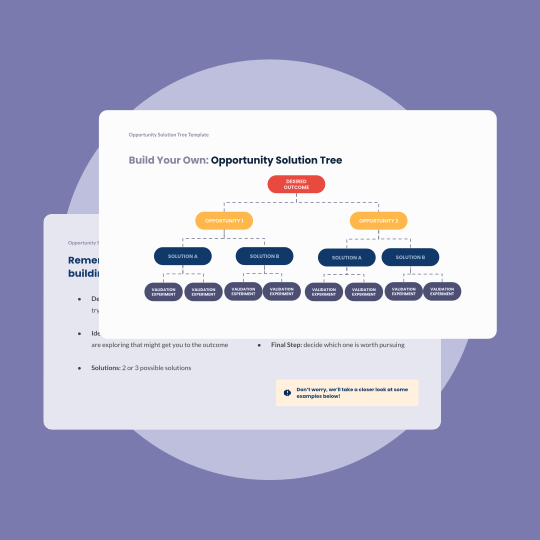
Challenges of Traditional Product Discovery
Traditional product discovery often suffers from fragmentation and delays. For example, data and insights typically live in separate tools (research notes here, user analytics there, stakeholder feedback in a different doc).
This creates information silos that block breakthroughs. One team’s continuous discovery of a user pain point might never reach the engineers prioritizing features. By the time different sources are manually synthesized, user needs and market conditions may have already shifted, leading to stale decisions.
Stakeholders then waste time in endless alignment meetings trying to piece together a constantly-moving picture. Other common bottlenecks include:
Biases and assumptions. Teams can fall prey to confirmation bias or “solution bias,” building features based on hunches. Unaddressed bias can “kill even the best product idea” by making teams miss real user needs.
Slow validation. Gathering meaningful user feedback (interviews, A/B tests, product analytics) takes time and often yields partial answers. Without quick evidence, teams may launch poorly vetted features.
Misalignment and handoffs. Waiting for engineering to build prototypes or for marketing to weigh in can stall learning. Every handoff risks losing context or introducing errors.
Shallow or sporadic user contact. Teams often talk to users only around big product launches or when something breaks, so they miss the everyday context, workarounds, and jobs-to-be-done that actually drive behavior.
Over-reliance on quantitative signals. Dashboards, NPS, and funnels dominate the conversation, while the “why” behind the numbers stays unexplored, leading to solutions that optimize metrics but don’t really solve user problems.
Overall, old-school discovery is often a costly guessing game. Many teams act like they’re trying to know everything instead of gathering enough data to feel confident,” enough earned conviction to move forward.
In this environment, decisions can be hobbled by incomplete product analysis or gut feel.
How AI Empowers Product Discovery
AI doesn’t invent strategy. It boosts the parts of discovery that benefit from heavy data crunching and pattern-spotting. In practical terms, AI tools can:
Uncover hidden patterns. AI tools can analyze thousands of feedback points, support tickets, and behavioral events to surface emerging themes and unmet needs that human analysis might miss.
Automate insight synthesis. Instead of spending days synthesizing interviews and surveys, AI can summarize notes, cluster themes, and highlight contradictions in a fraction of the time.
Prioritize opportunities with predictive scoring. Machine learning models can combine usage data, sentiment, and market signals to score and rank features or initiatives by likely impact on outcomes like product adoption or revenue growth.
Centralize customer intelligence. AI-powered platforms ingest feedback from calls, tickets, surveys, interviews, and reviews into a single insights layer that product teams can query in real time.
Transcribe and index research at scale. Modern speech-to-text and LLM tools can turn hours of user interviews into accurate, searchable transcripts within minutes, making qualitative data far easier to reuse.
Cluster feedback into themes tied to value. AI can automatically group comments by topic and, when combined with account data, quantify which problems represent the highest ARR or churn risk.
Automate recruiting and scheduling for discovery. AI assistants can pre-screen participants, ask qualifying questions, and schedule interviews, freeing PMs to focus on the conversations themselves.
Support data-informed roadmapping. AI-driven roadmap tools use historical data and predictive analysis to suggest priorities and highlight trade-offs, giving PMs a more objective starting point for planning.
In each case, AI is augmenting discovery. It’s giving teams more signal in their research, but humans still make the strategy calls.
As Amazon/Twitch product lead, Ashley Nutter puts it on The Product Podcast, data (and by extension AI) is a tool: “product management is still a mix of art and science.” It relies on strong product sense. AI can surface insights quickly, but AI PMs must still judge how to act on them.
The goal is earned conviction, not certainty: use AI to get that extra confidence, then trust your expertise.

AI-Driven Product Discovery Through Phases
In a modern, AI-augmented discovery cycle, each stage of the process is faster and smarter:
1. User and market research with AI
Traditional user and market research is slow, episodic, and expensive. It’s great for big quarterly studies, but badly matched to the pace most teams ship today.
AI lets you flip that model from “research projects” to “always-on discovery.” Instead of manually tagging interviews, surveys, tickets, and reviews, you can use AI to transcribe, summarize, and cluster all of that into themes, pain points, and opportunities in minutes, not weeks.
On top of that, AI agents are starting to handle the workflow: recruiting and screening participants, scheduling calls, running semi-structured interviews, and delivering first-pass syntheses while you sleep. They effectively act as research ops in the background, keeping a constant pulse on users and the market. This is exactly the reason why we teach agentic AI to product managers.
Your job doesn’t disappear, though. You still decide which signals matter, how they map to AI product strategy, and when you’ve seen enough to move. AI just makes sure you’re deciding with fresher, richer insight instead of stale decks and gut feel.
2. Turning messy data into decision-ready insight
Most teams already have the raw ingredients for great discovery scattered everywhere: survey tools, NPS widgets, support platforms, interview notes, app reviews, and analytics dashboards. The real problem isn’t “not enough data”. The problem is that no one has the time to turn this mess into a clear, shared picture of what users actually need.
AI is useful here because it can sit on top of your existing product stack and act as a synthesis layer. You pipe data from your survey tool, support system, and product analytics into a central “insights hub,” then use an LLM to auto-tag, cluster, and summarize everything that comes in. Ultimately, you get a handful of evolving themes like “user onboarding confusion,” “permissions pain,” or “billing surprises,” each with representative quotes and affected segments.
Where this gets really practical is when you pair AI with a workflow tool. For example, in your workflow automation platform of choice you could set up a simple pipeline:
When new feedback arrives, run an AI step that cleans, normalizes, and tags it.
Use another AI step to group it into an existing theme or create a new one if it doesn’t fit.
Post a short, human-readable summary into your product channel so the team sees trends in real time.
Automatically create a discovery ticket when a theme crosses a predefined threshold (volume, severity, or user value).
Review the queue weekly, merge duplicates, and promote the strongest themes into bets for deeper research or lightweight product experiments.
The result is that discovery doesn’t rely on someone having a free Friday to “go through all the feedback.” You have a system that continuously turns noisy signals into structured opportunities, and a lightweight ritual for the team to sanity-check what the AI surfaced and decide what to do next.
3. AI Prototyping
The biggest shift AI brings to product discovery is that prototyping no longer requires a designer, an engineer, and a full sprint. You can validate the shape of an idea the same day it appears.
Instead of waiting for a team to build wireframes or code a small demo, AI can generate interface drafts, write simple front-end components, or even simulate an interaction flow based on a plain-language prompt. This shortens a cycle that used to take weeks into hours, which means PMs can test five ideas instead of one and use real user reactions to choose what’s worth building.
What makes this powerful in practice is how quickly you can move from hypothesis → prototype → feedback.
Let’s say you’re exploring a new product-led onboarding concept. You describe the intended flow, the steps a user should take, and the job-to-be-done. AI produces a clickable mockup or lightweight interface.
As Glen Coates, the VP of Product at Shopify, points out on The Product Podcast:
I've now started doing the thing where I take a screenshot and ask AI to create a prototype. It speeds up the feedback cycle and helps me realize how dumb my ideas are before my team has to waste time on them.
You put that version in front of three to five target users, gather reactions, tweak the prompt, and generate version two before the end of the day. After a few rounds, you have a validated direction with evidence.
This is why AI prototyping and AI MVPs are becoming a core skill for AI-powered PMs. You don’t need pixel-perfect fidelity. You need something users can react to.
Product School’s AI Prototyping Certification reinforces this. The goal isn’t to produce production-ready UI, but to “bring ideas to life quickly enough that teams can learn before they commit.” When discovery becomes this fast, you avoid over-investing in ideas that don’t land and confidently double down on the ones that show promise.
Vibe Coding Certification
Go from idea to prototype in minutes. Build, debug, and scale AI prototypes with the latest tools to integrate APIs securely and hand off to engineering fast.
Enroll now
4. User testing and validation with AI
AI has made it possible to validate ideas far earlier and far more often, turning testing from a final checkpoint into a continuous feedback loop. Instead of waiting for engineered prototypes, teams can put AI-generated flows, sketches, or interactive demos in front of real users and collect reactions the same day.
Even small sessions (three to five targeted users) are enough to spot friction, misunderstandings, or moments of delight.
AI also helps you make sense of the feedback quickly. It can transcribe sessions, highlight recurring pain points, and summarize where users hesitated or got confused. Instead of spending hours reviewing recordings, PMs get a clean synthesis they can act on immediately.
A common pattern in mature product teams looks like this: generate a concept, test it with a handful of users, feed the results into AI for synthesis, refine the prototype, and retest (often within 24 hours).
The real-world benefit is speed and clarity. You don’t need to guess whether an idea works or wait for a sprint to find out. You can validate assumptions while they’re still cheap to change, build only what users respond to, and enter development with evidence instead of optimism.
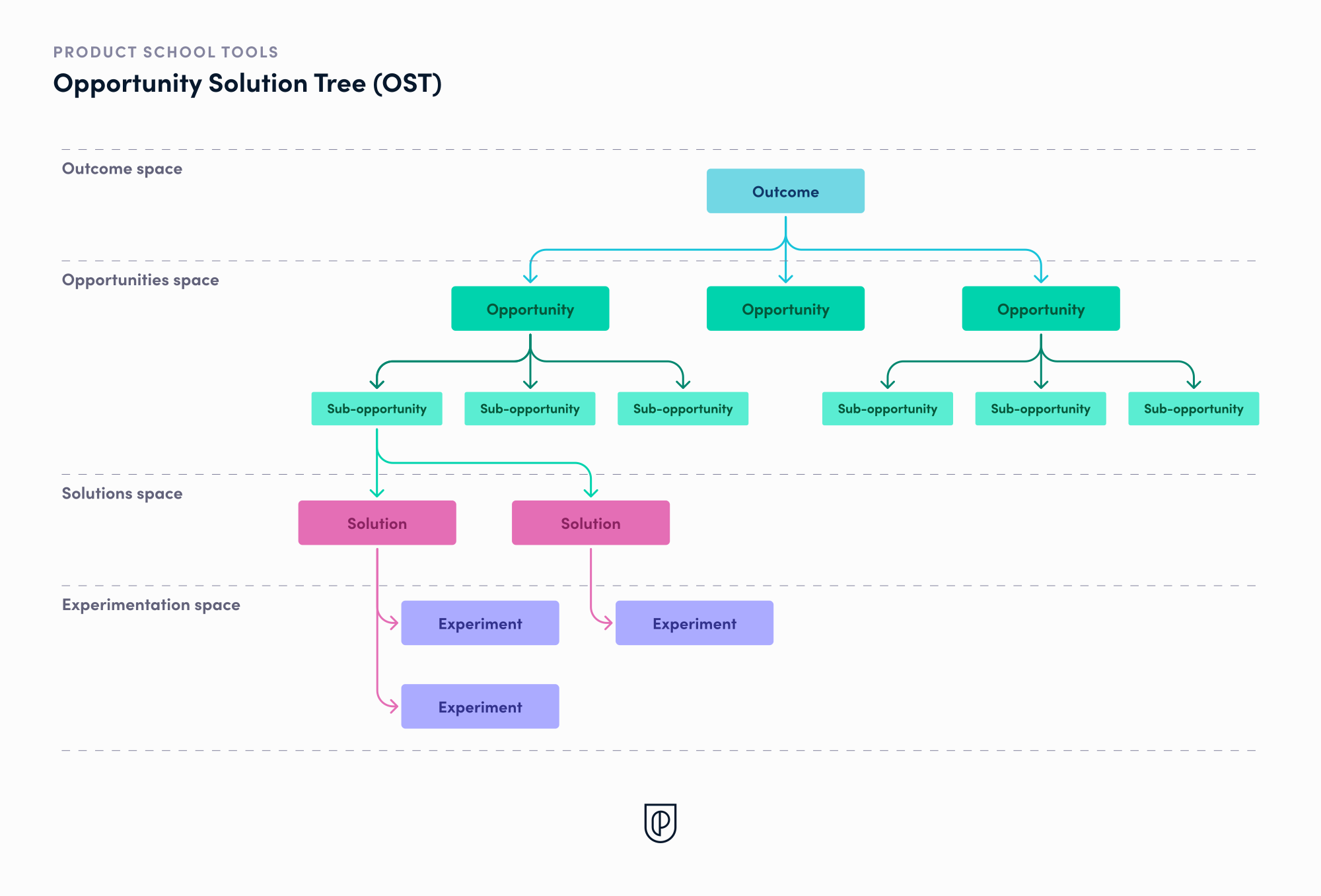
Opportunity Solution Tree Template
Branch out and discover something new with the opportunity solution tree. Visualize the product discovery process to build features that matter!
Get the template5. AI product prioritization and planning
Once you’ve gathered insights and validated a few directions, AI becomes useful for turning that learning into clear next steps.
It can look across user feedback, prototype performance, and business data to suggest which ideas have the strongest signals. Not to make the decision for you, but to surface patterns you might otherwise miss.
For example, if you’ve tested three user onboarding concepts, AI can highlight which one reduced confusion the most, which segments responded best, and which aligns most closely with past behavior in similar cohorts.
Where this really helps is in shaping early versions of an outcome-based roadmap. You can feed AI a product vision statement, a few strategic constraints, and what you’ve learned from testing. It can draft a rough sequence of milestones: which problems to solve first, what experiments to run, and what dependencies to consider.
Think of it as a fast “first pass” that frees you to focus on trade-offs, resourcing, and alignment. The final decisions still rely on human judgment (which is why AI won’t replace PMs) AI can cluster insights and suggest priorities, but only PMs can weigh business context, timing, and strategic fit.
In practice, teams use AI here to accelerate clarity: get a synthesized view of what’s working, generate a draft plan, refine it with the team, and lock in the bets that deserve investment. The result is a roadmap grounded in evidence instead of opinions, without losing the nuance only humans can provide.
6. Continuous Discovery, Dual-Track Development, And CI/CD Become Non-Negotiable
AI makes continuous discovery possible, and in many products, necessary to keep up. Once AI can synthesize feedback in minutes, generate AI prototypes in hours, and ship iterations safely, “big-batch discovery” becomes a competitive disadvantage.
This is where modern teams shift into dual-track development. Discovery runs continuously alongside delivery. Discovery is always feeding the next smallest bet, and delivery is shipping those bets through CI/CD in small, reversible increments.
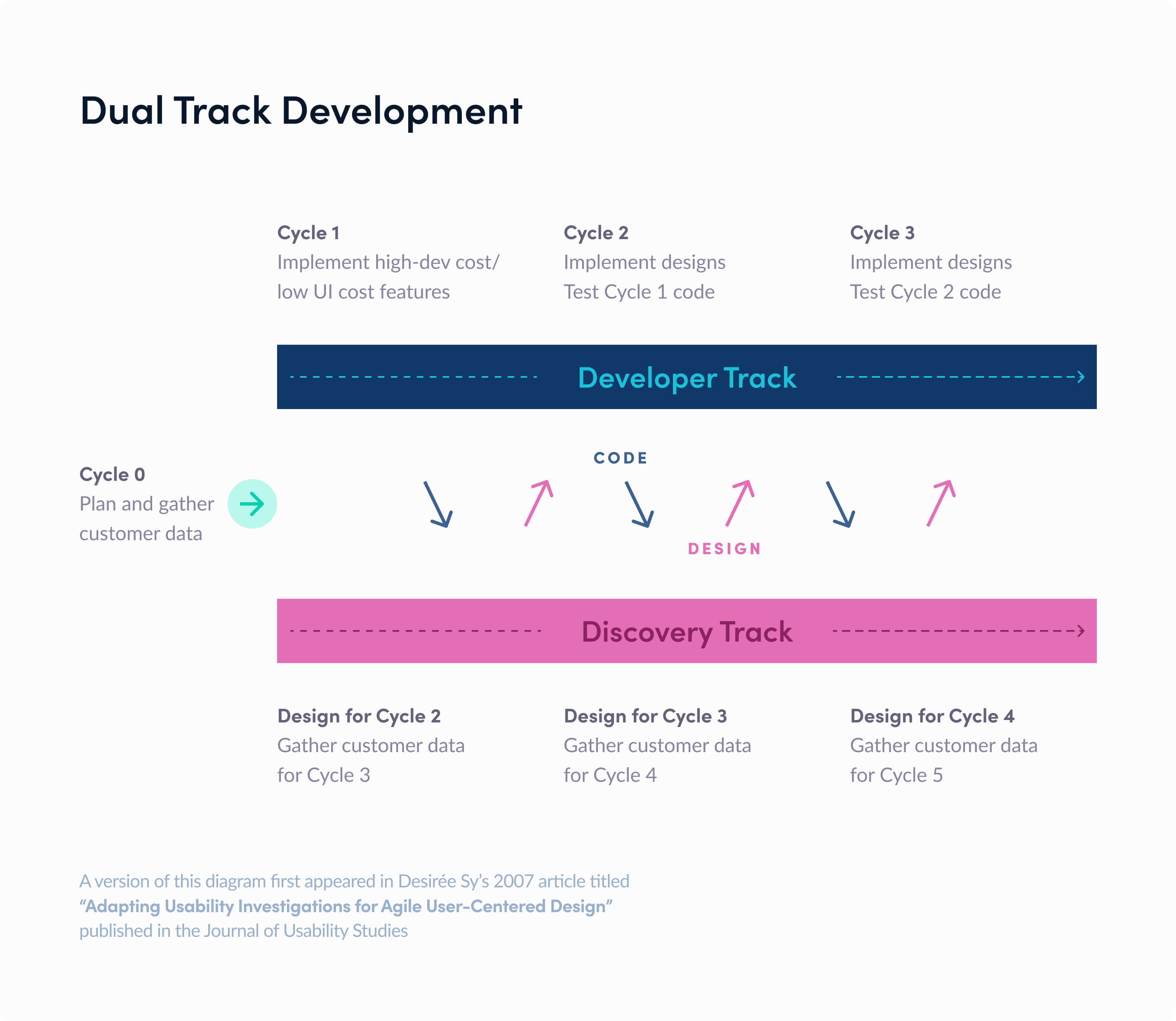
In AI products, this matters even more because the system can change without a code deploy. RAG pulls new information, models get updated, and agent workflows evolve. If the team is not continuously learning, validating, and shipping guarded improvements, quality and trust drift.
This is exactly how we teach it in Product School’s AI curriculum: discovery is not a phase. It’s a pipeline that stays alive after launch, tightly connected to delivery through continuous evaluation, safe rollout mechanics, and fast feedback loops.
Ten Unconventional Ways to Improve Product Discovery with AI
Here are ten sharp, high-leverage ideas your team can apply immediately to get smarter, faster discovery using AI.
Build a “living opportunity map” by having AI continuously cluster new feedback and highlight when an emerging theme crosses a relevance threshold — treat it like a stock ticker for user needs.
Run weekly 20-minute “AI sensemaking sessions” where the team reviews the top three shifts the model noticed in user sentiment, and decide one tiny experiment to run that week.
Ask AI to generate counter-arguments to your favourite ideas. Force it to confront blind spots, hidden risks, and user frustrations before you over-commit.
Use AI to simulate how different user personas would react to a concept (excited, confused, indifferent), then test those reactions with real users to see which predictions held up.
Feed AI your last three quarters of roadmap items and shipped features, and ask it to surface patterns in where you’ve repeatedly over- or under-invested — often revealing strategic drift you didn’t notice.
Summarize competitive launches with AI and ask it to extract “implied user needs” behind each one; this reframes competitor watching as discovery rather than feature-chasing.
Turn messy internal conversations (Slack threads, meeting notes) into an “alignment heat map” using AI to spot where opinions diverge most — that’s usually where deeper discovery is needed.
Use AI to compress long customer interviews into “moment of truth” highlights (moments of hesitation, delight, friction) so you can validate assumptions without drowning in transcripts.
After a prototype test, ask AI to generate three alternative design directions based on user feedback — not to implement blindly but to force fresh thinking when you’re stuck in a single solution frame.
Before prioritizing, have AI produce two roadmaps: one optimized for speed and one optimized for learning; comparing them with your team uncovers which bets deserve real discovery versus full delivery.
AI Product Discovery Tools to Explore
Here are a few battle-tested tools that pair especially well with AI-driven product discovery. Based on the vendors’ own documentation, all of these tools feature built-in AI functionality. You do not need all of them — think “stack,” not “silver bullet.”
Dovetail – Customer intelligence hub that pulls in interviews, surveys, support tickets, and more, then uses AI dashboards and agents to auto-tag, summarize, and surface real-time discovery themes.
Productboard – Product discovery and roadmapping platform that consolidates feedback from multiple channels and uses AI (Productboard Pulse) to categorize requests and highlight trending opportunities tied to the roadmap.
Maze – AI-powered user research and testing platform that runs usability tests, concept tests, and surveys, then auto-generates reports, themes, and insights so teams can move from prototype to learning fast.
Sprig – In-product survey and research tool with AI analysis that clusters open-text responses into clear themes and turns ongoing user feedback into an opportunity feed for discovery.
Usersnap – Flexible feedback layer (bug reports, ideas, CSAT, NPS) designed for product teams, useful for scaling discovery inputs and funneling structured signals into your insight stack.
UserTesting – Experience research platform with strong recruiting and AI-driven analysis that helps you run moderated/unmoderated tests at scale and turn video sessions into decision-ready insights.
Zeda.io – AI-powered product discovery platform built around voice of customer; aggregates feedback, analyzes sentiment and impact, and helps prioritize what to build next based on business value.
Amplitude – Digital analytics platform with AI features and “AI Agents” that analyze behavioral data and feedback to surface patterns, run experiments, and turn product usage into clear discovery insights.
Mixpanel – Product analytics focused on event-level behavior, now augmented with AI insights and predictive analytics to spot anomalies, key patterns, and likely churn or conversion drivers.
If you want to zoom out beyond discovery and look at your overall AI stack as a PM, we also have a dedicated guide on AI tools for Product Managers and Product Teams that is worth bookmarking.
How to Balance AI Insights with Product Discovery Judgment
AI provides data and suggestions, but it can’t replace product sense. Experienced product leaders emphasize that data (and AI) are tools and the human product manager still steers the ship.
As Ashley Nutter (Twitch Ads) reminds us:
Data is a tool, but product management is still a mix of art and science.
You can rely on AI to highlight signals, but you must decide which ones matter.
It’s tempting to treat AI dashboards or model outputs as the final word, but that’s risky. Instead, use AI to inform hypotheses, not dictate them.
For example, if AI points to a new user pain point, verify it with a real user conversation. If AI suggests a feature, stress-test it against product goals. Smart product teams know when they have “enough” evidence (the earned conviction) to move forward. They constantly question AI output and bring in human insights (context, values, ethics) before deciding.
In practice, this means: don’t outsource decisions to AI models. Keep cross-functional humans in the loop and view AI as augmentation.
For instance, even when an AI model ranks user segments, AI PMs might adjust based on strategy (perhaps targeting a smaller segment first due to a new initiative). Data-driven recommendations get you far, but final trade-offs remain a human judgement call.
Above all, remember to start with user needs and AI product strategy. AI can help at every step, but as Tricia Maia’s TED talk emphasized, it made all the difference that her team “started with the problem”scribd.com.
Likewise, AI-enabled discovery works best when you begin by listening to customers and defining your objectives. Only then use AI to help explore solutions, test ideas, and scale what works.
The Future of Product Discovery With AI
Product discovery with AI is about giving teams a clearer, faster, and more evidence-rich path to the truth.
When you can turn raw signals into patterns, prototypes into validation loops, and scattered insights into confident decisions, the entire discovery cycle becomes sharper and more strategic. The PMs who learn to pair AI’s speed with their own judgment will build products that win because they understand users earlier, deeper, and better than anyone else.
Level up on your AI knowledge
Based on insights from top Product Leaders from companies like Google, Grammarly, and Shopify, this guide ensures seamless AI adoption for sustainable growth.
Download Guide
(1): https://www.classicinformatics.com/blog/ai-development-statistics-2025
Updated: January 19, 2026