Product teams have never had more ideas.
We have more customer data, more behavioral signals, more competitive pressure, more AI tools, and more ways to AI-prototype than at any point in the history of product management. On paper, that sounds like a dream.
In reality, it has made product prioritization trickier.
That was one of the most important takeaways from a recent ProductCon talk by Vinod Suresh, VP of Product and GM at GoDaddy. Vinod put it simply:
“Like we've never ever ever had more ideas. We've never had more data. We've never had more, and we've never had more disruption.”
That is the new reality of AI product prioritization. And the new question product teams should be asking is “When AI makes almost anything buildable, what is actually worth scaling?”
That shift changes how AI PMs, product leaders, and product teams should think about roadmaps, experiments, metrics, and customer value.
Key Takeaways
AI product prioritization is harder because AI creates more buildable ideas than teams can responsibly scale.
The main bottleneck has shifted from engineering bandwidth to scale, revenue, GTM, security, integration, and adoption.
PMs should prioritize AI ideas based on customer outcomes, not novelty, usage, or demo quality.
AI confidence matters: teams need evals to understand where the model works, where it fails, and whether it is reliable enough to scale.
The best AI opportunities fit the broader customer journey and AI product strategy instead of creating fragmented experiences.
The PM role is shifting from roadmap owner to portfolio manager: deciding which AI bets to test, scale, pause, or kill.
What Is AI Product Prioritization?
AI product prioritization is the process of deciding which AI features, AI use cases, product experiments, and product bets should be built, tested, scaled, or killed.
I don’t like to think about it as a traditional prioritization with “AI” added as a hyped slang.
Traditional product prioritization usually weighs customer value, business impact, effort, urgency, and strategic fit. Those still matter. But AI adds new variables that product teams cannot ignore:
Model quality and reliability
Data readiness
Cost at scale
Risk when the AI is wrong and human-in-the-loop
Trust and explainability
AI ethics failures
Security and privacy requirements
Customer experience consistency
Build vs. partner trade-offs
A product team can now build a prototype in a day that would have taken weeks or months before. But that does not mean the feature is ready for customers or that the experience fits the rest of the product. And it definitely does not mean the company should shift traffic, sales motion, support resources, and brand trust behind it.
That is why AI product prioritization is becoming one of the most important skills for modern AI PMs. It’s also the reason why it’s a core piece of our AI Product Management Certification.
AI Product Management Certification
Adopt an AI-first mindset: design AI-native UX, build agents, define modern PRDs, and ship trustworthy AI-powered products.
Enroll now
Why AI Changes Product Prioritization
The biggest mistake teams can make is assuming AI makes prioritization easier because it makes building or vibe coding faster.
It’s actually not as simple as that. It makes prioritization more important and Vinod captured this directly:
“Prioritization in its traditional way has been fundamentally challenged.”
Why? Because the constraint has moved.
For years, product development was built around one very practical assumption: engineering bandwidth was scarce. PMs had to fight for resources, make trade-offs, and defend roadmap decisions because the company could only build so much.
AI has not removed every constraint, but it has weakened that one.
PMs can use AI to draft requirements, analyze feedback, generate prototypes, test copy, summarize research, produce code, and create early versions of product experiences.
Engineers can use AI to move faster.
Product designers can create more variations.
Product marketers can test more positioning.
Data teams can explore more hypotheses.
But once the team has 50 plausible ideas instead of five, the job gets harder. As Vinod noticed: “What has really happened is that the bottleneck has shifted. The entire product development lifecycle (whether you call it PDLC, SDLC, or Agile) was built on one fundamental assumption: engineering bandwidth was the most expensive and limited resource in the enterprise. Product decisions were governed by the internal supply and demand. But in the age of AI, that assumption no longer holds.”
The bottleneck is no longer engineering or building. It is deciding what deserves to become real.

The New Bottleneck Is Scale
AI does not automatically make it easier to get from idea to revenue. In fact, based on the heaviness of the setup with AI agents, the RAG systems, and vibe coding, the costs can multiply.
McKinsey’s 2025 State of AI report found that 88% of organizations now report regular AI use in at least one business function. But only approximately one-third have begun scaling AI programs across the enterprise. In the same report, only 39% of respondents reported EBIT impact at the enterprise level.
That gap should be a wake-up call for product teams. AI adoption is no longer the hard part. AI impact is.
Vinod made the same point from a product leadership perspective:
“Sometimes it may seem like we now can do more, but literally the bottleneck has shifted from building new things to what gets us to scale and what gets us to the revenue.”
This is the difference between an impressive demo and a product that changes the business.
A demo needs a prompt, a workflow, a model, and a few good examples. A scaled AI product needs:
Production-ready reliability
Security review
Data governance
Integration with existing systems
Customer education
Support readiness
Clear pricing or packaging
Cost controls
Success metrics
A trusted user experience
A go-to-market motion
That is why I think we need to move away from thinking about how fast we can ship this.
The better question is, “What would need to be true for this to create measurable customer and business value at scale?”
The AI Product Prioritization Framework
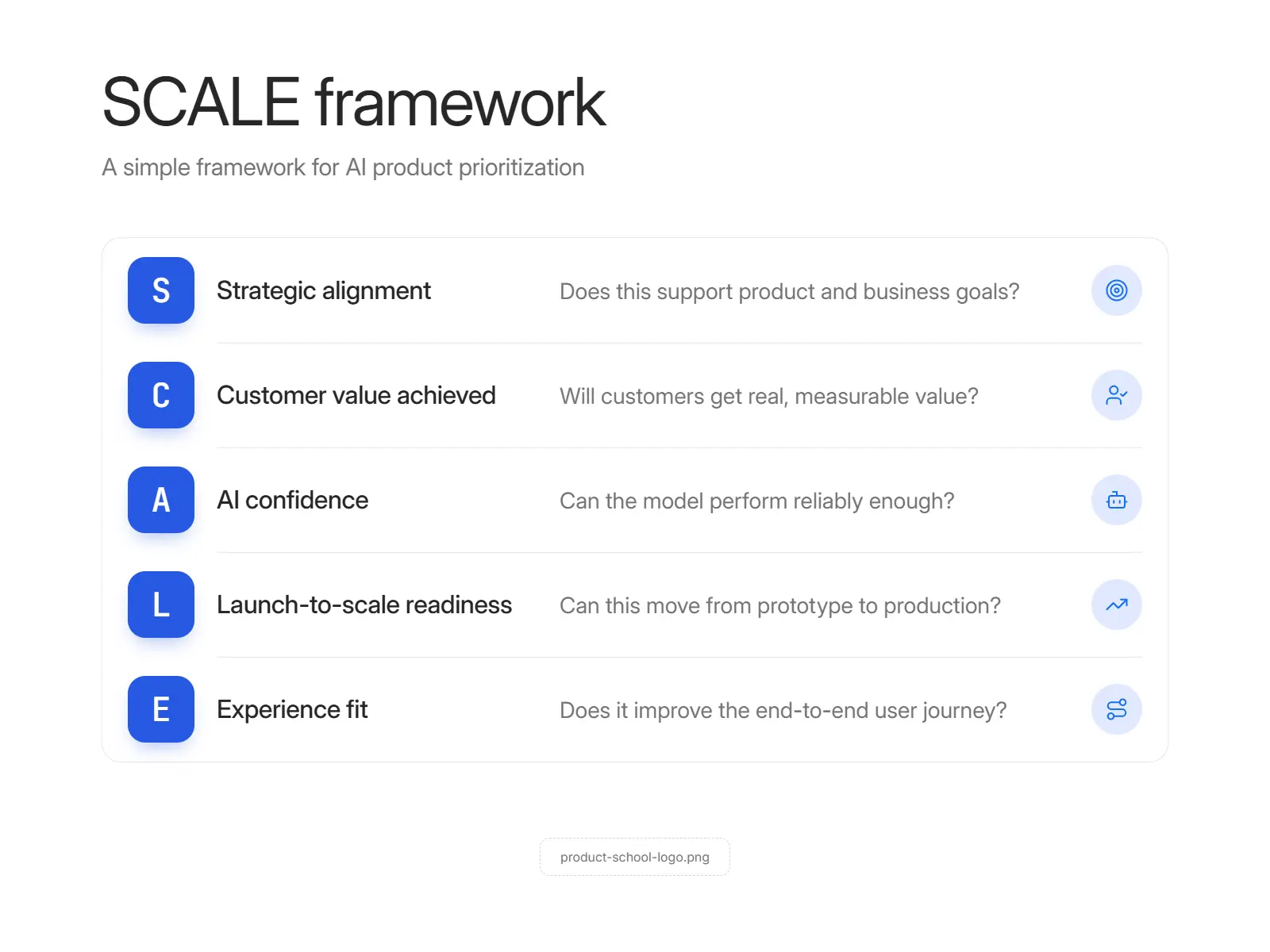
To prioritize the AI operating model, I like using a simple framework: SCALE.
SCALE stands for Strategic Alignment, Customer Value Achieved, AI Confidence, Launch-to-Scale Readiness, and Experience Fit. The point of the framework is to force the right conversations before a team overcommits to an AI idea that is exciting but not durable.
1. Strategic alignment
The first question is whether the AI initiative supports the AI product strategy.
This sounds obvious, but it is where many AI roadmaps go wrong. Teams see what the technology can do, then look for somewhere to put it. That creates AI features that are impressive in isolation but disconnected from the product’s real priorities.
A strong AI opportunity should support at least one key product metric:
Improve activation
Increase retention
Grow revenue
Reduce cost-to-serve
Improve customer success
Strengthen product differentiation
Unlock a new customer segment
Defend against competitive pressure
If the opportunity does not connect to strategy, it belongs in exploration, not on the roadmap.
PMs should be especially careful with features that exist only because competitors are doing something similar. Competitive pressure can reveal customer expectations, but it should not replace product judgment.
The real question is, “Does AI help customers achieve something important in a way that strengthens our product strategy?”
2. Customer value achieved
The second question is whether the feature creates real customer value.
Not usage. Not novelty. Not internal excitement. Customer value.
Vinod shared a useful concept from GoDaddy: Customer Value Achieved, or CVA.
“Traditional metrics like activation, usage, revenue, and average order value still matter, but they are not enough. At GoDaddy, the team looks at a composite metric called Customer Value Achieved, or CVA. For a website product, that means we do not just ask whether the customer is using the website. We ask whether the website is getting traffic, generating orders, or helping the customer book appointments. You only hit CVA when the customer gets value out of this. ”
That distinction is critical for AI products. For example, if you are building an AI website tool, success is not simply the customer generating a website. Success is if the website helps the customer get traffic, appointments, leads, orders, or revenue.
If you are building an AI support assistant, success is not that users ask questions. Success is that they resolve issues faster, avoid escalation, and leave with more confidence. If you are building an AI analytics feature, success is not that users generate insights. Success is making better decisions.
This is where many AI features fail. They optimize for interaction instead of outcome.
For every AI idea, PMs should define the customer outcome before defining the feature. Ask:
What job is the customer trying to get done?
What friction does AI remove?
What does success look like from the customer’s perspective?
How will we know the customer received value?
What metric proves the customer is better off?
The best AI products improve outcomes.
3. AI confidence
The third question is whether the AI can perform the task reliably enough for the AI use case.
This is where AI product prioritization differs sharply from traditional prioritization.
With most software features, PMs can reasonably assume the system will behave deterministically once built. With AI, that assumption breaks.
The model may perform well in one context and fail in another.
It may produce different answers to similar inputs.
It may be good enough for low-risk use cases and unacceptable for high-risk ones.
That means teams need to prioritize with model confidence in mind.
Vinod framed crucial questions this way:
“Can we identify the gap that exists within these LLM models? Can we then start writing evals to check where the model breaks?”
That is exactly right. AI PMs need to understand where the model succeeds, where it fails, and how those failures affect the customer. This is where AI evaluation is crucial.
A brainstorming assistant can tolerate more ambiguity than an AI tax advisor, right? So, before prioritizing an AI feature, ask:
Can we evaluate output quality?
Do we have representative test cases?
What are the most likely failure modes?
What happens if the AI is wrong?
Does the user have enough context to judge the output?
Do we need human review?
Can the experience recover gracefully from mistakes?
Evaluations turn AI quality from a subjective debate into a product decision. Without evals, teams end up relying on demos, anecdotes, or a few hand-picked examples that make the feature look better than it really is. With evals, PMs can define what “good” means for a specific use case, test the model against realistic scenarios, identify failure patterns, and decide whether the feature is ready to ship.
This is why AI evaluation is becoming a core PM skill. Product leaders do not need to become ML engineers, but they do need to understand how to translate customer expectations into evaluation criteria, how to work with technical teams on test sets and failure modes, and how to connect model performance to business outcomes.
At Product School, we cover this in our AI Evals Course, which is designed to help product teams and leaders build more reliable AI products by learning how to measure accuracy, safety, trust, and product quality before scaling AI features.
AI Evals Certification
Learn to build trusted AI products. Design eval suites, integrate CI/CD gates, monitor drift and bias, and lead responsible AI adoption.
Enroll now
4. Launch-to-scale readiness
The fourth question is whether the feature can move beyond the prototype. This is where product teams need to be honest.
AI makes prototypes deceptively easy. A working demo can make a team feel like it is 80% done. In many cases, it is actually 20% done.
The remaining work is the operating system around the product. Vinod again asked the key question here:
“But what happens is when you define the product cycle time as idea to revenue or idea to scale, then the real bottlenecks kick in, right?”
Those bottlenecks include security, integration, traffic allocation, revenue projection, testing, legacy systems, support, and go-to-market.
PMs should score AI ideas based on launch-to-scale readiness, not just prototype speed.
Ask:
Can this integrate with our existing product architecture?
What customer data does it need?
What are the privacy and security implications?
What will it cost at production volume?
Can sales and marketing explain it?
Can support troubleshoot it?
Can we monitor quality over time?
Can we roll it back safely?
Does the business model support the usage cost?
The goal is to prevent teams from scaling the wrong things. Fast learning is good. Fast waste is not.
5. Experience fit
The fifth question is whether the AI feature improves the end-to-end product experience.
This may be the most underrated part of AI product prioritization.
When more people have the best AI tools, more people can build. That is powerful, but it also creates risk. Different teams may ship AI features with different tones, patterns, models, interaction styles, and quality bars. Each feature may make sense locally, but the total experience can feel fragmented.
Vinod warned about this: “It is really hard to hold the bar in terms of holding an end-to-end experience because the customers are looking at your products end-to-end.”
Customers do not care which team built which feature. They experience the product as one thing. That means PMs need to prioritize AI features by how they fit into the critical user journey.
Ask:
Does this feature help the customer complete a meaningful workflow?
Does it fit the product’s UX patterns?
Is the tone consistent with the brand?
Does it create trust or confusion?
Does it connect to the next step in the journey?
Does it reduce fragmentation or add another disconnected surface?
A good AI feature should make the product feel more intelligent and more user-friendly.
How to Score AI Product Ideas
A simple scoring model can help teams compare AI opportunities without turning prioritization into theater.
So, to get this right, score each criterion from 1 to 5:
Criteria | Question |
Strategic alignment | Does this support a clear product or business priority? |
Customer Value Achieved | Will this create a measurable customer outcome? |
AI confidence | Can the model perform reliably enough for this use case? |
Eval readiness | Can we measure whether the AI output is good or bad? |
Launch-to-scale readiness | Can this move beyond prototype into production? |
Cost and margin impact | Will usage costs scale sustainably? |
Risk and trust | What is the downside if the AI is wrong? |
Experience fit | Does this improve the end-to-end customer journey? |
Then use the score to decide what happens next:
35–40: Candidate for scale
28–34: Run a controlled experiment
20–27: Keep in prototype or discovery
Below 20: Park, rethink, or reject
The numbers are less important than the conversation. Scoring is useful when it reveals assumptions, not when it pretends to replace judgment.
Build vs. Partner in the AI Era
AI also changes the build vs. partner conversation.
In the past, the decision was often based on capability. Could we build this ourselves? Do we have the engineering resources? Is there a vendor that already does it?
Today, building is often less of a limitation.
Vinod put it clearly:
“But today building is not a is not a limitation anymore. You could pretty much go and build anything that any company has today.”
That does not mean you should build everything.
It means the criteria have changed.
Build when:
The capability is core to your differentiation
You have proprietary data or workflow context
The customer experience must be deeply integrated
You need control over quality, evals, and iteration
The feature strengthens a strategic moat
Partner when:
The capability is generic
Speed matters more than control
A vendor has better model performance or infrastructure
The feature is not strategically unique
Maintenance would distract from higher-value work
The best product leaders will not ask, “Can we build this?”
They will ask, “Where do we create unique value?”
Common Mistakes in AI Product Prioritization
The mistakes I see most often are not technical. They are product judgment mistakes.
The first mistake is prioritizing demos instead of durable value. AI demos are easy to love because they make progress visible. But a demo is not a business case.
The second mistake is measuring usage instead of outcomes. If users try an AI feature once and never come back, that is not a success. If they use it often but do not achieve a better result, that is not success either.
The third mistake is underestimating the cost. AI features can have variable usage costs that traditional SaaS features do not. Token usage, latency, infrastructure, human review, support, and monitoring all affect margins.
The fourth mistake is ignoring risk. If the AI is wrong, what happens? Does the customer lose time, money, trust, or confidence? The higher the risk, the stronger the eval and review process needs to be.
The fifth mistake is breaking the customer experience. Vinod said:
“The speed of innovation is just so high that it is very easy for a lot of the builders within our companies to go build new things, but the new things may not be driving customer value if the end-to-end experience breaks.”
That is a product leadership problem. And it is one AI will not solve for us.
The New Role of the AI PM
AI does not remove the need for product managers. It raises the bar.
Elena Verna, Growth at Lovable, framed it sharply on the ProductCon stage:
“Platform shifts are everywhere. Your product roadmap includes something related to AI, I'm sure. Otherwise, you're living on the moon, or your CEO is not paying attention.”
If AI can help teams generate ideas, write drafts, build prototypes, and analyze data, then PMs need to spend less time defending the existence of an idea and more time deciding which ideas deserve the company’s focus.
To the next point, Vinod said it perfectly on the last ProductCon appearance: “The job of a CPO is now to say no to 999 good ideas to get to two or three great ideas.”
That is the job.
Not saying yes to AI because it is possible.
Not adding AI to the roadmap because the market expects it.
Not shipping isolated features because they are easy to prototype.
The PM’s job is to connect customer problems, business strategy, technical reality, and organizational focus. AI makes that job more valuable, not less.
As Vinod put it: “I think my job has shifted from approving road maps to managing portfolio of bets. Your jobs are changing, and you guys need to be ready for that.”
That is where product leadership is going. Roadmaps still matter. But in the AI era, the roadmap is not the only artifact that matters. PMs also need to manage a portfolio of bets:
Some bets are prototypes
Some bets are experiments
Some bets are scale candidates
Some bets are strategic options
Some bets need to be killed quickly
The best PMs will know the difference.
AI Product Prioritization Checklist
Before prioritizing an AI feature, use this table to pressure-test whether it is ready to build, test, scale, or pause.
Prioritization Question | Why It Matters | What to Look For |
What customer outcome does this improve? | AI should solve a real customer problem, not just add novelty. | Clear impact on time saved, revenue gained, friction reduced, or decisions improved. |
Is the use case strategically important? | Not every AI idea deserves roadmap space. | Strong connection to company goals, product strategy, retention, growth, or differentiation. |
Can we evaluate whether the AI output is good? | If you cannot measure quality, you cannot scale responsibly. | Clear eval criteria, test cases, human review, or measurable success standards. |
What happens when the model is wrong? | AI failures carry different levels of customer and business risk. | Defined failure modes, guardrails, fallback states, and acceptable risk thresholds. |
Does this improve the end-to-end customer journey? | AI features should make the product feel more useful, not more fragmented. | Better workflow completion, stronger UX consistency, and less customer confusion. |
Can this scale beyond a prototype? | A good demo is not the same as a production-ready product. | Security, reliability, monitoring, support, and operational readiness. |
What security, privacy, compliance, or integration risks exist? | AI often touches sensitive data, workflows, and systems. | Data safeguards, legal review, compliance checks, and system integration requirements. |
What is the cost at production volume? | AI usage costs can change the economics of a feature. | Sustainable token, infrastructure, support, and maintenance costs. |
Is this differentiated or easily copied? | AI features can become commoditized quickly. | Proprietary data, workflow context, brand advantage, or unique customer insight. |
Should we build, partner, experiment, or wait? | Prioritization is also about choosing the right execution path. | A clear decision based on strategic value, speed, control, and long-term advantage. |
This checklist will not make the decision for you. But it will make the decision better.
AI Product Prioritization Is Not About Finding More AI Ideas
It is about choosing the right ones.
The teams that win will use AI where it creates measurable customer value, strengthens the product strategy, and can scale responsibly.
AI has made building cheaper. But scaling the wrong thing is still expensive.
For product managers and product leaders, that means prioritization is no longer just about deciding what gets built. It is about deciding what deserves to become part of the customer experience, the business model, and the future of the product.
That is a much harder job and a much more important one.
AI Product Management Certification
Adopt an AI-first mindset: design AI-native UX, build agents, define modern PRDs, and ship trustworthy AI-powered products.
Enroll nowUpdated: October 30, 2026