Claude Code made $2.5 billion in its first year and now holds approximately 51% of the coding market. The team that built it operates in pods of 3 to 5 people where designers push code, engineers design, and titles describe specialty rather than contribution boundaries.
I learned this on stage at ProductCon New York, in a live episode of The Product Podcast with Meaghan Choi, Head of Design for Claude Code and Claude Cowork at Anthropic. We talked about how a video posted to a Slack channel became one of the fastest-growing products in software history, and what "everyone is an AI builder" means when you watch it up close.
I already published Claude Code for Product Managers: Why It Matters, which explains what the tool is and why PMs should learn it. This piece is the other part of the story: how the team behind Claude Code actually operates, and what other AI-native product teams can steal from it.
Claude Code for Product Managers
Claude Code is already changing how the best PMs work — at Stripe, Linear, and the fastest-moving teams in tech. Use the AI tool reshaping product work to prototype, analyze, and ship, before a ticket is written.
ENROLL NOW
Key Takeaways
Claude Code started as an internal side project in 2024 and generated $2.5 billion in its first year, according to Meaghan Choi speaking at ProductCon New York.
The team works in builder pods of 3 to 5 people where titles describe specialty, not contribution boundaries. Designers push code to production, and engineers design.
The quality gate has moved from PRDs and mockups to live working code, protected by code review, continuous integration, AI prototyping, and testing.
Anthropic is customer zero. Features need a defined number of internal daily active users before they are released externally.
Individual contributors now operate as mini managers directing fleets of AI agents, and every people manager at Anthropic builds.
Token usage is a floor signal for AI adoption, not a ceiling goal. Durable ROI still shows up in adoption, retention, and revenue.
How Claude Code Went From Slack Post to a $2.5 Billion Product
Claude Code began in 2024 as a side project by a few Anthropic engineers. They wanted to explore whether Claude could write code on a developer's behalf.
It became a product the moment a colleague posted a video of the concept working in the command line to an internal Slack channel. They then spent months in internal-only iteration before anyone outside the company saw it.
I guess the Slack channel is the new garage.
To appreciate how unglamorous this origin is, remember what AI-assisted coding looked like at the time. Developers were copying code out of a chat window, pasting it into their editor, and copying the errors back. The bet behind Claude Code was that the model could act directly instead.
The breakthrough demo ran in the CLI, the command-line interface. This is the text-based way of operating a computer through typed commands. Meaghan Choi, now Head of Design for Claude, remembers her reaction to the Slack video precisely: "Holy guacamole. This is it. This is incredible."

A prototype six months ahead of its models
The early version was rough in every way that matters. It took about an hour to set up, it was difficult to use, and the underlying models were not ready for what the team wanted the product to be.
"It was probably six months early for the models we wanted it to be powered by, but there were signs of life there," Choi told me. The team's response was not to wait for the models. It was to spend that time relentlessly tuning usability, so the product was ready the moment the capability arrived.
That is a pattern worth writing down. In AI product work, the AI product roadmap and the product roadmap are two different curves. The teams that win build the experience slightly ahead of the capability.
The first designs lived in Google Docs
Here is my favorite detail from the whole conversation. When Choi did her first design iterations on Claude Code, there was no design tooling for the job. "At the time, CLI design was so new that it was all in Google Docs, because that was the best representation you could have of what a CLI would look like."
The Head of Design of a product that now serves half the coding market started in a text document.
The lesson for product teams entering any emergent category is that the work precedes the latest, best AI tools. If you are waiting for a mature design stack before you start, you are already behind the people designing in a doc.
Internal adoption was the first product-market fit test
Before Claude Code ever shipped externally, the team spent roughly three months pushing for internal usage and iterating on what they saw. That meant following colleagues around, watching them use it, and fixing bugs on the spot.
The underlying belief was explicit. "We really believed that if we could build a tool that everyone at Anthropic would want to use. Then we'd build a tool that we think could be really useful for people in the industry as well."
Notice what this replaces. There was no market sizing exercise and no launch committee to decide the product was ready. The question was whether the company's own employees voluntarily adopted it. This is a theme we will come back to, because it later became a formal release rule.
What Is an AI-Native Builder Pod (Anthropic’s Operating Units)?
A builder pod is a team of 3 to 5 people, in any mix of engineers, product designers, and AI product managers, where every member ships to production and job titles describe a specialty rather than a boundary.
It is the default unit of product development on the Claude Code team, and it exists because AI has collapsed the cost of contributing outside your discipline.
Titles describe specialty, not contribution boundaries
Choi was blunt about how far this goes. "Our titles don't really matter at all anymore. I am pushing code to production, my engineers are designing."
She still sees a role for titles, just a smaller one. "I think of titles a little bit as a specialty you might bring to the team, but it doesn't delineate what you can contribute to the project."
A designer is the person others ask about design, not the only person allowed to touch it.
This is the same convergence we described in What Is an AI Builder, where PM, design, and engineering skills blend into a single building profile. Anthropic is simply the most complete production example of it that I have seen.
Why “three to five people” is the ceiling
Pod composition is fluid and depends on the problem. Choi's ideal team could be five engineers, or two designers and three engineers, or a PM and four engineers, all sprinting toward something that works in code.
The size limit is not arbitrary. A pod of 3 to 5 is small enough that everyone uses what they build, and in Choi's words, "that's how you build conviction."
Conviction built on usage travels faster through a small group than consensus built on documents travels through a large one.
In Claude Code for Product Managers I joked that the two-pizza team is becoming a one-pizza team, because the agents don't eat pizza, they eat tokens. Anthropic runs the production version of that joke.
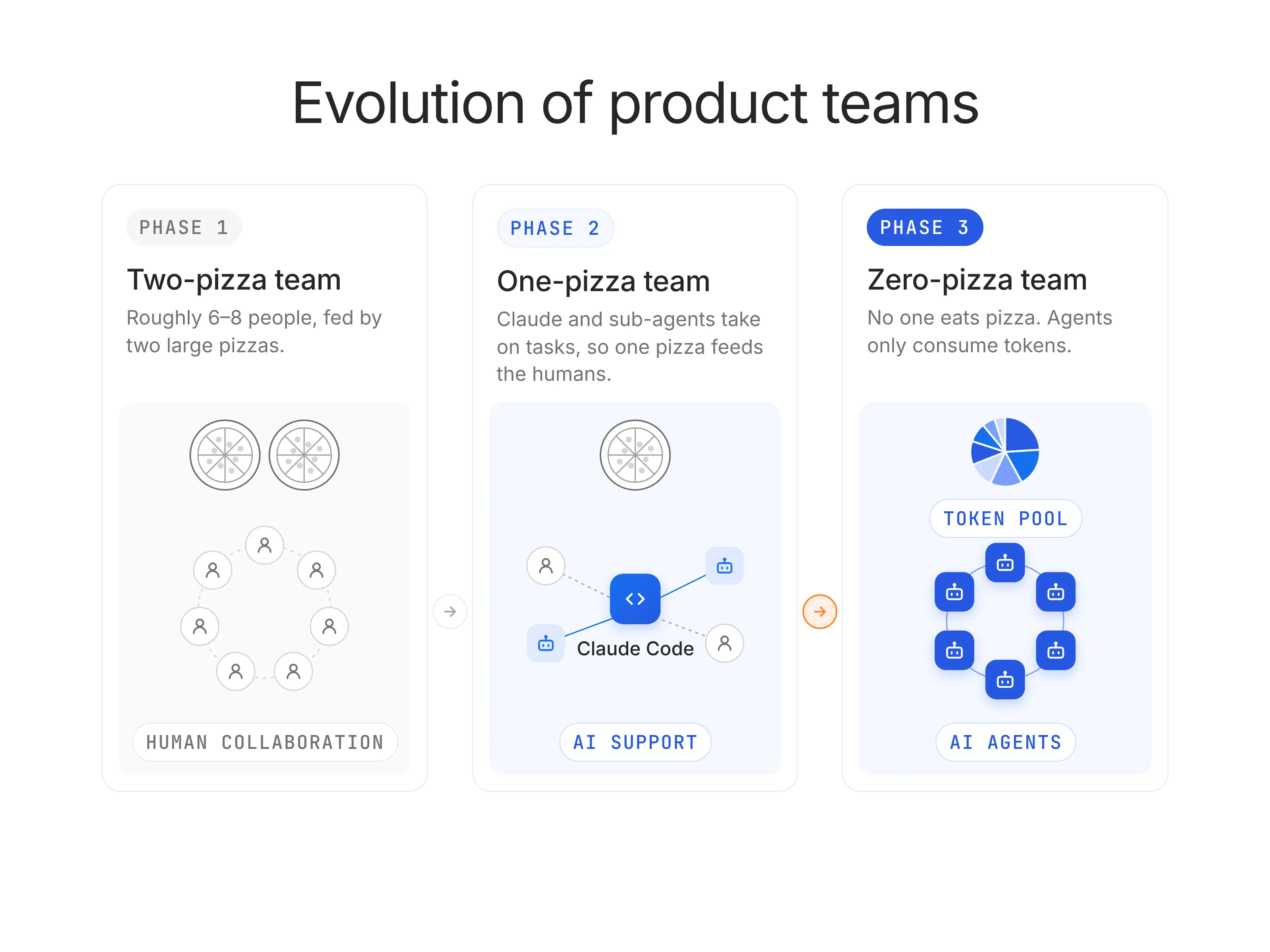
The data says small AI-native teams are the new norm
This is not an Anthropic quirk. A Harvard Business School and INSEAD study of close to 50,000 venture-backed startups found that AI-native firms run about 25% smaller than traditional startups, with roughly 15% fewer managers, flatter hierarchies, and similar funding and valuations.
AWS's 2026 Engines of Growth study, which surveyed more than 3,400 founders and startup leaders across 20 countries, points the same direction. It found AI-native startups reaching billion-dollar valuations in about 3.5 years, with half the staff that it took before generative AI.
The structural conclusion is the one we drew in The AI Operating Model. Headcount is no longer the unit of capacity. Teams that reorganize around small building units outrun teams that retrofit AI into old org charts.
Here is the shift side by side:
Comparison point | Traditional product team | AI-native builder pod |
Team size | 8 to 12 people across functions | 3 to 5 people, any mix of roles |
Role boundaries | Titles define who does what | Titles describe specialty; anyone can contribute anywhere |
Who ships to production | Engineers only | Everyone, protected by code review, CI, and tests |
Quality gate | PRD and mockup reviews | Live working code in a real workflow |
Manager's role | Coordinates, prioritizes, unblocks | Builds alongside the team and models the shipping motion |
First market test | External beta or launch | Internal daily active usage |
How Quality Gates Work When Everyone Ships
On the Claude Code team, quality decisions have moved from PRDs and mockups to live working code. Anyone can ship because code review, continuous integration, and testing protect production, and features only go external after reaching a defined threshold of internal daily active users.
Two quick definitions so we are all reading the same sentence. A PRD is a product requirements document, the spec that traditionally describes what should be built before anyone builds it. CI is continuous integration, the automated checks that run on every code change before it reaches users.
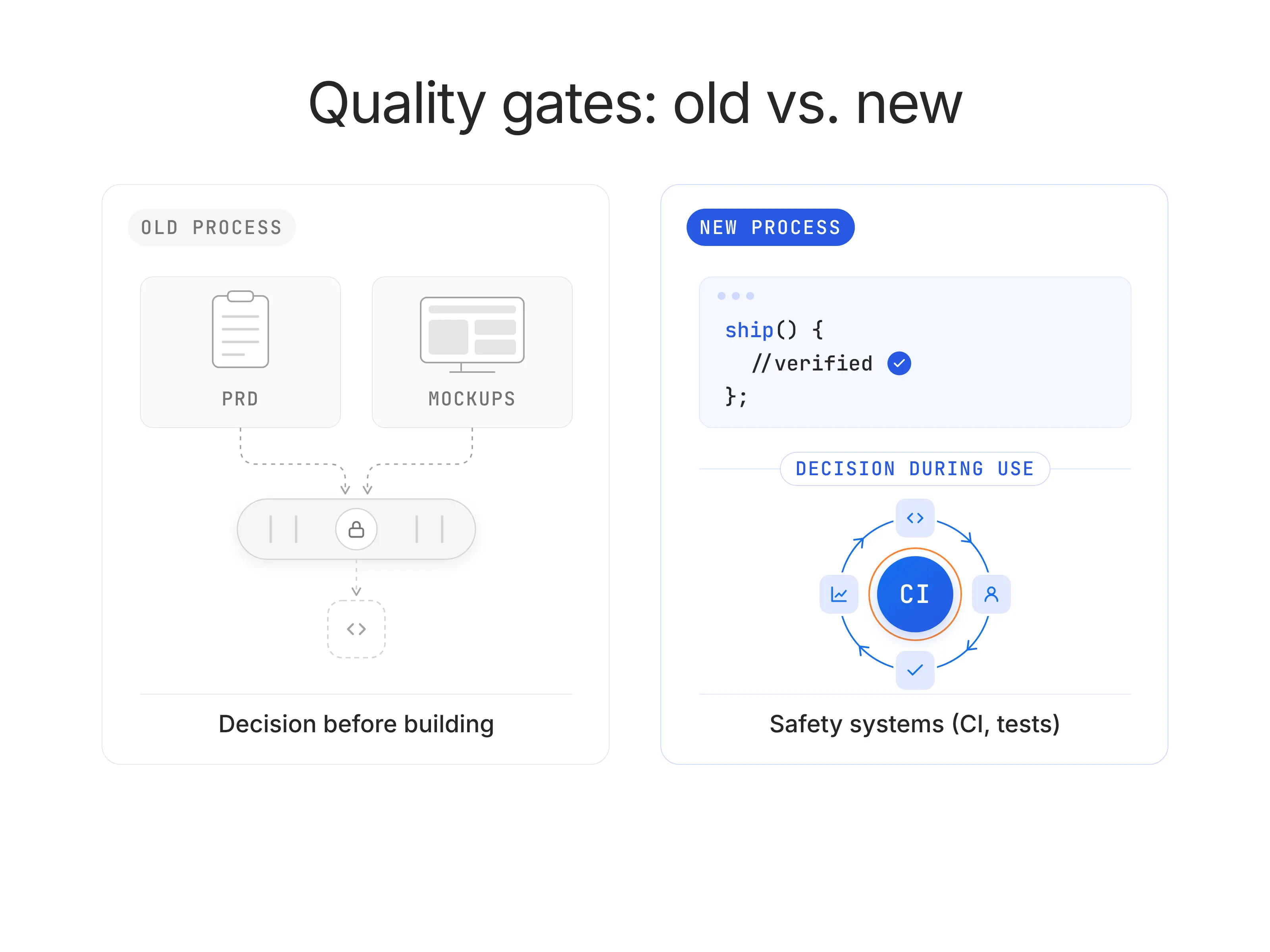
The quality decision moved from mockups to working code
This was the most challenged idea of the whole conversation, and Choi did not soften it. "We used to gate product quality decisions at a discussion level or at a mock. You'd look at a PRD, and that's when you'd make a decision. We've now pushed that decision-making into live working code."
Her argument is that a decision made on a real product in a real workflow is simply better informed than a decision made on a Figma file. "You need to be using it yourself. You experience the product in its actual workflow, and that's when you make a decision on the quality. It's so much more reflective of what the actual experience is going to be."
When building is expensive, gating at the spec makes sense because the spec is the cheapest artifact to argue about. When AI makes building nearly as cheap as speccing, the working version becomes the cheapest artifact worth arguing about. The old gate, as a result, became a theater.
Ship first, then iterate on quality
Choi is honest that this inverts a career's worth of design instinct. "It's uncomfortable to push people to build it first and then iterate on the quality rather than do all the iterations beforehand. It's like a flip on the head of how we work."
For anyone in a regulated or risk-averse environment, the safety mechanism matters more than the speed.
"What you can actually invest in is good code review, good CI, good testing, to make sure that code that goes into your production app is verified and reviewed."
Shipping rights are earned by the strength of the review system, not by job title.
That review layer is exactly the human-in-the-loop principle applied to AI-assisted shipping. Choi also credits it for enterprise adoption. The Claude Code bundle is designed to be "extremely hackable and extremely safe," which is why many enterprises adopted it without an intense procurement review.
Customer zero and the internal usage gate
The pod itself decides when something is good enough to release to the rest of Anthropic. Then a harder, more measurable gate kicks in.
"We look for a specific number of internal daily active users who are truly adopting these products into their workflow. Once we see that growth, then we'll release it externally." DAU, for anyone new to the term, means daily active users, the count of people who genuinely use a product each day. It’s one of the most important user engagement metrics to track.
Your internal team is the cheapest honest beta you will ever get. If your own colleagues will not adopt the feature into their daily workflow, that is not a rollout problem. That is the market speaking early, at a discount.
The Autonomous AI Colleague Model, Explained
The autonomous AI colleague model treats AI agents as working teammates rather than tools. At Anthropic, every individual contributor directs a fleet of Claude agents, every people manager builds, and a newer product called Claude Cowork extends the model beyond engineering work.
This is exactly why we teach both Advanced AI Agents and Claude Code for Product Managers in our course bundle.
From tool to teammate
A tool waits for input and returns output. A colleague takes a goal, does the work, and comes back with a result you review. It is precisely how agentic products like Claude Code behave inside a project.
If you want a framework for when this model genuinely helps, we broke it down in When Should Product Teams Use AI Agents.
Choi loves the CLI for this because, in her words, "it's truly the thinnest wrapper you could have around our models, and that's really what people want access to when they're building." But she is equally honest about its cost of entry: "If any of you have used the CLI, you know it's not easy. It's a whole new learning curve."
Claude Cowork is Anthropic's answer for the rest of the org. It brings the same multi-agentic way of working to non-engineering knowledge work through a desktop app, aimed at what Choi calls the semi-technical audience, people whose work does not live in the developer stack.
Every individual contributor is now a mini manager
This is the framing I keep quoting back to product leadership. "I see all of the individual contributors at the company as mini managers. Everyone's managing a fleet of Claudes. In the same way that you, as a people manager, might manage people, you're also managing Claudes."
Read that as a job description change for every IC on your team. Delegation, scoping, and reviewing output, the skills we used to reserve for managers, are now core individual contributor skills, because every IC has direct reports made of tokens.
And the model runs upward too. "All of the people managers at Anthropic build," Choi told me, and she holds it as a principle: "Going through that experience yourself is really important so you can build the muscle and understand what tooling and what training to invest in your team." A manager who has never performed the shipping motion cannot choose the tools or training for it.
The bottom-up loop that carries Claude Code into enterprises
Claude Code's enterprise growth is a product-led growth motion, meaning adoption starts with individual users rather than a top-down sales deal. But Choi described a compounding loop inside it that most PLG playbooks miss.
Individual developers adopt the tool for personal and side projects, then become internal advocates. As teams spin up, developer productivity teams build custom tooling and connectors to internal databases and infrastructure, which makes the tool more useful for everyone who follows.
"The more people who use them, the better the experience gets for everyone."
The final stage is the one to watch: adoption escapes engineering entirely. "All the designers use Claude Code. All our finance team uses Claude Code. Everyone's using it." Each function that joins makes the internal platform richer for the next one.
How Do You Measure the ROI of AI Adoption?
Token usage is a floor signal for AI adoption. It’s useful mainly for spotting people who are not using AI at all, and a poor ceiling goal because tokens are easy to burn without producing value.
The durable measures are the adoption of automations that create genuine value, plus the classic impact metrics: adoption metrics, user retention metrics, and revenue.
A token, for clarity, is the unit AI models process and bill by, roughly a short chunk of text. Token consumption is the closest thing we currently have to a usage meter for AI work.
Token usage is a floor signal, not a ceiling goal
Choi's rule is refreshingly asymmetric. "Token usage is primarily a good indicator of someone not using AI. If it's zero, that should be a concern."
The reverse does not hold, and she is direct about why: "It's very easy to use an infinite number of tokens and not do any work at all." The moment token consumption becomes a leaderboard, you are rewarding activity instead of output.
Her historical analogy should sting anyone who lived through it. "Engineering companies used to evaluate engineers by lines of code or PRs committed, and over time we learned that's not necessarily the best measure of someone's contributions. I think we're in a similar era right now."
Token dashboards are the new lines-of-code dashboards, and we already know how that story ends.
The metrics that survive the hype cycle
So what does she actually trust? "I still go back to the original impact metrics. What is the adoption? What is the retention? What is the revenue? Those all still hold true no matter if you're using AI or not."
This is exactly why learning about foundational Product Management is still key. The PM principles still stand in an AI era and you need to know them before you can steer this fancy-looking, new ship.
The one nuance worth adding is automations. Choi notes that some automations legitimately consume enormous token volumes and deliver real value, so the question is never how many tokens, but whether the automation is adopted and relied on.
Here is how I would read the signals as a product leader:
Signal | What it tells you | What it does not tell you |
Zero token usage | Someone has not started using AI at all, which is a red flag worth investigating | Why: the blocker could be tooling, training, or trust |
High token usage | AI is present in the workflow | Whether any value is being produced; tokens are easy to burn on nothing |
Adoption of automations | AI is doing repeatable work the team genuinely relies on | Whether the output holds quality without human review |
Adoption, retention, revenue | Whether the product and team are actually better because of AI | Which specific AI practice caused the improvement, so pair it with usage data |
What This Means for Your Product Team
You do not need Anthropic's models to copy this AI operating model. You need to:
Move your quality gate to working code
Protect production with review and automated testing
Treat internal usage as your first market test
Expect managers and non-engineers to ship
Here are the five moves I would take from this conversation, in the order I would make them:
Move the quality gate from specs to working code. Pick one pod and one feature, and agree that the go/no-go decision happens inside the product, not on a slide. Our guide to AI prototyping covers how to get to that working version fast.
Make sure everyone in the pod can contribute a pull request. A pull request, or PR, is a proposed code change submitted for review, and non-engineers can learn to open one safely far faster than most leaders assume. Product School's Vibe Coding certification exists for exactly this jump.
Require managers to perform the shipping motion themselves. Once, end to end, is enough to change how they invest in tooling and training. You cannot coach a motion you have never gone through.
Define an internal daily-active-usage threshold before external release. If your own team will not adopt the feature into its daily workflow, treat that as market feedback, not as an internal comms problem.
Track token usage only as a floor signal. Investigate zeros, ignore leaderboards, and anchor your AI ROI story in automation adoption plus retention, adoption, and revenue.
There is one more thing Choi said that I think is the real operating principle underneath all five. "The real skill here is to be flexible and not hold anything too dear. It’s to live curiously and build curiously right now, because it is going to keep changing."
The team behind a $2.5 billion product does not believe it has found the final way of working. It believes it has found a way to keep changing how it works, and that is the part worth copying first.
If you want the hands-on version of this operating model, Product School's Claude Code for Product Managers certification is the structured place to build it: live, applied, and designed around PM workflows rather than developer tutorials.
Claude Code for Product Managers
Claude Code is already changing how the best PMs work — at Stripe, Linear, and the fastest-moving teams in tech. Use the AI tool reshaping product work to prototype, analyze, and ship, before a ticket is written.
ENROLL NOWUpdated: October 23, 2026