Ideally, you learn product development in four stages. You learn the process, learn the tools, ship one small product end to end, then get structured feedback on what you shipped.
A very small percentage makes it to stage three. That is the entire problem, and it is not a problem of access. The material is free, abundant, and better than it has ever been. What is scarce is someone looking at your work and telling you where your judgment is wrong.
This piece is for anyone trying to learn the product development process from scratch: career switchers, engineers moving into product, and founders. It teaches you the four-stage path to actual competence, which free and paid resources genuinely earn their place at each stage, and a scored diagnostic to find out whether you're stuck at stage one or just avoiding the shipping rep that would move you past it.
Key Takeaways
Product development can be learned in four stages: process, tools, shipping, and feedback.
The bottleneck is not information. Free resources cover the fundamentals completely, and no amount of additional reading moves you past stage two.
Stage three is where nearly everyone stalls: shipping one small product end-to-end (to real users) is the first thing that converts knowledge into judgment.
Paid resources are worth their price for exactly three things reading cannot produce: feedback on your own work, a portfolio artifact, and a credential or network.
Free may be enough when you already sit next to product work and get feedback from your team, or when your real gap is that you have never shipped anything.
A practice project only counts if someone outside your head used it and you changed something because of what they did.
The realistic budget for a career switcher is months, not weeks. The milestone that matters is a shipped artifact, not a completed syllabus.
One little caveat. Digital product development and new product development are different crafts with different literatures, credentials, and daily work. NPD (new product development) is about physical goods (manufacturing, supply chain). Digital product development is about software, which is what we’re covering in this piece.
What Is Product Development?
Product development is the end-to-end process of turning an idea into a launched, used, and improved product. The arc runs roughly six ways:
Product discovery, where you find a problem worth solving
MVP definition, where you decide what to build and what to leave out
Product design, where the solution takes shape
Build, where it becomes real (most important to learn PD - check AI Builder piece)
Product launch, where it meets users
and learn, where evidence from real usage changes what you do next
There is a persistent three-way confusion between product development, product management, and project management that is worth clearing up before you spend money on the wrong course.
Dimension | Product development | (AI) Product management | Project management |
What it covers | The process of building the thing, from idea through launch and iteration | The discipline of deciding what to build and why, including where AI belongs in the product, and owning the outcome | The coordination of delivery: scope, timeline, dependencies, resources |
Core question | How does this get made? | Should this exist, for whom, and what should the model be trusted to do in it? | Will this land on time and on budget? |
Who typically owns it | Shared across product, design, and engineering | Product manager | Project or delivery manager, or a PM at smaller companies |
Typical artifacts | Roadmaps, specs, prototypes, release plans | Strategy docs, opportunity assessments, success metrics, eval criteria | Schedules, RAID logs, status reports, burndowns |
Where AI shows up | AI-built prototypes and faster build and iteration cycles | Deciding where AI creates value, defining what “good” output looks like, and owning the call when the model is wrong | Automated status tracking, dependency flagging, and reporting. If you are learning product development to become a product manager or an AI product manager, you need the middle column too. The resources below cover both, and I will flag which is which. |
Why Most People Stall Before They Ever Ship Anything
The reason most self-taught learners plateau is that they keep buying more information to solve a problem that information does not solve.
Here is the pattern I have watched for a decade. Someone decides to learn product development. They read Inspired, subscribe to three newsletters, and listen to forty podcast episodes. Six months in, they can talk fluently about discovery, north star metrics, and whatnot.
BUT, they cannot point to a single thing they have built. In an interview, they collapse the moment someone asks what they would have done differently.
Don’t be a person who knows more product theory than employed PMs if you haven’t practiced it.
HAVING DONE IT gives you the thing employers are actually screening for. It’s evidence that you have made a call under uncertainty, watched it play out, and been wrong about something in a way you can articulate.
I asked David Hsu, CEO at Retool, about keeping pace in our 1-on-1 webinar, and his answer applies well beyond senior roles: "I think the faster the industry is changing, the more important it is to stay on top. You need to build yourself and check whether you're doing it with the latest advancements."
The phrase I would underline there is "build yourself." Not read more. Build.
There is a market reason this matters more now than it did three years ago. LinkedIn's January 2026 labor-market report found that Product Management is one of the top three job functions by share of AI-skilled members, tied with Engineering at 10%.
I said something related on the ProductCon London stage, and I meant it literally. We are living in weird times. Product managers think they can code and design. Designers think they can code and build products. Engineers the same.
If the roles are overlapping with AI building, then a learning path that never produces a built thing is preparing you for a job that is disappearing.
The Four Stages of Learning Product Development
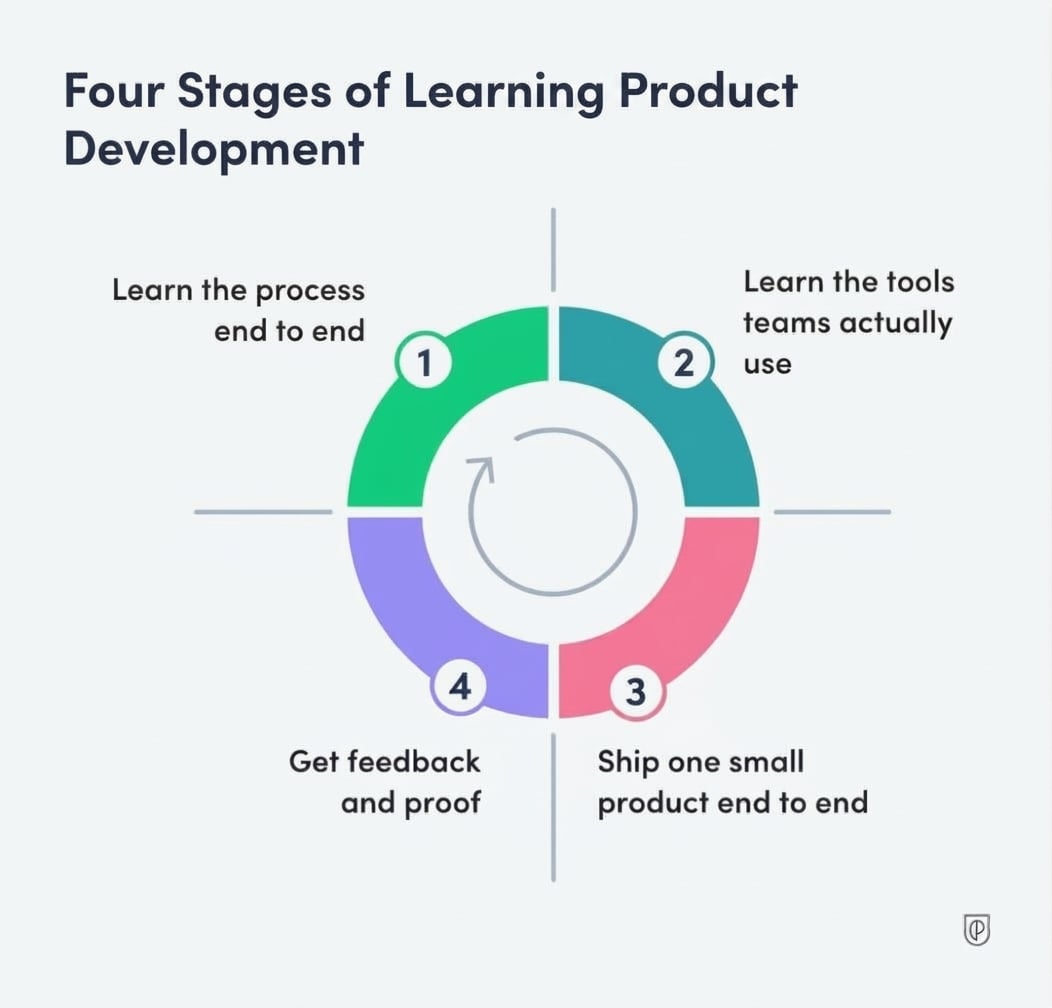
Here is the sequence I would give anyone starting from zero. The order matters more than the specific resources, and the failure point is predictable: it is almost always stage three.
1. Learn the process end to end
Understand the whole arc before you specialize in any part of it.
This is the stage everyone does well, because it is the stage that free content serves best. You are trying to reach the point where you can describe how an idea becomes a shipped, measured feature without looking anything up.
Done means you can explain discovery, prioritization, go-to-market, and key product metrics to someone else. You understand why a team would choose one approach over another rather than just naming both. You also understand how AI product strategy, AI agent architecture, AI evaluation, and AI tools in general fit the product goals because today they are essential.
There are two honest routes here, and the right one depends on the person rather than on the material.
Go free if you finish what you start without external pressure. A reading list, a calendar block, and four weeks will get you through the fundamentals for nothing. Paying at this stage would buy you the structure you were going to supply yourself, and you have nothing built yet for an instructor to give feedback on.
Pay for structure if you have a history of stalling. A syllabus, a start date, fixed deadlines, and a cohort moving at the same pace solve your problem. Be clear with yourself about what you are buying: not the information, which is free, but the enforcement. Enforcement is worth real money if you know you need it.
2. Learn the tools teams actually use
Not tool mastery. Enough fluency to be useful in your first week on a team.
You need to be able to run a backlog, read a product analytics dashboard, put a rough user flow into a design file, and increasingly, stand up a working AI prototype yourself. That is four categories: a work tracker, an analytics tool, a design tool, and an AI prototyping tool. Our rundown of product management tools and these 11 AI tools that I have actually tested covers the current landscape properly, so I will not duplicate it.
The trap here is over-investing. Jeff Smith, CPO at Zoom, made the point well on The Product Podcast: "If you have years of training in a particular tool, the switching cost is ridiculous. “
Deep expertise in one vendor's implementation is a liability. The tool your next employer uses will probably be a different one.
What actually transfers is what Smith described elsewhere in the same conversation: "You need the skills to craft a strategy and to ask the right questions." No single tool teaches that.
When you are choosing which tool to learn first, pick for adoption and range rather than novelty: something like Claude Code for PMs, which is broad enough to cover most of the work and common enough that the fluency transfers to your next team.
Done means you could join a team on Monday and not need anyone to walk you through the software. Budget one to two weeks, and stop there.
3. Ship one small product end to end
This is the stage that separates people who know product development from people who can do it. It’s also where most people stop and ultimately get rejected in interviews.
The requirement is something real, in front of real users who are not your friends, and a product that’s evolved based on what they did.
The scope should be embarrassingly small. It can be a tool that solves one annoyance for one community, for instance. The smallness is the point, because the learning comes from completing the loop, and a big project never completes it.
Here is where Vinod Suresh, VP of Product and GM at GoDaddy, gives you the right definition of done. Talking about CPO’s playbook for tough calls, he described a metric called Customer Value Achieved: "We do not just ask whether the customer is using the website. We ask whether the website is getting traffic, generating orders, or helping the customer book appointments. You only hit CVA when the customer gets value out of this."
Apply that standard to your practice project. I know, it gets much harder, but it does in exactly the useful way. Get at least one person getting something they wanted from your product.
What good looks like: You shipped something narrow, watched real usage, discovered your assumption was wrong somewhere, changed the product, and can explain the before and after.
What bad looks like: you built something impressive-looking and showed it to nobody.
4. Get feedback and proof
A simple book can not give you feedback on your own work, a portfolio artifact, and a credential or network that gets you into rooms.
This is where paid options earn their price, and where they do not. A course that hands you recorded lectures is selling you stage one again at a stage-four price. A course that reviews your work, puts you in a cohort of people doing the same thing, and connects you to practitioners is selling you something you genuinely cannot self-serve.
Done means that someone qualified has critiqued your actual work and you have changed it in response.
Free Resources to Learn Product Development
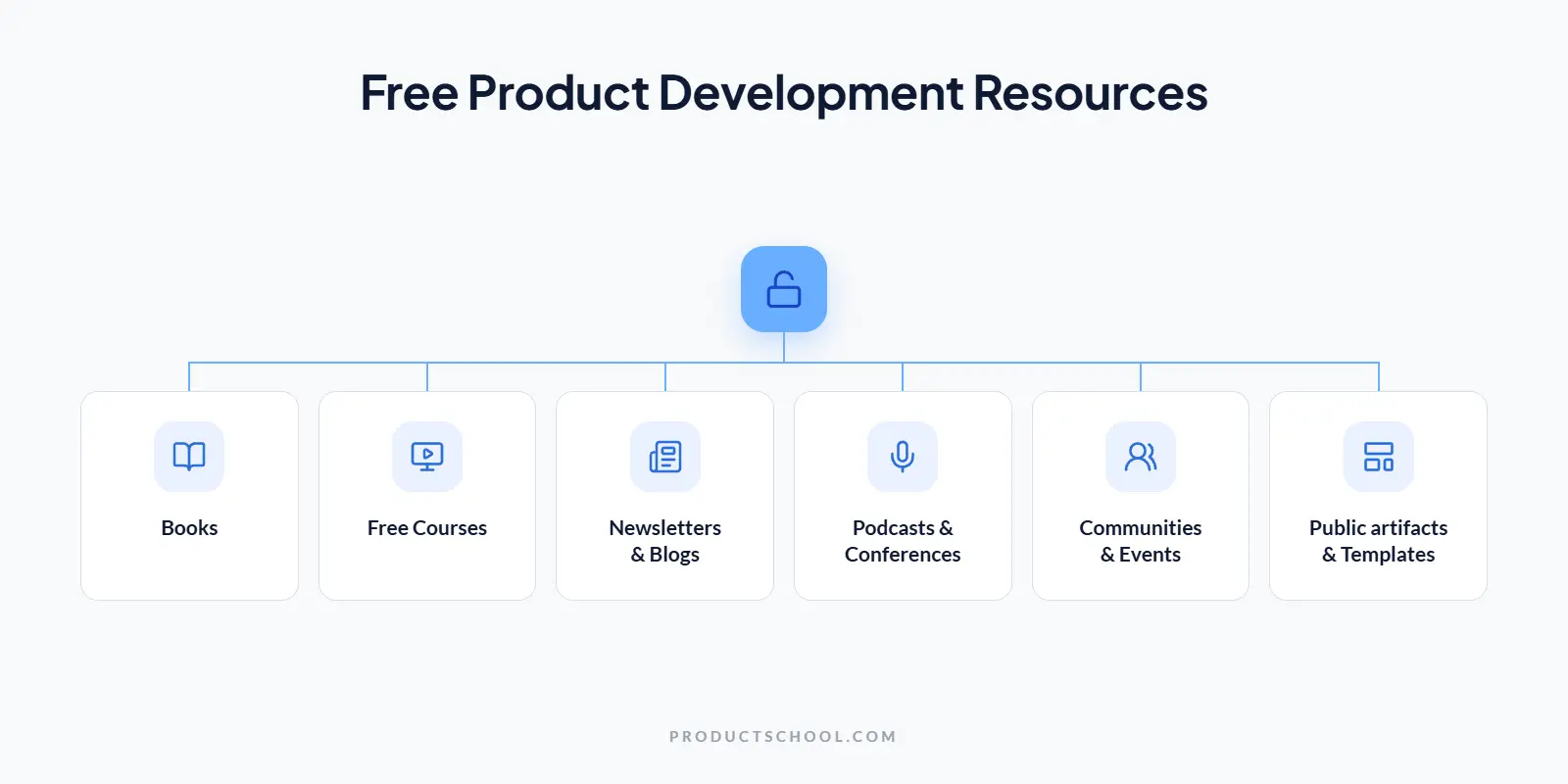
The honest position: free resources will take you through stage one completely, most of stage two, and a surprising amount of stage three. Anyone telling you otherwise is selling something.
1. Books
Free resources will take you through stage one completely, most of stage two, and rarely a fair amount of stage three. What they do not reliably provide is sequencing, deadlines, and someone qualified to review your work.
That is a separate problem from whether the material is good enough, and it is the one worth paying to solve.
Inspired by Marty Cagan: The closest thing the discipline has to a standard text on how strong product teams work.
Continuous Discovery Habits by Teresa Torres: The practical counterpart, focused on building a research habit rather than running research projects.
Escaping the Build Trap by Melissa Perri: The argument for outcomes over output, and the best explanation of why shipping more features is not progress.
The Mom Test by Rob Fitzpatrick: Short, cheap, and the single best thing to read before your first user interview.
Shape Up by Ryan Singer: Basecamp's approach to scoping and betting, and it is free to read online.
Product School’s eBook library: Shorter and more practical than the titles above, and free. Useful when you want one specific topic covered properly rather than a whole book.
Read Inspired and The Mom Test before stage three. Save the rest for after you have shipped something, when they will land differently.
2. Free courses and open courseware
Y Combinator's Startup School: Free, and unusually good on the build-measure-learn loop from a founder's angle, which is closer to real product work than most academic material.
MIT OpenCourseWare: Genuinely free university material, stronger on the engineering and NPD side than on software product management.
Coursera and edX audit tracks: Most courses can be audited without paying, with the certificate behind the paywall. If you only want the knowledge, audit.
On most platforms, the content is free, and the credential is the product. Decide which one you are buying.
The same logic applies to us, and I would rather say it directly than let you work it out later. Our templates, playbooks, eBooks, blog, and podcast are free and are not trimmed-down teasers for the paid programs. They cover the fundamentals, which is exactly the argument I have been making about stage one: that layer of the craft is not what anyone should be paying for.
3. Newsletters, blogs, and public case studies
Silicon Valley Product Group's writing: Cagan and colleagues, and the closest thing to a canonical blog for the discipline.
Lenny's Newsletter: Broad, practitioner-heavy, with a substantial free archive.
Atlassian's product and agile guides: Unglamorous, well-structured explainers of process mechanics.
Product School’s free resources and Product Podcast: Templates, playbooks, eBooks, blogs, interviews with leaders at world-renowned companies.
4. Podcasts and conference talks
Podcasts are the weakest format for learning a craft and the strongest for absorbing how practitioners reason. You are not there for frameworks. You are there to hear someone describe a decision they got wrong.
ProductCon talks are free to watch and skew toward the "here is what actually happened" register rather than the tidy retrospective one.
5. Communities and events
Communities are how you solve the feedback problem without paying for it, and they are underused. Post your practice project. Ask for a teardown. Offer to review someone else's in exchange.
Product School’s Slack community: Free to join, and a fast place to get a practice project looked at by someone who is not your friend.
Mind the Product: Long-running community with local meetups and a large free article archive.
r/ProductManagement: Uneven, but the portfolio, interview, and career-switch threads are blunter than anything polished enough to be published.
Lenny's community: Paid, attached to the newsletter subscription, and unusually high signal for job-hunting and salary questions.
Reviewing other people's work teaches you more than having yours reviewed, and there is always more demand for reviewers than supply.
Live events are the cheapest way to hear practitioners think out loud. ProductCon runs quarterly with free tickets, and there are workshops and podcast episodes weekly, though individual sessions vary between free registration and member access.
6. Templates, frameworks, and public artifacts
Real PRDs, roadmaps, and strategy docs published by working teams are worth more than any template pack, because templates show you the shape and real artifacts show you the judgment.
Product School’s template library: PRDs, roadmaps, and strategy docs you can fill in rather than design from scratch. Use them to learn the shape, then eventually stop using them.
GitLab's public handbook: The most complete public record of how a company actually operates, product process included. Nothing else comes close to seeing the real process rather than the described process.
The Linear Method: Linear's published account of how it builds, and unusually opinionated about what it refuses to do.
Shape Up: Listed under books above, it doubles as a working process document you can lift directly.
Just keep in mind that a template teaches you the format, and a real artifact teaches you the reasoning. Search for published examples from companies you admire before downloading another blank framework.
Paid Resources to Learn Product Development
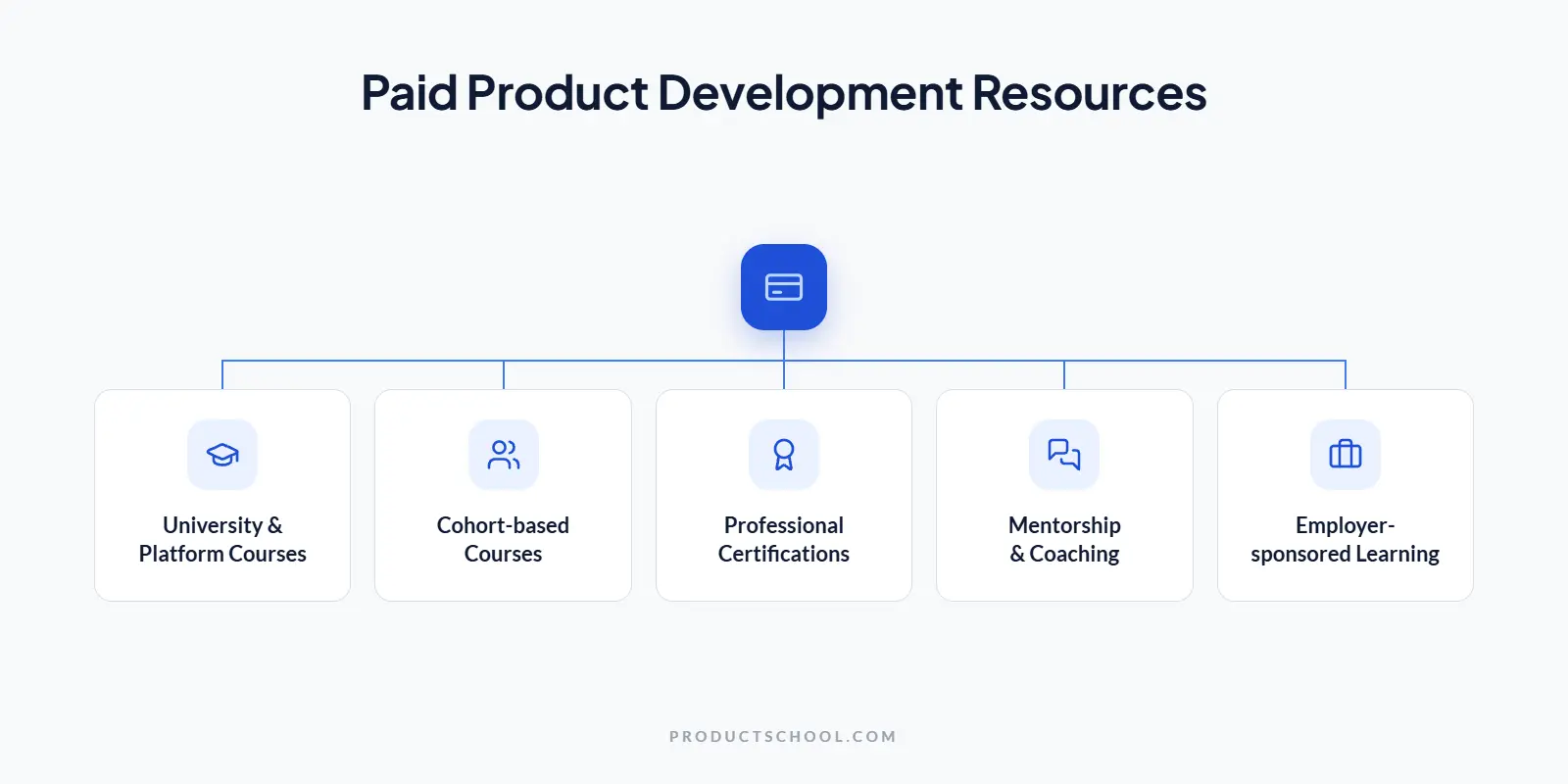
Paid resources are worth it when they buy you something structurally unavailable for free. In what I’ve seen so far, this is mostly sequencing, enforcement, feedback on your own work, or a credential someone else recognizes.
Several choices below are run by people who compete with us, so I am not going to rank them against ours or tell you which to buy. What I will tell you is which ones clear the bar of being taken seriously in this field, and what each one is actually for.
A resource guide that only pointed to its own products would not be genuine in its approach, so I steered away from it.
1. University and platform courses
You are buying sequencing and an institution's name. Feedback is usually minimal or automated, so these solve the structure problem rather than the critique problem.
Digital Product Management, UVA Darden on Coursera: A five-course specialization taught by Alex Cowan, covering hypothesis-driven development, customer discovery, and launch, ending in a capstone. It is among the highest-enrolled product courses anywhere, with tens of thousands of learners and a review count in the thousands. Audit free; pay for the certificate.
Product Management Fundamentals, University of Maryland on edX: Graduate-level material, free to audit. A good second opinion if the Darden framing does not click.
Udacity's product management school: The Nanodegree programs run roughly 50 hours across six courses and four projects, and the differentiator is human mentor review of your submitted work. That makes it the rare platform option that touches stage four. There is also a dedicated AI Product Manager Nanodegree.
eCornell: The right destination if you came here for physical product development rather than software. Built around prototyping and manufacturing, not discovery and iteration.
The risk with everything in this category is the one nobody publishes. Enrollment numbers get announced proudly, and completion numbers almost never do. Ten hours a week, self-paced, with nobody checking whether you show up, is exactly the setup that defeats most people at stage one.
2. Cohort-based courses
Live, scheduled, taught by a practitioner, with peers moving through it alongside you. You are buying pace enforcement, feedback, and a peer group, and the peer group is frequently the actual product.
Product School's certifications: Live online, small cohorts, instructor feedback on your own project, taught by practicing Fortune 500 product leaders. Named here so the comparison is complete and because these courses were created with our 4-phase criteria in mind.
3. Professional certifications
Two independent professional bodies issue credentials that are not tied to any single school, which is what makes them portable.
NPDP from the PDMA: The Product Development and Management Association has been running since 1976, and its New Product Development Professional credential covers seven knowledge areas from NPD strategy through lifecycle management. It requires documented professional experience, a proctored exam, and 60 professional development hours every three years to maintain. If you are on the physical-product side of this field, this is the credential that carries.
AIPMM: the Association of International Product Marketers and Managers is the other independent body, oriented more toward the front end of product and product marketing[s].
Pragmatic Institute: A course-based certification path built on the Pragmatic Framework, which maps 37 focus areas across seven categories. Strongest in B2B and enterprise SaaS, its training has been used by a large share of the Fortune 500. Each course in the sequence awards its own credential.
A certification is a signal and a structure, not necessarily a requirement. Nobody in software product management will hire you on a credential alone. In fact, plenty of strong PMs I have met over the years hold none.
4. Mentorship and coaching
The most direct purchase of the one thing that is genuinely scarce. An hour a month with someone senior reviewing your actual work can, in some scenarios, outperform a course costing ten times as much.
ADPList: Thousands of product mentors offering free 30- to 60-minute sessions, including portfolio reviews. Mentors are vetted before joining and carry public ratings. It is the single best answer to "I have shipped something, and nobody qualified has looked at it," and it costs nothing. This is why it belongs in this section as much as the paid options do.
Paid coaching marketplaces: expect $100 to $500 per session. Worth it when you need sustained calibration from one person rather than a one-off review. It’s hard to justify before you have some work to show.
Your own company's senior PMs: Free, closest to your context, and almost always underused. Ask.
5. Employer-sponsored learning
The most underused option on this list. Plenty of companies hold a learning and development budget that goes unclaimed every year, mostly because nobody asks for it.
The ask lands better when you tell your manager what the course would let you handle without help. As a CEO, I’d like to hear something along the lines: "This would mean I stop filing a data request every sprint". It’s a business case I’d like them to act on. "I want to grow professionally" is not.
Ask before you pay out of pocket. The conversation costs nothing.
Free vs. Paid: What Each One Actually Gets You
Dimension | Free resources | Paid resources |
Cost | Nothing, plus your time | Hundreds to several thousand, depending on format |
Structure and sequencing | You build it yourself, which is where most people fail | Provided, and enforced by deadlines in cohort formats |
Feedback on your own work | Rare; depends on communities you have to work to find | The core of what you are buying, if the format includes it |
Portfolio artifact | Only if you create one yourself | Usually built into the program |
Credential and hiring signal | None | Varies from meaningful to decorative |
Network and peers | Diffuse, self-assembled | Concentrated, and often the highest-value component |
Realistic time to competence | Longer, with a much higher dropout rate | Shorter, mostly because someone else is enforcing pace |
Best for | Stages one and two, and anyone who has not yet shipped | Stages three and four, and anyone whose gap is feedback |
How to Practice Product Development Without a Product Job
This is the part that determines whether you get past stage three.
The internal project: The fastest path by a wide margin if you are already employed anywhere. Find a broken process on your own team, scope a fix, get someone to use it, and measure whether it helped. You have users, context, and a stakeholder, which are the three things a side project makes you invent.
The tiny side project: One annoyance, one small community, one shipped thing. AI prototyping tools have collapsed the build cost of this to a weekend, which removes the last honest excuse.
Nonprofit or volunteer product work: Real users, real constraints, real stakes, and organizations that will genuinely take the help. The closest simulation of the job you can get without the job.
Open source: Fewer product-shaped roles than people assume, but issue triage and roadmap work on an active project is real prioritization practice with a public record.
Public teardowns: Pick a product, find a specific flow, explain what you would change and what evidence would tell you if you were right. Weaker than shipping, but it produces an artifact and it is the fastest way to get a stranger to critique your reasoning.
Shadowing internally: If your company has PMs, ask to sit in on discovery calls and roadmap reviews. Most will say yes and most people never ask.
The goal with any of these, and also the reason why I have them listed, is to get someone outside your head to use it. Then, subsequently, you change something because of what they did. If neither half is true, you have not produced a rep.
How to Learn Product Development If You Do Not Work in Tech at All
If you are a nurse, a teacher, a logistics coordinator, a shop manager, or an accountant, most of the tips above are unavailable to you. The starting position is better than it looks. Product development is the practice of deciding what to build, for whom, and whether it worked. You almost certainly already do a version of that.
What you lack is the vocabulary, the tooling, and the evidence. What you have is domain knowledge, which is the half that product teams in healthcare, logistics, education, and finance are perpetually short of.
The practical difference is that you will probably struggle to assemble the four stages from scattered free resources. You simply have no colleague to tell you when you have got something wrong. You need one environment that carries you through all four.
Buy one ecosystem rather than assembling a path: The thing you are missing is a structure that ends in something reviewed. For instance, Udacity's product management Nanodegrees and our own course path both span the whole arc — instruction, tooling, a project you build, and a human who critiques it.
Audit before you commit: Run a few weeks ofessential product management courses and read books for free first. If the vocabulary starts to feel usable rather than alien, you have your answer about whether to spend money. If it does not, you have saved several thousand.
Build your practice project inside the industry you already know: A shift-swap tool for the ward, a stock-check flow for the shop floor, a parent-communication tracker for the school. You have the domain insight and the access to real users that a career switcher from another tech role does not.
Recruit your users from your current job: Your colleagues are real users with a real problem. Five of them using something you built, and one thing you changed because of what they did, satisfies stage three completely.
Buy the feedback your workplace cannot give you:Look for offers for free sessions with vetted product mentors, including portfolio reviews. For someone with no product people around them, this is the highest-leverage free resource in this entire article.
Translate your experience before you apply: "I coordinated ward rotas" is invisible to a hiring manager. "I identified a scheduling failure affecting 40 staff, prototyped a fix, tested it with users, and cut swap requests" is product work described in product language.
How To Master The Art Of Prioritization In Product Management
Learn how prioritization shapes efficiency, productivity, and strategic focus. Plus, explore practical steps to balance immediate tasks with future goals.
Read Now
How to Learn AI Product Development
You learn AI product development by running the same four stages against a product that has a model inside it: learn how probabilistic systems behave, learn the multi-agentic systems, ship one small AI feature, then get feedback on whether it is good enough to be trusted.
Why AI is now a core product skill rather than a specialization
Microsoft's 2025 Work Trend Index found that 81% of leaders expect AI agents to be moderately or extensively integrated into their company's AI strategy within 12 to 18 months, and 78% said they plan to hire for new AI roles.
Again, LinkedIn's January 2026 labor-market report found that Product Management is one of the top three job functions by share of AI-skilled members. The default composition of product teams, in my anecdotal experience, is largely aligned with this.
I have made this point repeatedly: the roles are not converging into one job, but a new capability is appearing in the overlap between them. Product managers stay product managers, and designers stay designers, while a large chunk of them are being asked to get to know AI or grow into something like an AI builder role alongside what they already are.
The concepts you actually need to understand
What the AI Product Manager role asks is that you decide what a model is allowed to do inside your product, judge whether its output is good enough to put in front of a real person, and own the answer when it turns out to be wrong.
That is the working half of the AI builder role, and it runs on seven concepts. Treat them as decisions you will have to make, not terms you will have to define.
AI product management, or applying AI across the whole lifecycle: AI belongs in discovery, definition, build, launch, and measurement, not bolted on at the end as a feature. Teams that treat it as a feature get a novelty. Teams that treat it as a lifecycle capability get leverage.
Vibe coding, or building and shipping end to end with AI: turning a clear brief into working software yourself. This is the capability that collapses the distance between having an idea and having something a real person can use, and it is the one that matters most while you are learning.
Creating AI agents, meaning directing a tool like Claude Code: running an agent the way you would run an engineering team. Scope the work, review what comes back, reject what is wrong. The failure mode is accepting the first plausible output because it looks finished.
Agentic architecture, or orchestrating agents rather than prompting one: the step up from one agent doing one task to a set of them carrying product work continuously. Once that happens, the questions become what each one may touch, what it may not, and when it has to stop and ask.
AI evals, or defining what good looks like: evals are the test suite for work with no single right answer. Instead of asserting that output equals an expected value, you set the quality bar and grade against it. This is also where probabilistic behaviour gets concrete — the same input can produce different results, a model can be fluent and wrong at once, and someone has to decide what error rate is acceptable.
Product analytics and experimentation, or proving the feature actually worked: an AI feature people use is not the same as an AI feature that changed anything, and the gap between those two is where most AI roadmaps quietly fail.
AI product strategy, or deciding where AI is worth it at all: which investments create real value, and which flows should stay deterministic because auditability or consistency matters more than adaptability. This is the strategy layer, and it is the clearest separator between senior judgment and enthusiasm.
Learn these well enough to use them in a conversation, and you are past the barrier that stops most newcomers, which is not technical difficulty but unfamiliar vocabulary.
How AI gets you through stage three
Here is the part that matters most if you are new. Stage three (ship one small product end to end) has always been the wall. It required either an engineer who owed you a favor or months learning to build things yourself.
That barrier has moved. Not disappeared, moved.
The mechanical work of producing something usable has collapsed in cost, which means the stage that used to be gated by build capacity is now gated by judgment. Judgment is the thing you were trying to develop in the first place.
The old stage-three blocker | What it takes now | What AI does not do for you |
Getting a working version at all, which previously needed an engineer or months of learning to code | Describe what you want and have an agent build a working version in an afternoon | Decide what is worth building, and notice when the output is confidently wrong |
Iterating after user feedback, where every change meant another dependency and another wait | Change it during the session, while the user is still in front of you | Judge which feedback to act on and which to ignore |
Testing more than one approach, so most people built one thing and defended it | Build two or three variants and let real behaviour choose between them | Design the comparison so the result actually means something |
Understanding what happened after launch, which needed SQL or an analyst | Ask questions of your own data in plain language | Define success before you look, so you are not fitting a story to the numbers afterwards |
Producing something to show, which for most career switchers meant a slide deck about an idea | A working thing a stranger has used | The story of the decision you got wrong, which is what interviewers are actually buying |
Read the right-hand column carefully, because it is the whole argument. When everyone can produce a working prototype, the prototype stops being the achievement and the reasoning behind it becomes the achievement.
The AI skills worth learning
The useful filter is that the work is moving away from implementation and toward curation, taste, and judgment. Learn the skills that sharpen judgment rather than the ones that only speed up output.
AI-native skill | Why it matters now | How to learn it |
Briefing an agent | The brief is now the input to the build itself, so a vague problem statement produces vague software | Write real briefs and have an agent build them, then rewrite the brief when the output is wrong. Our Claude Code for Product Managers course is the structured version of this |
Agentic prototyping | Working software, not a doc or a mockup, is increasingly the first thing stakeholders react to | Rebuild one screen of a product you already use in Cursor, Bolt, Lovable, or v0. Vibe Coding for PMs[k] covers the guided path |
Defining what good looks like | AI features are evaluated rather than specced; without evals you are shipping on instinct | Hand-write 20 test cases for one feature and grade the outputs yourself before automating anything. The AI Evals Certification goes deeper |
Probabilistic judgment | Accuracy is a distribution, not a number, and someone has to decide which error rate is acceptable | Free and self-directed: read public AI failure post-mortems and NIST's AI Risk Management Framework work on generative AI, then turn each one into a product question. Our AI product sense guide is the short version |
Reviewing and rejecting AI output | The scarce skill is recognizing plausible-but-wrong before it ships | Free and self-directed: accept nothing on the first pass. Make one specific, named critique of every agent output you receive |
Knowing where not to use AI | Deterministic rules still beat models for compliance, auditability, and zero-tolerance flows | Take ten product prompts and answer only one question for each: where should we not use AI here? The AI Product Management Certification frames the wider decision |
One caution. AI fluency does not substitute for the four stages.
Someone who can prompt an agent fluently but has never put anything in front of a real user is still at stage two. The AI layer makes stage three cheaper to reach than it has ever been. It does not replace you plowing through it.
The Product Development Readiness Score
Use this to find out which stage you are actually in.
Score each area from 0 to 3. Do not score confidence. Score evidence.
If you cannot point to a specific artifact, decision, or story, your score is lower than you think.
Score | What it means |
0 | No evidence. You have not encountered this in practice. |
1 | Conceptual fluency. You can explain it in conversation but have not done it. |
2 | Practiced competence. You have done it at least once, in a low-stakes setting, and can explain your reasoning. |
3 | Demonstrable proof. You have done it in a real context and can tell a specific story with a decision, evidence, and a consequence. |
Readiness area | The question to ask yourself | What a 3 looks like |
Process fluency | Can I explain how an idea becomes a shipped, measured feature? | You can walk through the full arc and explain why a team would choose one approach over another in a given context. |
Tool fluency | Could I join a team on Monday without a software walkthrough? | You have run a backlog, read a dashboard, and stood up a rough prototype yourself. |
Discovery reps | When did I last talk to a user who was not a colleague or friend? | You have run interviews, and at least one changed what you believed. |
Shipping reps | Have I put something in front of real users? | Something you built exists, was used by strangers, and changed based on their behavior. |
Measurement | Do I know whether the thing I shipped worked? | You defined success before launch, measured it, and can say honestly whether you hit it. |
Feedback loop | Has someone qualified critiqued my actual work? | A practitioner reviewed your work, you disagreed with some of it, and you changed something anyway. |
Portfolio artifact | Could I show something in an interview tomorrow? | You have a project you can demo and a five-minute story about a decision you got wrong. |
Total score | What it means | What to do next |
0–6 | You are at stage one. | Stop buying courses. Read Inspired and The Mom Test, and pick a tiny project. |
7–12 | You know the theory and have not applied it. This is the most common score and the most misleading one. | Go straight to stage three. More content will not move this number. |
13–17 | You have shipped something, but nobody qualified has pressure-tested it. | Get feedback: a community teardown, a mentor, or a cohort program. |
18–21 | You are interview-ready on evidence, not just vocabulary. | Deepen into a specialization, and start covering the AI-specific layer of the job. |
The most useful thing this scorecard does is expose the 7–12 band. That is where the majority of self-taught learners sit while believing they are close. A high process score with a zero in shipping reps is not most of the way there. It is still stage one.
Which path fits where you are now
Engineer moving into product: Your gap is discovery and stakeholder judgment, not build. Start at stage three immediately, with an internal project. Read about stage one materials and skip most of stage two.
Designer moving into product: Your gap is usually measurement and commercial reasoning. Prioritize the analytics half of stage two and define success metrics before you build anything in stage three.
Founder or solo builder: You have shipping reps already. Your gap is process vocabulary and the ability to explain your judgment in someone else's frame. Stage one and stage four.
Career switcher from outside tech: You need all four stages, and you need the network most of all. Budget three to six months and weight stage four more heavily than the others.
New AI PM already in seat: Your gap is calibration. Mentorship will outperform any course, and your own company is the practice environment.
Hardware or NPD reader: None of these paths is built for you. Look at university programs organized around prototyping and manufacturing, and expect formal credentials to matter more than a portfolio.
Learning Product Development Is a Reps Problem
The material is free and better than it has ever been. That is good news, and it is also why so many people stall. When the supply of information is infinite, consuming it feels like progress until someone asks you what you have built.
So to really dumb it down... Spend weeks on the fundamentals and stop. Spend weeks on tools and stop. Then spend months building something small that real people use, and find someone qualified to tell you what is wrong with it.
If you want that fourth stage structured, with feedback on your own project rather than another library of recorded content, that is what Product School's Product Manager Certification is built for. The AI Product Management Certification is where to go once the fundamentals are solid and you want the layer the job now assumes.
Whichever route you take, the milestone is the same. Ship and get feedback.
Updated: October 20, 2026